
Diagonals of quadrilaterals: equal, bisecting and perpendicular
Answer in short
A diagonal joins two opposite corners. In a parallelogram the diagonals bisect each other. In a rectangle they are also equal, and in a rhombus they meet at 90°. A square has all three properties. In a kite, one diagonal is the perpendicular bisector of the other. Knowing this, you can build each shape from its diagonals.
Stuck on a question? Take a photo and Lagnever AI explains it step by step. Try it for 7 days for ₹2. Get it on Google Play
What is the carpenter’s problem?
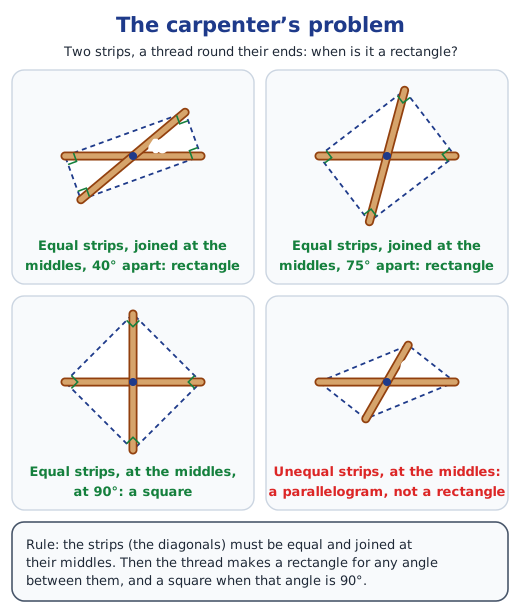
A carpenter has an 8 cm strip of wood and wants to cross a second strip with it so that a thread round the four ends makes a rectangle. The strips are the diagonals of the rectangle, the segments joining opposite corners. So the question becomes: what must the diagonals of a rectangle be like? How long is the second one, where do they cross, and at what angle?
Why are a rectangle’s diagonals equal, and why do they bisect each other?
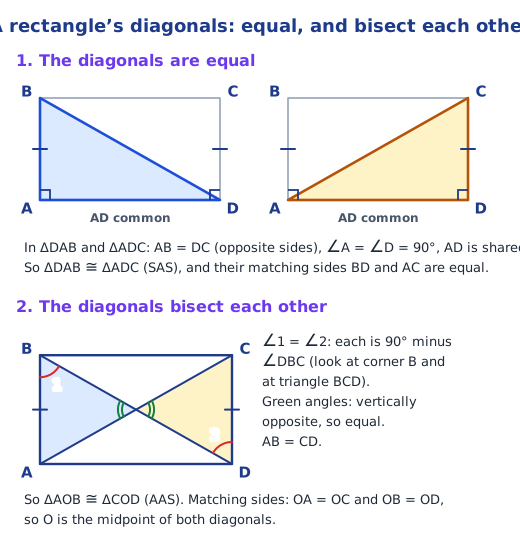
Take rectangle ABCD with A at the bottom left, B above it, then C and D. Triangles DAB and ADC share the side AD, have AB = DC and right angles at A and D. So they are congruent by SAS, and the matching sides BD and AC are equal: the diagonals are equal.
Let the diagonals meet at O. In triangles AOB and COD, AB = CD, the angles at O are vertically opposite, and ∠ABO = ∠CDO, because each is 90° minus ∠DBC. So the triangles are congruent by AAS, giving OA = OC and OB = OD: the diagonals bisect each other.
Do equal diagonals that bisect each other always make a rectangle?
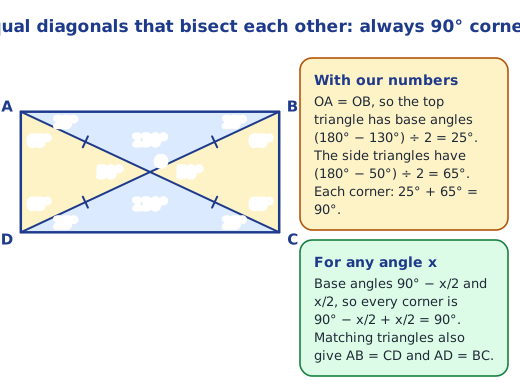
Yes, whatever the angle between them. Let the diagonals be equal and cross at their midpoint O, making an angle x. All four half-diagonals are equal, so the four triangles around O are isosceles. Two of them have base angles of (180° − x) ÷ 2 = 90° − x/2, and the other two have base angles of x/2. Each corner gets one of each: 90° − x/2 + x/2 = 90°. Four right angles: a rectangle. So the carpenter needs a second 8 cm strip, joined to the first at their midpoints, at any angle.
What is special about a square’s diagonals?
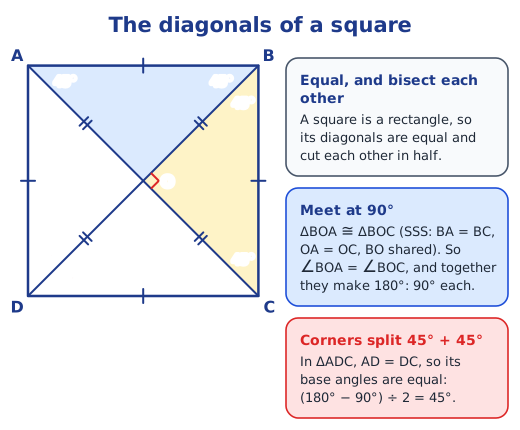
A square is a rectangle, so its diagonals are equal and bisect each other. They also meet at 90°: in square ABCD, triangles BOA and BOC are congruent by SSS, so ∠BOA = ∠BOC, and as they make a straight angle together, each is 90°. And each diagonal cuts every corner into 45° + 45°. To make a square, join equal strips at their midpoints at right angles.
What about parallelograms and rhombuses?
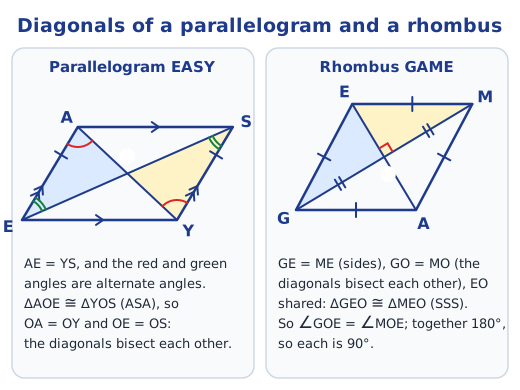
In parallelogram EASY, triangles AOE and YOS have AE = YS and two pairs of equal alternate angles, so they are congruent by ASA. Hence OA = OY and OE = OS: in a parallelogram, the diagonals bisect each other. They are usually not equal, and usually not perpendicular.
A rhombus is a parallelogram, so its diagonals bisect each other. In rhombus GAME, triangles GEO and MEO match side for side (SSS), so the angles at O are equal and the diagonals meet at 90°.
And the diagonals of a kite?
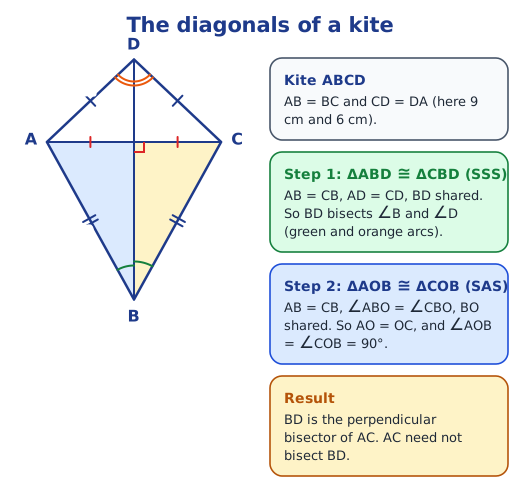
In kite ABCD with AB = BC and CD = DA, triangles ABD and CBD are congruent by SSS, so BD splits the angles at B and D into equal halves. Then triangles AOB and COB are congruent by SAS, so AO = OC and the angles at O are 90°. BD is the perpendicular bisector of AC, but AC need not cut BD in half.
How do you build a shape from its diagonals?
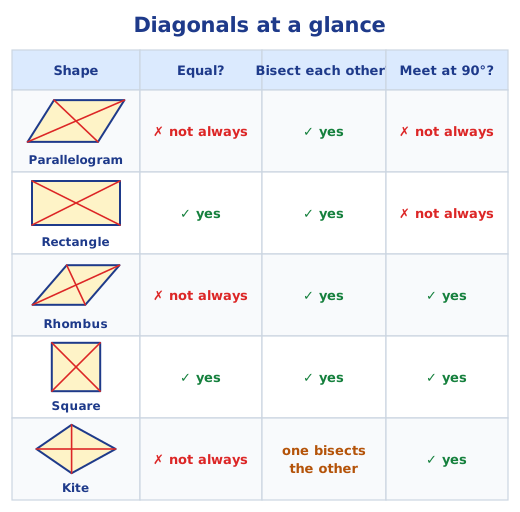
The endpoints of the two diagonals are the four corners, so the diagonals fix the shape. Draw one diagonal, mark the crossing point on it, draw the second line through that point at the right angle, mark the other two corners and join all four. The table shows which conditions to use.
Read next: the chapter notes, types of quadrilaterals, angles in a quadrilateral and NCERT solutions.
Practice
-
The diagonals of a quadrilateral are both 6 cm long and bisect each other at 90°. It is a:
Show answer
Answer: (b) square
-
In rectangle ABCD, the diagonals meet at O and AC = 10 cm. How long is OB?
Show answer
Answer: (b) 5 cm
-
Which quadrilateral can have diagonals that meet at 90° without bisecting each other?
Show answer
Answer: (c) Kite
-
How would you construct a rhombus whose diagonals are 8 cm and 6 cm?
Show answer
Answer: Draw AC = 8 cm and its perpendicular bisector, which meets AC at O. Mark B and D on the bisector, 3 cm from O on each side. Join A, B, C and D.
-
The diagonals of a quadrilateral are 7 cm and 9 cm and bisect each other. Can it be a rectangle?
Show answer
Answer: No. A rectangle’s diagonals are equal. Unequal diagonals that bisect each other give a parallelogram that is not a rectangle.
Questions students ask
What are the properties of the diagonals of a rectangle?
They are equal and they bisect each other. The reverse is also true: if the diagonals of a quadrilateral are equal and bisect each other, it is a rectangle.
Does a parallelogram have diagonals that bisect each other?
Yes. The triangles on two opposite sides are congruent by ASA (alternate angles and the equal opposite sides), so the diagonals cut each other in half. They need not be equal or perpendicular.
Are the diagonals of a rhombus perpendicular?
Yes. Two neighbouring triangles formed by the diagonals are congruent by SSS, so the two angles at the centre are equal. Together they make 180°, so each is 90°.
What is the carpenter’s problem in Class 8 Maths?
A carpenter crosses two strips of wood so that a thread round their ends makes a rectangle. The strips must be of equal length and joined at their midpoints; the angle between them does not matter.
Stuck on a question?
Take a photo and Lagnever AI explains it step by step. Try it for 7 days for ₹2.
Get it on Google Play Open in browser
For parents: after the trial, the plan renews monthly by UPI or card autopay. You can cancel anytime in the app.