
Triangle inequality and angle sum property
Answer in short
Three lengths make a triangle only if each is less than the sum of the other two (the triangle inequality); check only the longest. Two angles make a triangle only if their sum is under 180°. The angles of every triangle add up to 180°, and an exterior angle equals the sum of the two opposite interior angles.
Stuck on a question? Take a photo and Lagnever AI explains it step by step. Try it for 7 days for ₹2. Get it on Google Play
Not every three lengths make a triangle
Try constructing triangles with sides 3, 4 and 8 cm, or 2, 3 and 6 cm. However carefully you draw, the two arcs never meet. Checking every case by construction would be slow, so we look for a rule.
Direct path or roundabout path?
Picture a tent, a tree and a pole on flat ground. A straight walk from the tent to the tree takes fewer steps than a walk to the pole first and then on to the tree. In the same way, in any triangle the side joining two vertices is shorter than the path through the third vertex. Suppose 10 cm, 15 cm and 30 cm were the sides of a triangle. Comparing each side with the other two: 10 < 15 + 30 and 15 < 10 + 30, but 30 is more than 10 + 15 = 25, so a direct path would be longer than a roundabout one, which is absurd. No such triangle exists.
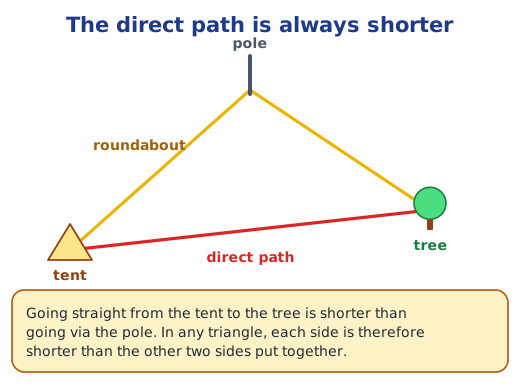
The triangle inequality
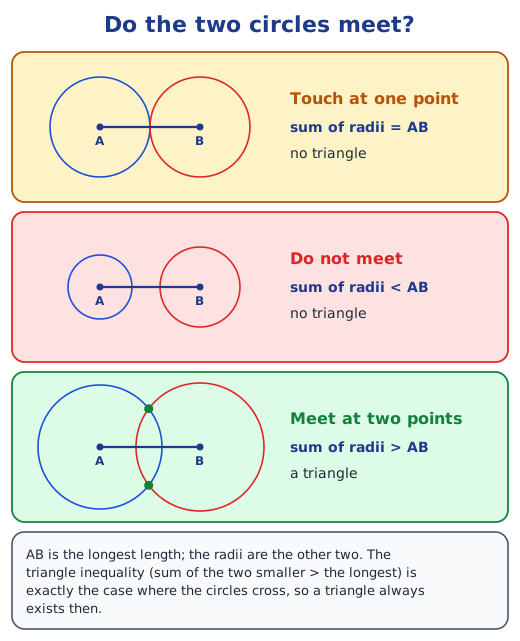
Three lengths satisfy the triangle inequality when each one is less than the sum of the other two. The two smaller lengths always pass this test, since each is smaller than the longest length on its own, so only the longest needs checking. For 4, 5 and 8, the check 8 < 4 + 5 = 9 is enough.
But does satisfying the rule always give a triangle? Imagine the longest side as the base AB, with circles drawn from A and B using the two smaller lengths as radii. If the radii add up to exactly AB, the circles just touch; if less, they never meet; and if more, as the triangle inequality says, they cross at two points, and either point gives the third vertex. So a triangle exists exactly when the triangle inequality holds. With two sides fixed, the third side can be anything strictly between their difference and their sum: for 3 and 7, anything between 4 and 10.
When two angles make a triangle
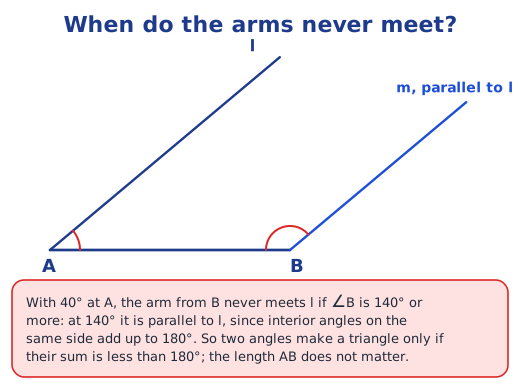
Given two angles and the side between them, draw the side and the two angles at its ends. If both angles are 90° or more, the arms clearly never meet. With 40° at A, the arm from B leans further and further right as ∠B grows; at 140° it becomes parallel to the first arm, because interior angles on the same side of a transversal add up to 180°. So two angles form a triangle only if their sum is less than 180°, and the length of the side makes no difference.
The angle sum property
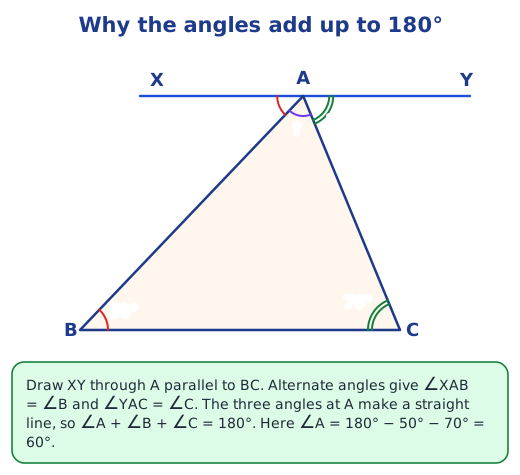
Constructing triangles with angles 60° and 70° on different bases gives the same third angle, 50°, every time. To see why, take ∆ABC with ∠B = 50° and ∠C = 70°, and draw a line XY through A parallel to BC. The alternate angles give ∠XAB = 50° and ∠YAC = 70°. The angles at A along XY make a straight angle, so ∠BAC = 180° − 120° = 60°. The same argument works for every triangle: the three angles of a triangle add up to 180°. This idea of a parallel line through the top vertex is found in Euclid’s Elements, written around 300 BCE.
Exterior angles
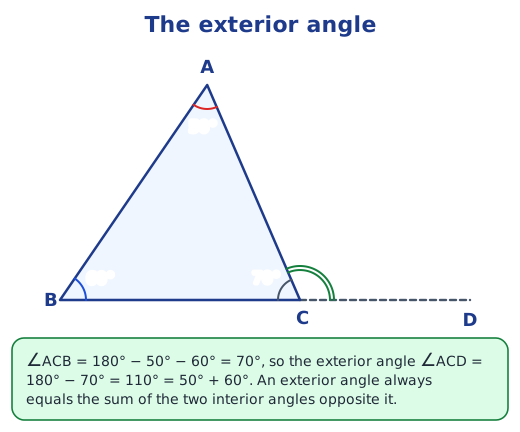
Extend side BC beyond C to a point D. The angle ∠ACD between the extension and side AC is an exterior angle. Since ∠ACB and ∠ACD form a straight angle, and ∠A + ∠B + ∠ACB = 180°, the exterior angle equals ∠A + ∠B, the sum of the two interior angles opposite it. With ∠A = 50° and ∠B = 60°, the exterior angle is 110°.
Why it matters
These two rules let us decide, before drawing anything, whether a triangle can exist, and the angle sum property is used throughout geometry. The constructions themselves are in constructing triangles, and the kinds of triangles in types of triangles. Answers to every question are in the NCERT solutions for Chapter 7; see also the full Chapter 7 notes.
Practice
-
Which set of lengths satisfies the triangle inequality?
Show answer
Answer: (c) 5, 10, 12
-
What is the third angle of a triangle whose other angles are 150° and 15°?
Show answer
Answer: (b) 15°
-
If one angle of a triangle is 40°, which second angle makes a triangle impossible?
Show answer
Answer: (d) 140°
-
Between which values must the third side lie if two sides are 3 cm and 7 cm?
Show answer
Answer: Strictly between 4 cm and 10 cm: it must be longer than 7 − 3 = 4 and shorter than 7 + 3 = 10.
-
In ∆ABC, ∠A = 50° and ∠B = 60°. Find the exterior angle at C.
Show answer
Answer: ∠ACB = 180° − 110° = 70°, so the exterior angle is 180° − 70° = 110°, which is also 50° + 60°.
Questions students ask
What is the triangle inequality?
It is the rule that each side of a triangle is shorter than the sum of the other two, because the direct path between two vertices is shorter than the roundabout path through the third. Three lengths that satisfy it always form a triangle, and lengths that break it never do.
How can you tell quickly if three lengths make a triangle?
Put them in order and compare the longest with the sum of the other two. If the longest is smaller, a triangle exists: 4, 5, 8 works since 8 < 9. If it is equal or larger, there is no triangle: 3, 6, 9 fails since 9 = 3 + 6, and the arcs would only touch.
What is the angle sum property of a triangle?
The three angles of any triangle add up to 180°. Draw a line through one vertex parallel to the opposite side: the alternate angles it makes equal the other two angles of the triangle, and together with the angle at that vertex they form a straight angle of 180°.
Stuck on a question?
Take a photo and Lagnever AI explains it step by step. Try it for 7 days for ₹2.
Get it on Google Play Open in browser
For parents: after the trial, the plan renews monthly by UPI or card autopay. You can cancel anytime in the app.