
Constructing triangles
Answer in short
To construct a triangle from its three sides, draw one side as the base and draw arcs from its ends with the other two lengths; where they meet is the third vertex. With two sides and the included angle, draw the angle and mark the second side; with two angles and the included side, draw both angles on the base.
Stuck on a question? Take a photo and Lagnever AI explains it step by step. Try it for 7 days for ₹2. Get it on Google Play
Why a compass helps
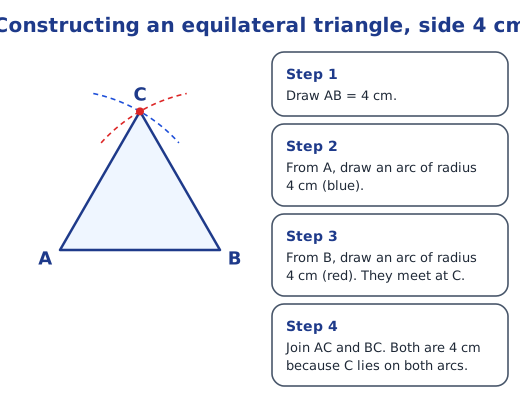
Suppose we want a triangle with every side 4 cm, an equilateral triangle. With only a marked ruler, we draw a base AB of 4 cm and then try to mark a point C that is 4 cm from A, checking whether it is also 4 cm from B, again and again. A compass removes the guesswork. All the points 4 cm from A lie on a circle of radius 4 cm around A, and all the points 4 cm from B lie on a circle around B. The point we want lies on both, so it is where the two arcs cross.
Three sides given
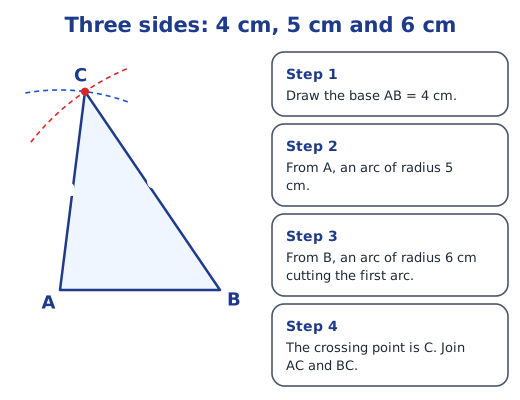
The same idea works for any three sides, say 4 cm, 5 cm and 6 cm.
- Draw the base AB = 4 cm.
- From A, draw an arc of radius 5 cm, long enough to cross the next one.
- From B, draw an arc of radius 6 cm that cuts the first arc.
- The crossing point is C. Join AC and BC.
Because C lies on both arcs, AC is 5 cm and BC is 6 cm. Full circles are not needed, only arcs that are long enough to meet. Triangles such as 4, 4, 6 or 3.5, 3.5, 3.5 are built the same way; with two equal sides the triangle is isosceles, and with three it is equilateral.
Not every three lengths work: if the longest is not less than the sum of the other two, the arcs never meet. That rule is explained in triangle inequality and angle sum property.
Two sides and the included angle
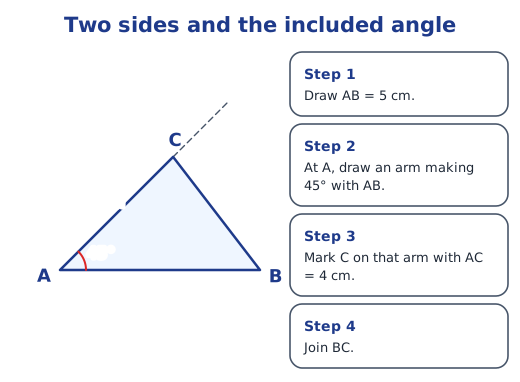
The included angle is the angle between the two given sides. To construct ∆ABC with AB = 5 cm, AC = 4 cm and ∠A = 45°:
- Draw AB = 5 cm.
- At A, draw an arm making 45° with AB.
- Mark C on that arm so that AC = 4 cm.
- Join BC.
A triangle can be made this way for any included angle less than 180°; only a straight angle or more makes it impossible.
Two angles and the included side
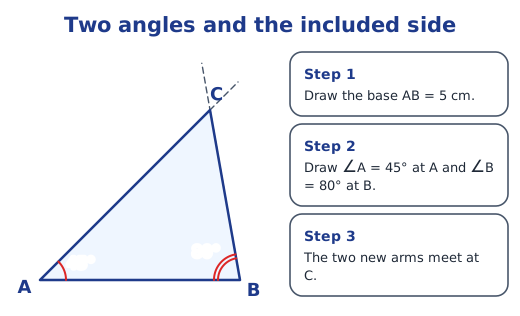
The included side is the side shared by the two given angles. To construct ∆ABC with AB = 5 cm, ∠A = 45° and ∠B = 80°, draw AB, draw 45° at A and 80° at B, and the two new arms meet at C. Here the two angles must add up to less than 180°, otherwise the arms do not meet.
Constructing an altitude
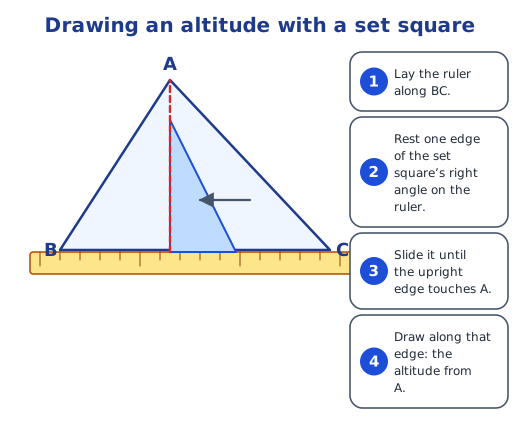
An altitude from A is the perpendicular from A to the opposite side BC. Drawing it with a ruler alone is not accurate, so we use a set square: lay the ruler along BC, rest one edge of the set square’s right angle on the ruler, slide it until the upright edge touches A, and draw along that edge. If the triangle is obtuse at B or C, extend BC first, since the altitude then falls outside the triangle.
Why it matters
Careful constructions turn the facts of geometry into accurate drawings, and they help us test ideas, such as whether a triangle exists. The kinds of triangle these constructions produce are in types of triangles. Answers to every question are in the NCERT solutions for Chapter 7; see also the full Chapter 7 notes.
Practice
-
In the compass method, what is the radius of the arc drawn from A when AC = 5 cm?
Show answer
Answer: (b) 5 cm
-
Which measurements are given in a ‘two sides and included angle’ construction?
Show answer
Answer: (b) Two sides and the angle between them
-
What tool, with a ruler, gives an accurate 90° for drawing an altitude?
Show answer
Answer: (c) Set square
-
Why does the meeting point of the two arcs give the right triangle?
Show answer
Answer: It lies on both arcs, so its distance from A equals the radius of the arc drawn from A and its distance from B equals the radius of the arc drawn from B: exactly the two required sides.
-
Construct ∆ABC with AB = 5 cm, ∠A = 45° and ∠B = 80°. What is ∠C?
Show answer
Answer: ∠C = 180° − 45° − 80° = 55°. Draw AB, draw 45° at A and 80° at B, and the arms meet at C.
Questions students ask
How do you construct a triangle with sides 4 cm, 5 cm and 6 cm?
Draw a base AB = 4 cm. From A draw an arc of radius 5 cm, and from B an arc of radius 6 cm that cuts the first arc. The point where the arcs meet is C; join AC and BC. Full circles are not needed, only arcs long enough to cross.
Can you construct a triangle with just a ruler?
Yes, but it takes trial and error: after drawing the base, you keep marking a third point at the right distance from one end and checking its distance from the other end until both are correct. A compass finds the point directly, so it is much quicker and more accurate.
How do you draw an altitude with a set square?
Lay a ruler along the base BC. Rest one edge of the set square’s right angle on the ruler and slide it until its upright edge touches the vertex A. Draw a line along that edge from A to the base: that is the altitude from A.
Stuck on a question?
Take a photo and Lagnever AI explains it step by step. Try it for 7 days for ₹2.
Get it on Google Play Open in browser
For parents: after the trial, the plan renews monthly by UPI or card autopay. You can cancel anytime in the app.