
Class 7 Maths Chapter 7: A Tale of Three Intersecting Lines Notes
This chapter in five lines
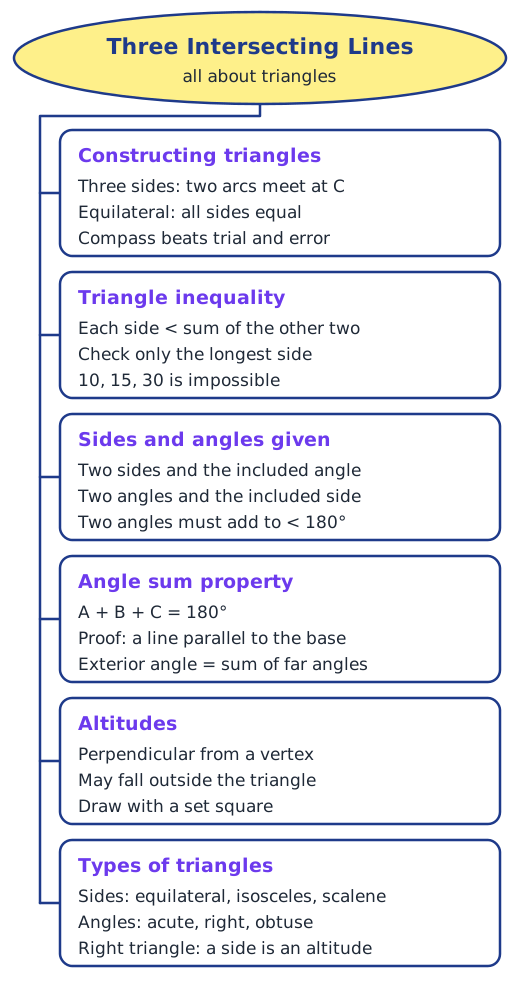
A Tale of Three Intersecting Lines is about triangles. It shows how to construct a triangle from three sides with a compass, from two sides and the included angle, or from two angles and the included side; when a triangle can exist at all; why the three angles always add up to 180°; exterior angles; altitudes; and the types of triangles.
What is this chapter about?
A triangle is the simplest closed shape: three vertices joined by three sides, with an angle at each corner. In ∆ABC the angles are ∠CAB, ∠ABC and ∠BCA, written simply ∠A, ∠B and ∠C, and the vertices can be named in any order. If the three points lie on one straight line, no triangle forms at all. The chapter asks how to construct triangles accurately, when a triangle can exist, and what is always true of its angles.
Constructing a triangle from three sides
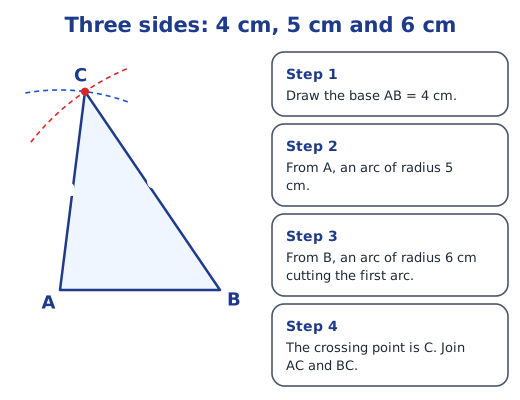
To draw an equilateral triangle of side 4 cm with only a ruler, we would mark the third point by trial and error. A compass does it in one go: draw the base AB = 4 cm, draw an arc of radius 4 cm from A and another from B, and join their meeting point C to A and B. C lies on both arcs, so it is 4 cm from each end. The same method builds any triangle from its three sides, such as 4 cm, 5 cm and 6 cm: draw one side as the base, then arcs with the other two lengths from its ends. Read constructing triangles.
When can three lengths make a triangle?
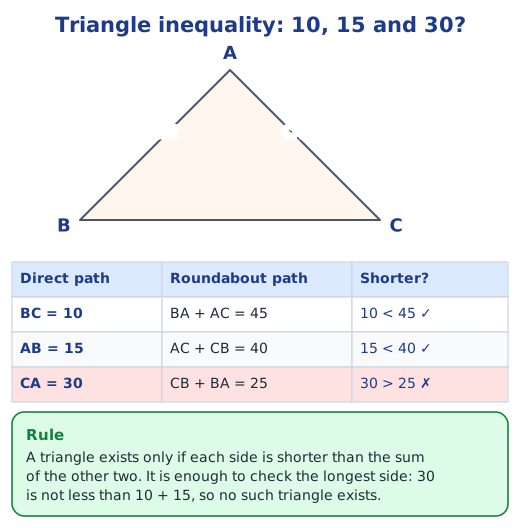
Try 3 cm, 4 cm and 8 cm: the arcs never meet. The reason is simple. Walking straight from a tent to a tree is shorter than going via a pole, so in any triangle the direct side between two vertices is shorter than the roundabout path through the third vertex. For 10, 15 and 30 this fails, since 30 is more than 10 + 15, so no such triangle exists. Three lengths satisfy the triangle inequality when each is less than the sum of the other two, and it is enough to check the longest. Picturing the two circles from the ends of the longest side shows why the rule is enough: they touch when the two smaller lengths add up exactly to the longest, miss each other when they add up to less, and cross, giving a triangle, when they add up to more. Read triangle inequality and angle sum property.
Two sides and an angle, or two angles and a side
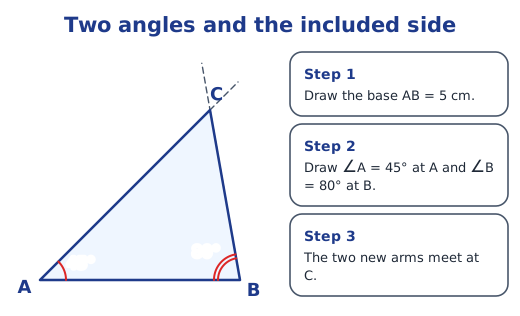
Given two sides and the included angle, draw one side, draw the angle at its end, and mark the second side along the new arm; a triangle exists for any included angle less than 180°. Given two angles and the included side, draw the side and both angles at its ends; the arms meet at the third vertex. This works only when the two angles add up to less than 180°. With 40° at A, an arm from B at 140° runs parallel to the first arm and never meets it, however long AB is.
The angle sum property
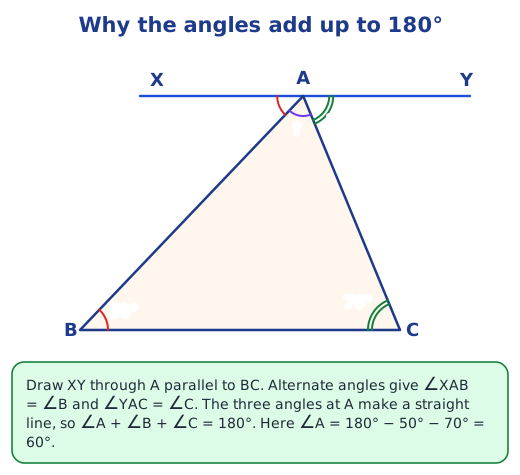
Fix two angles, say 60° and 70°, and the third angle comes out the same whatever the base length. To find it without measuring, draw a line XY through the top vertex parallel to the base. The angles it makes with the two sides are alternate angles, equal to the two base angles, and together with the top angle they form a straight angle. So the three angles of every triangle add up to 180°. This clever idea appears in Euclid’s Elements, written around 300 BCE. Folding the corners of a paper triangle to meet on its base shows the same thing. Closely linked, an exterior angle, made by extending one side, equals the sum of the two interior angles opposite it.
Altitudes
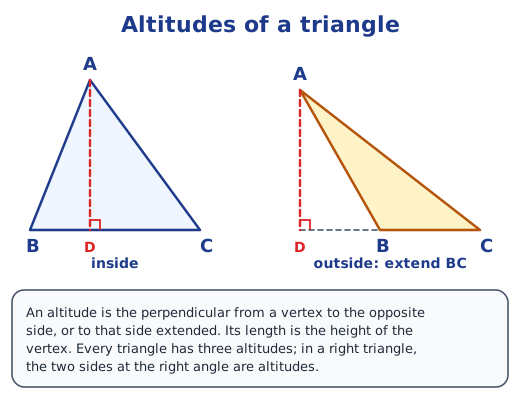
The height of a vertex is measured straight down to the opposite side. The perpendicular segment from a vertex to the opposite side is an altitude, and every triangle has three. In an obtuse triangle the base must be extended and the altitude falls outside. A paper fold that lays the base onto itself through the top vertex makes the altitude, and a ruler with a set square draws it accurately. In a right-angled triangle, the sides at the right angle are themselves altitudes.
Types of triangles
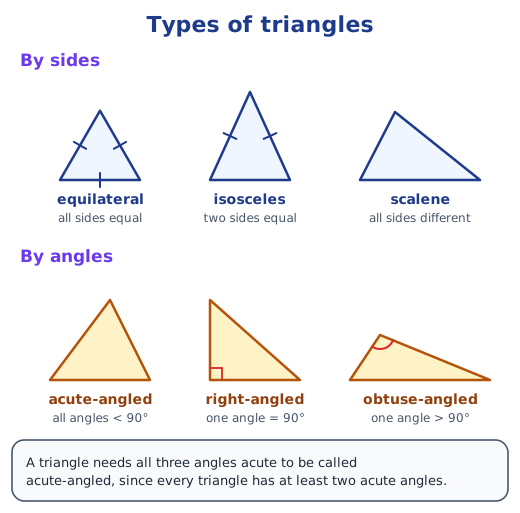
By sides, a triangle is equilateral (three equal sides), isosceles (two equal sides) or scalene (all sides different). By angles, it is acute-angled (all three angles acute), right-angled (one right angle) or obtuse-angled (one obtuse angle). An acute-angled triangle needs all three angles acute, because every triangle already has at least two acute angles. Read types of triangles.
In a nutshell
A compass turns triangle construction into a few clean steps; the triangle inequality and the 180° rule tell us in advance whether a triangle can exist; parallel lines prove the angle sum property; and altitudes and types complete the picture. The chapter ends with a puzzle about the shortest path for a spider walking over a box. Answers to every question are in the NCERT solutions for Chapter 7.
Key terms
| Term | Meaning |
|---|---|
| Triangle | A closed shape with three vertices joined by three sides; ∆ABC can be named with its vertices in any order. Its angles are ∠A, ∠B and ∠C. |
| Equilateral triangle | A triangle whose three sides are all equal; it is the most symmetric triangle, and each of its angles is 60°. |
| Isosceles triangle | A triangle with two equal sides. |
| Scalene triangle | A triangle whose three sides all have different lengths. |
| Triangle inequality | Three lengths satisfy it when each is less than the sum of the other two; exactly then a triangle with those sides exists. |
| Included angle | The angle between two given sides of a triangle, at the vertex where they meet. |
| Included side | The side that is an arm of both of two given angles, the side joining their vertices. |
| Angle sum property | The three angles of any triangle add up to 180°, proved by drawing a line through one vertex parallel to the opposite side. |
| Exterior angle | The angle between one side of a triangle and the extension of another side; it equals the sum of the two interior angles opposite it. |
| Altitude | The perpendicular line segment from a vertex to the opposite side, or to that side extended; its length is the height of the vertex. |
| Right-angled triangle | A triangle with one right angle; the two sides forming the right angle are also altitudes. |
| Acute and obtuse-angled triangles | An acute-angled triangle has all three angles less than 90°; an obtuse-angled triangle has one angle greater than 90°. |
Topics in this chapter
Practice
-
Which set of lengths can be the sides of a triangle?
Show answer
Answer: (c) 4, 5, 8
-
Two angles of a triangle are 50° and 70°. What is the third angle?
Show answer
Answer: (b) 60°
-
Which pair of angles cannot be two angles of a triangle?
Show answer
Answer: (c) 35°, 150°
-
In ∆ABC, ∠A = 50° and ∠B = 60°. What is the exterior angle at C?
Show answer
Answer: (b) 110°
-
A triangle with all three sides of different lengths is called:
Show answer
Answer: (c) Scalene
-
Can an equilateral triangle be right-angled?
Show answer
Answer: (c) No, its angles are all 60°
Questions students ask
What are the main topics of Class 7 Maths Chapter 7?
Constructing equilateral and other triangles from three sides with a compass; the triangle inequality and why it decides whether a triangle exists; constructing triangles from two sides and the included angle, or two angles and the included side; the angle sum property and exterior angles; altitudes and how to draw them; and types of triangles by sides and by angles.
Is A Tale of Three Intersecting Lines in the new NCERT Class 7 Maths book?
Yes. It is Chapter 7 of Ganita Prakash, the Class 7 Maths textbook Part 1 (Reprint 2026-27), on pages 147 to 172. It follows Number Play and comes before Working with Fractions, and it builds on the parallel lines of Chapter 5.
What is the triangle inequality?
Three lengths satisfy the triangle inequality when each one is less than the sum of the other two. A triangle exists with those sides exactly when this is true. In practice, compare the longest length with the sum of the other two: 4, 5, 8 works because 8 < 9, but 10, 15, 30 does not because 30 > 25.
Why do the angles of a triangle add up to 180°?
Draw a line through one vertex parallel to the opposite side. The two angles it makes with the other sides equal the triangle’s base angles, because they are alternate angles. Together with the angle at that vertex they form a straight angle, 180°, so the three angles of the triangle add up to 180°.
Stuck on a question?
Take a photo and Lagnever AI explains it step by step. Try it for 7 days for ₹2.
Get it on Google Play Open in browser
For parents: after the trial, the plan renews monthly by UPI or card autopay. You can cancel anytime in the app.