
NCERT Solutions Class 7 Maths Chapter 7: A Tale of Three Intersecting Lines
Answers to every question in Chapter 7, A Tale of Three Intersecting Lines, of Ganita Prakash, the Class 7 Maths textbook Part 1 (Reprint 2026-27): the questions in the text, every Construct task, all six Figure it Out sets, the Math Talk and Try This questions, and the spider puzzle. Page numbers follow the book (pages 147–172). Constructions are described step by step; draw them yourself with a ruler, compass, protractor and set square. Short notes: Chapter 7 notes.
Triangles (page 147)
What happens when the three vertices lie on a straight line? No triangle is formed: the three ‘sides’ lie along one line and enclose no region. One side then equals the sum of the other two, which is exactly the case the triangle inequality rules out.
7.1 Equilateral Triangles (pages 147–148)
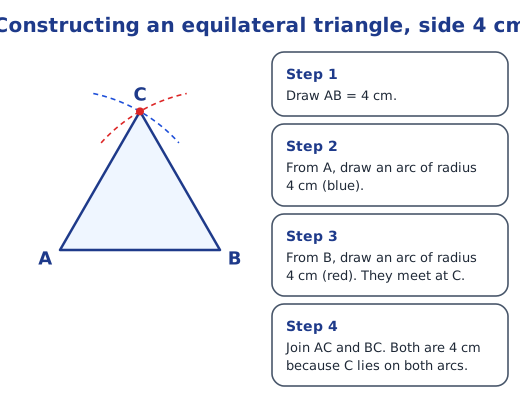
Construct a triangle with all sides 4 cm. What tools did you use? Can it be done with only a marked ruler? It can be done with a ruler alone, but only by trial and error: after drawing AB = 4 cm, we keep marking a point C 4 cm from A until it is also 4 cm from B. With a compass it is direct: draw AB = 4 cm, draw arcs of radius 4 cm from A and from B, and join their meeting point C to A and B.
Why are AC and BC both 4 cm? C lies on the arc centred at A with radius 4 cm, so AC = 4 cm, and on the arc centred at B with radius 4 cm, so BC = 4 cm.
7.2 Triangles from Three Sides (pages 148–150)
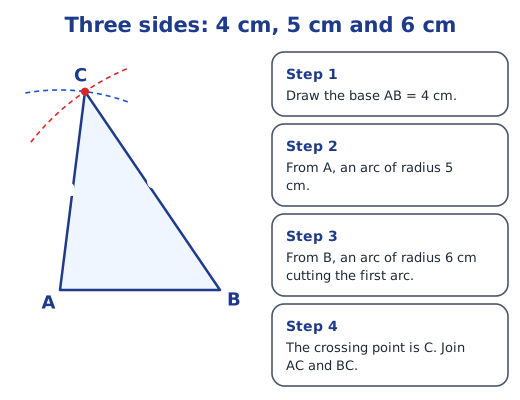
Construct a triangle with sides 4 cm, 5 cm and 6 cm. Draw AB = 4 cm; from A an arc of radius 5 cm; from B an arc of radius 6 cm cutting it at C; join AC and BC.
Construct (a) 4, 4, 6; (b) 3, 4, 5; (c) 1, 5, 5; (d) 4, 6, 8; (e) 3.5, 3.5, 3.5. Use the same steps each time, taking the longest side as the base. (a) and (c) are isosceles, (c) being tall and thin; (b) turns out to have a right angle between the 3 cm and 4 cm sides; (d) is scalene; (e) is equilateral.
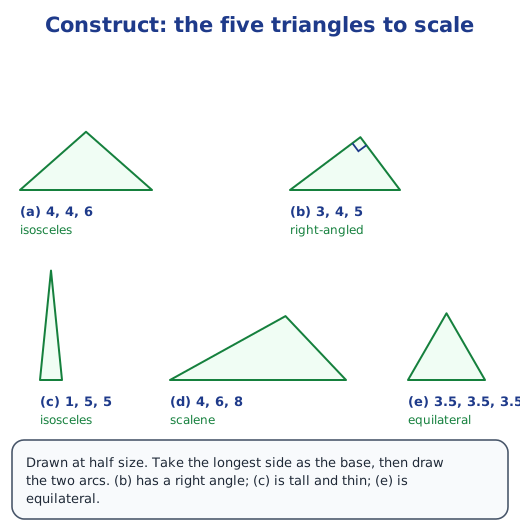
Figure it Out (pages 150–151)
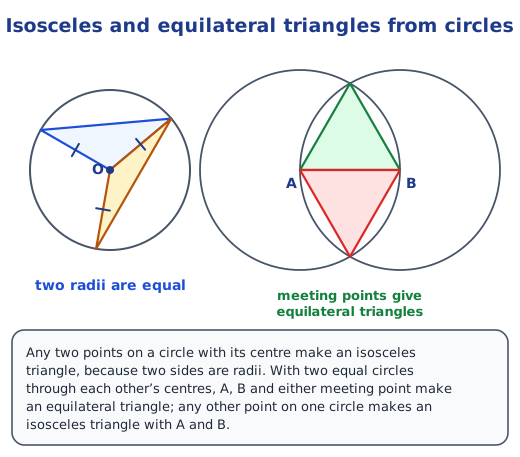
1. Isosceles triangles from a circle. Join the centre O to any two points P and Q on the circle: OP and OQ are radii, so ∆OPQ is isosceles. Every such pair of points gives one.
2. Two (or three) circles of the same size. In the first figure each circle passes through the other’s centre, so AB equals the radius. A, B and either point where the circles meet form an equilateral triangle, since all three sides are radii. For any other point C on the circle centred at B, ∆ABC is isosceles (BA = BC), and similarly for points on the circle centred at A. In the second figure each of A, B and C lies on the other two circles, so ∆ABC is equilateral, and each centre with two points on its own circle again gives isosceles triangles.
Are Triangles Possible for any Lengths? (page 151)
3 cm, 4 cm and 8 cm; 2 cm, 3 cm and 6 cm. Neither works: the arcs never meet. More impossible sets: 1, 2, 5; 2, 2, 6; 4, 5, 10. The pattern: in each, the longest length is at least the sum of the other two.
Triangle Inequality (pages 151–153)
10 cm, 15 cm and 30 cm? No triangle: the direct path CA = 30 cm would be longer than the roundabout path CB + BA = 25 cm, which is impossible.
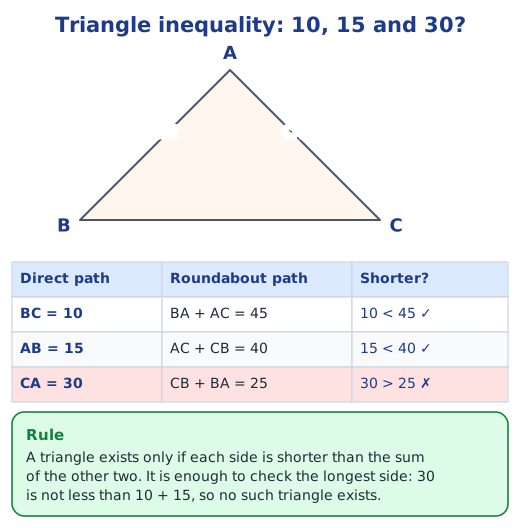
3 cm, 3 cm and 7 cm? No: 7 > 3 + 3 = 6. Constructing it, the two arcs of radius 3 cm drawn from the ends of a 7 cm base do not meet.
Math Talk: can the lengths be rearranged so that every direct path is shorter? No. Whichever side is given 30, it is longer than the other two sides together (10 + 15 = 25), so one comparison always fails.
Figure it Out (page 154)
1. Yes, without constructing: 8 > 3 + 4 = 7 and 6 > 2 + 3 = 5, so in each set one length is longer than the other two together.
2. (a) 10, 10, 25 km: no, 25 > 20. (b) 5, 10, 20 mm: no, 20 > 15. (c) 12, 20, 40 cm: no, 40 > 32.
3 (Try This). Will at least two comparisons always work? Yes. The two smaller lengths are each at most the longest, so each is less than a sum that includes the longest. For example, in 7, 10, 15: 7 < 25 and 10 < 22 at once. Only the longest length needs a real check, so compare the longest length with the sum of the other two.
Visualising the Construction of Circles (pages 155–156)
4 cm, 5 cm and 8 cm. 8 < 4 + 5 = 9, so the set satisfies the triangle inequality. The other two comparisons need no checking, since 4 and 5 are each less than 8 alone. Drawing the 8 cm base AB, the circle of radius 4 cm around A reaches X with BX = 4 cm, inside the 5 cm circle around B, so the circles cross at two points and the triangle exists.
Figure it Out (page 156)
1. (a) 2, 2, 5: no, 5 > 4. (b) 3, 4, 6: yes, 6 < 7. (c) 2, 4, 8: no, 8 > 6. (d) 5, 5, 8: yes, 8 < 10. (e) 10, 20, 25: yes, 25 < 30. (f) 10, 20, 35: no, 35 > 30. (g) 24, 26, 28: yes, 28 < 50.
The Three Cases of Two Circles (pages 157–159)
Sets that do not satisfy the triangle inequality, where the circles (a) touch at a point: 2, 3, 5; 4, 4, 8; 1, 6, 7 (the two smaller add up to the longest). (b) do not meet: 2, 3, 6; 1, 1, 5; 3, 4, 9 (the two smaller add up to less).
A complete procedure: arrange the three lengths in order; add the two smaller ones; if the sum is greater than the longest, a triangle exists, and otherwise it does not.
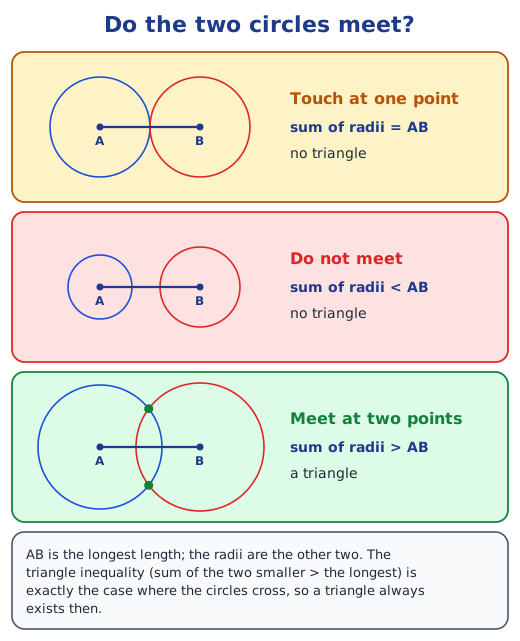
Figure it Out (page 159)
1. (a) 1, 100, 100: exists, 100 < 101. (b) 3, 6, 9: does not, 9 = 3 + 6 (the circles only touch). (c) 1, 1, 5: does not, 5 > 2. (d) 5, 10, 12: exists, 12 < 15.
2. Yes, 50 < 50 + 50. In general, an equilateral triangle exists for any side length a, since a < a + a always.
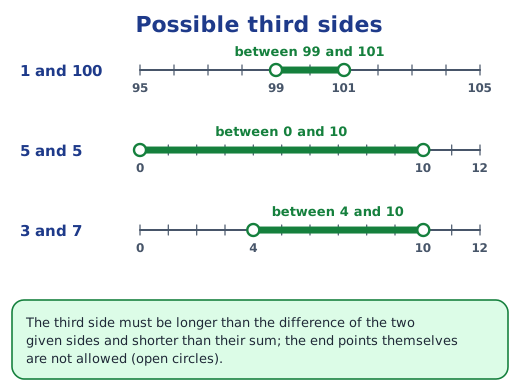
3. Five possible third sides: (a) with 1 and 100: 99.5, 99.9, 100, 100.4, 100.9. (b) with 5 and 5: 1, 3, 5, 7, 9.5. (c) with 3 and 7: 4.5, 5, 6, 8, 9.9.
Try This: all possible third sides. Strictly between the difference and the sum of the two given sides: (a) between 99 and 101, (b) between 0 and 10, (c) between 4 and 10.
7.3 Two Sides and the Included Angle (pages 160–161)
Construct ∆ABC with AB = 5 cm, AC = 4 cm and ∠A = 45°. Draw AB = 5 cm, draw a 45° arm at A, mark C on it with AC = 4 cm, and join BC.
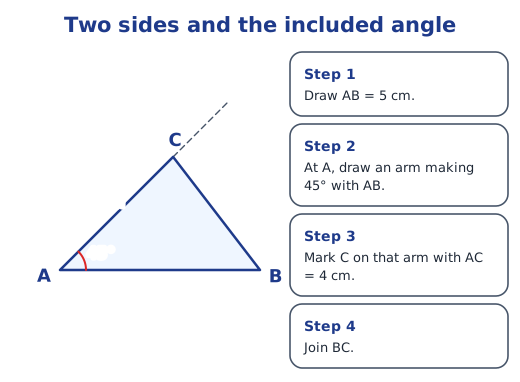
Figure it Out (page 161)
1. In each, draw one side, make the angle at one end, and mark the other side along the new arm: (a) 7 cm base, 75° at one end, 3 cm along the arm; (b) 6 cm base, 25°, 3 cm; (c) 8 cm base, 120°, 3 cm (an obtuse-angled triangle).
Math Talk: is a triangle ever impossible here? Only if the included angle is 180° or more, since the two sides then lie on one line or open away from each other. For any angle less than 180°, the construction always closes into a triangle.
Two Angles and the Included Side (pages 161–163)
Construct ∆ABC with AB = 5 cm, ∠A = 45° and ∠B = 80°. Draw AB, draw 45° at A and 80° at B; the arms meet at C, and ∠C measures 55°.
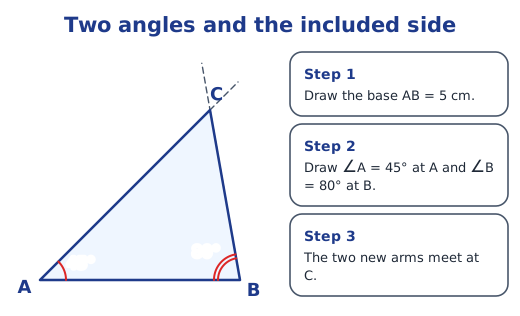
Figure it Out (page 162)
1. (a) 75°, 5 cm, 75°: an isosceles triangle with third angle 30°. (b) 25°, 3 cm, 60°: third angle 95°. (c) 120°, 6 cm, 30°: third angle 30°, an isosceles obtuse-angled triangle.
Do triangles always exist? Examples where they do not: 90° and 90°; 100° and 80°; 120° and 70°; 40° and 150°.
With 40° at A: (a) any ∠B of 140° or more, such as 150°, stops the arms meeting. (b) The smallest such ∠B is 140°: then the arm from B is parallel to the first arm, because interior angles on the same side of the transversal AB add up to 180°. The length AB plays no part.
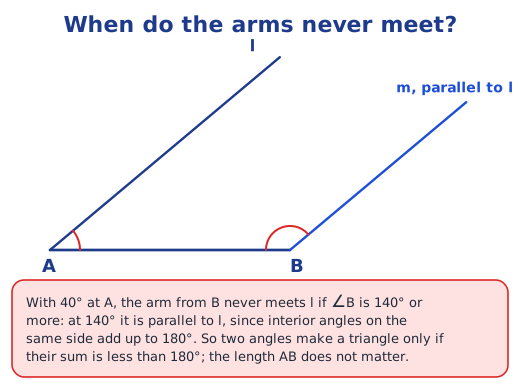
Figure it Out (page 163)
1. Another angle that does or does not give a triangle:
- (a) 30°: possible with any angle under 150°, such as 50° or 90°; not possible with 150° or more, such as 150° or 170°.
- (b) 70°: possible under 110°, such as 60° or 80°; not possible with 110° or more, such as 120° or 140°.
- (c) 54°: possible under 126°, such as 64° or 90°; not possible with 126° or more, such as 134° or 154°.
- (d) 144°: possible under 36°, such as 20° or 35°; not possible with 36° or more, such as 36° or 90°.
2. (a) 35°, 150°: cannot, sum 185°. (b) 70°, 30°: can, sum 100°. (c) 90°, 85°: can, sum 175°. (d) 50°, 150°: cannot, sum 200°.
The rule: two angles can be angles of a triangle exactly when their sum is less than 180°.
The Third Angle (page 164)
60° and 70° on a 5 cm base, then a 7 cm base: the third angle is 50° both times; it does not depend on the side length. Math Talk, keeping track: list the two given angles and the measured third angle for several triangles, one row each, and add each row; the totals all come out at about 180°. The relation: the third angle is 180° minus the sum of the other two. ∆ABC with ∠B = 50°, ∠C = 70°: a line XY through A parallel to BC gives alternate angles ∠XAB = 50° and ∠YAC = 70°, so ∠BAC = 180° − 120° = 60°.
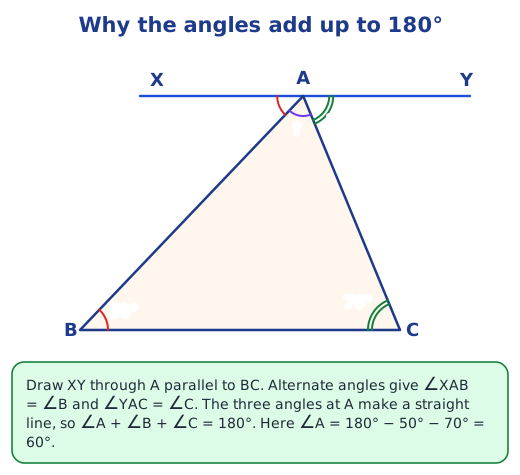
Figure it Out (page 165)
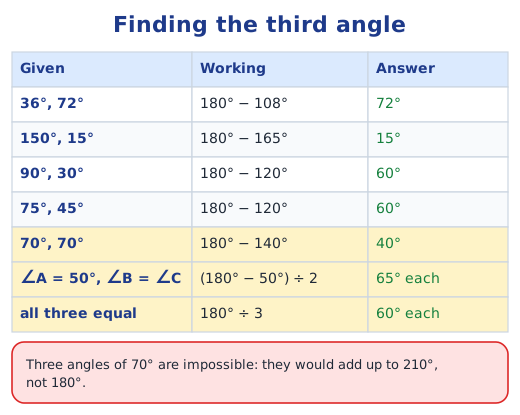
1. (a) 36°, 72°: third angle 72°. (b) 150°, 15°: 15°. (c) 90°, 30°: 60°. (d) 75°, 45°: 60°. In each, a line through the third vertex parallel to the opposite side makes the two given angles as alternate angles, and the three angles at that vertex make 180°.
2. No, three 70° angles add up to 210°. If two angles are 70°, the third is 40°. If all three are equal, each is 180° ÷ 3 = 60°.
3. ∠B + ∠C = 180° − 50° = 130°, and they are equal, so ∠B = ∠C = 65°.
Angle Sum Property (pages 165–166)
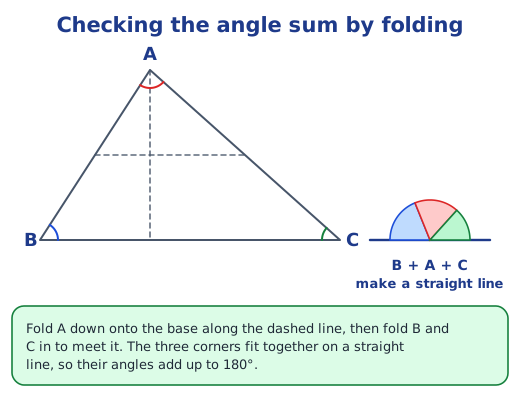
Folding a paper triangle. Fold the top vertex down onto the base, then fold the other two corners in to meet it. The three angles fit side by side along the straight base, so together they make 180°.
Exterior Angles (page 167)
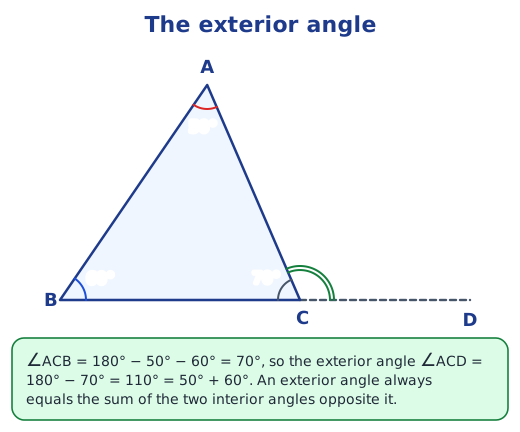
∠ACD when ∠A = 50° and ∠B = 60°: ∠ACB = 70°, so ∠ACD = 180° − 70° = 110°. The relation: since ∠A + ∠B + ∠ACB = 180° and ∠ACD + ∠ACB = 180°, the exterior angle ∠ACD always equals ∠A + ∠B.
7.4 Altitudes (pages 167–169)
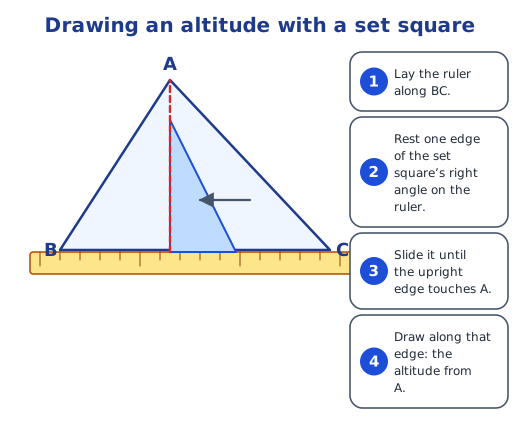
What do we mean by height? The straight-up distance from the bottom to the top, measured at right angles to the ground. For a triangle, the height of a vertex is its perpendicular distance from the opposite side.
The altitude from A to BC when the angle at B is obtuse: extend CB beyond B and drop the perpendicular from A to this extended line; the altitude lies outside the triangle.
Paper folding. Fold so that the base folds onto itself and the crease passes through the top vertex. The two angles the crease makes with the base then match exactly and together form a straight angle, so each is 90°: the crease is perpendicular to the base.
A triangle in which a side is also an altitude: a right-angled triangle; each of the two sides forming the right angle is perpendicular to the other.
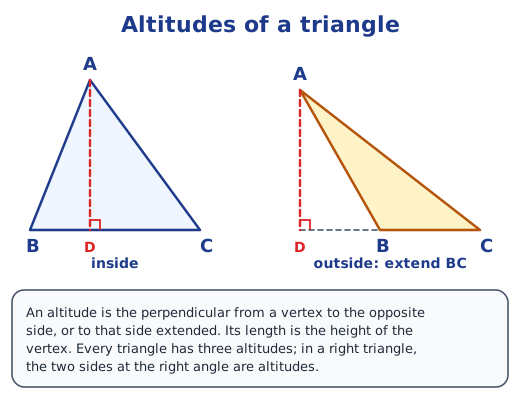
7.5 Types of Triangles (page 170)
Any other type? Yes: triangles with an obtuse angle, such as the 120° triangles and the 140° triangle TRY in this chapter, and triangles whose angles are all acute. These give the classification by angles. Why not define an acute-angled triangle as one with an acute angle? Every triangle has at least two acute angles, so that definition would include every triangle; an acute-angled triangle must have all three angles acute.
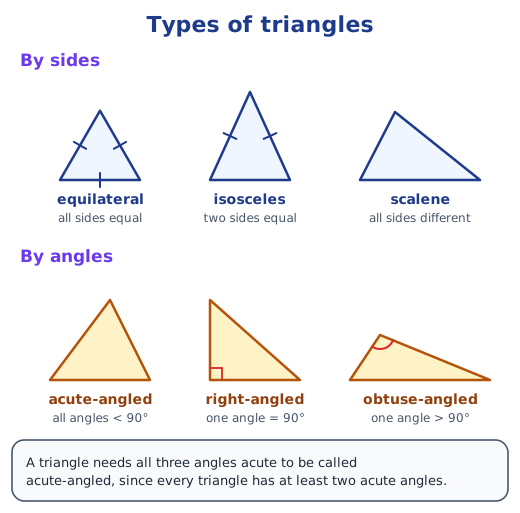
Figure it Out (pages 170–171)
1. BC = 5 cm, AB = 6 cm, CA = 5 cm. Draw BC = 5 cm, an arc of radius 6 cm from B and one of 5 cm from C, meeting at A. The triangle is isosceles (CA = CB) and all its angles are acute, so the altitude from A falls inside BC; measured, it is about 4.8 cm, meeting BC about 3.6 cm from B.
2. RY = 4 cm, TR = 7 cm, ∠R = 140°. Draw RY = 4 cm, an arm at R making 140° with RY, and mark T 7 cm along it; join TY. The angle at R is obtuse, so extend YR beyond R and drop the perpendicular from T to the extended line with a set square; it lies outside the triangle, measures about 4.5 cm and meets the extended line about 5.4 cm beyond R.
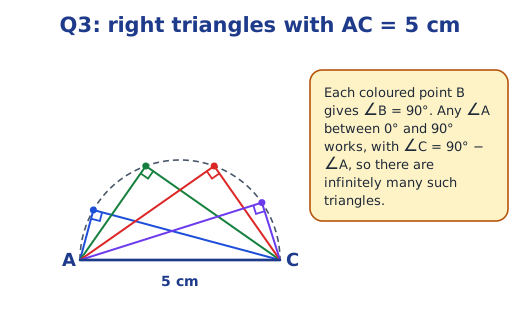
3. ∠B = 90°, AC = 5 cm. Infinitely many. Taking AC as the base, ∠A can be any angle between 0° and 90°, with ∠C = 90° − ∠A; each choice gives a different right triangle.
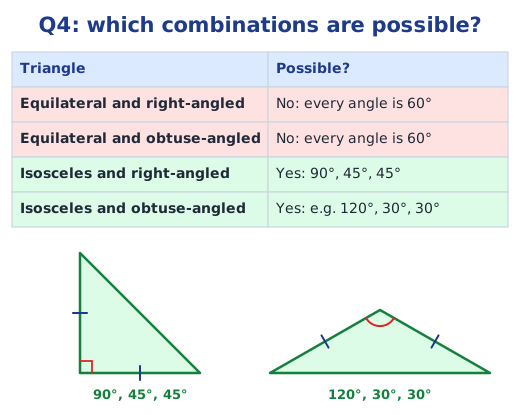
4. An equilateral triangle can be neither right-angled nor obtuse-angled, because all its angles are 60°. An isosceles triangle can be both: right-angled with angles 90°, 45°, 45°, and obtuse-angled with angles such as 120°, 30°, 30°.
Shortest Path in a Box (page 172)
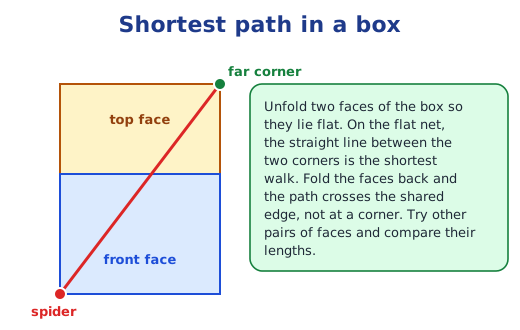
The spider’s shortest path. Unfold the two faces it must cross (for example the front and the top) so that they lie flat as one rectangle. On this flat net, the straight line from the spider’s corner to the far corner is the shortest walk. Folded back, the path crosses the shared edge at a point between its ends, not at a corner. Different pairs of faces give different lengths, so measure each straight line on the net and pick the shortest.
Short notes and more practice are on the topic pages: constructing triangles, types of triangles and triangle inequality and angle sum property.
Practice
-
Which set of lengths cannot form a triangle?
Show answer
Answer: (c) 10, 20, 35
-
Two angles of a triangle are equal and the third is 50°. What is each equal angle?
Show answer
Answer: (c) 65°
-
What is the smallest ∠B that stops a triangle forming when ∠A = 40°?
Show answer
Answer: (d) 140°
-
Give two lengths that, with 5 cm and 5 cm, form a triangle, and one that does not.
Show answer
Answer: Any length strictly between 0 and 10 cm works, such as 3 cm or 9 cm; 10 cm does not, because 10 is not less than 5 + 5.
-
Can a triangle have angles 60°, 60° and 70°?
Show answer
Answer: No. They add up to 190°, but the angles of every triangle add up to 180°.
Stuck on a question?
Take a photo and Lagnever AI explains it step by step. Try it for 7 days for ₹2.
Get it on Google Play Open in browser
For parents: after the trial, the plan renews monthly by UPI or card autopay. You can cancel anytime in the app.