
Types of triangles
Answer in short
Triangles are grouped by sides and by angles. By sides, an equilateral triangle has three equal sides, an isosceles triangle two and a scalene triangle none. By angles, an acute-angled triangle has all angles under 90°, a right-angled triangle has one 90° angle and an obtuse-angled triangle has one angle over 90°.
Stuck on a question? Take a photo and Lagnever AI explains it step by step. Try it for 7 days for ₹2. Get it on Google Play
Two ways to sort triangles
While constructing triangles, we meet many shapes: tall and thin, wide and flat, perfectly regular or lopsided. Two simple questions sort them. Are any of the sides equal? And how big is the largest angle?
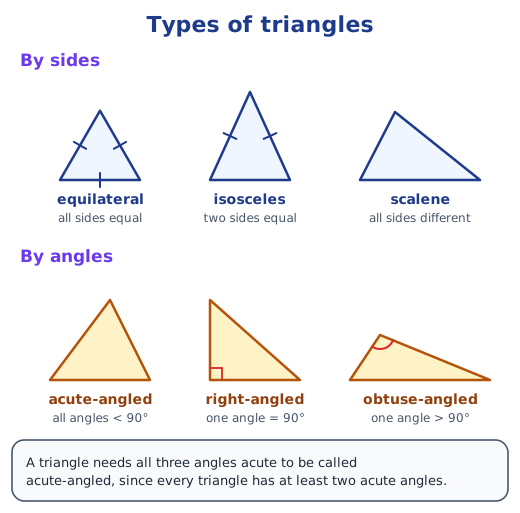
By sides
- An equilateral triangle has all three sides equal. It is the most symmetric triangle, and each of its angles is 60°.
- An isosceles triangle has two equal sides, such as 4 cm, 4 cm and 6 cm.
- A scalene triangle has three sides of different lengths, such as 4 cm, 6 cm and 8 cm.
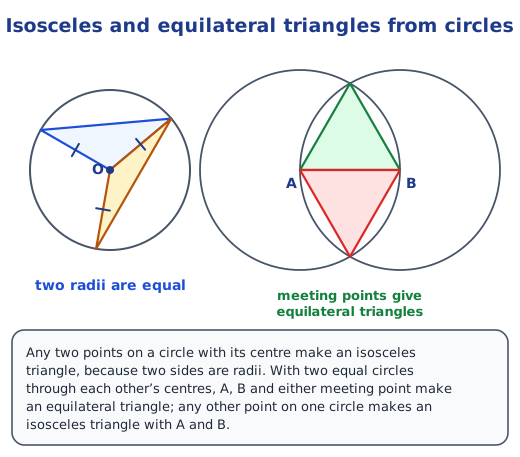
Circles give a quick way to make isosceles triangles. Join the centre of a circle to any two points on it: two sides are radii, so they are equal. With two equal circles that pass through each other’s centres, A and B, the centres and either point where the circles meet form an equilateral triangle.
By angles
- An acute-angled triangle has all three angles acute, less than 90°.
- A right-angled triangle, or right triangle, has one right angle.
- An obtuse-angled triangle contains one angle bigger than 90°, an obtuse angle.
Why must all three angles be acute for the first type? Because the three angles of any triangle add up to 180°, so every triangle already has at least two acute angles. A triangle cannot have two right angles or two obtuse angles either.
So, to name a triangle by its angles, look only at its largest angle. If the largest angle is less than 90°, the triangle is acute-angled; if it is exactly 90°, the triangle is right-angled; and if it is more than 90°, the triangle is obtuse-angled. A triangle with angles 50°, 60° and 70° is acute-angled, one with 30°, 60° and 90° is right-angled, and one with 120°, 30° and 30° is obtuse-angled.
Altitudes and right triangles
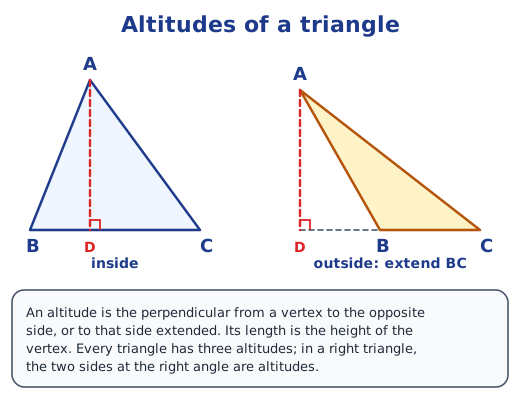
The height of a vertex is measured along the altitude, the perpendicular from that vertex to the opposite side. In an acute-angled triangle all three altitudes fall inside. In an obtuse-angled triangle, the opposite side has to be extended and the altitude falls outside the triangle. In a right-angled triangle, something special happens: the two sides that make the right angle are themselves altitudes, since each is perpendicular to the other.
Which combinations are possible?
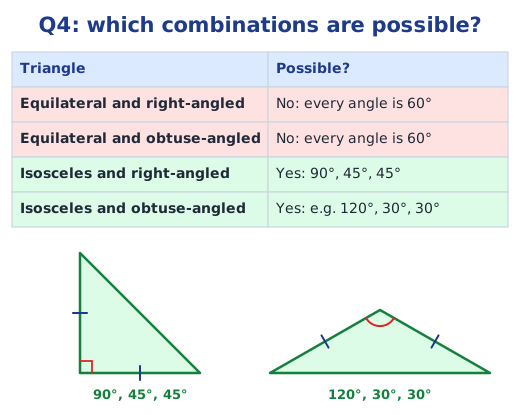
The two ways of sorting can be combined. An equilateral triangle is always acute-angled, because each angle is 60°; it can never be right-angled or obtuse-angled. An isosceles triangle can be right-angled, with angles 90°, 45° and 45°, or obtuse-angled, with angles such as 120°, 30° and 30°. A scalene triangle can be of any of the three angle types, like the 3, 4, 5 triangle, which has a right angle.
Why it matters
Naming triangles by sides and angles helps us describe shapes precisely and predict their properties: an equilateral triangle’s angles are always 60°, and a right triangle carries two of its own altitudes. How to draw these triangles is in constructing triangles, and the 180° rule behind many of these facts is in triangle inequality and angle sum property. Answers to every question are in the NCERT solutions for Chapter 7; see also the full Chapter 7 notes.
Practice
-
A triangle has sides 5 cm, 5 cm and 8 cm. What type is it by sides?
Show answer
Answer: (b) Isosceles
-
A triangle has angles 30°, 60° and 90°. What type is it by angles?
Show answer
Answer: (b) Right-angled
-
In which triangle can an altitude fall outside the triangle?
Show answer
Answer: (c) Obtuse-angled
-
Can a triangle be both isosceles and right-angled? Give an example.
Show answer
Answer: Yes. A triangle with angles 90°, 45° and 45° has two equal sides, the two sides that form the right angle.
-
Why must all three angles of an acute-angled triangle be acute?
Show answer
Answer: Because every triangle already has at least two acute angles (the three add up to 180°), so saying ‘one acute angle’ would describe every triangle; the name is kept for triangles whose largest angle is also acute.
Questions students ask
What are the types of triangles by sides?
An equilateral triangle has all three sides equal, an isosceles triangle has two equal sides, and a scalene triangle has all three sides of different lengths. An equilateral triangle is the most symmetric of all; a triangle such as 4, 4, 6 is isosceles and one such as 4, 6, 8 is scalene.
What are the types of triangles by angles?
An acute-angled triangle has all three angles less than 90°, a right-angled triangle has one angle of exactly 90°, and an obtuse-angled triangle has one angle greater than 90°. A triangle cannot have two right or obtuse angles, because the three angles add up to only 180°.
What is an altitude of a triangle?
An altitude is the perpendicular segment from a vertex to the opposite side, or to that side extended. Its length is the height of that vertex. Every triangle has three altitudes; in an obtuse-angled triangle two of them fall outside, and in a right-angled triangle the two sides forming the right angle are altitudes.
Stuck on a question?
Take a photo and Lagnever AI explains it step by step. Try it for 7 days for ₹2.
Get it on Google Play Open in browser
For parents: after the trial, the plan renews monthly by UPI or card autopay. You can cancel anytime in the app.