
NCERT Solutions Class 8 Maths Chapter 5: Number Play
Answers to the questions inside the chapter, all four Figure it Out sets and the cryptarithms in Chapter 5, Number Play, of Ganita Prakash, Grade 8 Part 1. Page numbers follow the book (pages 112–135). Where a question asks you to choose your own numbers, ours are examples, and other answers are possible. Short notes: Chapter 5 notes.
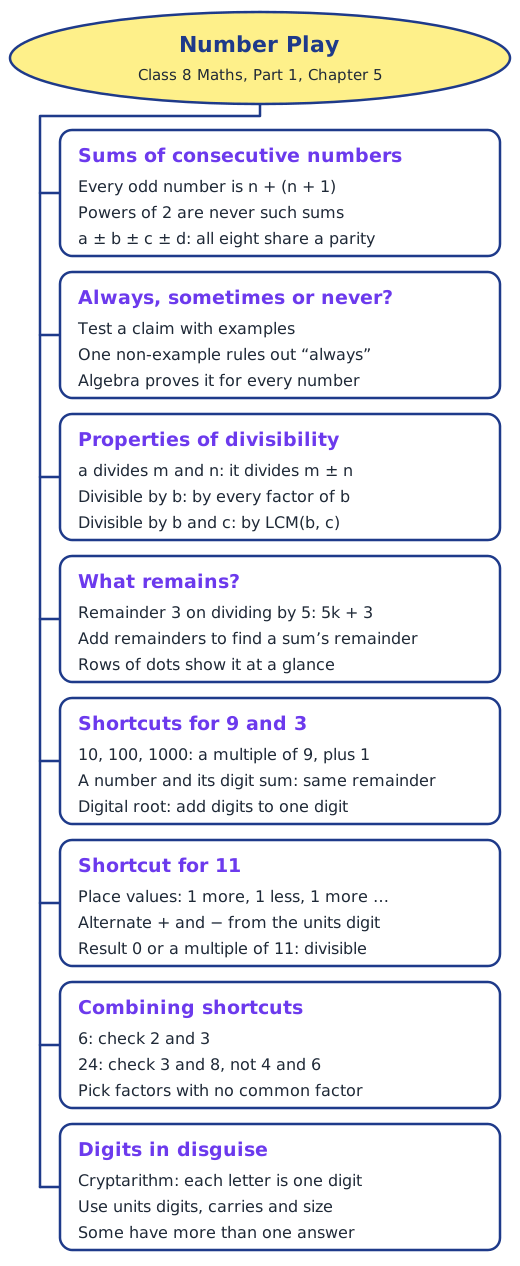
Sums of consecutive numbers (page 112)
Can every natural number be written as a sum of consecutive numbers? No, not with counting numbers alone. 1, 2, 4, 8, 16, 32, …, the powers of 2, cannot. Here is why. A sum of an odd number of consecutive numbers equals (how many there are) × (the middle number), so it has an odd factor of 3 or more. A sum of an even number of them can be paired from the outside in, first with last, and each pair adds up to the same odd number; so it too has an odd factor of 3 or more. A power of 2 has no odd factor except 1. Every other number has such a factor and can be written as a sum, for example 6 = 1 + 2 + 3 and 20 = 2 + 3 + 4 + 5 + 6.
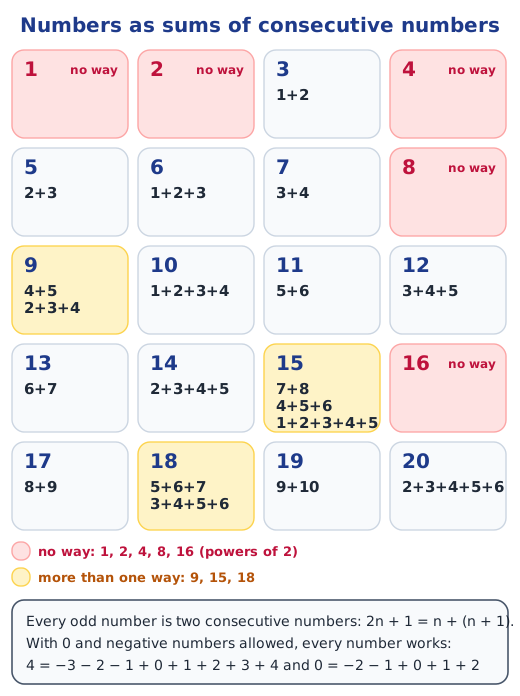
Which numbers can be written in more than one way? For example 9 = 4 + 5 = 2 + 3 + 4, 15 = 7 + 8 = 4 + 5 + 6 = 1 + 2 + 3 + 4 + 5, 18 = 5 + 6 + 7 = 3 + 4 + 5 + 6, and also 21, 25, 27 and 30. These numbers have more than one odd factor bigger than 1. Extra: the number of ways is always one less than the number of odd factors, so 15 (odd factors 1, 3, 5, 15) has three ways, while an odd prime such as 7 has only one.
Can every even number be written as a sum of consecutive numbers? Not as a sum of two, because two consecutive numbers always add up to an odd number. Many even numbers work with three or more, such as 6 = 1 + 2 + 3, 10 = 1 + 2 + 3 + 4 and 12 = 3 + 4 + 5. The powers of 2 (2, 4, 8, 16, …) never do.
Can 0 be written as a sum of consecutive numbers? Yes, with negative numbers: 0 = −1 + 0 + 1 = −2 − 1 + 0 + 1 + 2. With negative numbers every number works, for example 4 = −3 − 2 − 1 + 0 + 1 + 2 + 3 + 4.
Four consecutive numbers with + and − (pages 112–114)
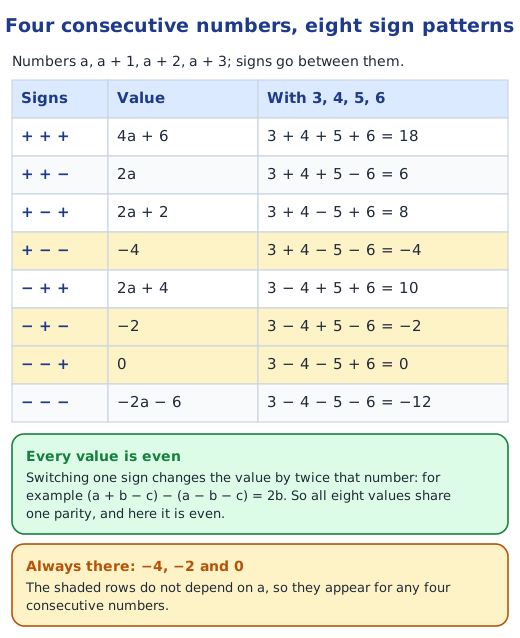
Math Talk: list and evaluate all the expressions for 3, 4, 5, 6. There are 8, since each of the three gaps gets + or −: 3 + 4 + 5 + 6 = 18, 3 + 4 + 5 − 6 = 6, 3 + 4 − 5 + 6 = 8, 3 + 4 − 5 − 6 = −4, 3 − 4 + 5 + 6 = 10, 3 − 4 + 5 − 6 = −2, 3 − 4 − 5 + 6 = 0 and 3 − 4 − 5 − 6 = −12. Every result is even.
Repeat with two more sets of four. 5, 6, 7, 8 give 26, 10, 12, −4, 14, −2, 0 and −16. 10, 11, 12, 13 give 46, 20, 22, −4, 24, −2, 0 and −26. Again all are even, and −4, −2 and 0 turn up every time.
Do these patterns always occur? Reason with algebra. Yes. Call the numbers a, a + 1, a + 2 and a + 3. The eight values are 4a + 6, 2a, 2a + 2, −4, 2a + 4, −2, 0 and −2a − 6. Each has 2 as a factor, so each is even, and −4, −2 and 0 do not depend on a at all.
Any four numbers: what about the parities? Within one set, all eight results have the same parity, but it can be odd. 1, 4, 6, 9 give 20, 2, 8, −10, 12, −6, 0 and −18, all even. 2, 3, 5, 7 give 17, 3, 7, −7, 11, −3, 1 and −13, all odd.
Switch a − sign to + in a + b − c − d. By how much does the value change? To a + b + c − d, the value goes up by (a + b + c − d) − (a + b − c − d) = 2c. Switching −d instead changes it by 2d. The change is always twice a number, so it is even, and the parity stays the same. So all eight expressions share one parity.
Explanation 3: how do positive and negative tokens show it? Lay out a tokens for a, b for b, and so on, positive for a + sign and negative for a − sign. Each positive token cancels a negative one, two tokens at a time. Removing tokens in twos never changes whether the count left over is even or odd, so every value has the same parity as a + b + c + d.
Is this limited to four numbers? No. The same argument works for any count of numbers: each sign switch changes the value by twice a number.
Breaking Even (pages 115–116)
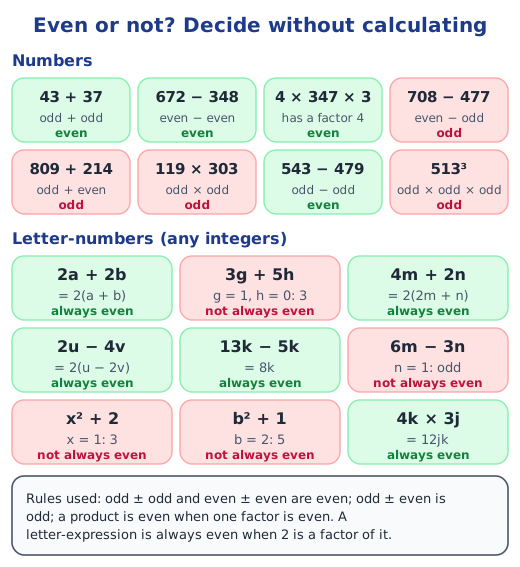
Without working them out, which of these are even? 43 + 37 (odd + odd), 672 − 348 (even − even), 4 × 347 × 3 (it has the factor 4) and 543 − 479 (odd − odd) are even. 708 − 477 (even − odd), 809 + 214 (odd + even), 119 × 303 (odd × odd) and 513³ (odd × odd × odd) are odd.
Which algebraic expressions are always even? Give examples and non-examples.
- 2a + 2b = 2(a + b): always even. a = 3, b = 4 gives 14; a = −1, b = 6 gives 10.
- 3g + 5h: not always. g = 1, h = 1 gives 8, but g = 1, h = 0 gives 3.
- 4m + 2n = 2(2m + n): always even. m = 2, n = −5 gives −2.
- 2u − 4v = 2(u − 2v): always even. u = 7, v = 1 gives 10.
- 13k − 5k = 8k: always even. k = 3 gives 24; k = −2 gives −16.
- 6m − 3n: not always. m = 1, n = 2 gives 0, but m = 1, n = 1 gives 3. It is even exactly when n is even.
- x² + 2: not always. x = 4 gives 18, but x = 3 gives 11.
- b² + 1: not always. b = 3 gives 10, but b = 2 gives 5.
- 4k × 3j = 12jk: always even. k = 1, j = 5 gives 60.
Write a few expressions that are always even. 6p + 10q = 2(3p + 5q), 2x + 8 = 2(x + 4), 4a − 2 = 2(2a − 1), and x² + x = x(x + 1), a product of two consecutive integers, one of which is even.
Pairs to Make Fours (pages 116–118)
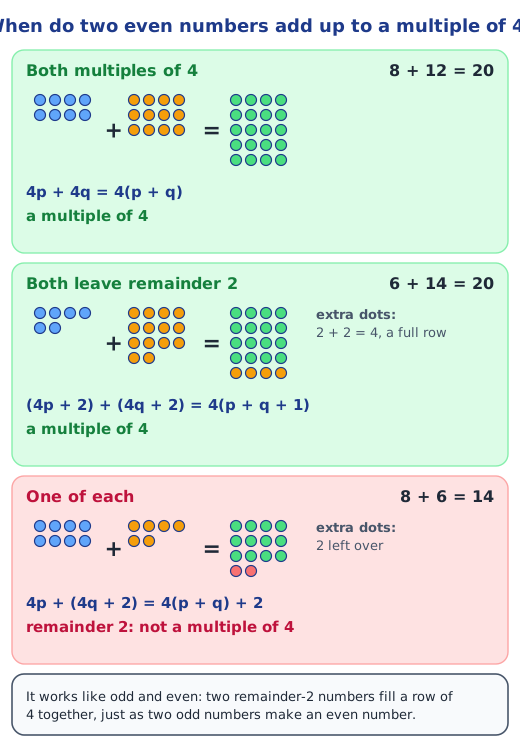
When is the sum of two even numbers a multiple of 4? When both are multiples of 4 (8 + 12 = 20), or when both leave remainder 2 on dividing by 4 (6 + 14 = 20). It is not when one of each is added (8 + 6 = 14). This is like parity: two remainder-2 numbers behave like two odd numbers.
Third case: 4p plus 4q + 2. Explain it and give examples. 4p + (4q + 2) = 4(p + q) + 2. The rows of 4 stay full, and 2 dots are left over, so the sum always leaves remainder 2 and is never a multiple of 4. Examples: 8 + 6 = 14, 12 + 10 = 22, 20 + 2 = 22.
Always, Sometimes, or Never (pages 118–121)
Statement 1 with subtraction: if 8 divides two numbers, does it divide their difference? Always. 8a − 8b = 8(a − b). For example, 64 − 24 = 40 = 8 × 5.
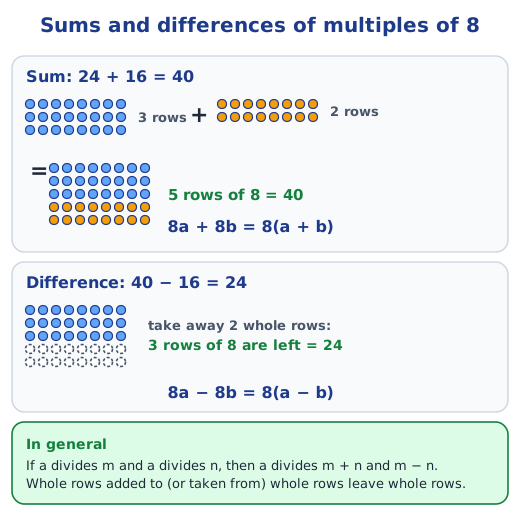
The book explains Statements 2 to 5 itself: Statement 2 is sometimes true (40 = 16 + 24, but also 15 + 25), Statements 3 and 4 are always true, and Statement 5 is sometimes true (35 is divisible by 7 and by 35, but not by 14).
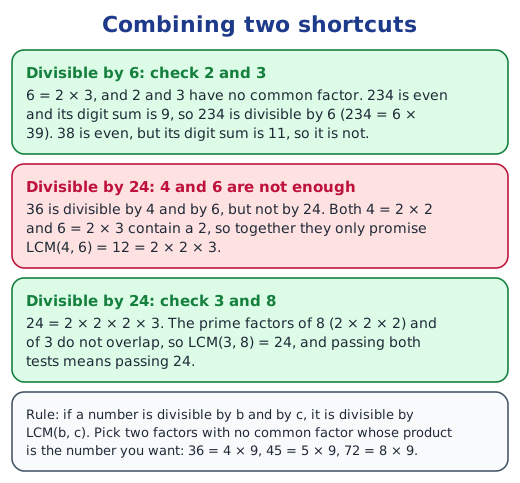
Statement 6: divisible by both 9 and 4, so divisible by 36? Always true. A multiple of 9 has 3 × 3 in its prime factorisation and a multiple of 4 has 2 × 2. These share no prime factor, so a number divisible by both contains 2 × 2 × 3 × 3 = 36 = LCM(9, 4). For example, 72 and 180 are divisible by 9, 4 and 36.
Statement 7: divisible by both 6 and 4, so divisible by 24? Sometimes true. 48 is divisible by 6, 4 and 24, but 36 is divisible by 6 and 4 and not by 24. 6 = 2 × 3 and 4 = 2 × 2 share a 2, so the number is only sure to be divisible by LCM(6, 4) = 12.
Statement 8 is answered in the book: never true, because an odd number plus an even number is odd, and every multiple of 6 is even.
What Remains? (pages 121–122)
Find numbers that leave remainder 3 on dividing by 5. 3, 8, 13, 18, 23, 28, … each 3 more than a multiple of 5.
Which expressions capture all of them? (iv) 5k + 3, for k = 0, 1, 2, …, and (v) 5k − 2, for k = 1, 2, 3, … The others do not:
- (i) 3k + 5 gives 5 for k = 0, which leaves remainder 0.
- (ii) 3k − 5 gives 1 for k = 2.
- (iii) 3k ÷ 5 gives 0.6 for k = 1, not even a whole number.
- (vi) 5k − 3 gives 2, 7, 12, …, which leave remainder 2.
Are there other expressions? Yes: 5k + 8 (k = −1, 0, 1, …), 5k − 7 (k = 2, 3, …) or 5k + 13 (k = −2, −1, 0, …). Any multiple of 5 plus 3 works, as long as k starts at the right place.
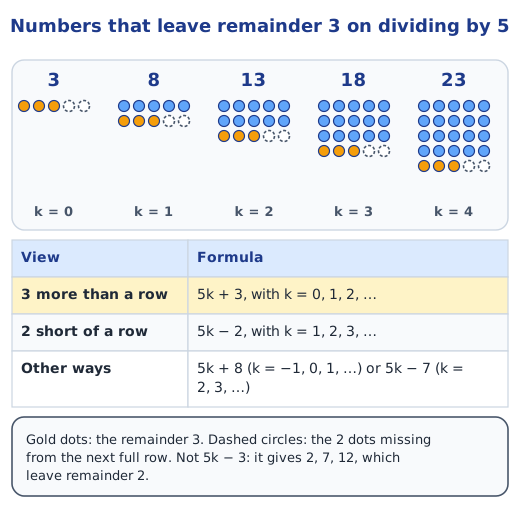
Figure it Out (pages 122–123)
1. Call the numbers n, n + 1, n + 2 and n + 3. Their sum is 4n + 6 = 34, so 4n = 28 and n = 7. The numbers are 7, 8, 9 and 10. Check: 7 + 8 + 9 + 10 = 34.
2. Counting up to p, the five numbers are p − 4, p − 3, p − 2, p − 1 and p.
3. (i) Sometimes true. 4 + 8 = 12 is a multiple of 3, but 4 + 6 = 10 is not. Two even numbers are 2a and 2b, and 2a + 2b = 2(a + b) is a multiple of 3 only when a + b is.
(ii) Sometimes true. 20 is divisible by neither 18 nor 9, so it fits, but 27 is not divisible by 18 and is divisible by 9. A multiple of 9 is 9k, and it is divisible by 18 only when k is even; 9k with k odd (9, 27, 45, …) breaks the claim.
(iii) Sometimes true. 7 + 8 = 15 is not divisible by 6, but 7 + 11 = 18 is. Write the numbers as 6a + r and 6b + s, with remainders r and s from 1 to 5. The sum is 6(a + b) + (r + s), which is divisible by 6 exactly when r + s = 6.
(iv) Always true. 6a + 9b = 3(2a + 3b), which has the factor 3. For example, 12 + 27 = 39 = 3 × 13.
(v) Sometimes true. 6 + 3 = 9 is a multiple of 9, but 6 + 6 = 12 is not. 6a + 3b = 3(2a + b), a multiple of 9 only when 2a + b is a multiple of 3.
4. Such a number is 2 more than a multiple of 3 and 2 more than a multiple of 4, so the number minus 2 is a multiple of both, that is, of LCM(3, 4) = 12. The numbers are 2, 14, 26, 38, 50, …, all of the form 12k + 2 (k = 0, 1, 2, …).
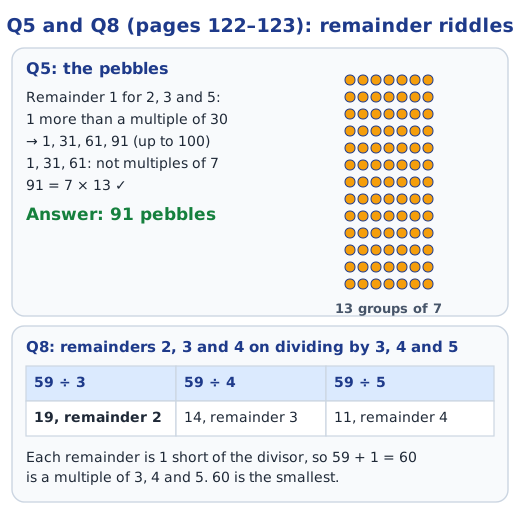
5. The pebbles leave remainder 1 when grouped in 2s, 3s and 5s, so their number is 1 more than a multiple of LCM(2, 3, 5) = 30: 1, 31, 61 or 91, as there are not more than 100. Only 91 can be grouped exactly in 7s (91 = 7 × 13). There are 91 pebbles.
6. Yes, the claim is true. Three such numbers are 6a + 2, 6b + 2 and 6c + 2. Their sum is 6a + 6b + 6c + 6 = 6(a + b + c + 1). For example, 2 + 8 + 14 = 24 = 6 × 4.
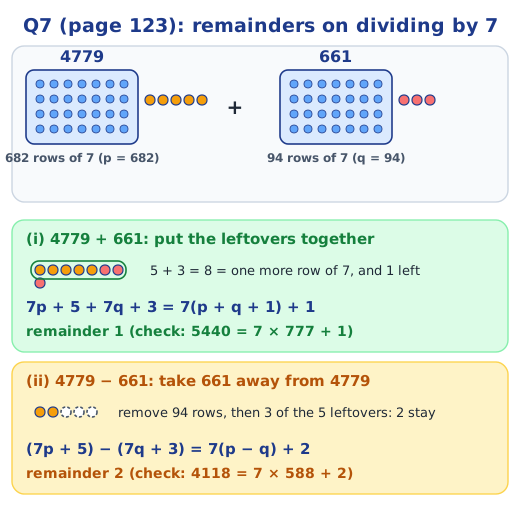
7. Write 4779 = 7p + 5 and 661 = 7q + 3 (here p = 682 and q = 94).
(i) 4779 + 661 = 7p + 7q + 8 = 7(p + q + 1) + 1, so the remainder is 1. In the picture, the leftover 5 dots and 3 dots make one more row of 7, with 1 dot over.
(ii) 4779 − 661 = (7p + 5) − (7q + 3) = 7(p − q) + 2, so the remainder is 2. In the picture, 94 full rows are taken away, and 3 of the 5 leftover dots, so 2 dots stay.
Check: 5440 = 7 × 777 + 1 and 4118 = 7 × 588 + 2.
8. In each case the remainder falls 1 short of the divisor, so adding 1 to the number gives a number divisible by 3, 4 and 5, and so by LCM(3, 4, 5) = 60. The smallest such number is 59. Check: 59 = 3 × 19 + 2 = 4 × 14 + 3 = 5 × 11 + 4. It is the smallest because 60 is the smallest positive common multiple of 3, 4 and 5; the next answers are 119, 179, …
Checking divisibility quickly (pages 123–126)
Use algebra to show why the tests for 5, 2, 4 and 8 work. Write the number as … + 1000d + 100c + 10b + a. Every place value except the units is a multiple of 10, so of 5 and of 2: only the units digit a decides divisibility by 5 (a is 0 or 5) and by 2 (a is even). From the hundreds place up, every place value is a multiple of 100 = 4 × 25, so only the last two digits, 10b + a, decide divisibility by 4. From the thousands place up, every place value is a multiple of 1000 = 8 × 125, so only the last three digits, 100c + 10b + a, decide divisibility by 8.
Which of 999, 909, 900, 90 and 990 are divisible by 9? All of them. Each digit is 9 or 0, so each part of the number is 9 × (a place value) or 0.
Is 10 divisible by 9? What is the remainder? No; 10 = 9 + 1, so the remainder is 1. Each ten leaves 1, so 20 leaves 2, 30 leaves 3, and so on up to 80, which leaves 8; 90 leaves 9 ones, which make another 9, so its remainder is 0.
What about multiples of 100? 100 = 99 + 1, so each hundred leaves 1: 300 leaves 3 and 700 leaves 7.
What remainder does 427 leave on dividing by 9? The hundreds leave 4, the tens leave 2 and the units are 7: 4 + 2 + 7 = 13 = 9 + 4. The remainder is 4. Check: 427 = 9 × 47 + 4.
Will this work for bigger numbers? Yes, because every place value is a string of 9s plus 1. For example, 6142 has digit sum 13, so it leaves remainder 4: 6142 = 9 × 682 + 4.
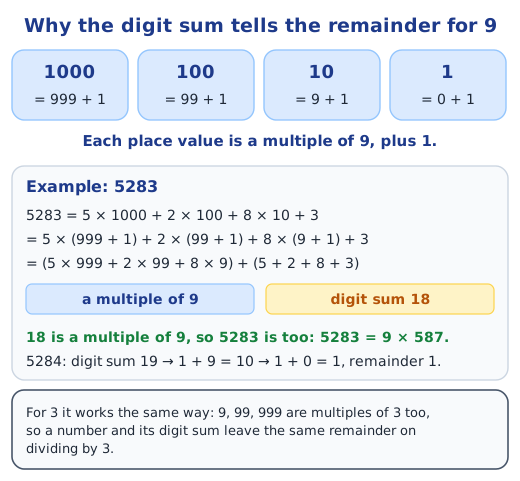
Which of statements (i) to (iv) are correct? All four. A number and its digit sum leave the same remainder on dividing by 9, so either both are divisible by 9 or neither is. (i) and (ii) say this in each direction; (iii) is the same fact as (ii) seen the other way round, and (iv) is the same as (i).
Figure it Out (page 126)
1. Add the digits. (i) 123: 6, not divisible. (ii) 405: 9, divisible. (iii) 8888: 32, not divisible. (iv) 93547: 28, not divisible. (v) 358095: 30, not divisible. Only 405 is divisible by 9.
2. The digits can only be 0, 2, 4, 6 and 8, so the digit sum is even. The smallest even multiple of 9 is 18, and two digits give at most 8 + 8 = 16, so at least three digits are needed. For the smallest number, make the first digit as small as possible: 2, and the other two must add up to 16, so they are 8 and 8. The answer is 288 = 9 × 32 (not counting 0).
3. 6000 has digit sum 6, so it is 6 more than a multiple of 9 (5994) and 3 less than the next one (6003). The closest multiple of 9 is 6003.
4. The first multiple of 9 after 4300 is 4302 (digit sum 9) and the last before 4400 is 4392 (digit sum 18). From 4302 to 4392 there are (4392 − 4302) ÷ 9 + 1 = 10 + 1 = 11 multiples of 9.
A shortcut for divisibility by 3 (page 126)
What remainders do the powers of 10 leave on dividing by 3? Why does the shortcut work? Every one leaves remainder 1, because 9, 99, 999, … are multiples of 3: 10 = 9 + 1, 100 = 99 + 1, and so on. So a number is a multiple of 3 plus its digit sum, and it is divisible by 3 exactly when its digit sum is. For example, 15, 33 and 87 have digit sums 6, 6 and 15, all multiples of 3.
A shortcut for divisibility by 11 (pages 126–129)
Is 462 divisible by 11? 400 is 4 above 396, a multiple of 11; 60 is 6 below 66; and 2 is 2 above 0. Together: 4 − 6 + 2 = 0, so yes: 462 = 11 × 42.
What could be a general method? Starting from the units digit, add and subtract the digits in turn. A result of 0 or a multiple of 11 means the number is divisible by 11; otherwise the result gives the remainder.
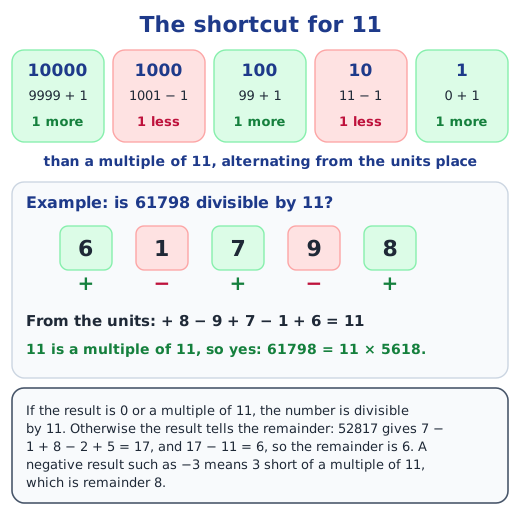
What if the result is 11 or some other multiple of 11? 0: the number is divisible by 11.
Check (i) to (vi) for divisibility by 11 and find the remainders.
- (i) 158: 8 − 5 + 1 = 4, remainder 4.
- (ii) 841: 1 − 4 + 8 = 5, remainder 5.
- (iii) 481: 1 − 8 + 4 = −3, that is 3 short of a multiple of 11, remainder 8.
- (iv) 5529: 9 − 2 + 5 − 5 = 7, remainder 7.
- (v) 90904: 4 − 0 + 9 − 0 + 9 = 22, divisible (90904 = 11 × 8264).
- (vi) 857076: 6 − 7 + 0 − 7 + 5 − 8 = −11, divisible (857076 = 11 × 77916).
Is the method of placing + and − before each digit similar or different? It is the same method written in one line. Giving + to the units, hundreds and ten-thousands digits and − to the others is exactly “excess minus short”. Note: the book’s table works with 320185 and the next sentence names 3,28,105; both give −3 and both leave remainder 8, so the conclusion holds for either.
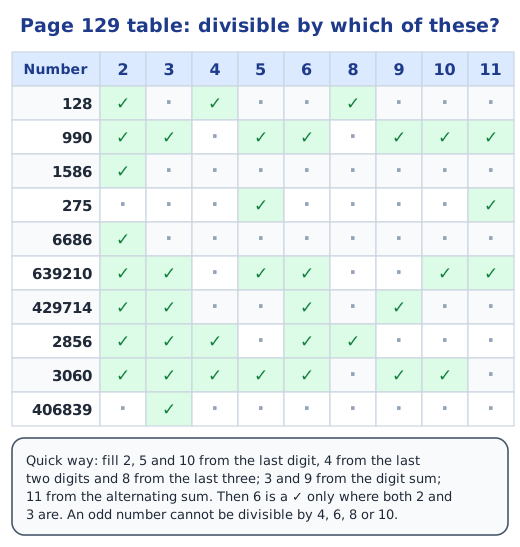
Fill in the table (page 129). Is there a quick way? Yes. Fill 2, 5 and 10 from the last digit, 4 from the last two digits and 8 from the last three, 3 and 9 from the digit sum and 11 from the alternating sum. Then 6 gets a yes only where 2 and 3 both do, and an odd number cannot be divisible by 4, 6, 8 or 10.
- 128: 2, 4, 8.
- 990: 2, 3, 5, 6, 9, 10, 11.
- 1586: 2 only.
- 275: 5, 11.
- 6686: 2 only.
- 639210: 2, 3, 5, 6, 10, 11.
- 429714: 2, 3, 6, 9.
- 2856: 2, 3, 4, 6, 8.
- 3060: 2, 3, 4, 5, 6, 9, 10.
- 406839: 3 only.
The book’s sample row for 128 marks 4 as “No”, but 128 = 4 × 32, so 128 is divisible by 4; the answer key also says yes.
More divisibility shortcuts (pages 129–130)
Does checking 2 and 3 test divisibility by 6? Try 38, 225, 186 and 64. Yes.
- 38 is even, but its digit sum is 11, so it is not divisible by 6 (38 = 6 × 6 + 2).
- 225 is odd, so it is not (225 = 6 × 37 + 3).
- 186 is even and its digit sum is 15, so it is: 186 = 6 × 31.
- 64 is even, but its digit sum is 10, so it is not (64 = 6 × 10 + 4).
Why do 3 and 8 work for 24, but not 4 and 6? Use prime factorisation. 24 = 2 × 2 × 2 × 3. A number divisible by 8 has 2 × 2 × 2 among its prime factors, and one divisible by 3 has a 3; together that is all of 24, since LCM(3, 8) = 24. But 4 = 2 × 2 and 6 = 2 × 3 share a 2, so a number divisible by both only has to contain 2 × 2 × 3 = 12. 12 and 36 are divisible by 4 and 6, but not by 24.
Digital roots (pages 130–131)
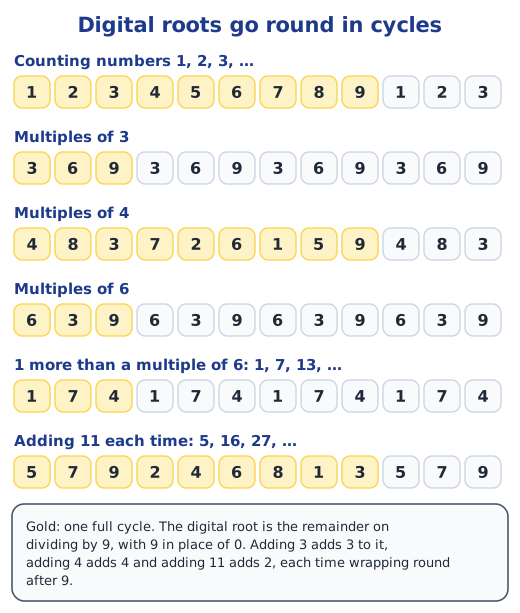
What property does the digital root have? It equals the remainder on dividing the number by 9, except that a multiple of 9 has digital root 9 (remainder 0).
Between 600 and 700, find the numbers whose digital root is 5, 7 or 3.
- (i) 5: 608, 617, 626, 635, 644, 653, 662, 671, 680, 689, 698 (digit sums 14 and 23).
- (ii) 7: 601, 610, 619, 628, 637, 646, 655, 664, 673, 682, 691 (digit sums 7 and 16), and 700 if you count it.
- (iii) 3: 606, 615, 624, 633, 642, 651, 660, 669, 678, 687, 696 (digit sums 12 and 21).
Each list goes up in steps of 9.
Digital roots of 12 numbers in a row. For 25 to 36: 7, 8, 9, 1, 2, 3, 4, 5, 6, 7, 8, 9. The digital roots run through 1 to 9 in order and then start again.
Find the digital roots of consecutive multiples of 3, 4 and 6. Multiples of 3: 3, 6, 9, 3, 6, 9, … Multiples of 4: 4, 8, 3, 7, 2, 6, 1, 5, 9, then the same again. Multiples of 6: 6, 3, 9, 6, 3, 9, …
What are the digital roots of numbers 1 more than a multiple of 6? 1, 7, 13, 19, 25, 31, … have digital roots 1, 7, 4, 1, 7, 4, …: always 1, 4 or 7.
Explain the patterns. The digital root is the remainder on dividing by 9 (with 9 for 0). Adding 3 adds 3 to the remainder, adding 4 adds 4, and so on, wrapping round after 9. Multiples of 6 have roots 6, 3, 9, so adding 1 gives 7, 4, 1.
The riddle (page 130): which number is it? Every digit is the smallest odd digit, 1. The number of digits, their sum and the digital root are all the largest odd single digit, 9. So the number is nine 1s in a row: 111111111, written 11,11,11,111 in the Indian system.
Figure it Out (page 131)
1. The digital root becomes 6. Adding 10 is adding 9 and then 1, and adding 9 does not change the remainder on dividing by 9, so the remainder goes up by 1. For example, 12345674 has digital root 5, and 12345684 has digital root 6. It works even with carrying: 10000094 (root 5) becomes 10000104 (root 6).
2. Starting from 5: 5, 16, 27, 38, 49, 60, 71, 82, 93, 104, … have digital roots 5, 7, 9, 2, 4, 6, 8, 1, 3, 5, … Each step adds 11 = 9 + 2, so the digital root goes up by 2, wrapping round after 9. All nine digital roots appear, and they repeat every 9 steps, whatever number you start with.
3. 9a + 36b + 13 = 9(a + 4b + 1) + 4 is 4 more than a multiple of 9, so its digital root is 4 (for whole numbers a and b).
4. (i) There is no link between parity and digital root. 12 (even) and 21 (odd) both have digital root 3; 10 (even) and 19 (odd) both have 1.
(ii) The remainder on dividing by 9 is the digital root, except that digital root 9 means remainder 0. For 3, digital roots 3, 6 and 9 give remainder 0; 1, 4 and 7 give remainder 1; 2, 5 and 8 give remainder 2.
Digits in disguise (pages 131–132)
Solve cryptarithms (i) to (iv).
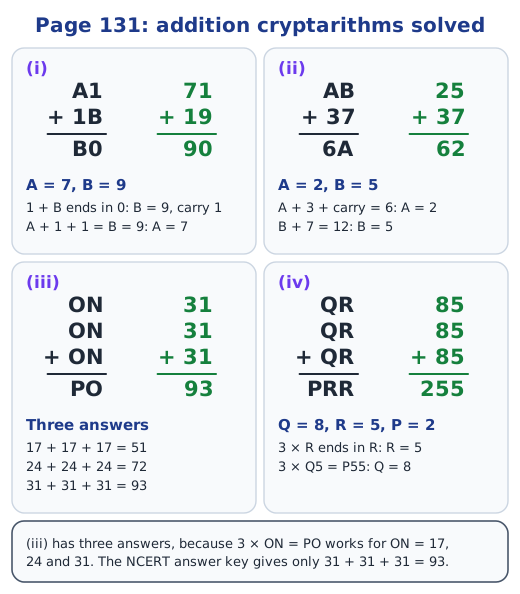
- (i) A1 + 1B = B0: 1 + B ends in 0, so B = 9 with a carry; then A + 1 + 1 = 9, so A = 7. 71 + 19 = 90.
- (ii) AB + 37 = 6A: the tens give A + 3 + 1 = 6, so A = 2; then B + 7 = 12, so B = 5. 25 + 37 = 62.
- (iii) ON + ON + ON = PO: three times ON is a 2-digit number whose last digit is O, the first digit of ON. There are three answers: 17 + 17 + 17 = 51, 24 + 24 + 24 = 72 and 31 + 31 + 31 = 93. The NCERT answer key gives only the last.
- (iv) QR + QR + QR = PRR: 3 × R ends in R, so R = 5 (R = 0 does not work); then 3 × Q5 = P55 gives 85 + 85 + 85 = 255 (Q = 8, R = 5, P = 2).
(v) Can PQ be 13 in PQ × 8 = RS? No: 13 × 8 = 104 has three digits, and so does every larger product. With 10 and 11 ruled out, 12 × 8 = 96 is the only answer.
(vi) Which option solves GH × H = 9K? 24 × 4 = 96. The multiplier must equal the units digit of the 2-digit number, which rules out 11 × 9, 12 × 8, 46 × 2, 47 × 2 and 31 × 3. 16 × 6 = 96 fails because K would be 6, the same digit as H.
(vii) What can you say about Y in BYE × 6 = RAY? Y is the units digit of 6 × E, so Y is even, and it is less than 7, so Y is 0, 2, 4 or 6. Trying them, only 105 × 6 = 630 fits, with B = 1, Y = 0, E = 5, R = 6 and A = 3.
Solve (i) to (vi).
- (i) UT × 3 = PUT: the answer ends in UT, so 2 × UT is a whole number of hundreds; UT = 50 gives 50 × 3 = 150.
- (ii) AB × 5 = BC: the product has 2 digits, so A = 1; then 5 × (10 + B) = 10B + C gives 5B + C = 50, so B = 9 and C = 5: 19 × 5 = 95.
- (iii) L2N × 2 = 2NP: the product starts with 2, so L = 1, and 2 × (120 + N) = 200 + 10N + P gives 8N + P = 40. Two answers: 124 × 2 = 248 and 125 × 2 = 250. The answer key gives only 125.
- (iv) XY × 4 = ZX: the product has 2 digits, so XY is at most 24, and X is even (it ends 4 × Y), so X = 2; 4 × Y ends in 2 and XY ≤ 24, so Y = 3: 23 × 4 = 92.
- (v) PP × QQ = PRP: PP × QQ = 121 × P × Q, which must be a 3-digit number starting and ending with P. Three answers: 22 × 11 = 242, 33 × 11 = 363 and 44 × 11 = 484. The answer key gives only the first.
- (vi) JK × 6 = KKK: KKK = 111 × K must be 6 times a 2-digit number ending in K. Only 74 × 6 = 444 works.
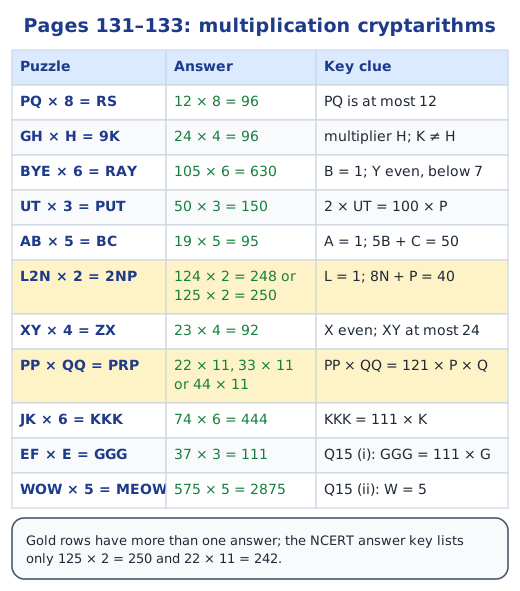
Figure it Out (pages 132–134)
1. The digit sum is 3 + 1 + z + 5 = 9 + z, which must be a multiple of 9. As z is a digit from 0 to 9, 9 + z can be 9 or 18, so z = 0 or z = 9: 3105 = 9 × 345 and 3195 = 9 × 355. There are two answers because adding 9 to a digit sum keeps it a multiple of 9.
2. The claim is false; it is only sometimes true. The numbers are 12n + 8 and 12m − 4, so their sum is 12(n + m) + 4 = 4(3(n + m) + 1). This is a multiple of 8 only when 3(n + m) + 1 is even. 8 + 8 = 16 works, but 20 + 8 = 28 is not a multiple of 8.
3. The multiples are 3a and 3b, and 3a + 3b = 3(a + b) is a multiple of 6 exactly when a + b is even. So the sum is a multiple of 6 when both numbers are even multiples of 3 (6 + 12 = 18) or both are odd multiples (9 + 15 = 24), and not when one is even and one odd (6 + 9 = 15). In general, two multiples of k add up to a multiple of 2k exactly when they are both even multiples or both odd multiples of k.
4. (i) True for every multiple of 9. Reversing the digits does not change the digit sum, so the digit sum stays a multiple of 9. For example, 1458 = 9 × 162 and 8541 = 9 × 949.
(ii) Yes, any shuffle. No rearrangement changes the digit sum, so any reordering of the digits of a multiple of 9 gives another multiple of 9, such as 4158.
5. 18 = 2 × 9 and 2 and 9 share no factor, so the number must be even and have a digit sum that is a multiple of 9. b is even, and the digit sum 17 + a + b (the known digits give 4 + 8 + 2 + 3 = 17) has to be 18 or 27, so a + b = 1 or 10. The pairs (a, b) are (1, 0), (2, 8), (4, 6), (6, 4) and (8, 2).
6. 44 = 4 × 11, and 4 and 11 share no factor. For 4, the last two digits q8 must be divisible by 4, so q is 0, 2, 4, 6 or 8. For 11, from the units: 8 − q + 7 − p + 3 = 18 − (p + q) must be 0 or a multiple of 11. p + q = 18 would need p = q = 9, but q is even; so p + q = 7. The pairs (p, q) are (7, 0), (5, 2), (3, 4) and (1, 6): 37708, 35728, 33748 and 31768, each divisible by 44.
7. Call the numbers n, n + 1, n + 2. We need n + 2 to be a multiple of 4 and n + 1 a multiple of 3, so n is 2 more than a multiple of 4 and 2 more than a multiple of 3, that is, 2 more than a multiple of 12 (n is then even, as needed). The first set is 2, 3, 4, then 14, 15, 16, 26, 27, 28, and so on: a new set every 12 numbers.
8. 36 = 4 × 9, and 4 and 9 share no factor, so look for numbers whose last two digits make a multiple of 4 and whose digit sum is a multiple of 9. 45000 = 36 × 1250 is one, so add 36 again and again: 45036, 45072, 45108, 45144, 45180. The digit rule also finds others directly, such as 45900, 46080, 46440 and 46800.
9. Consecutive even numbers differ by 2, so the five numbers are 5p − 4, 5p − 2, 5p, 5p + 2 and 5p + 4.
10. For example, 412335. Divisible by 15 means divisible by 3 and 5. It must end in 5, not 0, or its reverse would start with 0. Its reverse must be divisible by 6, so even, so the first digit must be even. Finally, the digit sum must be a multiple of 3 (it is the same for both numbers). 412335 has digit sum 18 and ends in 5, so 412335 = 15 × 27489; its reverse 533214 is even with digit sum 18, so 533214 = 6 × 88869.
11. The claim is false. A multiple of 11 is 11k, and doubling gives 22k = 11 × 2k, again a multiple of 11. Every multiple of 11 stays a multiple of 11 when doubled.
12. (i) Always true. 6a × 3b = 18ab = 9 × 2ab.
(ii) Always true. Three consecutive even numbers are 2n − 2, 2n and 2n + 2, and their sum is 6n.
(iii) Always true. Swapping the first two digits and the next two does not change the digit sum, so the number is still divisible by 3, and the last digit f is unchanged, so it is still even.
(iv) Never true. 8(7b − 3) − 4(11b + 1) = 56b − 24 − 44b − 4 = 12b − 28 = 12(b − 3) + 8, which always leaves remainder 8 on dividing by 12.
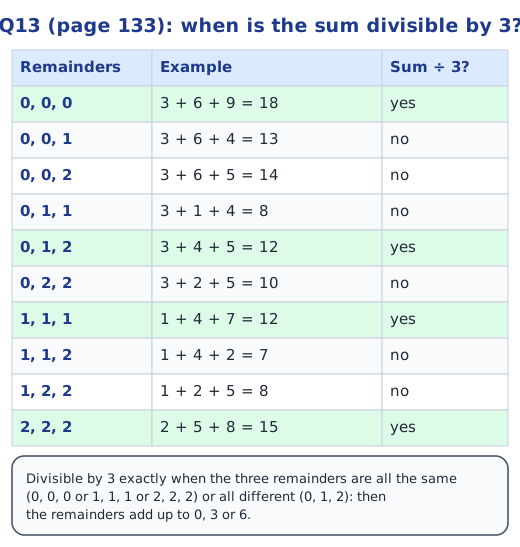
13. Look at the remainders of the three numbers on dividing by 3. The sum is divisible by 3 exactly when the three remainders are all the same (0, 0, 0 or 1, 1, 1 or 2, 2, 2) or all different (0, 1, 2), because then the remainders add up to 0, 3 or 6. In the other six cases the sum leaves remainder 1 or 2.
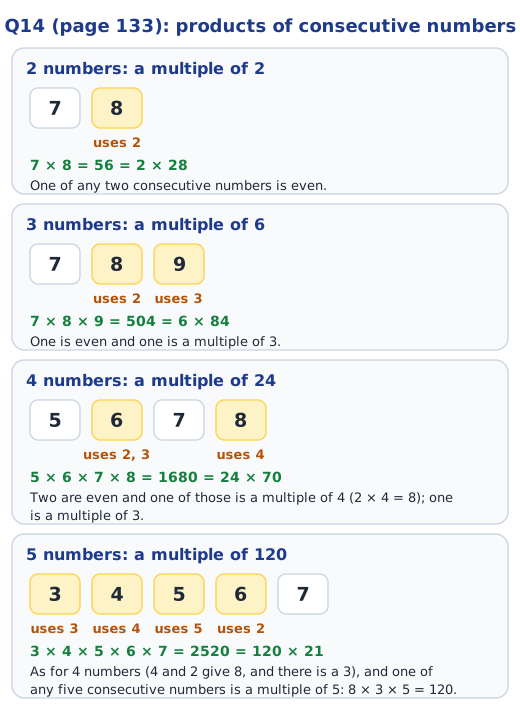
14. Two consecutive integers: always a multiple of 2, because one of them is even. Three: always a multiple of 6, because one is even and one is a multiple of 3. Four: always a multiple of 24, because two are even and one of those is a multiple of 4 (giving 2 × 4 = 8), and one is a multiple of 3. Five: always a multiple of 120, adding a multiple of 5 to the four-number reasons (8 × 3 × 5 = 120). For example, 5 × 6 × 7 × 8 = 1680 = 24 × 70 and 3 × 4 × 5 × 6 × 7 = 2520 = 120 × 21.
15. (i) GGG = 111 × G = 3 × 37 × G. The only way to write it as a 2-digit number EF times its own first digit E is 37 × 3 = 111 (E = 3, F = 7, G = 1).
(ii) WOW × 5 ends in W, so W is 0 or 5, and as a first digit W = 5. Then 5O5 × 5 is between 2525 and 2975, so M = 2. Trying each O, the product ends in OW only for O = 2 (2625) and O = 7 (2875); O = 2 fails because M is already 2. So 575 × 5 = 2875 (M = 2, E = 8, O = 7, W = 5).
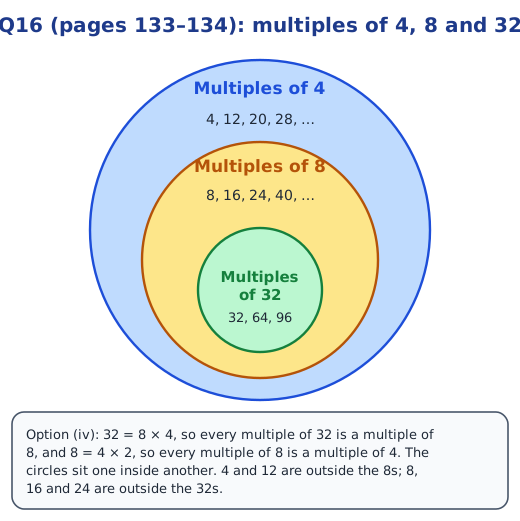
16. (iv). 32 = 8 × 4, so every multiple of 32 is a multiple of 8; and 8 = 4 × 2, so every multiple of 8 is a multiple of 4. The multiples of 32 sit inside the multiples of 8, which sit inside the multiples of 4.
Puzzle Time: Navakankari (page 135)
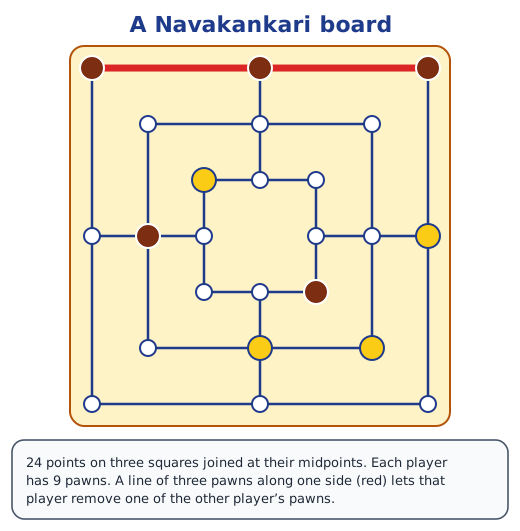
Navakankari is a board game for two players on 24 points: three squares, one inside another, joined at the middles of their sides. Each player first places 9 pawns, one at a time, and then moves them along the lines to neighbouring empty points. Three of your pawns in a straight line let you remove one of your opponent’s pawns that is not in a line of three. You win when your opponent has fewer than 3 pawns or cannot move. A useful habit: while placing pawns, block your opponent’s lines of two before building your own.
Practice
-
What is the remainder when 83507 is divided by 9?
Show answer
Answer: (a) 5
-
Which of these numbers is divisible by 44?
Show answer
Answer: (a) 5236
-
Two numbers leave remainders 4 and 5 on dividing by 6. Their sum leaves the remainder:
Show answer
Answer: (a) 3
-
7a52 is divisible by 9, where a is a digit. Find a.
Show answer
Answer: The digit sum 7 + a + 5 + 2 = 14 + a must be a multiple of 9. 14 + a = 18 gives a = 4 (27 would need a = 13). So a = 4, and 7452 = 9 × 828.
-
Find the smallest number that leaves remainder 1 on dividing by 2, 3, 4, 5 and 6, and is divisible by 7.
Show answer
Answer: One less than the number is a multiple of LCM(2, 3, 4, 5, 6) = 60, so try 61, 121, 181, 241, 301. The first that is divisible by 7 is 301 = 7 × 43.
Stuck on a question?
Take a photo and Lagnever AI explains it step by step. Try it for 7 days for ₹2.
Get it on Google Play Open in browser
For parents: after the trial, the plan renews monthly by UPI or card autopay. You can cancel anytime in the app.