
Class 8 Maths Chapter 5: Number Play Notes
This chapter in five lines
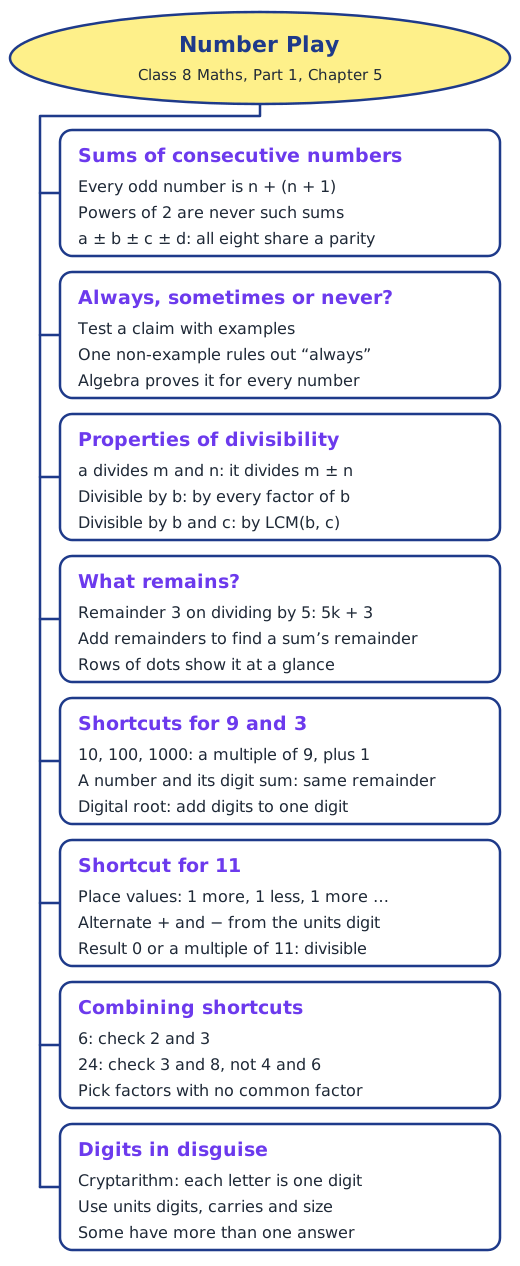
Number Play asks when a claim about numbers is always, sometimes or never true, and proves the answer with algebra and rows of dots. It covers parity, the rules that make sums and multiples divisible, and remainders written as 5k + 3. It explains why the shortcuts for 3, 9 and 11 work, adds digital roots, and ends with cryptarithms.
What is this chapter about?
This is the fifth chapter of Ganita Prakash, Grade 8 Part 1. It plays with numbers to find patterns, and then asks the important question: will the pattern always happen? To answer, it uses three tools together: examples, algebra with letter-numbers, and pictures made of rows of dots. The chapter has three parts: multiples and remainders, quick divisibility checks, and cryptarithms, which the book calls “digits in disguise”.
Sums of consecutive numbers and parity
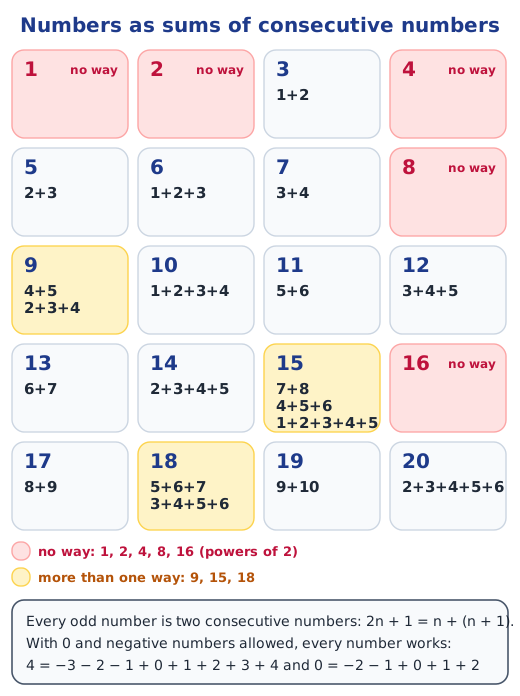
Some numbers are sums of consecutive numbers, such as 9 = 4 + 5 = 2 + 3 + 4. Every odd number is the sum of two: 2n + 1 = n + (n + 1). But 1, 2, 4, 8 and 16, the powers of 2, cannot be written this way with counting numbers. Allow 0 and negative numbers, and every number works.
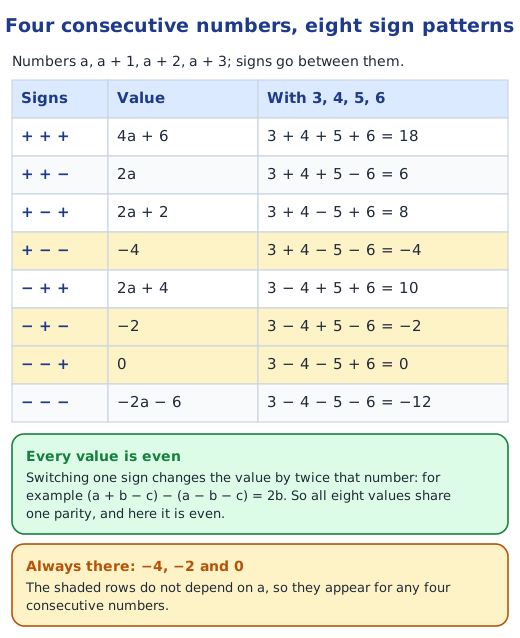
Now put + or − between four consecutive numbers, such as 3, 4, 5, 6. There are eight ways, and every result is even. In fact, for any four numbers the eight results share one parity (all even or all odd). Switching one sign changes the result by twice that number, which is even, so the parity never changes.
Always, sometimes or never?
The chapter checks claims such as “if 8 divides two numbers, it divides their sum”. A few examples can suggest an answer, and one non-example shows that a claim is not always true. To show that it is always true, write the numbers with letters: 8a + 8b = 8(a + b). The chapter collects these rules:
- When a divides both m and n, it also divides m + n and m − n.
- When a is divisible by b, so is every multiple of a, and a is also divisible by each factor of b.
- A number divisible by b and by c is a multiple of the LCM of b and c. Divisible by 9 and 4 means divisible by 36, but divisible by 6 and 4 only means divisible by 12.
Read properties of divisibility.
What remains?
Numbers that leave remainder 3 on dividing by 5 are 3, 8, 13, 18, … Each is 3 more than a multiple of 5, so they are all of the form 5k + 3. Remainders also add: 4779 leaves 5 and 661 leaves 3 on dividing by 7, so their sum leaves 5 + 3 = 8, which is one more 7 and remainder 1.
Shortcuts for 9 and 3
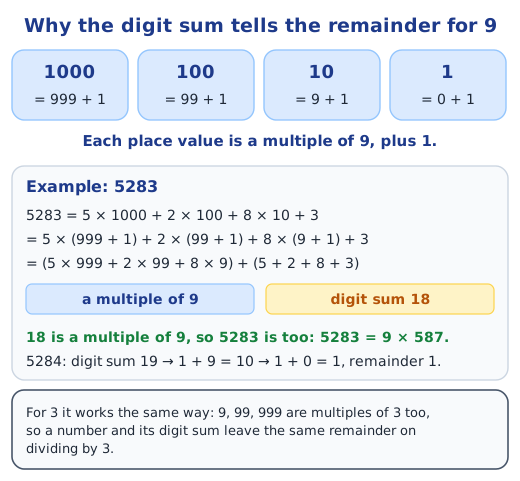
Every place value is a multiple of 9 plus 1: 10 = 9 + 1, 100 = 99 + 1, 1000 = 999 + 1. So any number is a multiple of 9 plus the sum of its digits. That is why a number is divisible by 9 exactly when its digit sum is, and the same idea works for 3. Read divisibility shortcuts.
The shortcut for 11
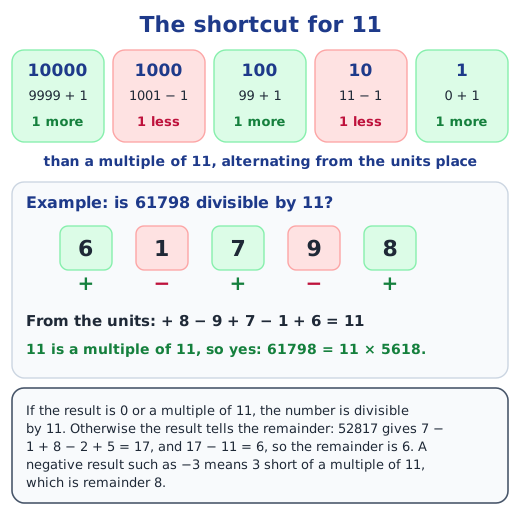
For 11, the place values sit alternately 1 above and 1 below a multiple of 11: 1 = 0 + 1, 10 = 11 − 1, 100 = 99 + 1, 1000 = 1001 − 1. So give the digits + and − signs in turn, starting with + at the units digit, and add up. If the result is 0 or a multiple of 11, the number is divisible by 11; otherwise the result gives the remainder.
Combining shortcuts and digital roots
To test 6, test 2 and 3. To test 24, testing 4 and 6 is not enough, because 36 passes both; test 3 and 8 instead, since LCM(3, 8) = 24. The digital root of a number is what you get by adding its digits again and again until one digit is left. It equals the remainder on dividing by 9, with 9 in place of 0. The chapter notes that Aryabhata II described this method in his Mahāsiddhānta (around 950 CE), and that it was used to check calculations.
Digits in disguise: cryptarithms
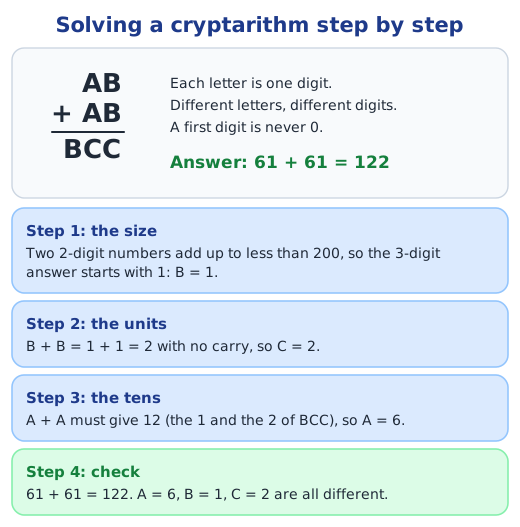
In a cryptarithm, letters stand for digits: each letter is one digit, different letters are different digits, and a first digit is never 0. The clues are the units digits, the carries and the sizes of the numbers. For example, in AB + AB = BCC the answer is below 200, so B = 1, and then 61 + 61 = 122. Read cryptarithms.
Puzzle Time: Navakankari
The chapter ends with Navakankari, a traditional Indian board game for two players, the same as the game known in the West as Nine Men’s Morris. Each player places 9 pawns and then moves them, trying to make lines of three.
Before we move on
This chapter builds on the divisibility rules of Class 6, parity, letter-numbers and the LCM of Class 7. More divisibility tricks come in Part 2, Chapter 6: Algebra Play. Answers to every question in this chapter and all four Figure it Out sets are in the NCERT solutions for Chapter 5.
Key terms
| Term | Meaning |
|---|---|
| Parity | Whether a number is even or odd. Even numbers have 2 as a factor; odd numbers leave remainder 1 on dividing by 2. |
| Consecutive numbers | Numbers that follow one another with no gaps, such as 7, 8, 9, 10. With letters: n, n + 1, n + 2, … |
| Divides (is divisible by) | a divides m when m ÷ a leaves no remainder, that is, when m is a multiple of a. |
| Remainder | What is left after making as many equal groups as possible. 23 ÷ 5 gives 4 groups and remainder 3. |
| Always, sometimes, never true | Labels for a claim: true for every number, true for some numbers only, or true for none. |
| Non-example | A case where a claim fails. One is enough to show that the claim is not always true. |
| LCM | Lowest common multiple: the smallest number that is a multiple of both numbers. LCM(4, 6) = 12. |
| Divisibility shortcut | A quick test, using only the digits, of whether a number is divisible by another number. |
| Digit sum | The sum of a number’s digits. A number and its digit sum leave the same remainder on dividing by 9, and by 3. |
| Digital root | The single digit left after adding the digits again and again. For 489: 4 + 8 + 9 = 21, then 2 + 1 = 3. |
| Alternating sum | The digits added and subtracted in turn, starting with + at the units digit. It gives the remainder on dividing by 11. |
| Cryptarithm | A sum or product in which letters stand for digits. Each letter is one digit, and a first digit is never 0. |
| Letter-number | A letter that stands for a number, such as k in 5k + 3. |
Topics in this chapter
Practice
-
Which of these numbers is divisible by 9?
Show answer
Answer: (b) 7362
-
Which of these numbers is divisible by 11?
Show answer
Answer: (a) 4851
-
What is the digital root of 58467?
Show answer
Answer: (a) 3
-
A number can be divided exactly by 6 and by 10. It must also be divisible by:
Show answer
Answer: (b) 30
-
Which expression gives all the numbers that leave remainder 2 on dividing by 7 (k = 0, 1, 2, …)?
Show answer
Answer: (b) 7k + 2
-
Four consecutive numbers add up to 50. The smallest of them is:
Show answer
Answer: (a) 11
Questions students ask
What are the main topics of Class 8 Maths Chapter 5?
Sums of consecutive numbers and parity, claims that are always, sometimes or never true, the properties of divisibility, remainders, the shortcuts for 3, 9 and 11 with the reasons behind them, combining shortcuts, digital roots and cryptarithms.
Is Number Play in the new NCERT Class 8 Maths book?
Yes. It is Chapter 5 of Ganita Prakash, Grade 8 Part 1, on pages 112 to 135 of the book marked Reprint 2026-27. It ends with a board game, Navakankari.
Why does the digit sum test for 9 work?
Every place value is a multiple of 9 plus 1: 10 = 9 + 1, 100 = 99 + 1, and so on. So a number is a multiple of 9 plus its digit sum, and both leave the same remainder on dividing by 9.
What is a digital root?
Add the digits of a number, then add the digits of the answer, until one digit is left. That digit is the remainder on dividing by 9, except that multiples of 9 have digital root 9.
Stuck on a question?
Take a photo and Lagnever AI explains it step by step. Try it for 7 days for ₹2.
Get it on Google Play Open in browser
For parents: after the trial, the plan renews monthly by UPI or card autopay. You can cancel anytime in the app.