
LCM: least common multiple
Answer in short
The LCM (lowest or least common multiple) of two or more numbers is the smallest number that is a multiple of each of them. List multiples until one is common, or use prime factorisation: multiply every prime that appears, each taken the most times it appears in any one number. For 72 and 120, the LCM is 360.
Stuck on a question? Take a photo and Lagnever AI explains it step by step. Try it for 7 days for ₹2. Get it on Google Play
Common multiples
A multiple of a number is that number times 1, 2, 3 and so on. A common multiple of two or more numbers is a multiple of each of them. Common multiples answer questions about things that must match up or happen together. Anshu makes torans by joining 6 cm strips and Guna by joining 8 cm strips. If their torans must be equally long, the length must be a multiple of 6 and also a multiple of 8.
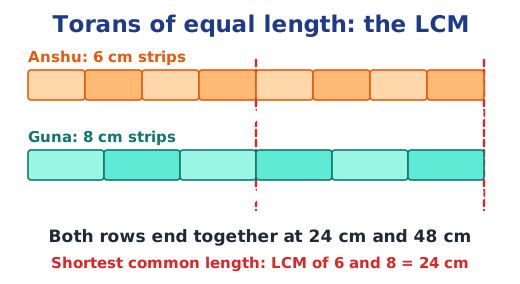
Multiples of 6: 6, 12, 18, 24, 30, 36, 42, 48 … Multiples of 8: 8, 16, 24, 32, 40, 48 … The common ones are 24, 48, 72 and so on, so the shortest toran they can both make is 24 cm.
The lowest common multiple
The LCM, the lowest (or least) common multiple, is the smallest of the common multiples. There is no highest common multiple: if 24 is common, so are 48, 72, 96 and every further multiple of 24.
Problems about events that repeat use the LCM. A sweet shop hands out gajak to schoolchildren every Monday, that is, every 7 days, and Kabamai, who got some today, comes back every 10 days. She gets gajak again only on a day that is a multiple of both 7 and 10, and the first such day is 70 days later. In the Idli-Vada game, the first number called “idli-vada” is the LCM of the two chosen numbers: 12 for 4 and 6, and 77 for 7 and 11.
Using prime factorisation
Listing multiples gets long for numbers such as 14 and 30. Prime factorisation is quicker. A multiple of a number always contains all of that number’s primes, plus perhaps more. So a common multiple must contain the full factorisation of every number, and the smallest one adds nothing extra:
- take every prime that appears in any of the numbers;
- take each of them the most times it appears in any one number.
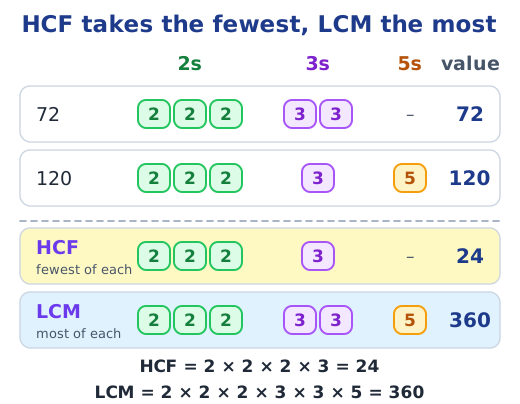
For 14 = 2 × 7 and 35 = 5 × 7, the LCM is 2 × 5 × 7 = 70: it contains 2 × 7 and 5 × 7, and removing any prime would lose one of them. For 72 = 2 × 2 × 2 × 3 × 3 and 120 = 2 × 2 × 2 × 3 × 5, take three 2s, two 3s and one 5: LCM = 360. For 96 = 2 × 2 × 2 × 2 × 2 × 3 and 360 = 2 × 2 × 2 × 3 × 3 × 5, take five 2s, two 3s and one 5: LCM = 1440. Using six 2s would still give a common multiple, but twice as big as needed.
Patterns that repeat
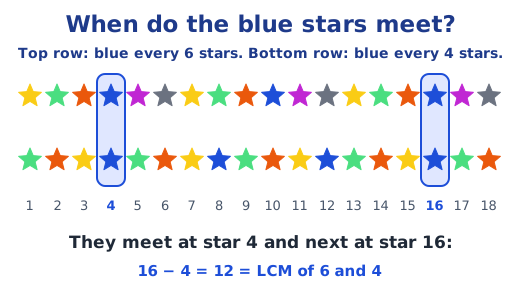
When two patterns repeat every 6 and every 4 places, matching places come round again every 12 places, the LCM of 6 and 4. The same thinking tells when two buses leaving every 20 and 30 minutes next leave together (after 60 minutes), or when two lights blinking every 8 and 12 seconds next blink together (after 24 seconds).
Shortcuts worth knowing
If one number is a multiple of the other, the LCM is the larger number: the LCM of 3 and 24 is 24. If two numbers share no prime, such as 8 and 9, the LCM is their product, 72. In every case, the LCM of two numbers is never more than their product, because the product itself is a common multiple.
Why it matters
The LCM tells us when repeating things line up again: bells, buses, festivals, gears and patterns. It also gives the smallest common denominator for adding fractions. Compare it with HCF: highest common factor, and see how the two are linked in relation between HCF and LCM. Answers to the textbook questions are in the NCERT solutions for Part 2 Chapter 3; see all of Part 2 Chapter 3 notes.
Practice
-
The first three common multiples of 4 and 6 are:
Show answer
Answer: (a) 12, 24, 36
-
The LCM of 2 × 2 × 3 and 2 × 3 × 3 is:
Show answer
Answer: (c) 36
-
Two lights blink together, then one blinks every 8 s and the other every 12 s. They next blink together after:
Show answer
Answer: (b) 24 s
-
Find the LCM of 18 and 30 using prime factorisation.
Show answer
Answer: 18 = 2 × 3 × 3 and 30 = 2 × 3 × 5. Every prime, each the most times it appears: 2 × 3 × 3 × 5 = 90.
-
Is there a largest common multiple of 6 and 8? Why?
Show answer
Answer: No. If a number is a common multiple, then 2 times it, 3 times it and so on are also common multiples, so the list never ends.
Questions students ask
What is the LCM?
The LCM of two or more numbers is the smallest number that is a multiple of all of them. The multiples of 6 are 6, 12, 18, 24 and so on, and of 8 are 8, 16, 24 and so on, so the LCM of 6 and 8 is 24.
Is it lowest common multiple or least common multiple?
Both mean the same number. The NCERT book says lowest common multiple, and many books say least common multiple: the smallest number that is a multiple of all the given numbers.
How do you find the LCM of three numbers?
Break each number into primes, take every prime that appears, each the most times it appears in any one of them, and multiply. For 4 = 2 × 2, 6 = 2 × 3 and 10 = 2 × 5, the LCM is 2 × 2 × 3 × 5 = 60.
Stuck on a question?
Take a photo and Lagnever AI explains it step by step. Try it for 7 days for ₹2.
Get it on Google Play Open in browser
For parents: after the trial, the plan renews monthly by UPI or card autopay. You can cancel anytime in the app.