
Class 7 Maths Part 2 Chapter 3: Finding Common Ground Notes
This chapter in five lines
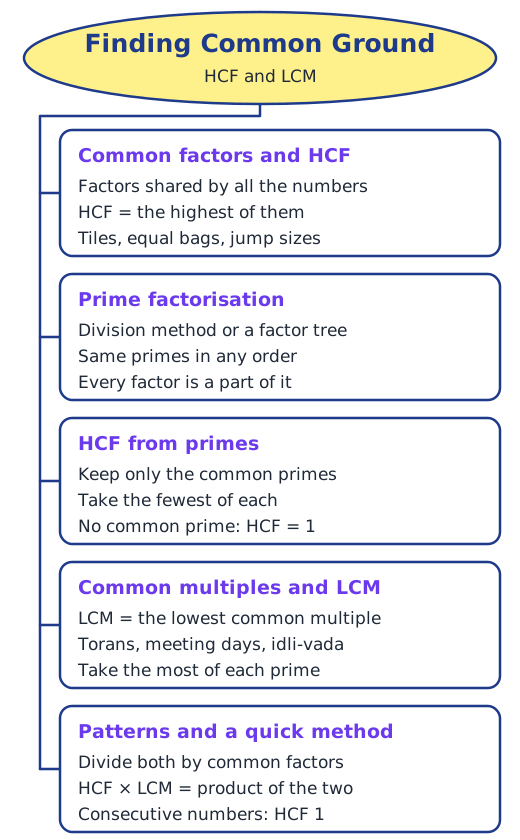
Finding Common Ground is about the HCF and the LCM. The HCF of some numbers is the highest of their common factors, and the LCM is the lowest of their common multiples. Both come easily from prime factorisations: the HCF keeps each common prime the fewest times it appears, and the LCM keeps every prime the most times it appears. For two numbers, HCF × LCM equals their product.
What is this chapter about?
Many everyday questions ask for something two numbers share. What is the biggest square tile that fits a room exactly? When will two events happen on the same day again? The first needs the highest common factor (HCF) and the second the lowest common multiple (LCM). In Class 6 you found them by listing; this chapter uses prime factorisation to find them quickly and reliably, and then looks for patterns and a short method.
Common factors and the HCF
Sameeksha wants to cover a 12 ft by 16 ft floor with equal square tiles, using as few as possible, with whole-foot sides. A tile side must divide both 12 and 16, so it must be a common factor: 1, 2 or 4. The biggest, 4 ft, needs the fewest tiles, just 3 × 4 = 12.
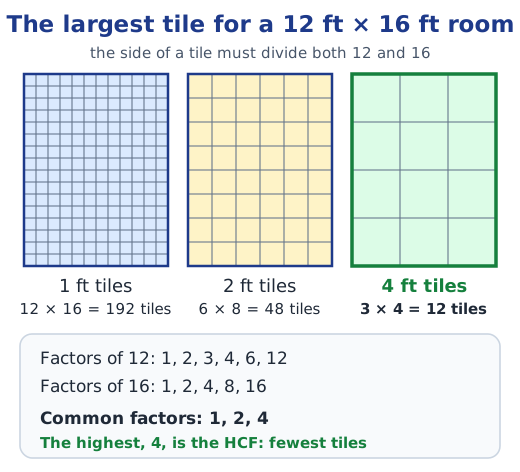
The HCF of two or more numbers is the highest of their common factors; it is also called the GCD (greatest common divisor). Packing 84 kg and 108 kg of rice into equal bags uses the fewest bags with 12 kg bags, since 12 is the HCF. In the Jump Jackpot game, the longest jump from 0 that lands on both treasures is also the HCF.
Prime factorisation
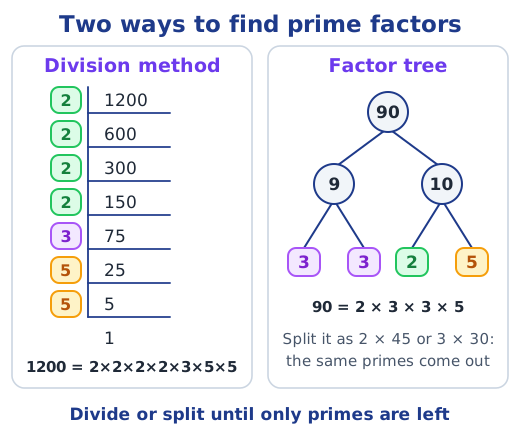
Listing factors is slow for big numbers and easy to get wrong. Instead, break each number into primes. The division method divides by one prime at a time, writing each quotient below, until 1 is left. A factor tree splits a number into any two factors and keeps splitting. Either way the primes are the same, only perhaps in a different order.
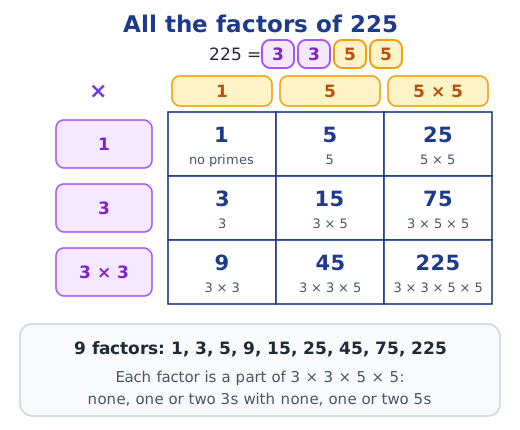
Every factor of a number is a part of its prime factorisation. Since 840 = 2 × 2 × 2 × 3 × 5 × 7, the part 2 × 2 × 7 = 28 is a factor, and the rest, 2 × 3 × 5 = 30, is what multiplies it to give 840. But 3 × 3 × 3 is not a factor, because 840 has only one 3. Taking every possible part lists all the factors.
Anshu guessed that a larger number always has a longer prime factorisation. Such a guess is a conjecture, and one counterexample disproves it: 96 = 2 × 2 × 2 × 2 × 2 × 3 has six primes, but the larger 121 = 11 × 11 has only two.
The HCF from prime factors
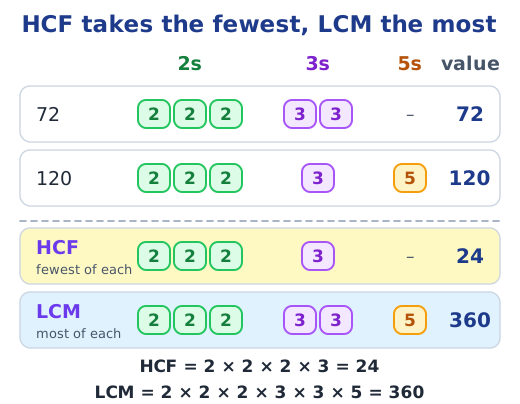
A common factor must be a part of every factorisation, so the HCF is the largest such shared part: take each common prime the fewest times it appears. For 30 = 2 × 3 × 5 and 72 = 2 × 2 × 2 × 3 × 3, the HCF is 2 × 3 = 6. If no prime is shared, as with 96 and 275, the HCF is 1. Read more in HCF: highest common factor.
Common multiples and the LCM
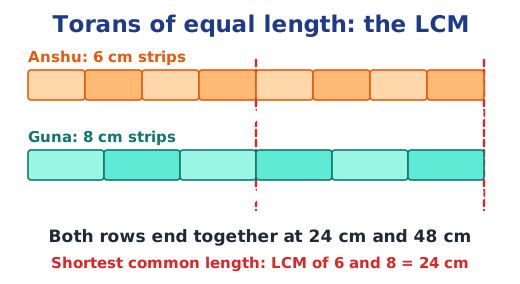
Anshu’s torans are made of 6 cm strips and Guna’s of 8 cm strips. Equal torans must have a length that is a common multiple of 6 and 8, such as 24 or 48 cm, and the shortest is 24 cm. There is no largest common multiple, since doubling one gives another. Similarly, if a shop hands out gajak every Monday and Kabamai visits every 10 days, she next gets some after the LCM of 7 and 10, which is 70 days.
A multiple of a number contains all of that number’s primes, so a common multiple contains every prime of each number. The LCM keeps every prime the most times it appears: for 96 = 2 × 2 × 2 × 2 × 2 × 3 and 360 = 2 × 2 × 2 × 3 × 3 × 5, the LCM is 2 × 2 × 2 × 2 × 2 × 3 × 3 × 5 = 1440. See LCM: least common multiple.
Patterns and a quick method
If one number is a factor of the other, such as 6 and 18, the smaller is the HCF and the larger is the LCM. Consecutive numbers and co-prime numbers have HCF 1. To get both answers at once, divide the two numbers by common primes (or any common factor) in a ladder until nothing more is shared.
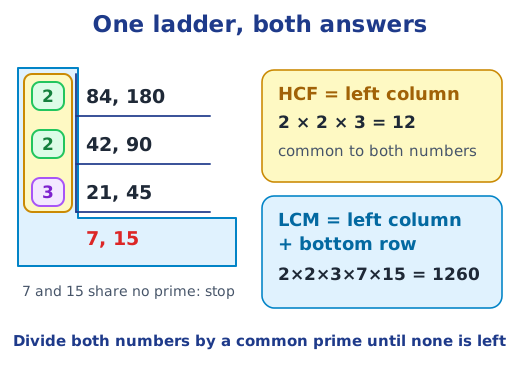
The divisors give the HCF, 2 × 2 × 3 = 12, and the divisors times the numbers left, 7 and 15, give the LCM, 1260. For two numbers, HCF × LCM = product of the numbers: 12 × 1260 = 15,120 = 84 × 180. Read relation between HCF and LCM. Answers to every question are in the NCERT solutions for Part 2 Chapter 3.
Key terms
| Term | Meaning |
|---|---|
| Factor | A number that divides another number exactly. 4 is a factor of 12. |
| Multiple | A number made by multiplying a number by 1, 2, 3 and so on. 24 is a multiple of 6 and also of 8. |
| Common factor | A number that is a factor of each of the given numbers. 1, 2 and 4 are the common factors of 12 and 16. |
| HCF (Highest Common Factor) | The highest of the common factors of two or more numbers. It is also called the GCD, the Greatest Common Divisor. |
| Common multiple | A number that is a multiple of each of the given numbers, such as 24 and 48 for 6 and 8. |
| LCM (Lowest Common Multiple) | The lowest of the common multiples of two or more numbers, also called the least common multiple. The LCM of 6 and 8 is 24. |
| Prime number | A number greater than 1 whose only factors are 1 and itself, such as 2, 3, 5, 7 and 11. |
| Prime factorisation | A number written as a product of primes, such as 90 = 2 × 3 × 3 × 5. The primes are always the same; only their order can change. |
| Co-prime numbers | Numbers whose only common factor is 1, such as 8 and 15. Their HCF is 1. |
| Conjecture | A claim made without proof. One counterexample, a case where it fails, is enough to disprove it. |
| Generalisation | A statement that holds in every case, such as: if one number is a factor of the other, it is their HCF. |
Topics in this chapter
Practice
-
The HCF of 18 and 24 is:
Show answer
Answer: (b) 6
-
The LCM of 4 and 10 is:
Show answer
Answer: (c) 20
-
Which is the prime factorisation of 60?
Show answer
Answer: (b) 2 × 2 × 3 × 5
-
Two numbers have HCF 4 and LCM 48. One of them is 12. The other is:
Show answer
Answer: (a) 16 HCF × LCM = product, so the other number = 4 × 48 ÷ 12 = 16.
-
The HCF of two consecutive numbers is always:
Show answer
Answer: (b) 1
-
Two bells ring every 6 minutes and every 9 minutes. They ring together at 9:00. When do they next ring together?
Show answer
Answer: (b) 9:18 The LCM of 6 and 9 is 18, so 18 minutes later.
Questions students ask
What are the main topics of Class 7 Maths Part 2 Chapter 3?
Common factors and the HCF; prime factorisation by the division method; finding all the factors of a number from its primes; the HCF from prime factorisations; common multiples and the LCM; general statements about the HCF and LCM; a quick common division method; and the rule HCF × LCM = product of two numbers.
Is Finding Common Ground in the new Ganita Prakash Part 2 book?
Yes. It is Chapter 3 of Ganita Prakash, the Class 7 Maths textbook Part 2 (2026-27), on pages 47 to 66.
How do you find the HCF and LCM using prime factorisation?
Write each number as a product of primes. For the HCF, multiply the primes common to all the numbers, each taken the fewest times it appears. For the LCM, multiply every prime that appears, each taken the most times it appears. For 72 and 120, the HCF is 24 and the LCM is 360.
Stuck on a question?
Take a photo and Lagnever AI explains it step by step. Try it for 7 days for ₹2.
Get it on Google Play Open in browser
For parents: after the trial, the plan renews monthly by UPI or card autopay. You can cancel anytime in the app.