
NCERT Solutions Class 7 Maths Part 2 Chapter 3: Finding Common Ground
Answers to every question in Part 2 Chapter 3, Finding Common Ground, of Ganita Prakash Grade 7 (2026-27): the in-text questions, every Figure it Out, Try This and Math Talk question, and the Mystery Colours puzzle. The page numbers match the book (pages 47–66). Short notes: Part 2 Chapter 3 notes.
The greatest of all (pages 47–48)
Why should Sameeksha use the largest of the possible tiles? A bigger tile covers more floor, so fewer tiles are needed. Tiles of 1 ft, 2 ft and 4 ft would need 192, 48 and 12 tiles.
How many 4 ft tiles should she buy? 12 ft ÷ 4 ft = 3 tiles across and 16 ft ÷ 4 ft = 4 tiles along, so 3 × 4 = 12 tiles.
Would the answer change if the side could be a fraction of a foot? No. The side must fit a whole number of times into 12 ft and into 16 ft. Sides such as 4/3 ft or 2/3 ft also fit, but they are smaller than 4 ft, so 4 ft is still the largest tile and 12 tiles are still the fewest.
Which bag weight should Lekhana choose for 84 kg and 108 kg of rice? The weight must be a common factor of 84 and 108 (1, 2, 3, 4, 6 or 12 kg). The heaviest bag gives the fewest bags, so she should use 12 kg bags: 84 ÷ 12 = 7 and 108 ÷ 12 = 9, so 16 bags in all.
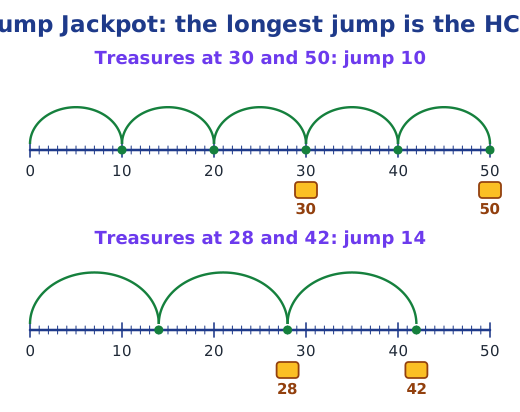
Jump Jackpot: the longest jump from 0 that lands on both treasures. (a) 14 and 30: 2. (b) 7 and 11: 1. (c) 30 and 50: 10. (d) 28 and 42: 14.
Is the longest jump the HCF? Why? Yes. Starting at 0, a jump size lands only on its own multiples, so it reaches both treasures only if it is a factor of both numbers, that is, a common factor. The longest such jump is the highest common factor.
Prime factorisation (pages 49–51)
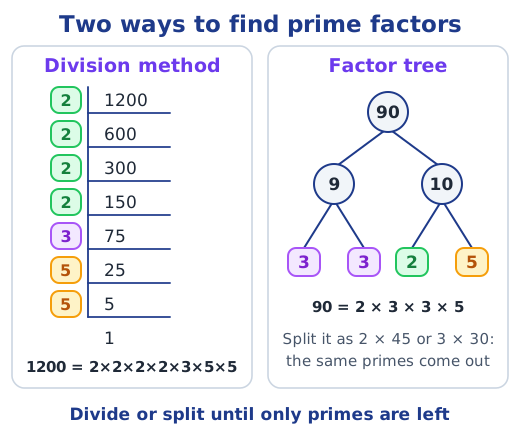
Does splitting 90 as 3 × 30 or 2 × 45 give the same primes? Yes. Every way of splitting 90 ends in 2 × 3 × 3 × 5; only the order can differ.
Write the prime factorisations of 105 and 30 from the two figures. 105 = 3 × 5 × 7 and 30 = 2 × 3 × 5.
Find the prime factorisation of 1200 by the division method. 1200 ÷ 2 = 600, ÷ 2 = 300, ÷ 2 = 150, ÷ 2 = 75, ÷ 3 = 25, ÷ 5 = 5, ÷ 5 = 1. So 1200 = 2 × 2 × 2 × 2 × 3 × 5 × 5.
Which way is easier? The division method. Each step divides by one small prime, so there is nothing to guess. Splitting 1200 as 40 × 30, then 5 × 8 × 5 × 6 and so on, means breaking several composite numbers at once, and it is easy to lose one.
840 = 2 × 2 × 2 × 3 × 5 × 7. Is 2 × 7 = 14 a factor? Yes, 2 × 7 is a part of the factorisation; the rest, 2 × 2 × 3 × 5 = 60, gives 14 × 60 = 840. Is 2 × 2 × 2 = 8 a factor? Yes, 840 has three 2s; 8 × 105 = 840. Is 3 × 3 × 3 = 27 a factor? No, 840 has only one 3, so 27 cannot be a part of it.
Check that every factor of 225 is in the list 1, 3, 5, 9, 15, 25, 45, 75, 225. The factor pairs of 225 are 1 × 225, 3 × 75, 5 × 45, 9 × 25 and 15 × 15, which give exactly these nine numbers.
Figure it Out (page 51)
List all the factors. (a) 90 = 2 × 3 × 3 × 5: 1, 2, 3, 5, 6, 9, 10, 15, 18, 30, 45, 90 (12 factors). (b) 105 = 3 × 5 × 7: 1, 3, 5, 7, 15, 21, 35, 105 (8 factors). (c) 132 = 2 × 2 × 3 × 11: 1, 2, 3, 4, 6, 11, 12, 22, 33, 44, 66, 132 (12 factors). (d) 360 = 2 × 2 × 2 × 3 × 3 × 5: 1, 2, 3, 4, 5, 6, 8, 9, 10, 12, 15, 18, 20, 24, 30, 36, 40, 45, 60, 72, 90, 120, 180, 360 (24 factors). (e) 840 = 2 × 2 × 2 × 3 × 5 × 7: 1, 2, 3, 4, 5, 6, 7, 8, 10, 12, 14, 15, 20, 21, 24, 28, 30, 35, 40, 42, 56, 60, 70, 84, 105, 120, 140, 168, 210, 280, 420, 840 (32 factors).
(Extra) The counts follow a pattern: add 1 to how many times each prime appears and multiply. For 360, (3 + 1) × (2 + 1) × (1 + 1) = 24.
Anshu says a larger number always has a longer prime factorisation. Is he right? No. His claim is a conjecture, and one counterexample disproves it: 96 = 2 × 2 × 2 × 2 × 2 × 3 has six primes, but the larger 121 = 11 × 11 has only two. Likewise 64 has six primes while the larger 97, a prime, has one.
The HCF from prime factors (pages 52–53)
Example 1: write down the parts common to 45 = 3 × 3 × 5 and 75 = 3 × 5 × 5. 3, 5 and 3 × 5 = 15. With 1, these are the common factors, and the HCF is 15.
Find the common factors and the HCF. (a) 50 = 2 × 5 × 5 and 60 = 2 × 2 × 3 × 5: common factors 1, 2, 5, 10; HCF = 10. (b) 140 = 2 × 2 × 5 × 7 and 275 = 5 × 5 × 11: common factors 1, 5; HCF = 5. (c) 77 = 7 × 11 and 725 = 5 × 5 × 29: no shared prime, so the only common factor is 1; HCF = 1. (d) 370 = 2 × 5 × 37 and 592 = 2 × 2 × 2 × 2 × 37: common factors 1, 2, 37, 74; HCF = 74. (e) 81 = 3 × 3 × 3 × 3 and 243 = 3 × 3 × 3 × 3 × 3: common factors 1, 3, 9, 27, 81; HCF = 81 (81 is a factor of 243).
Figure it Out (page 54)
1. Find the HCF. Keep the shared primes, each the fewest times it appears. (a) 24 = 2 × 2 × 2 × 3, 180 = 2 × 2 × 3 × 3 × 5: HCF = 2 × 2 × 3 = 12. (b) 42 = 2 × 3 × 7, 75 = 3 × 5 × 5, 24 = 2 × 2 × 2 × 3: only 3 is in all three, so HCF = 3. (c) 240 = 2 × 2 × 2 × 2 × 3 × 5, 378 = 2 × 3 × 3 × 3 × 7: HCF = 2 × 3 = 6. (d) 400 = 2 × 2 × 2 × 2 × 5 × 5, 2500 = 2 × 2 × 5 × 5 × 5 × 5: HCF = 2 × 2 × 5 × 5 = 100. (e) 300 = 2 × 2 × 3 × 5 × 5, 800 = 2 × 2 × 2 × 2 × 2 × 5 × 5: HCF = 2 × 2 × 5 × 5 = 100.
2. From 72 = 6 × 12 and 144 = 8 × 18, can we say 72 and 144 share no factor except 1? No. These are splits into composite numbers, not into primes, and composite pieces hide shared primes. In primes, 72 = 2 × 2 × 2 × 3 × 3 and 144 = 2 × 2 × 2 × 2 × 3 × 3, so they share 2 × 2 × 2 × 3 × 3 = 72. In fact 144 = 2 × 72, and their HCF is 72.
Least, but not last (pages 55–56)
What is the shortest toran both Anshu (6 cm strips) and Guna (8 cm strips) can make? The length must be a common multiple of 6 and 8; the common multiples are 24, 48, 72 and so on, so the shortest is 24 cm.
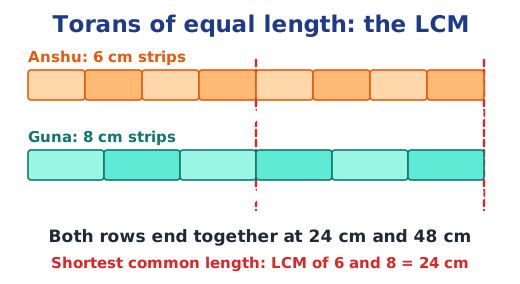
Is there a largest common multiple? No. If a number is a common multiple, then twice it, three times it and so on are common multiples too, so there is always a bigger one.
A sweet shop hands out gajak every Monday, and Kabamai, who got some today, visits every 10 days. When does she next get gajak? Mondays come every 7 days and her visits every 10 days, so she needs a common multiple of 7 and 10. The lowest is 70 days from today.
Idli-Vada: the first number called “idli-vada”. (a) 4 and 6: 12. (b) 7 and 11: 77. (c) 14 and 30: 210. (d) 15 and 55: 165.
Is it always the LCM? Explain. Yes. “Idli-vada” is called on numbers that are multiples of both, and counting upwards from 1, the first such number we reach is the lowest common multiple.
LCM through prime factorisation (pages 56–58)
Do the primes of every multiple contain the primes of the number? Yes. A multiple is the number times some whole number, so its prime factorisation is the number’s own primes together with the primes of that whole number.
Is 2 × 3 × 5 × 7 a common multiple of 14 = 2 × 7 and 35 = 5 × 7? Yes. It contains 2 × 7 and also 5 × 7: 210 = 14 × 15 = 35 × 6. But it is not the lowest; 2 × 5 × 7 = 70 is.
Why does choosing more than five 2s for 96 and 360 not give the lowest common multiple? Each extra 2 doubles the number. Five 2s already contain the 2s of both numbers, so a sixth 2 gives a common multiple twice as big as needed.
Figure it Out: find the LCM. Keep every prime, each the most times it appears. (a) 30 = 2 × 3 × 5, 72 = 2 × 2 × 2 × 3 × 3: LCM = 2 × 2 × 2 × 3 × 3 × 5 = 360. (b) 36 = 2 × 2 × 3 × 3, 54 = 2 × 3 × 3 × 3: LCM = 2 × 2 × 3 × 3 × 3 = 108. (c) 105 = 3 × 5 × 7, 195 = 3 × 5 × 13, 65 = 5 × 13: LCM = 3 × 5 × 7 × 13 = 1365. (d) 222 = 2 × 3 × 37, 370 = 2 × 5 × 37: LCM = 2 × 3 × 5 × 37 = 1110.
Patterns and properties (pages 58–60)
Find more pairs whose HCF is one of the two numbers, and describe them. Examples: 4 and 12, 5 and 35, 9 and 27, 7 and 7. In each pair, the smaller number is a factor of the larger, or, put the other way, the larger is a multiple of the smaller.
If m is one such number, what could the other be? If 7k is one, what could the other be? If m is the HCF, the other number is any multiple of m: 2m, 3m, 5m and so on. If the other number is the HCF, it is any factor of m. For 7k: any multiple of 7k, such as 14k or 21k, or any factor of 7k, such as 7 or k.
Figure it Out 1. General statements about the HCF. (a) Two consecutive even numbers: the HCF is 2. Both are even, and they are only 2 apart, so no number bigger than 2 can divide both (its multiples are more than 2 apart). Example: 14 and 16. (b) Two consecutive odd numbers: the HCF is 1. A common factor would have to divide their difference, 2, but odd numbers are not divisible by 2. Example: 15 and 17. (c) Two even numbers: the HCF is even, at least 2, since 2 is always shared. Example: 12 and 18 have HCF 6. (d) Two consecutive numbers: the HCF is 1. Multiples of any number bigger than 1 are more than 1 apart, so it cannot divide both. Example: 20 and 21. (e) Two co-prime numbers: the HCF is 1, because co-prime means they share no factor except 1.
2. The LCM of 3 and 24 is 24. (a) More such pairs: 4 and 20 (LCM 20), 5 and 15 (LCM 15), 6 and 36 (LCM 36), 9 and 9 (LCM 9). (b) The LCM is one of the two numbers when the larger number is a multiple of the smaller. In algebra: for n and kn, where k is a whole number, the LCM is kn (and the HCF is n).
3. General statements about the LCM. (a) Two multiples of 3: the LCM is a multiple of 3. Example: 6 and 9 have LCM 18. (b) Two consecutive even numbers: the LCM is half their product, because their HCF is 2. Example: 10 and 12 have LCM 60. (c) Two consecutive numbers: the LCM is their product, because their HCF is 1. Example: 8 and 9 have LCM 72. (d) Two co-prime numbers: the LCM is their product. Example: 4 and 9 have LCM 36.
Math Talk: what happens to the HCF if both numbers are doubled? It doubles. Each factorisation gets one more 2, and that 2 is shared, so the shared part gains a 2. Example: HCF(6, 8) = 2 and HCF(12, 16) = 4.
HCF of numbers that are multiples of the same number. (a) 18 × 10 and 18 × 15: 10 and 15 still share 5, so HCF = 18 × 5 = 90. (b) 10 × 38 and 10 × 21: 38 and 21 share nothing, so HCF = 10. (c) 5 × 13 and 5 × 20: 13 and 20 share nothing, so HCF = 5. (d) 12 × 16 and 12 × 20: 16 and 20 share 4, so HCF = 12 × 4 = 48.
When is the HCF the same as the common multiplier? In (b) and (c): when the other two multipliers are co-prime. If they share a factor, as 10 and 15 or 16 and 20 do, the HCF is bigger.
Efficient procedures (pages 60–62)
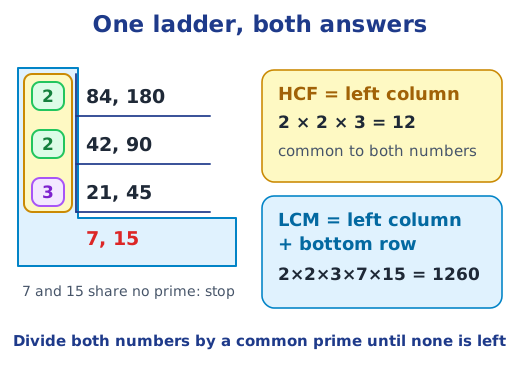
Explain the ladder for 84 and 180. Both numbers are divided by a prime they share, and the two quotients are written below: 2 gives 42 and 90, 2 again gives 21 and 45, and 3 gives 7 and 15. It stops because 7 and 15 share no prime.
How does it give the HCF of 84 and 180? Multiply the divisors on the left: 2 × 2 × 3 = 12. They are exactly the primes the two numbers share.
Find the HCF from the two ladders. 300 and 150: divisors 2, 5, 5 and 3 leave 2 and 1, so HCF = 2 × 5 × 5 × 3 = 150. 630 and 770: divisors 2, 5 and 7 leave 9 and 11, so HCF = 2 × 5 × 7 = 70.
How does it give the LCM? Multiply the divisors by the numbers left at the bottom. For 300 and 150: 2 × 5 × 5 × 3 × 2 × 1 = 300. For 630 and 770: 2 × 5 × 7 × 9 × 11 = 6930 (the book splits 9 further as 3 × 3, with the same result). For 84 and 180: 12 × 7 × 15 = 1260.
Why are these the LCMs? Each number equals the divisors times its own bottom number (300 = 150 × 2 and 150 = 150 × 1), so the product contains the full factorisation of both numbers. Since the bottom numbers share no prime, nothing can be removed, so it is the smallest such number.
Why do Guna’s and Anshu’s shortcuts work? Dividing by 50 = 2 × 5 × 5 at once is the same as dividing by 2, 5 and 5 one after another, and dividing by 10 is dividing by 2 and 5. Any common factor can be taken out in one step, as long as we keep going until the numbers left share nothing.
Try it. (a) 90 and 150: divide by 30 to get 3 and 5, so HCF = 30 and LCM = 30 × 3 × 5 = 450. (b) 84 and 132: divide by 12 to get 7 and 11, so HCF = 12 and LCM = 12 × 7 × 11 = 924.
Which is greater, the LCM of two numbers or their product? Why? The LCM is never greater. The product is itself a common multiple (it is a multiple of each number), and the LCM is the lowest common multiple, so LCM ≤ product. They are equal when the numbers share no factor except 1.
Is the LCM a factor of the product? By what is it multiplied? Yes, in each case, and the multiplier is the HCF. (a) 45 and 105: LCM = 315, product = 4725 = 315 × 15, and HCF = 15. (b) 275 and 352: LCM = 8800, product = 96,800 = 8800 × 11, and HCF = 11. (c) 222 and 370: LCM = 1110, product = 82,140 = 1110 × 74, and HCF = 74.
Why is HCF × LCM = product of the two numbers? Sort the primes into those shared by both numbers and those found in only one. The HCF is made of the shared primes. The LCM is made of the shared primes once more plus all the others. So HCF × LCM contains the shared primes twice and the others once, which is exactly what the product of the two numbers contains. In terms of counts: if a prime appears x times in one number and y times in the other, the HCF takes the smaller count and the LCM the larger, and together they make x + y.
Does it hold for three numbers? Not in general. For 2, 4 and 8: HCF = 2 and LCM = 8, so HCF × LCM = 16, but the product is 64. It can happen in special cases, such as 2, 3 and 5 (1 × 30 = 30), but it is not a rule.
Figure it Out (pages 63–64)
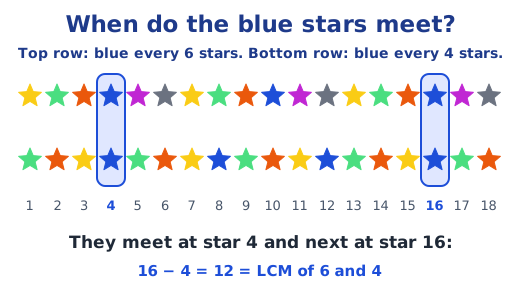
1. When will the blue stars meet next? In the top row the colours repeat every 6 stars, with blue at places 4, 10, 16, … In the bottom row they repeat every 4 stars, with blue at places 4, 8, 12, 16, … The blue stars meet at place 4, and next at place 16, 12 places later, because the LCM of 6 and 4 is 12. After that they meet every 12 stars: 28, 40 and so on.
2. (a) Is 5 × 7 × 11 × 11 a multiple of 5 × 7 × 7 × 11 × 2? No. A multiple must contain all the primes of 5 × 7 × 7 × 11 × 2, but 5 × 7 × 11 × 11 has no 2 and only one 7. (b) Is it a factor? No. A factor must be a part of 5 × 7 × 7 × 11 × 2, but 5 × 7 × 11 × 11 has two 11s and that number has only one.
3. HCF and LCM as prime factorisations. (a) 3 × 3 × 5 × 7 × 7 and 12 × 7 × 11 = 2 × 2 × 3 × 7 × 11: HCF = 3 × 7 (= 21); LCM = 2 × 2 × 3 × 3 × 5 × 7 × 7 × 11 (= 97,020). (b) 45 = 3 × 3 × 5 and 36 = 2 × 2 × 3 × 3: HCF = 3 × 3 (= 9); LCM = 2 × 2 × 3 × 3 × 5 (= 180).
4. Two numbers with HCF 1 and LCM 66. 66 = 2 × 3 × 11. Give its primes to the two numbers so that nothing is shared: 6 and 11 work, and so do 2 and 33, 3 and 22, and 1 and 66.
5. The cowherd’s cows (fewer than 200). Equal numbers went through 3, 5 and 7 gates, so the number of cows is a multiple of 3, 5 and 7, that is, a multiple of their LCM, 3 × 5 × 7 = 105. The only such number below 200 is 105 cows.
6. Which cubes fill a 12 cm × 18 cm × 36 cm box without gaps? The side must divide 12, 18 and 36, so it must be a common factor: 1, 2, 3 or 6 cm. So (b) 6 cm, (d) 3 cm and (e) 2 cm fit. 9 cm does not divide 12, and 4 cm does not divide 18.
7. The largest of the given numbers that divides both 306 and 36. 306 = 2 × 3 × 3 × 17 and 36 = 2 × 2 × 3 × 3, so the HCF is 2 × 3 × 3 = 18. Answer: (c) 18. (36 does not divide 306, and 612 and 360 are bigger than 36.)
8. The smallest number divisible by 3, 4, 5 and 7 that leaves remainder 10 when divided by 11. It must be a multiple of the LCM of 3, 4, 5 and 7, which is 420. Check the multiples: 420, 840, 1260 and 1680 leave remainders 2, 4, 6 and 8 when divided by 11, and 2100 leaves 10 (11 × 190 = 2090). Answer: 2100.
9. ‘Fire in the Mountain’: no one was out when 6 or 9 was called, but some were out when 10 was called. The number of children divides exactly into groups of 6 and of 9, so it is a multiple of the LCM of 6 and 9, which is 18, but not a multiple of 10. Of the choices, (a) 72 and (e) 36 fit. 90 is a multiple of 10, so nobody would have been out; 45 and 3 are not multiples of 6.
10. The LCM of two different primes m and n can be: The primes share nothing, so their LCM is m × n, which is bigger than both. Only (c) greater than both numbers is correct. It cannot be less than both or between them, and it is neither less than nor greater than m × n, since it equals m × n.
11. A dog chases a rabbit with a 150 ft head start; the dog jumps 9 ft each time the rabbit jumps 7 ft. In how many leaps does it catch up? Each leap the dog gains 9 − 7 = 2 ft, so it needs 150 ÷ 2 = 75 leaps. Check: the dog covers 75 × 9 = 675 ft and the rabbit is at 150 + 75 × 7 = 675 ft.
12. The smallest multiple of 1, 2, 3, 4, 5, 6, 8, 9 and 10. It needs three 2s (for 8), two 3s (for 9) and one 5: 2 × 2 × 2 × 3 × 3 × 5 = 360. This matches the Grade 6 answer for the numbers 1 to 10 without 7, in the Class 6 Prime Time solutions.
13. Mahaviracharya’s sum: 8/15 + 1/20 + 7/36 + 11/63 + 1/21. Use the LCM of the denominators as the common denominator. 15 = 3 × 5, 20 = 2 × 2 × 5, 36 = 2 × 2 × 3 × 3, 63 = 3 × 3 × 7 and 21 = 3 × 7, so the LCM is 2 × 2 × 3 × 3 × 5 × 7 = 1260. Then 8/15 = 672/1260, 1/20 = 63/1260, 7/36 = 245/1260, 11/63 = 220/1260 and 1/21 = 60/1260. The sum is (672 + 63 + 245 + 220 + 60)/1260 = 1260/1260 = 1.
Summary box and Mystery Colours (pages 65–66)
The largest prime known has 4,10,24,320 digits. How long would writing it take? That is 41,024,320 digits. At one digit a second without a break, it would take 41,024,320 seconds, about 475 days. Writing 8 hours a day, it would take about 1425 days, nearly 4 years. (Extra: it is a Mersenne prime, 1 less than 2 multiplied by itself 136,279,841 times.)
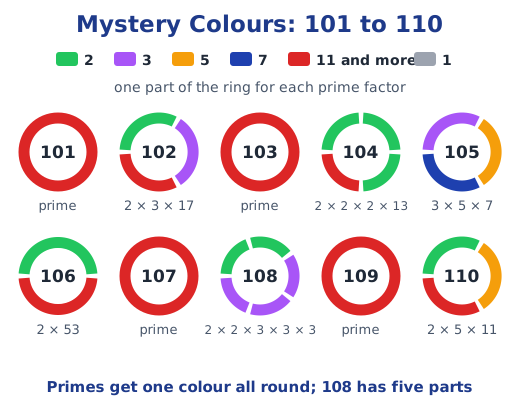
Decode the colour scheme of the rings around the page numbers. The ring around a number is cut into as many equal parts as it has prime factors, counting repeats, and each part has the colour of its prime: 2 green, 3 purple, 5 orange, 7 blue, and 11 or more red, with the prime written small beside a red part. The number 1, which has no prime factors, gets a grey ring, and every prime gets a full ring of one colour. Patterns: even numbers always have a green part, multiples of 3 a purple part, powers of 2 are all green, and the number of parts grows with the number of primes, not with the size of the number.
Colour the page numbers 101 to 110. 101, 103, 107 and 109 are primes: full red rings. 102 = 2 × 3 × 17: green, purple, red. 104 = 2 × 2 × 2 × 13: three green parts and one red. 105 = 3 × 5 × 7: purple, orange, blue. 106 = 2 × 53: green and red. 108 = 2 × 2 × 3 × 3 × 3: two green and three purple parts. 110 = 2 × 5 × 11: green, orange, red.
Practice
-
The HCF of 2 × 2 × 3 × 7 and 2 × 3 × 3 × 5 is:
Show answer
Answer: (b) 6 The shared primes are one 2 and one 3, so the HCF is 2 × 3 = 6.
-
The LCM of 9 and 12 is:
Show answer
Answer: (b) 36 9 = 3 × 3 and 12 = 2 × 2 × 3, so the LCM is 2 × 2 × 3 × 3 = 36.
-
Which pair has HCF 1?
Show answer
Answer: (b) 15 and 16
-
A floor is 18 ft by 24 ft. What is the fewest number of equal square tiles, with whole-foot sides, that cover it exactly?
Show answer
Answer: The largest tile side is the HCF of 18 and 24, which is 6 ft. The floor then needs 3 × 4 = 12 tiles.
-
Two buses leave a stop together. One leaves every 20 minutes and the other every 30 minutes. When do they next leave together?
Show answer
Answer: After the LCM of 20 and 30: 20 = 2 × 2 × 5 and 30 = 2 × 3 × 5, so the LCM is 2 × 2 × 3 × 5 = 60 minutes.
Stuck on a question?
Take a photo and Lagnever AI explains it step by step. Try it for 7 days for ₹2.
Get it on Google Play Open in browser
For parents: after the trial, the plan renews monthly by UPI or card autopay. You can cancel anytime in the app.