
Relation between HCF and LCM
Answer in short
For any two numbers, HCF × LCM = their product. The shared primes go into both the HCF and the LCM, and the other primes only into the LCM, so together they use every prime of both numbers once. For 24 and 36, 12 × 72 = 864 = 24 × 36. It is a rule for two numbers.
Stuck on a question? Take a photo and Lagnever AI explains it step by step. Try it for 7 days for ₹2. Get it on Google Play
The rule
Take any two numbers, find their HCF and LCM, and multiply the two answers. You always get the product of the numbers:
HCF × LCM = first number × second number
For 105 = 3 × 5 × 7 and 95 = 5 × 19, the LCM is 3 × 5 × 7 × 19 = 1995 and the HCF is 5; 1995 × 5 = 9975 = 105 × 95. For 45 and 105, the LCM is 315 and the HCF is 15, and 315 × 15 = 4725 = 45 × 105.
Why it works
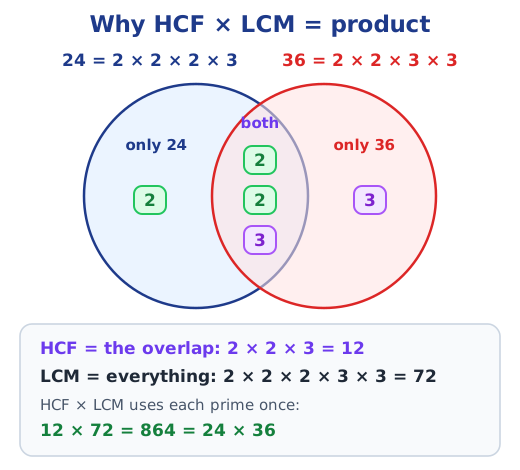
Put the primes of both numbers into two overlapping circles. The shared primes sit in the overlap and the rest sit outside it. The HCF is the overlap. The LCM is everything: the overlap once, plus the primes found only in one number. So the HCF and the LCM together contain the overlap twice and every other prime once, exactly what the two numbers contain together. For 24 = 2 × 2 × 2 × 3 and 36 = 2 × 2 × 3 × 3, the HCF is 2 × 2 × 3 = 12, the LCM is 2 × 2 × 2 × 3 × 3 = 72, and 12 × 72 = 864 = 24 × 36.
The rule gives two useful facts. The LCM is never more than the product, and it equals the product exactly when the HCF is 1. Also, if you know three of the four values, you can find the fourth: if two numbers have HCF 4 and LCM 48 and one of them is 12, the other is 4 × 48 ÷ 12 = 16.
The rule is about two numbers. For 2, 4 and 8 the HCF is 2 and the LCM is 8, but 2 × 8 = 16 is not 2 × 4 × 8 = 64.
Patterns
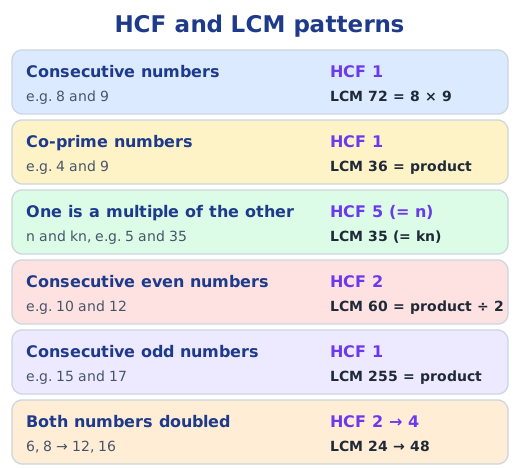
- One number a factor of the other (n and kn): the HCF is n and the LCM is kn. For 6 and 18, they are 6 and 18.
- Consecutive numbers such as 8 and 9: HCF 1 and LCM 72, their product.
- Consecutive even numbers such as 10 and 12: HCF 2, so the LCM is half the product, 60.
- Consecutive odd numbers such as 15 and 17: HCF 1, LCM 255.
- Both numbers doubled: the HCF and the LCM double too.
A quick ladder method
To find both at once, write the two numbers side by side and divide both by a common prime, writing the quotients below. Repeat until the two numbers left share no prime.
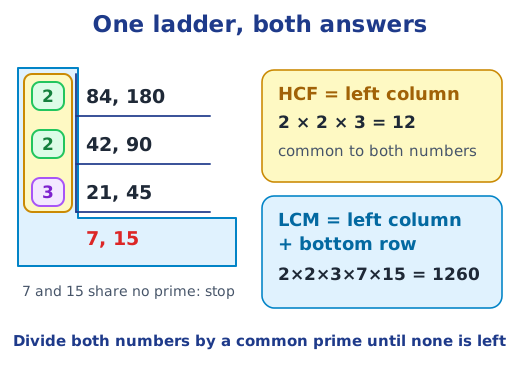
The divisors multiply to the HCF: for 84 and 180, 2 × 2 × 3 = 12. Multiplying the divisors by the numbers left at the bottom gives the LCM: 12 × 7 × 15 = 1260. This works because each number equals the HCF times its own leftover, and the leftovers share nothing, so nothing can be removed. You may divide by any common factor you spot, not just a prime: for 630 and 770, divide by 10 and then by 7 to reach 9 and 11, so the HCF is 70 and the LCM is 70 × 9 × 11 = 6930.
Why it matters
The rule checks answers quickly and finds a missing number. Learn each part in HCF: highest common factor and LCM: least common multiple. Answers to the textbook questions are in the NCERT solutions for Part 2 Chapter 3; see all of Part 2 Chapter 3 notes.
Practice
-
Two numbers have product 180 and HCF 6. Their LCM is:
Show answer
Answer: (a) 30
-
The HCF of 8 and 9 is 1. Their LCM is:
Show answer
Answer: (c) 72
-
The HCF of two numbers is 7. Which of these can be their LCM?
Show answer
Answer: (b) 35
-
Use the ladder method to find the HCF and LCM of 90 and 150.
Show answer
Answer: Divide both by 30 to get 3 and 5, which share no prime. HCF = 30 and LCM = 30 × 3 × 5 = 450. Check: 30 × 450 = 13,500 = 90 × 150.
-
Why can the LCM of two numbers never be more than their product?
Show answer
Answer: The product is itself a common multiple of the two numbers, and the LCM is the lowest common multiple, so it cannot be bigger than the product.
Questions students ask
What is the relation between HCF and LCM?
For any two numbers, the HCF multiplied by the LCM equals the product of the two numbers. For 12 and 18, the HCF is 6 and the LCM is 36, and 6 × 36 = 216 = 12 × 18.
Does HCF × LCM = product work for three numbers?
Not in general. For 2, 4 and 8, the HCF is 2 and the LCM is 8, so HCF × LCM = 16, while the product is 64. The rule is for two numbers.
What happens to the HCF and LCM if both numbers are doubled?
Both double. Doubling adds one more 2 to each prime factorisation, so the shared part (the HCF) and the full part (the LCM) each gain a 2. For 6 and 8, the HCF goes from 2 to 4 and the LCM from 24 to 48.
Stuck on a question?
Take a photo and Lagnever AI explains it step by step. Try it for 7 days for ₹2.
Get it on Google Play Open in browser
For parents: after the trial, the plan renews monthly by UPI or card autopay. You can cancel anytime in the app.