
Parity: odd and even numbers
Answer in short
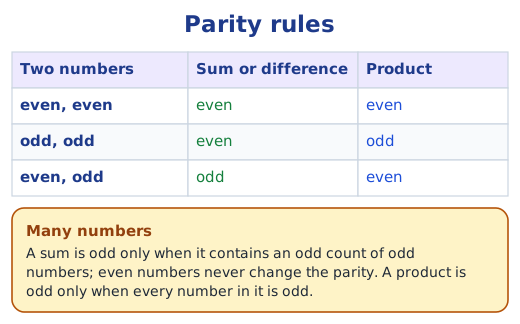
Parity means whether a number is odd or even. Even numbers form pairs with nothing left over, while odd numbers leave one over. Adding two even or two odd numbers gives an even sum; adding an even and an odd number gives an odd sum. A product is odd only when all its factors are odd.
Stuck on a question? Take a photo and Lagnever AI explains it step by step. Try it for 7 days for ₹2. Get it on Google Play
What is parity?
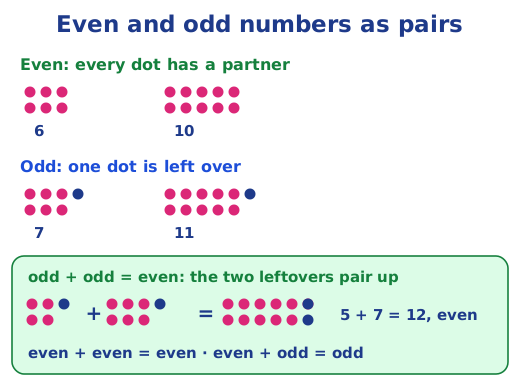
Think of a number as a set of dots. If the dots can all be put into pairs, with none left alone, the number is even: 6 makes 3 pairs and 10 makes 5. If one dot is always left without a partner, the number is odd, like 7 or 11. So an odd number is a set of pairs plus one extra dot, or, looked at the other way, a set of pairs with one dot missing. Whether a number is odd or even is called its parity.
Adding even and odd numbers
The dot pictures act as proofs. Put two even numbers together and every dot still has a partner, so even + even = even, however many even numbers we add. Put two odd numbers together and the two leftover dots pair up with each other, so odd + odd = even. An even number and an odd number together keep exactly one leftover, so even + odd = odd. For longer sums, only the odd numbers matter: with 4 or 6 odd numbers the leftovers all pair up and the sum is even, while with 3 or 5 odd numbers one dot is left over and the sum is odd.
Puzzles that parity solves
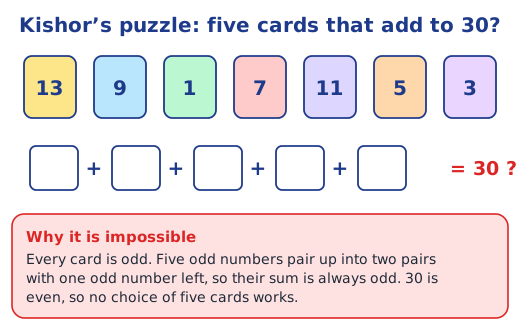
Kishor must choose five number cards that add up to 30, but every card he has is odd: 13, 9, 1, 7, 11, 5 or 3. Checking every choice would take ages, yet parity settles it at once. Five odd numbers make an odd sum, and 30 is even, so the puzzle has no answer.
Martin and Maria’s birthdays are exactly a year apart. Can their ages add up to 112? Counting numbers take turns, odd, even, odd, even, so two consecutive numbers are always one odd and one even, and their sum is odd: 51 + 52 = 103. Since 112 is even, it is impossible.
Differences and products
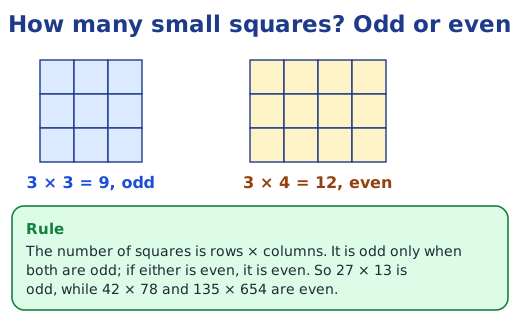
Subtraction follows the same pattern as addition: even − even and odd − odd are even, while even − odd and odd − even are odd. Products behave differently. Think of a grid of small squares with some number of rows and columns. A 3 × 3 grid has 9 squares, odd, but a 3 × 4 grid has 12, even. If either side is even, the grid can be cut into pairs of squares, so the product is even. The product is odd only when both sides are odd. So 27 × 13 is odd, while 42 × 78 and 135 × 654 are even, all without multiplying.
Parity of expressions
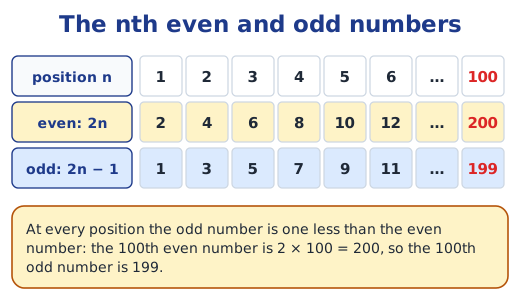
An algebraic expression can have a fixed parity or a changing one. 3n + 4 is odd when n = 3 (13) but even when n = 8 (28). Expressions such as 100p, 2n or 48w − 2 are always even, because 2 divides every value; 2n + 1 and 4n + 3 are always odd. To list every even number we use 2n, for n = 1, 2, 3, …, and to list every odd number we use 2n − 1. The 100th even number is 200, and since each odd number is one less than the even number in the same position, the 100th odd number is 199.
Why it matters
Parity is one of the quickest tools in mathematics for proving that something is impossible. It also helps with magic squares and with the pattern of odd and even Virahanka–Fibonacci numbers. Answers to every question are in the NCERT solutions for Chapter 6; see also the full Chapter 6 notes.
Practice
-
What is the parity of 27 × 13?
Show answer
Answer: (b) Odd
-
Which expression is always even, whatever whole number w is?
Show answer
Answer: (c) 48w − 2
-
Lakpa’s piggy bank holds an odd count of ₹1 coins and of ₹5 coins, and an even count of ₹10 coins. What can you say about the total?
Show answer
Answer: (b) It is even
-
A light bulb is ON and its switch is toggled 77 times. Is it on or off?
Show answer
Answer: Off. Each toggle changes the state, so after any even number of toggles the bulb is on again. After 76 toggles it is on, and the 77th turns it off.
-
Can the ages of two people born exactly a year apart add up to 112?
Show answer
Answer: No. Their ages are consecutive numbers, one odd and one even, so the sum is always odd, but 112 is even.
Questions students ask
What is parity in maths?
Parity is the property of a number being odd or even. For example, the parity of 14 is even and the parity of 9 is odd. We also speak of the parity of sums and products, such as ‘the sum of two consecutive numbers has odd parity’.
How can you tell if a sum is odd or even without adding?
Count the odd numbers in it. Even numbers never change the parity of a sum. If the count of odd numbers is even, the sum is even; if the count is odd, the sum is odd. So 7 + 4 + 9 + 2 has two odd numbers and an even sum, 22.
What is the formula for the nth odd number?
2n − 1. The nth even number is 2n, and at every position the odd number is one less: the 4th even number is 8 and the 4th odd number is 7. So the 100th odd number is 2 × 100 − 1 = 199.
Stuck on a question?
Take a photo and Lagnever AI explains it step by step. Try it for 7 days for ₹2.
Get it on Google Play Open in browser
For parents: after the trial, the plan renews monthly by UPI or card autopay. You can cancel anytime in the app.