
NCERT Solutions Class 7 Maths Chapter 6: Number Play
Answers to every question in Chapter 6, Number Play, of Ganita Prakash, the Class 7 Maths textbook Part 1 (Reprint 2026-27): the questions in the text, the grid and magic square puzzles, the rhythm and cryptarithm questions and all five Figure it Out sets. Page numbers follow the book (pages 127–145). Where the book asks you to try something yourself, one possible answer is given. Short notes: Chapter 6 notes.
Numbers Tell us Things (pages 127–128)
What do the numbers tell us? What could they mean? Each child calls out how many children standing in front of them are taller than them. In the pictures the front of the line is on the left. In the first line the calls are 0, 1, 0, 2, 2, 2, 1, and after the children rearrange themselves they are 0, 0, 1, 2, 2, 5, 6; in both lines every call fits this rule.
The number each child should say in the third line: from left to right, 0, 0, 1, 0, 3, 0, 3. Writing heights from 1 (shortest) to 7 (tallest), the line is 1, 5, 3, 6, 2, 7, 4: for example, the fifth child (height 2) has the children of heights 5, 3 and 6 in front who are taller, so says 3.
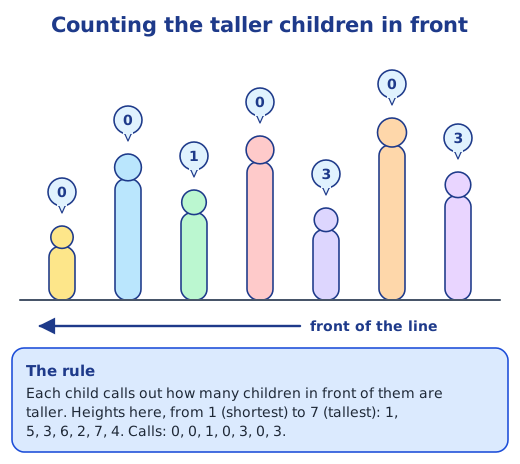
Figure it Out (page 128)
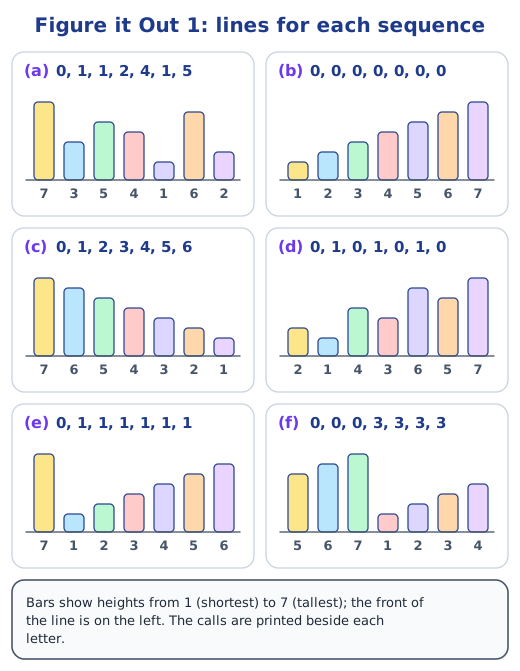
1. Height arrangements (heights from 1, shortest, to 7, tallest, front of the line first):
- (a) 0, 1, 1, 2, 4, 1, 5: 7, 3, 5, 4, 1, 6, 2.
- (b) 0, 0, 0, 0, 0, 0, 0: 1, 2, 3, 4, 5, 6, 7, shortest in front, each child taller than everyone ahead.
- (c) 0, 1, 2, 3, 4, 5, 6: 7, 6, 5, 4, 3, 2, 1, tallest in front.
- (d) 0, 1, 0, 1, 0, 1, 0: 2, 1, 4, 3, 6, 5, 7.
- (e) 0, 1, 1, 1, 1, 1, 1: 7, 1, 2, 3, 4, 5, 6, the tallest first, then from shortest upwards.
- (f) 0, 0, 0, 3, 3, 3, 3: 5, 6, 7, 1, 2, 3, 4.
With seven different heights, each of these lines is the only one that works.
2. Always, sometimes or never true?
- (a) Only sometimes true. The first child always says 0 without having to be the tallest, and anyone taller than all the children ahead says 0.
- (b) Always true. Nobody is taller than the tallest, so the tallest child counts 0.
- (c) Always true. No one stands in front of the first child.
- (d) Only sometimes true. A child in the middle says 0 whenever they are taller than everyone ahead, as in line (b).
- (e) Only sometimes true. In the line 1, 3, 2 (heights), the child of height 2 calls the largest number, 1, but the shortest child, standing first, says 0.
- (f) 7. The shortest person standing last has all 7 others in front, all taller.
Picking Parity (pages 129–131)
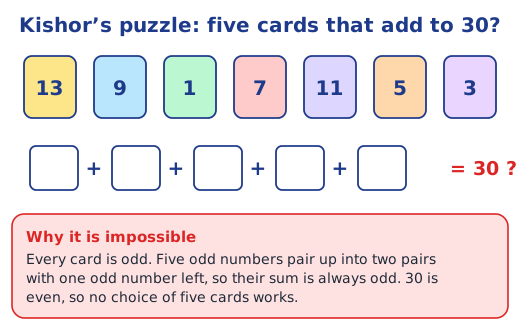
Kishor’s cards. It is not possible. Every card (13, 9, 1, 7, 11, 5, 3) is odd. Five odd numbers make two pairs of odd numbers, each pair adding to an even number, plus one odd number left, so the total is odd; 30 is even. No checking of cases is needed.
Adding even numbers: the sum is always even, however many even numbers are added, because all the pairs stay pairs.
Adding odd numbers: it depends on how many. Each odd number brings one leftover dot. With an even count of odd numbers the leftovers pair up and the sum is even; with an odd count one dot stays alone and the sum is odd.
Can an odd number be one less than a collection of pairs? Yes. For example, 9 is 5 pairs (10 dots) with one dot missing.
Sums of 4, 5 and 6 odd numbers: (a) even, (b) odd, (c) even.
Martin and Maria. Not possible. Their ages are consecutive numbers, and of any two consecutive numbers one is odd and the other even, so their sum is odd (51 + 52 = 103, 55 + 56 = 111, 56 + 57 = 113). 112 is even.
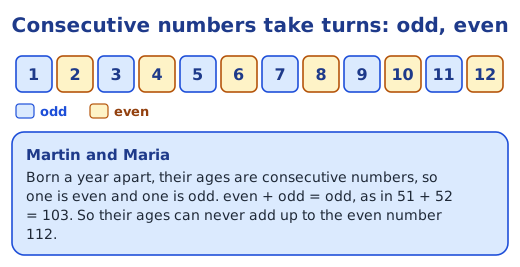
Figure it Out (page 131)
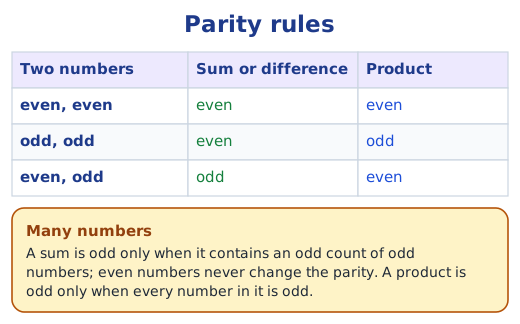
1. Parity of the sums: (a) 2 even + 2 odd: even; (b) 2 odd + 3 even: even; (c) 5 even: even; (d) 8 odd: even. In each case the odd numbers come in an even count.
2. Lakpa’s coins. Yes, he made a mistake. An odd number of ₹1 coins makes an odd amount; an odd number of ₹5 coins makes an odd amount too, since odd × odd = odd; and any number of ₹10 coins makes an even amount. Odd + odd + even is even, so the total can never be ₹205, an odd amount.
3. Parity of differences: (d) even − even = even; (e) odd − odd = even; (f) even − odd = odd; (g) odd − even = odd.
Small Squares in Grids (pages 131–132)
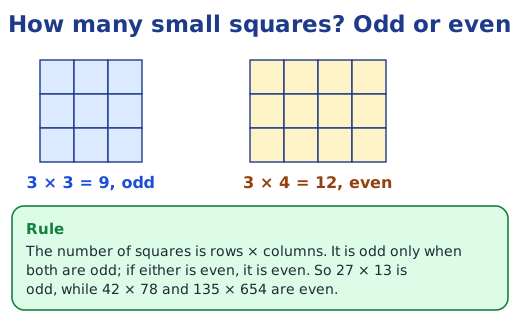
Telling the parity without multiplying. The number of small squares is rows × columns. If either the rows or the columns are even, the grid splits into pairs of squares and the total is even. Only when both are odd is the total odd.
- (a) 27 × 13: both odd, so odd (351).
- (b) 42 × 78: even.
- (c) 135 × 654: 654 is even, so even.
Parity of Expressions (pages 132–133)
Expressions that are always even: 2n, 6k + 4, 10m − 2, 100p, 48w − 2; each value has 2 as a factor.
Expressions that are always odd: 2n + 1, 4n + 3, 10m + 5, 6k − 1; each is an even number plus or minus an odd number.
Expressions that can be either: n + 5, 5n + 2, 7n + 1, like 3n + 4; their parity changes with n (for n + 5: n = 1 gives 6, n = 2 gives 7).
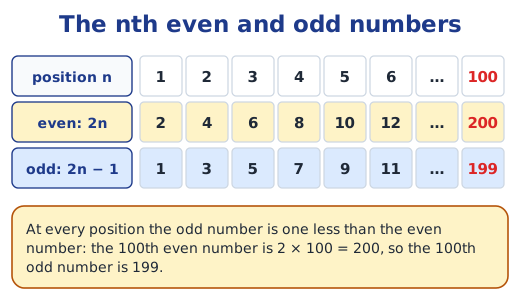
All even numbers: the expression 2n lists 2, 4, 6, 8, … for n = 1, 2, 3, …, and this is also the nth term of the multiples of 2. All odd numbers: 2n − 1 lists 1, 3, 5, 7, …
The 100th even number is 2 × 100 = 200, so the odd number in 100th place is one less, 199, and the nth odd number is 2n − 1.
Some Explorations in Grids (pages 133–134)
What do the circled numbers represent? The sums of the rows (on the right) and of the columns (below).
Filling the grids.
- Grid with 9 in the top-left and 5 in the bottom-right (rows 13, 14, 18; columns 24, 9, 12): 9 1 3, 8 2 4, 7 6 5. This is the only answer.
- Grid with 4 in the middle-left and 3 in the bottom-right (rows 24, 15, 6; columns 12, 16, 17): 7 8 9, 4 6 5, 1 2 3, or 7 9 8, 4 5 6, 1 2 3.
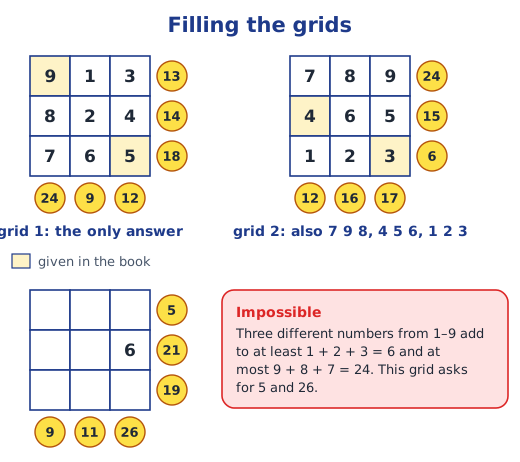
Make your own question. For example, fill 1 8 3, 9 4 6, 2 7 5 in secret and give a friend only the row sums 12, 19, 14, the column sums 12, 19, 14 and two numbers as clues.
Why is the third grid impossible? Three different numbers from 1 to 9 add to at least 1 + 2 + 3 = 6 and at most 9 + 8 + 7 = 24, but this grid needs a row sum of 5 and a column sum of 26.
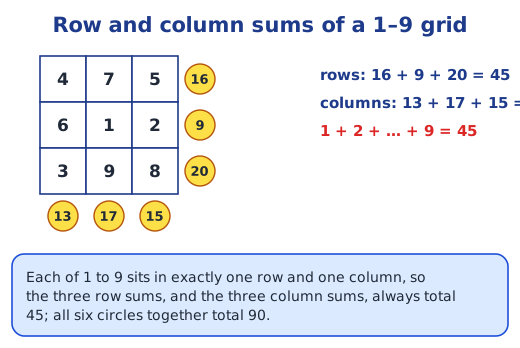
Kishor’s 90 and Vidya’s 45. In every grid above, the row sums total 45, the column sums total 45, and all six circles total 90. The row sums together count every number from 1 to 9 once, so they always add to 1 + 2 + … + 9 = 45; the same is true of the column sums.
Magic Squares (pages 134–136)
1. What can the magic sum be? Only 15: the three equal row sums must total 45, so each is 45 ÷ 3.
2. Which numbers cannot be at the centre? The centre is on a line with each of the other eight cells. With 8 in the centre, 9 shares a line with it and 8 + 9 = 17 > 15. With 7, the line with 9 needs 7 + 9 + (−1). With 6, the line with 9 needs a 0. With 2, the line with 1 needs 12; with 3, it needs 11; with 4, it needs 10. So 1, 2, 3, 4, 6, 7, 8 and 9 cannot be at the centre; only 5 can.
Can 1 be in a corner? No. A corner lies on three lines (a row, a column and a diagonal), so 1 would need three different pairs adding to 14, but only 5 + 9 and 6 + 8 exist. Can 9 be in a corner? No: it would need three pairs adding to 6, and only 1 + 5 and 2 + 4 exist.
Other positions for 1 and 9: they sit in the middles of two opposite edges, in one line with 5: 1 on the left and 9 on the right, or the other way round, or 1 at the top and 9 at the bottom, or the other way round.
Completing it. With 1 5 9 across the middle, the column through 1 needs two numbers adding to 14 (6 and 8), the column through 9 needs two adding to 6 (2 and 4), and each diagonal through 5 needs a pair adding to 10. One result: 8 3 4, 1 5 9, 6 7 2.
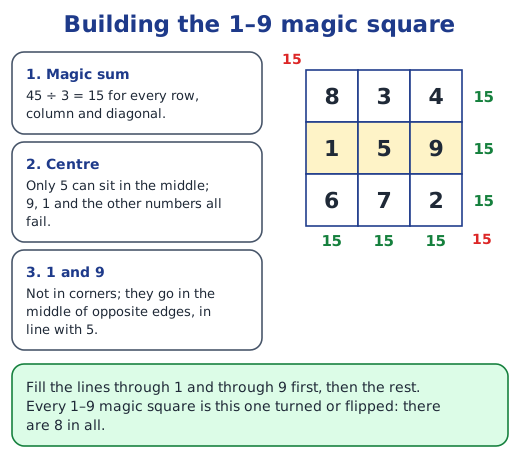
Figure it Out (page 136)
1. 8 magic squares can be made with 1 to 9, but they are all one square (such as 8 1 6, 3 5 7, 4 9 2) turned through quarter turns or flipped, so there is essentially only one.
2. Using 2 to 10. Add 1 to every number of a 1–9 magic square: 9 2 7, 4 6 8, 5 10 3. The pattern of positions is the same, the centre is 6 instead of 5, and the magic sum is 18 instead of 15.
3. (a) Increasing each number by 1 gives a magic square again, with magic sum 15 + 3 = 18, since each line gains 1 three times. (b) Doubling each number also gives a magic square, with magic sum 2 × 15 = 30.
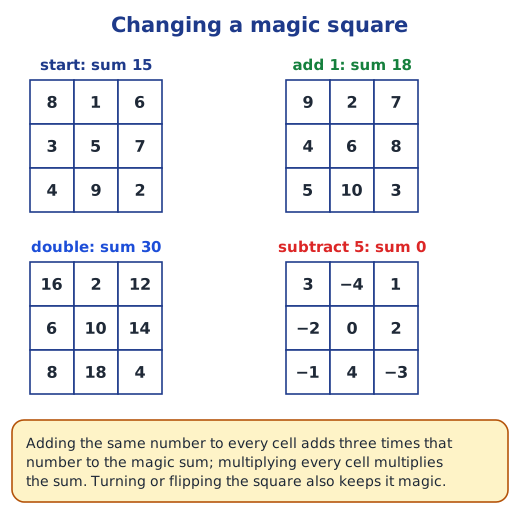
4. Other operations that give another magic square: subtracting the same number from every cell; multiplying or dividing every cell by the same non-zero number; turning the square or flipping it; and adding two magic squares cell by cell.
5. Any nine consecutive numbers. Start from the 1–9 square and add (first number − 1) to every cell. For 3 to 11 add 2: 10 3 8, 5 7 9, 6 11 4 (sum 21); for 9 to 17 add 8: 16 9 14, 11 13 15, 12 17 10 (sum 39). The middle number of the nine goes in the centre, and the magic sum is 3 times it.
Generalising a 3 × 3 Magic Square (pages 136–137)
Relating each cell to the centre m: in 8 1 6, 3 5 7, 4 9 2, the centre is 5 = m, so the square is m + 3, m − 4, m + 1; m − 2, m, m + 2; m − 1, m + 4, m − 3. The same form fits every square made from consecutive numbers.
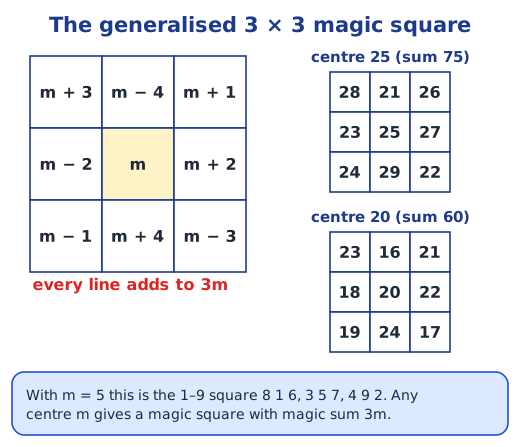
Figure it Out (page 137)
1. Centre 25: 28 21 26, 23 25 27, 24 29 22 (every line adds to 75).
2. Each row, column and diagonal adds to 3m; for example (m + 3) + (m − 4) + (m + 1) = 3m.
3. (a) Adding 1 to every term: m + 4, m − 3, m + 2; m − 1, m + 1, m + 3; m, m + 5, m − 2, with every line adding to 3m + 3. (b) Doubling every term: 2m + 6, 2m − 8, 2m + 2; 2m − 4, 2m, 2m + 4; 2m − 2, 2m + 8, 2m − 6, with every line adding to 6m.
4. Magic sum 60: 3m = 60, so m = 20: 23 16 21, 18 20 22, 19 24 17.
5. Yes. Multiply every number of a 1–9 square by 3: 24 3 18, 9 15 21, 12 27 6 (sum 45). Or use the odd numbers 1 to 17: 15 1 11, 5 9 13, 7 17 3 (sum 27).
The First-ever 4 × 4 Magic Square (page 137)
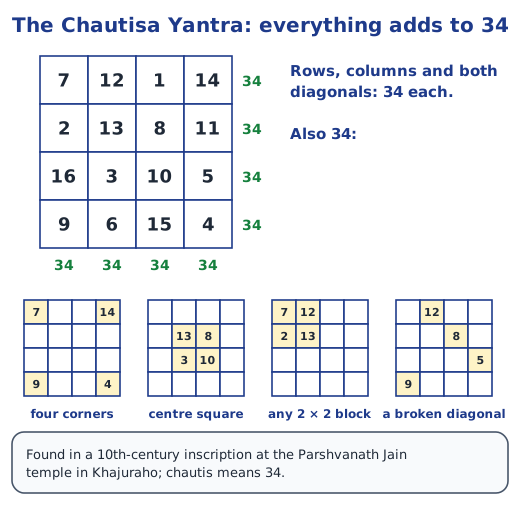
Why “Chautisa”? Chautis means 34, and every row, column and diagonal of the yantra adds up to 34. Other patterns of four that make 34: the four corners (7 + 14 + 9 + 4); the centre square (13 + 8 + 3 + 10); each corner 2 × 2 block, such as 7 + 12 + 2 + 13; the middle two cells of the top and bottom rows (12 + 1 + 6 + 15); the middle two cells of the side columns (2 + 16 + 11 + 5); and the broken diagonals, such as 12 + 8 + 5 + 9 and 1 + 11 + 16 + 6. In fact every 2 × 2 block, even one that wraps around the edges, adds to 34.
Magic Squares in History and Culture (pages 138–139)
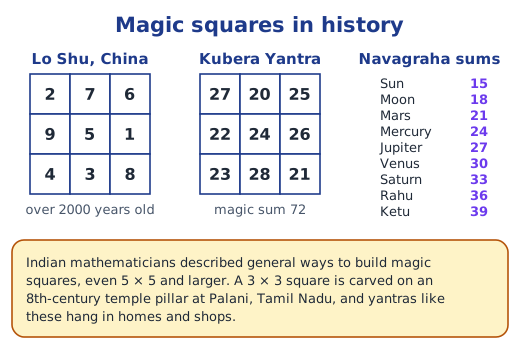
A different magic sum for each graha. Adding any row of the Navagraha Yantra gives: Sun 15, Moon 18, Mars 21, Mercury 24, Jupiter 27, Venus 30, Saturn 33, Rahu 36 and Ketu 39. Each is 3 times the number at its centre. The Kubera Yantra (27 20 25, 22 24 26, 23 28 21) has magic sum 72 = 3 × 24.
The Virahanka–Fibonacci Numbers (pages 139–142)
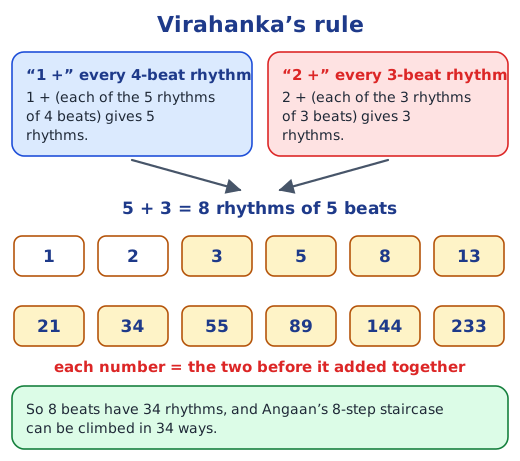
More 8-beat rhythms (S = short, L = long): S S L L L (1 + 1 + 2 + 2 + 2), L S S L L (2 + 1 + 1 + 2 + 2), S L S L L (1 + 2 + 1 + 2 + 2), L L L S S (2 + 2 + 2 + 1 + 1), S S S S L L (1 + 1 + 1 + 1 + 2 + 2) and L S S S S L (2 + 1 + 1 + 1 + 1 + 2).
5 as sums of 1s and 2s (8 ways): 1 + 1 + 1 + 1 + 1; 1 + 1 + 1 + 2; 1 + 1 + 2 + 1; 1 + 2 + 1 + 1; 1 + 2 + 2; 2 + 1 + 1 + 1; 2 + 1 + 2; 2 + 2 + 1. For n = 8 there are 34 ways, without listing them, by the rule below.
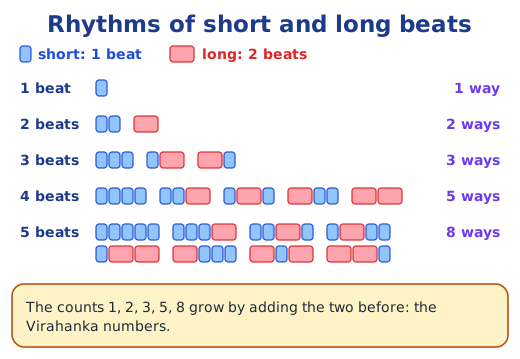
All 13 six-beat rhythms (“1 +” each 5-beat rhythm, then “2 +” each 4-beat rhythm): 1 + 1 + 1 + 1 + 1 + 1; 1 + 1 + 1 + 1 + 2; 1 + 1 + 1 + 2 + 1; 1 + 1 + 2 + 1 + 1; 1 + 1 + 2 + 2; 1 + 2 + 1 + 1 + 1; 1 + 2 + 1 + 2; 1 + 2 + 2 + 1; 2 + 1 + 1 + 1 + 1; 2 + 1 + 1 + 2; 2 + 1 + 2 + 1; 2 + 2 + 1 + 1; 2 + 2 + 2.
After 55: 34 + 55 = 89. The next three: 144, 233, 377. One more: it is even, because 233 and 377 are both odd and odd + odd = even (it is 610).
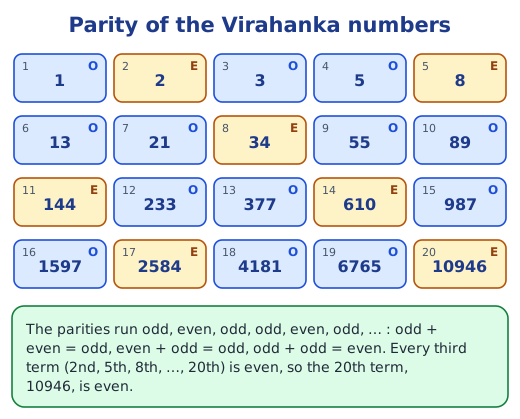
The parities: 1 odd, 2 even, 3 odd, 5 odd, 8 even, 13 odd, 21 odd, 34 even, … The block odd, even, odd repeats, because odd + even = odd, even + odd = odd and odd + odd = even. Every third number, starting from the second, is even.
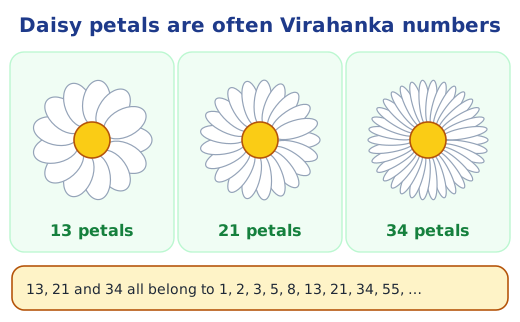
Petals on the daisies: 13, 21 and 34, all Virahanka numbers.
Digits in Disguise (pages 142–143)
T + T + T = UT. Three equal digits add to a number ending in the same digit. T = 2 gives 6 and T = 3 gives 9, which are not 2-digit numbers; only T = 5 works: 5 + 5 + 5 = 15, so U = 1.
K2 + K2 = HMM. The units digit is 2 + 2 = 4, so M = 4. Then K + K must end in 4 and make a number starting with 1: K + K = 14, so K = 7 and H = 1: 72 + 72 = 144.
The four more:
- YY + Z = ZOO: a 2-digit number plus one digit is at most 99 + 9 = 108, so Z = 1 and YY = 99: 99 + 1 = 100 (Y = 9, Z = 1, O = 0).
- B5 + 3D = ED5: 5 + D ends in 5, so D = 0; B + 3 makes a 2-digit number E0, so it is 10 and B = 7: 75 + 30 = 105 (B = 7, D = 0, E = 1).
- KP + KP = PRR: a 2-digit number doubled is less than 200, so P = 1; then R = 1 + 1 = 2, and K + K = 12, so K = 6: 61 + 61 = 122.
- C1 + C = 1FF: the sum is at least 100, so C = 9: 91 + 9 = 100 (F = 0).
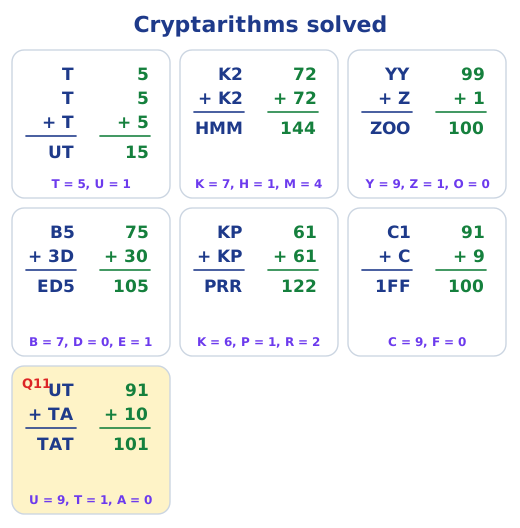
Figure it Out (pages 143–144)
1. Dorjee’s bulb. Off. Every toggle changes the state, so after an even number of toggles the bulb is back to on. After 76 toggles it is on, and the 77th, an odd number in all, switches it off.
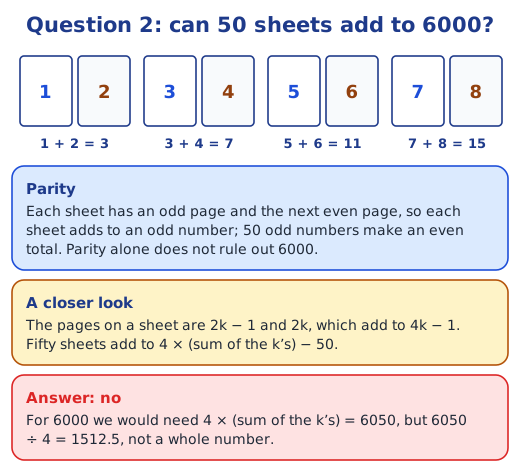
2. Liswini’s loose sheets. No, the sum cannot be 6000. Each sheet carries an odd page number on one side and the next even number on the other, such as 7 and 8, so each sheet adds to an odd number, and 50 sheets give an even total. Parity alone therefore does not rule out 6000. A closer look settles it: the pages on a sheet are 2k − 1 and 2k, which add to 4k − 1, one less than a multiple of 4. Fifty sheets add up to 4 × (sum of the k’s) − 50. For this to be 6000 we would need 4 × (sum of the k’s) = 6050, but 6050 ÷ 4 = 1512.5 is not a whole number.
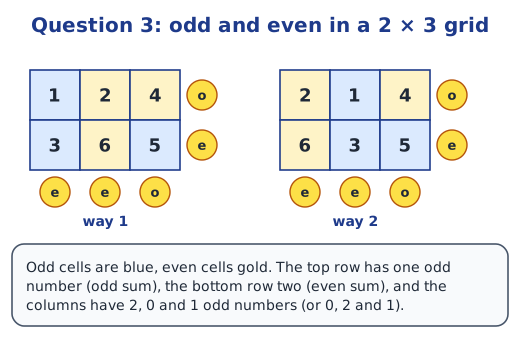
3. The 2 × 3 grid. One way: top row 1, 2, 4 (sum 7, odd) and bottom row 3, 6, 5 (sum 14, even); the columns add to 4, 8 and 9, which are even, even and odd. Another way: 2, 1, 4 over 6, 3, 5.
4. Magic sum 0. Subtract 5 from every number of a 1–9 magic square: 3, −4, 1; −2, 0, 2; −1, 4, −3. Every row, column and diagonal adds to 0 (this is the general form with m = 0).
5. (a) even; (b) even; (c) even; (d) odd.
6. 1 to 100. Even. There are 50 odd numbers from 1 to 100 (1, 3, …, 99), an even count, so their sum is even, and the even numbers do not change the parity. (Indeed 1 + 2 + … + 100 = 5050.)
7. After 987 and 1597: 987 + 1597 = 2584, then 1597 + 2584 = 4181. Before them: 1597 − 987 = 610, then 987 − 610 = 377.
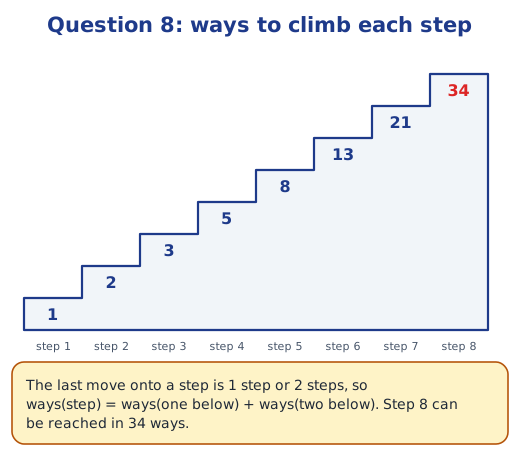
8. Angaan’s staircase. 34 ways. His last move onto any step is 1 step or 2 steps, so the ways to reach a step are the ways to reach the one below plus the ways to reach the one two below: 1, 2, 3, 5, 8, 13, 21, 34.
9. The 20th term is even. The parities repeat odd, even, odd, so the 2nd, 5th, 8th, 11th, 14th, 17th and 20th terms are even (the 20th term is 10946).
10. Which statements are true? (Take m, j, p, q and f to be 1, 2, 3, ….)
- (a) True. 4m is even, so 4m − 1 is always odd (3, 7, 11, …), though it does not give every odd number.
- (b) False. 6j − 4 gives 2, 8, 14, … and misses even numbers such as 4 and 6.
- (c) False. 2q − 1 gives every odd number, but 2p + 1 gives 3, 5, 7, … and misses 1.
- (d) False. 2f is even, so 2f + 3 is always odd.
11. UT + TA = TAT. Two 2-digit numbers add to less than 200, so T = 1. In the units, T + A ends in T, so A + 1 ends in 1 and A = 0. Then U1 + 10 = 101, so U1 = 91 and U = 9: 91 + 10 = 101.
The wedding count (page 145)
Shouldn’t it be an even number? Yes. Every marriage joins two people, so the people who married in a year come in pairs and their total should be even. An odd figure such as 14,70,369 means the count has a mistake somewhere.
Short notes and more practice are on the topic pages: parity: odd and even numbers, Virahanka–Fibonacci numbers and magic squares.
Practice
-
Is 1 + 2 + 3 + … + 10 odd or even?
Show answer
Answer: (a) Odd
-
A 3 × 3 magic square uses the nine consecutive numbers 4 to 12. What is its centre?
Show answer
Answer: (b) 8
-
Two consecutive Virahanka numbers are 377 and 610. What is the next one?
Show answer
Answer: (b) 987
-
In the cryptarithm A + A = 1B, A can be any digit from 5 to 9. If B = 4, what is A?
Show answer
Answer: A = 7, because 7 + 7 = 14.
-
Without multiplying, is the number of small squares in a 25 × 49 grid odd or even?
Show answer
Answer: Odd, because both 25 and 49 are odd, and a product is odd only when every factor is odd.
Stuck on a question?
Take a photo and Lagnever AI explains it step by step. Try it for 7 days for ₹2.
Get it on Google Play Open in browser
For parents: after the trial, the plan renews monthly by UPI or card autopay. You can cancel anytime in the app.