
Class 7 Maths Chapter 6: Number Play Notes
This chapter in five lines
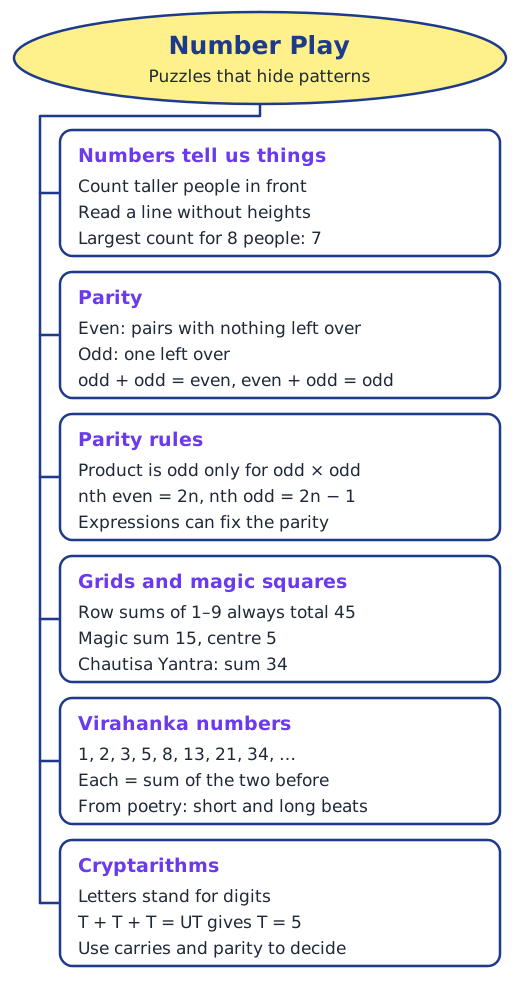
Number Play is a chapter of puzzles that hide patterns. Children in a line call out how many taller children stand in front of them. Parity, being odd or even, decides puzzles without trying every case. Grid sums lead to magic squares with magic sum 15, poetry rhythms give the Virahanka numbers 1, 2, 3, 5, 8, …, and cryptarithms hide digits behind letters.
What is this chapter about?
Number Play is a chapter of puzzles. Each one looks like a game, but behind it sits a pattern that lets us answer the question without trying every possibility. The chapter moves from a line of children calling out numbers, to odd and even numbers, to sums in grids and magic squares, to a famous sequence that first appeared in Indian poetry, and finally to sums in which letters hide digits.
Numbers that tell us things
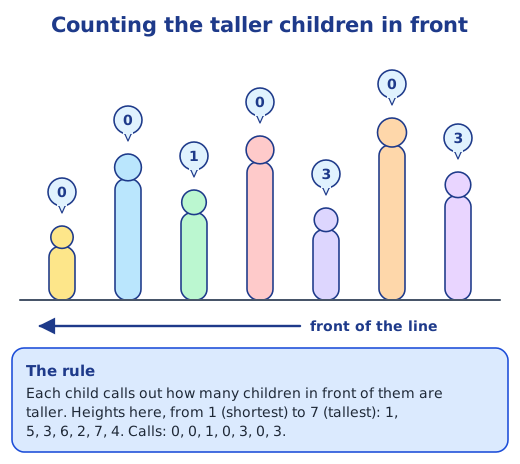
Seven children stand in a line, and each one calls out a number. The rule turns out to be: say how many children in front of you are taller than you. The first child always says 0, because nobody stands in front, and the tallest child also says 0. The numbers describe how the line is arranged without telling us anyone’s actual height. In a group of 8 people, the largest possible call is 7, made by the shortest person standing last.
Picking parity
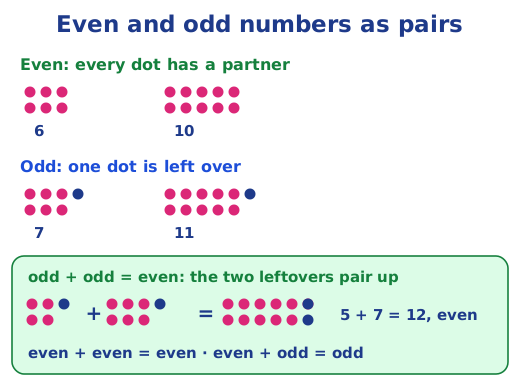
Whether a number is odd or even is called its parity. Even numbers can be arranged in pairs with nothing left over; odd numbers always leave one over. Pictures of dots prove the rules: even + even = even; two odd numbers each have a leftover, and the two leftovers pair up, so odd + odd = even; and even + odd = odd. So Kishor cannot pick five odd number cards that add to 30, since five odd numbers make an odd total. Martin and Maria, born a year apart, have consecutive ages, one odd and one even, so their ages can never add up to 112. Read parity: odd and even numbers.
Parity of products and expressions
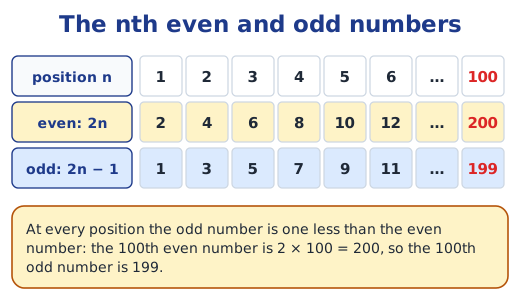
A grid with 3 rows and 3 columns has 9 small squares, odd; one with 3 rows and 4 columns has 12, even. The number of squares is odd only when both sides are odd. Expressions have parity too: 100p is always even, 2n + 1 is always odd, and 3n + 4 can be either, depending on n. Comparing 2, 4, 6, … with 1, 3, 5, … position by position shows that the nth even number is 2n and the nth odd number is 2n − 1; so the 100th odd number is 199.
Grids and magic squares
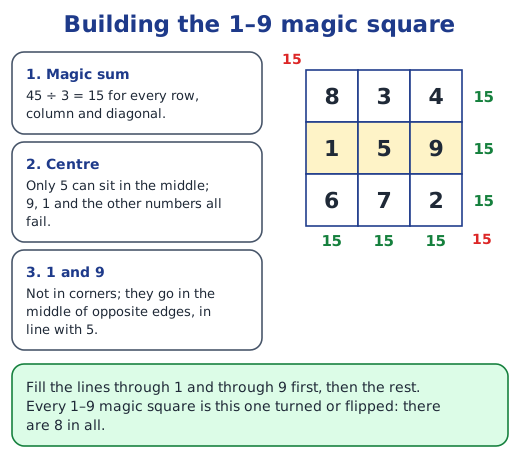
Fill a 3 × 3 grid with the numbers 1 to 9, once each, and write the sum of every row and column outside it. The three row sums always total 45, and so do the three column sums, because together they add up 1 + 2 + … + 9. This tells us at once that some puzzles are impossible: three different numbers from 1 to 9 can never add to less than 6 or more than 24. A magic square goes further: every row, column and diagonal has the same total, the magic sum. With 1 to 9, the magic sum must be 45 ÷ 3 = 15, the centre must be 5, and 1 and 9 cannot go in a corner. Read magic squares.
Magic squares in general and in history
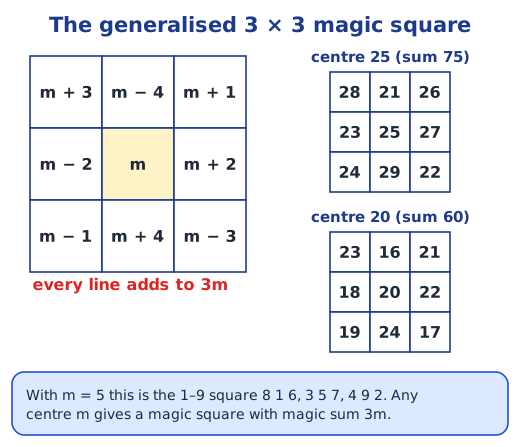
Writing the centre as a letter-number m, the other cells become m + 3, m − 4, m + 1, m − 2, m + 2, m − 1, m + 4 and m − 3, and every line adds to 3m; with m = 25 the magic sum is 75. Adding the same number to every cell, or doubling every cell, keeps the square magic. The first recorded 4 × 4 magic square, the Chautisa Yantra, is carved in a 10th-century inscription at the Parshvanath Jain temple in Khajuraho; its lines all add to 34. Magic squares also appear in China’s Lo Shu square, on an 8th-century temple pillar at Palani in Tamil Nadu, and in yantras found in homes and shops.
The Virahanka–Fibonacci numbers
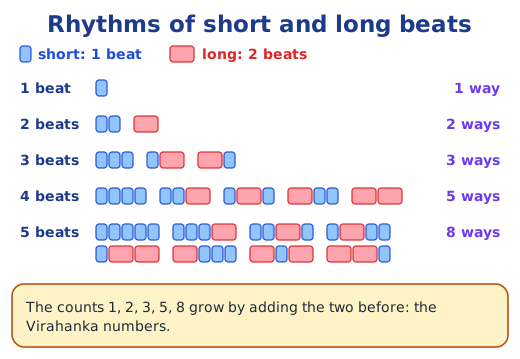
In the poetry of Prakrit, Sanskrit, Marathi, Malayalam, Tamil, Telugu and other Indian languages, a short syllable lasts one beat and a long syllable lasts two. How many rhythms fill a given number of beats? For 1, 2, 3, 4 and 5 beats there are 1, 2, 3, 5 and 8 rhythms. Around 700 CE the Prakrit scholar Virahanka explained why: every rhythm begins with a short or a long syllable, so the count for n beats is the count for n − 1 beats plus the count for n − 2 beats. This gives 1, 2, 3, 5, 8, 13, 21, 34, 55, …, the Virahanka numbers, known in the West as the Fibonacci numbers after an Italian mathematician who wrote about them in 1202 CE. Their parities run odd, even, odd, odd, even, odd, …, and they turn up in nature, such as daisies with 13, 21 or 34 petals. Read Virahanka–Fibonacci numbers.
Digits in disguise
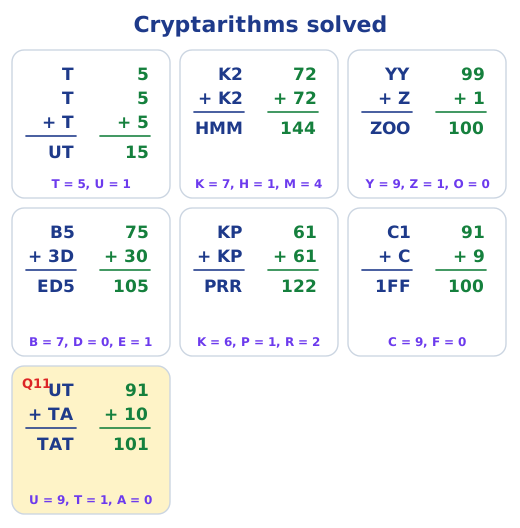
In a cryptarithm, or alphametic, each letter stands for a digit from 0 to 9. In T + T + T = UT, a digit added three times ends in itself only for T = 5, giving 5 + 5 + 5 = 15. In K2 + K2 = HMM, the units digit is 2 + 2 = 4, so M = 4, and K + K must be 14, so K = 7 and 72 + 72 = 144. Carries, the size of the answer and parity are the main clues.
In a nutshell
A line’s calls describe it without heights; parity settles many puzzles at a glance; grid sums of 1 to 9 always total 45, which leads to the 1–9 magic square with magic sum 15 and centre 5; Virahanka’s rule builds 1, 2, 3, 5, 8, …; and cryptarithms are solved like detective work. Answers to every question are in the NCERT solutions for Chapter 6.
Key terms
| Term | Meaning |
|---|---|
| Parity | Whether a number is odd or even. For example, the parity of the sum of two consecutive numbers is odd. |
| Even number | A number that can be arranged in pairs with nothing left over, such as 6 or 10; it has 2 as a factor. The nth even number is 2n. |
| Odd number | A number that leaves one over when arranged in pairs, such as 7 or 11; it is one more, or one less, than an even number. The nth odd number is 2n − 1. |
| Consecutive numbers | Counting numbers that follow one another, like 51 and 52. Of two consecutive numbers, one is always odd and the other even. |
| Magic square | A square grid of numbers in which every row, every column and both diagonals add up to the same number. |
| Magic sum | The common total of each row, column and diagonal of a magic square. With the numbers 1 to 9 it must be 15. |
| Generalised magic square | A 3 × 3 magic square written with a letter-number m in the centre: m + 3, m − 4, m + 1; m − 2, m, m + 2; m − 1, m + 4, m − 3. Every line adds to 3m. |
| Chautisa Yantra | The first recorded 4 × 4 magic square, from a 10th-century inscription at the Parshvanath Jain temple in Khajuraho; every row, column and diagonal adds to 34. |
| Short and long syllables | In the poetry of many Indian languages a short syllable lasts one beat and a long syllable two beats; counting their rhythms gives the Virahanka numbers. |
| Virahanka numbers | The numbers 1, 2, 3, 5, 8, 13, 21, 34, …, in which each one is the sum of the two before it. Known in the West as the Fibonacci numbers. |
| Cryptarithm | A sum in which each letter stands for a digit, also called an alphametic, such as T + T + T = UT, where T = 5 and U = 1. |
| Proof by picture | An argument that shows a fact is always true, such as two odd numbers drawn as pairs with one dot left over: the two leftovers pair up, so the sum is even. |
Topics in this chapter
Practice
-
Is the sum of 5 odd numbers odd or even?
Show answer
Answer: (b) Odd
-
What is the 50th odd number?
Show answer
Answer: (b) 99
-
What is the magic sum of a magic square made with the numbers 1 to 9?
Show answer
Answer: (c) 15
-
Which number must be in the centre of a 1–9 magic square?
Show answer
Answer: (b) 5
-
What comes next in 1, 2, 3, 5, 8, 13, 21, …?
Show answer
Answer: (b) 34
-
In the cryptarithm T + T + T = UT, what is T?
Show answer
Answer: (b) 5
Questions students ask
What are the main topics of Class 7 Maths Chapter 6?
A line of children calling out how many taller children stand in front of them; parity, or odd and even numbers, with sums, differences, products, grids and the formulas 2n and 2n − 1; row and column sums in grids and magic squares, including the generalised 3 × 3 square and the Chautisa Yantra; the Virahanka–Fibonacci numbers from Indian poetry; and cryptarithms.
Is Number Play in the new NCERT Class 7 Maths book?
Yes. It is Chapter 6 of Ganita Prakash, the Class 7 Maths textbook, Part 1 (Reprint 2026-27), on pages 127 to 145. It comes after Parallel and Intersecting Lines and before A Tale of Three Intersecting Lines.
Why does parity help solve puzzles quickly?
Parity lets us rule out answers without checking every case. Five odd cards can never add to 30, because a sum of five odd numbers is odd; ages a year apart can never add to 112, because consecutive numbers give an odd sum. One look at odd or even settles the question.
Why are they called Virahanka–Fibonacci numbers?
The Prakrit scholar Virahanka gave the rule for these numbers around 700 CE while counting poetry rhythms, after earlier work by Pingala; Gopala and Hemachandra wrote about them in the 12th century. Fibonacci wrote about them in Italy in 1202 CE, about 500 years after Virahanka, so the joint name makes clear who came first.
Stuck on a question?
Take a photo and Lagnever AI explains it step by step. Try it for 7 days for ₹2.
Get it on Google Play Open in browser
For parents: after the trial, the plan renews monthly by UPI or card autopay. You can cancel anytime in the app.