
Virahanka–Fibonacci numbers
Answer in short
The Virahanka numbers 1, 2, 3, 5, 8, 13, 21, 34, … count the rhythms of short (one beat) and long (two beat) syllables. Each number is the sum of the two before it. Virahanka gave this rule around 700 CE, about 500 years before Fibonacci, which is why they are called Virahanka–Fibonacci numbers.
Stuck on a question? Take a photo and Lagnever AI explains it step by step. Try it for 7 days for ₹2. Get it on Google Play
Numbers that came from poetry
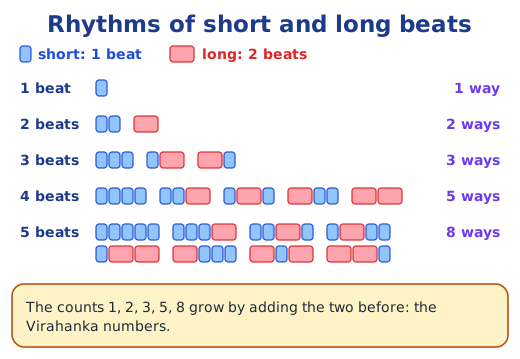
Few sequences in mathematics are as celebrated as 1, 2, 3, 5, 8, 13, 21, 34, …, and it turns up in art, science and nature. Remarkably, it was first discovered through art: poetry. In Prakrit, Sanskrit, Marathi, Malayalam, Tamil, Telugu and many other Indian languages, each syllable of a poem is either short or long. A long syllable lasts exactly twice as long as a short one, so when a poem is sung, a short syllable takes one beat and a long syllable two. Poets asked a natural question: in how many ways can a line of, say, 8 beats be filled with short and long syllables? In the language of numbers, in how many ways can 8 be written as a sum of 1s and 2s?
Counting rhythms
Start small. One beat can only be one short syllable: 1 way. Two beats can be 1 + 1 or 2: 2 ways. Three beats: 1 + 1 + 1, 1 + 2 and 2 + 1, so 3 ways. Four beats give 5 ways and five beats give 8 ways. Listing them all becomes tiring very quickly, so we need a smarter method.
Virahanka’s rule
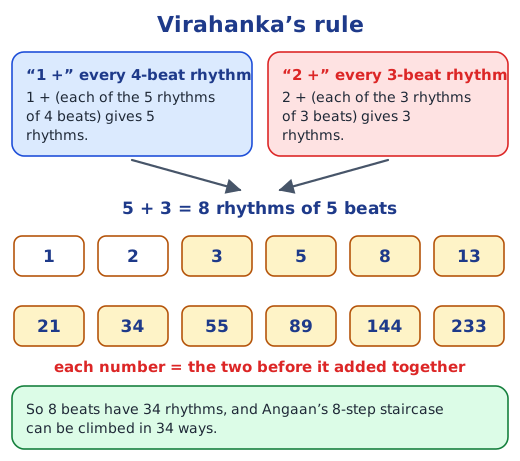
Every rhythm must begin with either a short syllable (1 +) or a long one (2 +). If it begins with 1 +, the rest is a rhythm of one beat less; if it begins with 2 +, the rest is a rhythm of two beats less. So the 5-beat rhythms are “1 +” each of the 5 four-beat rhythms together with “2 +” each of the 3 three-beat rhythms: 5 + 3 = 8. In the same way, 6 beats give 8 + 5 = 13 rhythms. Each number in the sequence is the sum of the two numbers before it: 1, 2, 3, 5, 8, 13, 21, 34, 55, 89, 144, … So a line of 8 beats can be filled in 34 ways.
A long history
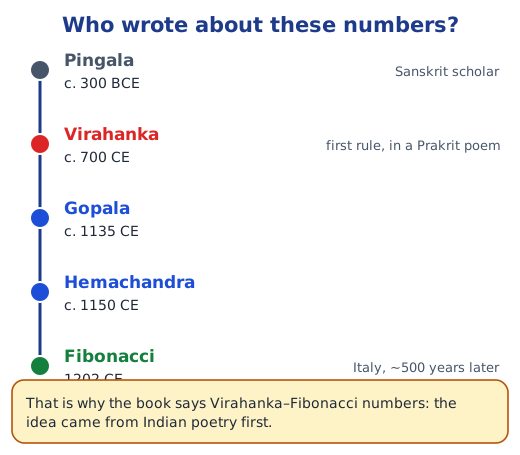
The great Prakrit scholar Virahanka described this method around 700 CE, writing it, fittingly, as a Prakrit poem. He is the first known person to state these numbers and the rule for making them, inspired by the earlier work of the Sanskrit scholar Pingala, who lived around 300 BCE. After Virahanka, Gopala (around 1135 CE) and Hemachandra (around 1150 CE) also wrote about them. In the West they are called the Fibonacci numbers, after an Italian mathematician who wrote about them in 1202 CE, roughly five centuries after Virahanka, so Fibonacci was not even the fourth to describe them. The name “Virahanka–Fibonacci numbers” helps everyone recognise the sequence.
Odd and even in the sequence
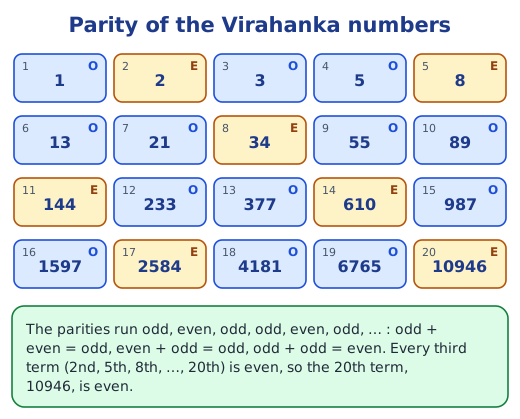
The numbers follow a parity pattern: 1 odd, 2 even, 3 odd, 5 odd, 8 even, 13 odd, 21 odd, 34 even, … Since odd + even = odd, even + odd = odd and odd + odd = even, the pattern odd, even, odd repeats for ever, and every third number, the 2nd, 5th, 8th, …, is even. So without adding we can say that the number after 233 and 377 is even (it is 610), and that the 20th number is even (it is 10946).
In nature, and on a staircase
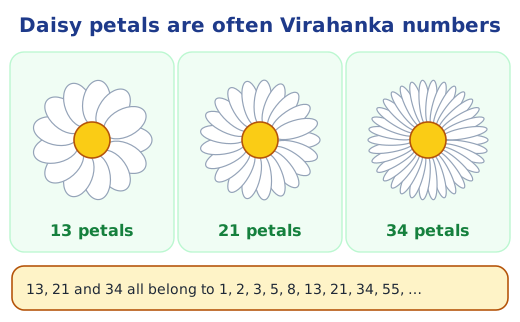
Perhaps the most striking place to find these numbers is in nature: a daisy often has 13, 21 or 34 petals. The same counting also solves everyday puzzles. If Angaan climbs an 8-step staircase taking 1 or 2 steps at a time, his last move onto any step is from one or two steps below, so the ways to reach each step are 1, 2, 3, 5, 8, 13, 21, 34: there are 34 ways to reach the top.
Why it matters
The Virahanka numbers show how closely art, science and mathematics are linked, and they will appear again in later classes. The parity reasoning used here comes from parity: odd and even numbers, and another kind of number puzzle is in magic squares. Answers to every question are in the NCERT solutions for Chapter 6; see also the full Chapter 6 notes.
Practice
-
How many different 6-beat rhythms can be made from short and long syllables?
Show answer
Answer: (c) 13
-
Which number comes after 89 in the Virahanka sequence?
Show answer
Answer: (b) 144
-
Around when did Virahanka give the rule for these numbers?
Show answer
Answer: (b) 700 CE
-
Why is the number of 5-beat rhythms equal to 5 + 3?
Show answer
Answer: Every 5-beat rhythm starts with a short syllable followed by a 4-beat rhythm (5 ways) or a long syllable followed by a 3-beat rhythm (3 ways), so there are 5 + 3 = 8.
-
Without adding, is the number after 233 and 377 odd or even?
Show answer
Answer: Even. Both 233 and 377 are odd, and odd + odd = even; indeed 233 + 377 = 610.
Questions students ask
What are the Virahanka numbers?
They are the numbers 1, 2, 3, 5, 8, 13, 21, 34, 55, …, in which each number is the sum of the two before it. They count the rhythms that can be made from short syllables of one beat and long syllables of two beats: for example, 5 beats can be filled in 8 ways.
Who discovered the Virahanka–Fibonacci numbers?
They first came up in the work of Indian scholars of poetry. Pingala, around 300 BCE, studied such rhythms; Virahanka gave the rule for forming the numbers around 700 CE, in a Prakrit poem; and Gopala (around 1135 CE) and Hemachandra (around 1150 CE) wrote about them. Fibonacci wrote about them in Italy in 1202 CE.
Where do Virahanka numbers appear in nature?
A famous example is flowers: a daisy often has a Virahanka number of petals, such as 13, 21 or 34. The numbers also appear across art, science and mathematics, from poetry and drumming to visual art and architecture.
Stuck on a question?
Take a photo and Lagnever AI explains it step by step. Try it for 7 days for ₹2.
Get it on Google Play Open in browser
For parents: after the trial, the plan renews monthly by UPI or card autopay. You can cancel anytime in the app.