
Divisibility shortcuts: why the tests for 3, 9 and 11 work
Answer in short
A number is divisible by 9 or 3 exactly when its digit sum is, because every place value is a multiple of 9 plus 1. For 11, place values sit alternately 1 above and 1 below a multiple of 11, so add and subtract the digits in turn from the units digit. For 6 or 24, combine two tests.
Stuck on a question? Take a photo and Lagnever AI explains it step by step. Try it for 7 days for ₹2. Get it on Google Play
Why do the tests for 2, 5, 10, 4 and 8 work?
Write any number by place value, with letters for its digits: a number …dcba means … + 1000d + 100c + 10b + a. Every place value except the units is a multiple of 10. Hence the part 10b + 100c + … has the factor 10, and so the factors 2 and 5. Whether the whole number is divisible by 10, 5 or 2 therefore depends only on the units digit a.
The same idea works further along. 100 = 4 × 25, so every place from the hundreds up is a multiple of 4, and only the last two digits decide divisibility by 4. 1000 = 8 × 125, so only the last three digits decide divisibility by 8.
Why does the digit sum test for 9 work?
Here the units digit is not enough: 99 is divisible by 9 but 109 is not. Instead, notice that every place value is a multiple of 9 plus 1:
1 = 0 + 1, 10 = 9 + 1, 100 = 99 + 1, 1000 = 999 + 1, and so on.
So 5283 = 5 × (999 + 1) + 2 × (99 + 1) + 8 × (9 + 1) + 3 = (a multiple of 9) + (5 + 2 + 8 + 3). The number is a multiple of 9 plus its digit sum, 18. Since 18 is divisible by 9, so is 5283 (it is 9 × 587).
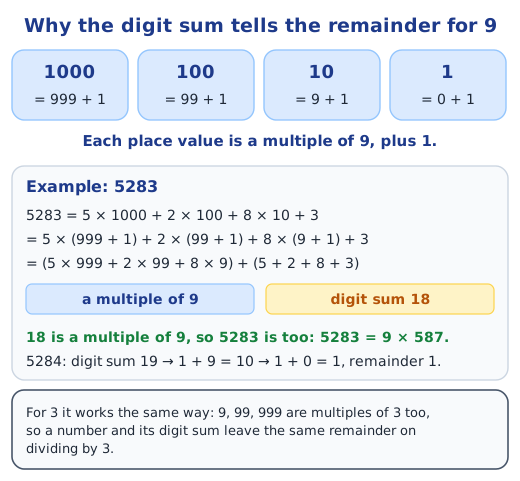
This shows more than a yes-or-no answer: a number and its digit sum leave the same remainder on dividing by 9. If the digit sum is large, add its digits again. For 5284 the digit sum is 19, then 10, then 1, so 5284 leaves remainder 1.
Does the same test work for 3?
Yes. 9, 99, 999 and so on are multiples of 3 as well, so every place value is a multiple of 3 plus 1. A number and its digit sum leave the same remainder on dividing by 3. Each multiple of 9 is also one of 3, but not the other way round: 726 has digit sum 15, so it is divisible by 3 but not by 9.
What is the shortcut for 11?
For 11 the place values alternate. 1 is 1 more than 0, 10 is 1 less than 11, 100 is 1 more than 99, 1000 is 1 less than 1001, and 10000 is 1 more than 9999. So the digits in the units, hundreds and ten-thousands places count as “extra”, and the digits in the tens and thousands places count as “short”.
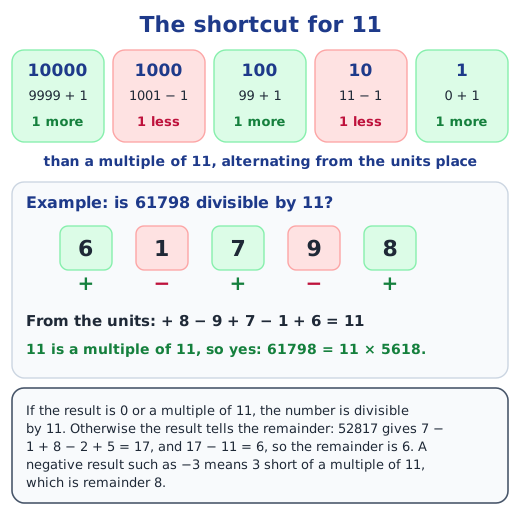
In practice: put + and − before the digits in turn, starting with + at the units digit, and work it out. For 61798 we get 8 − 9 + 7 − 1 + 6 = 11, a multiple of 11, so 61798 is divisible by 11. If the result is not 0 or a multiple of 11, it gives the remainder: 52817 gives 17, and 17 − 11 = 6, so the remainder is 6. A result of −3 means 3 short of a multiple of 11, which is remainder 8.
How do you combine two tests?
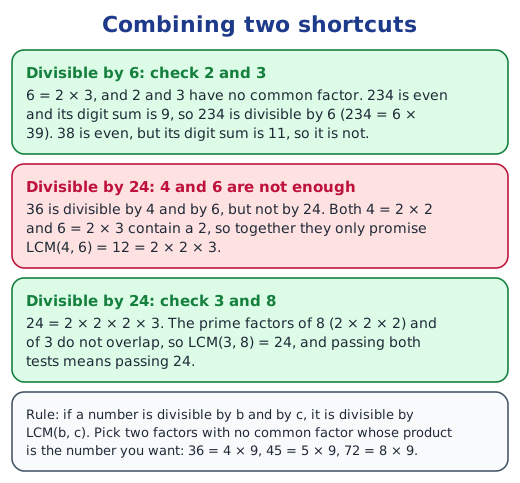
To test 6, check 2 and 3: 234 is even and its digit sum is 9, so it is divisible by 6. This works because 2 and 3 have no common factor, so a number divisible by both has 2 × 3 in its prime factorisation.
For 24, checking 4 and 6 fails: 36 passes both tests but is not divisible by 24. Since 4 = 2 × 2 and 6 = 2 × 3 share a 2, together they only promise LCM(4, 6) = 12. Check 3 and 8 instead, because 24 = 3 × 8 and LCM(3, 8) = 24.
What is a digital root?
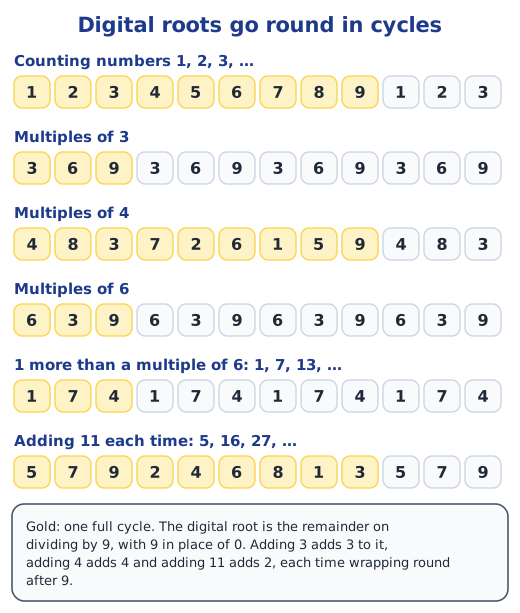
Add the digits of a number again and again until one digit is left. That digit is the digital root: for 489, 4 + 8 + 9 = 21 and 2 + 1 = 3. By the digit sum idea, the digital root is the remainder on dividing by 9, except that multiples of 9 have digital root 9. So digital roots go round in cycles. Multiples of 3 have digital roots 3, 6, 9, 3, 6, 9, …, and numbers 1 more than a multiple of 6 have 1, 7, 4, 1, 7, 4, … The chapter notes that Aryabhata II described this method around 950 CE, and that it was used to check calculations.
Read next: the chapter notes, properties of divisibility, cryptarithms and NCERT solutions.
Practice
-
Which number is divisible by 3 but not by 9?
Show answer
Answer: (d) 726
-
What is the remainder when 7256 is divided by 9?
Show answer
Answer: (a) 2
-
What is the remainder when 9183 is divided by 11?
Show answer
Answer: (a) 9
-
Without dividing, decide whether 5832 is divisible by 24.
Show answer
Answer: Yes. Its digit sum is 18, so it is divisible by 3, and its last three digits, 832 = 8 × 10⁴, make it divisible by 8. LCM(3, 8) = 24, and indeed 5832 = 24 × 243.
-
Find the digital root of 987654. What remainder does it leave on dividing by 9?
Show answer
Answer: 9 + 8 + 7 + 6 + 5 + 4 = 39, then 3 + 9 = 12, then 1 + 2 = 3. The digital root is 3, so the remainder is 3.
Questions students ask
What is the divisibility rule for 11 in Class 8?
Starting from the units digit, add and subtract the digits in turn. If the result is 0 or a multiple of 11, the number is divisible by 11. For 4851: 1 − 5 + 8 − 4 = 0, so it is divisible.
Why does the divisibility rule for 3 work?
10, 100, 1000 and every other place value are 1 more than a multiple of 9, and so of 3. A number is therefore a multiple of 3 plus its digit sum, so it is divisible by 3 exactly when its digit sum is.
Can I check divisibility by 24 using 4 and 6?
No. 4 and 6 share the factor 2, so passing both only guarantees divisibility by 12. Check 3 and 8, which share no factor and multiply to 24.
What is the digital root of a number?
Keep adding the digits until one digit is left; that digit is the digital root. It is the remainder on dividing by 9, except that multiples of 9 have digital root 9.
Stuck on a question?
Take a photo and Lagnever AI explains it step by step. Try it for 7 days for ₹2.
Get it on Google Play Open in browser
For parents: after the trial, the plan renews monthly by UPI or card autopay. You can cancel anytime in the app.