
Properties of divisibility: always, sometimes or never?
Answer in short
If a number divides two numbers, it also divides their sum and their difference. If a is divisible by b, so is every multiple of a, and a is divisible by every factor of b. A number divisible by both b and c is divisible by their LCM. Algebra and rows of dots show why.
Stuck on a question? Take a photo and Lagnever AI explains it step by step. Try it for 7 days for ₹2. Get it on Google Play
What does “a divides m” mean?
We say that a divides m, or that m is divisible by a, when m ÷ a leaves no remainder. Then m is a multiple of a, and we can write it as m = a × (some integer). For example, 56 = 8 × 7, so 8 divides 56. Writing multiples with letters, such as 8a for “a multiple of 8”, lets us check a claim for every number at once.
If a number divides two numbers, does it divide their sum?
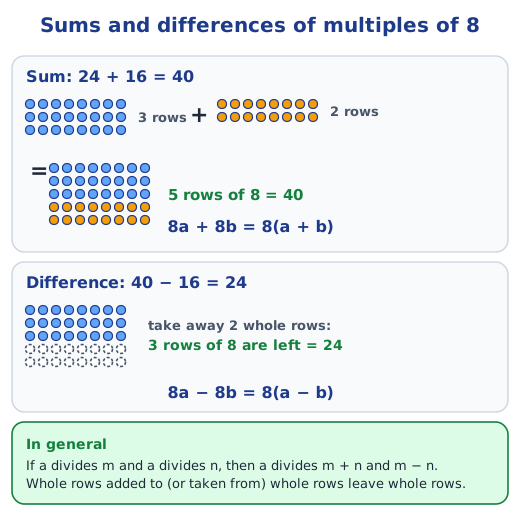
Yes. Think of a multiple of 8 as rows of 8 dots. 24 is 3 rows and 16 is 2 rows. Put them together and you get 5 full rows, 40, with no dot left over. Take 2 rows away from 5 rows and 3 full rows are left. In letters:
8a + 8b = 8(a + b) and 8a − 8b = 8(a − b).
So when a divides both m and n, it also divides m + n and m − n.
The opposite is not true. 40 is a multiple of 8, but it can be split as 15 + 25, and neither part is a multiple of 8.
What about multiples and factors?
If a number is divisible by 7, it is 7j for some j. Any multiple of it is 7j × m = 7(jm), which still has the factor 7. So every multiple of a multiple of 7 is a multiple of 7. In the same way, a number divisible by 12 is 12m = 2 × 6 × m = 3 × 4 × m, so it is also divisible by 1, 2, 3, 4, 6 and 12, every factor of 12.
But being divisible by 7 does not make a number divisible by every multiple of 7. 35 is divisible by 7 and by 35, but not by 14.
When is a number divisible by two numbers at once?
A number divisible by both 9 and 4 is a multiple of each, so its prime factors must include 3 × 3 and 2 × 2. That makes it a multiple of 36. In general, a number divisible by b and by c is divisible by LCM(b, c). Be careful with numbers that share a factor: divisible by 6 and by 4 only means divisible by LCM(6, 4) = 12, not 24. 36 is a non-example.
How do you decide: always, sometimes or never?
Try several examples first. If one example works and another fails, the claim is sometimes true. One failing example, called a non-example, is enough to rule out “always”. To show that a claim is always true or never true, write the numbers with letters and simplify.
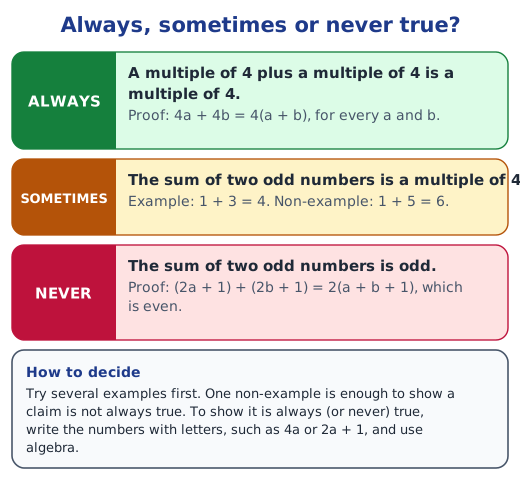
For example, “an odd number plus an even number is a multiple of 6” is never true: (2n) + (2m + 1) = 2(n + m) + 1 is odd, while every multiple of 6 is even.
When do two even numbers add up to a multiple of 4?
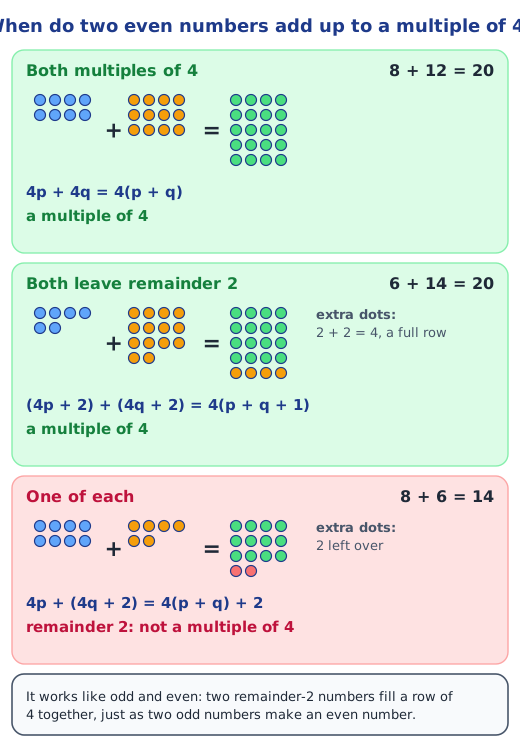
Every even number is either a multiple of 4 (4p) or 2 more than one (4p + 2). Two multiples of 4 give 4p + 4q = 4(p + q). Two of the second kind give (4p + 2) + (4q + 2) = 4(p + q + 1), because the two extra 2s make a 4. One of each gives 4(p + q) + 2, which leaves remainder 2. It works just like adding odd and even numbers.
How do we write numbers with a given remainder?
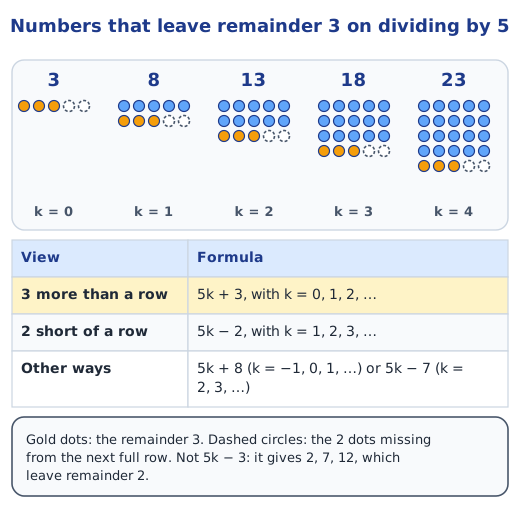
Numbers that leave remainder 3 on dividing by 5 sit 3 above a multiple of 5: 3, 8, 13, 18, … They are all of the form 5k + 3 (k = 0, 1, 2, …). Each is also 2 short of the next multiple of 5, so 5k − 2 (k = 1, 2, 3, …) describes them too.
Remainders can be added. If one number leaves 5 and another leaves 3 on dividing by 7, their sum is 7p + 5 + 7q + 3 = 7(p + q + 1) + 1, so it leaves remainder 1.
Why do the sign patterns of four numbers share a parity?
Put + or − between any four numbers a, b, c and d. Switching one sign, say +b to −b, changes the value by 2b, an even number. A change by an even number never turns even into odd, so all eight results have the same parity.
Read next: the chapter notes, divisibility shortcuts, cryptarithms and NCERT solutions.
Practice
-
7 divides both m and n. Which of these must 7 also divide?
Show answer
Answer: (a) m + n and m − n
-
A number is divisible by 4 and by 10. It must be divisible by:
Show answer
Answer: (b) 20
-
“The sum of two multiples of 5 is a multiple of 10.” This claim is:
Show answer
Answer: (b) sometimes true
-
Show that the sum of three consecutive numbers is always a multiple of 3.
Show answer
Answer: Write them as n − 1, n and n + 1. Their sum is (n − 1) + n + (n + 1) = 3n, which has 3 as a factor.
-
A number leaves remainder 4 on dividing by 6. What remainder does twice the number leave?
Show answer
Answer: 2 × (6k + 4) = 12k + 8 = 6(2k + 1) + 2, so the remainder is 2. Check with 10: 20 = 18 + 2.
Questions students ask
What are the properties of divisibility in Class 8 Maths?
When a divides both m and n, it also divides m + n and m − n. When a is divisible by b, so is every multiple of a, and a is also divisible by each factor of b. A number divisible by b and by c is divisible by LCM(b, c).
Is a number divisible by 4 and by 6 also divisible by 24?
Not always. 36 is divisible by 4 and by 6 but not by 24. Such a number is only sure to be divisible by LCM(4, 6) = 12.
How do you prove that a statement about numbers is always true?
Write the numbers with letters, for example a multiple of 8 as 8a, and simplify. If the result clearly has the right factor, such as 8(a + b), the statement holds for every number, not just the examples you tried.
Why do a + b + c + d and a − b + c − d share a parity?
Switching the sign of b changes the value by 2b, and switching the sign of d changes it by 2d. Both are even, and adding or taking away an even number never changes parity.
Stuck on a question?
Take a photo and Lagnever AI explains it step by step. Try it for 7 days for ₹2.
Get it on Google Play Open in browser
For parents: after the trial, the plan renews monthly by UPI or card autopay. You can cancel anytime in the app.