
Cryptarithms: how to solve letter-digit puzzles
Answer in short
A cryptarithm is a sum or product in which letters stand for digits. Each letter is one digit, different letters are different digits, and a first digit is never 0. Solve it with clues: the units digits, the carries, and how big or small the numbers can be. Some cryptarithms have more than one answer.
Stuck on a question? Take a photo and Lagnever AI explains it step by step. Try it for 7 days for ₹2. Get it on Google Play
What is a cryptarithm?
A cryptarithm is a sum or a product in which some digits are hidden behind letters. You saw them in Class 7; Chapter 5 calls them “digits in disguise”. The aim is to find which digit each letter stands for, so that the sum or product is correct.
What are the rules?
- Each letter stands for one digit, and the same letter always means the same digit.
- Different letters stand for different digits.
- No number starts with the digit 0, so AB cannot be 05.
Where do you start?
Do not try every digit at random. Look for the strongest clue first:
- The units column. The units digit of a sum or product depends only on the units digits. For example, if B × B ends in B, then B must be 0, 1, 5 or 6.
- The carries. When two numbers are added, each column carries at most 1. So if two 2-digit numbers make a 3-digit number, that number starts with 1.
- The size. A 2-digit number times 8 stays below 100 only up to 12 × 8 = 96, so the first number cannot be more than 12.
- Even and odd. 6 times any digit is even, so the units digit of a product of 6 is always even.
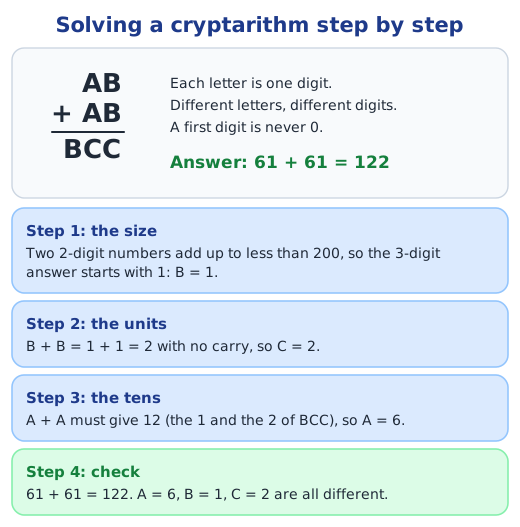
A worked example: AB + AB = BCC
Two 2-digit numbers add up to less than 200, so the 3-digit answer starts with 1: B = 1. Now the units column is 1 + 1 = 2, with no carry, so C = 2. The tens column, A + A, must give the 12 at the front of BCC, so A = 6. Check: 61 + 61 = 122, and 6, 1 and 2 are all different.
How do you solve a multiplication cryptarithm?
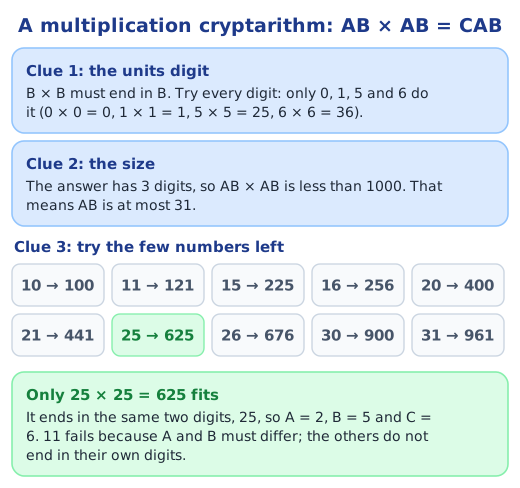
Take AB × AB = CAB, a 2-digit number times itself giving a 3-digit number that ends in the same two digits. First, the units: B × B ends in B, so B is 0, 1, 5 or 6. Next, the size: the answer is less than 1000, so AB is at most 31. That leaves only ten numbers to try: 10, 11, 15, 16, 20, 21, 25, 26, 30 and 31. Squaring each, only 25 × 25 = 625 ends in its own two digits, so A = 2, B = 5 and C = 6.
The same clues solve the multiplication puzzles in the chapter. In UT × 3 = PUT, for example, the answer ends in the same two digits UT, so 2 × UT must be a whole number of hundreds; that forces UT = 50 and 50 × 3 = 150.
Can a cryptarithm have more than one answer?
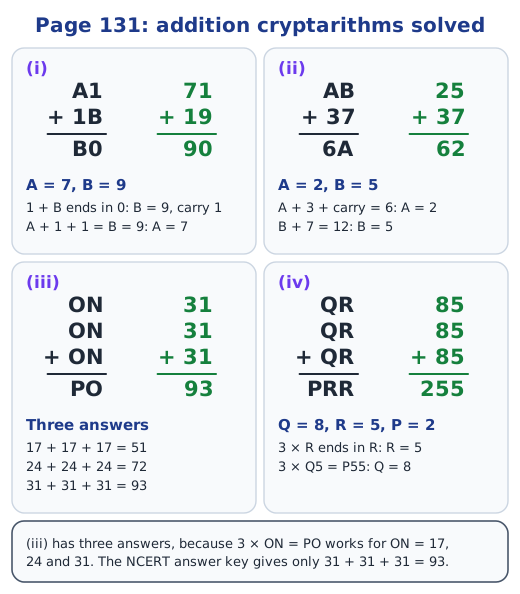
Yes, so always look for other answers after finding one. In ON + ON + ON = PO, three times ON is a 2-digit number whose units digit O is the tens digit of ON. That works for ON = 17, 24 and 31, giving 51, 72 and 93. A puzzle that should have a single answer needs enough clues to rule the others out.
Can you make your own?
Start from a true sum or product, such as 48 × 3 = 144, and replace each digit by a letter: AB × 3 = CAA. Then solve your puzzle as a stranger would. If you find a second answer, change the puzzle or add a clue until only one answer remains. Swap puzzles with a friend.
Read next: the chapter notes, properties of divisibility, divisibility shortcuts and NCERT solutions.
Practice
-
In AB + BA = CAC, what is C?
Show answer
Answer: (a) 1
-
In AB × 3 = CAA, what is AB?
Show answer
Answer: (a) 48
-
P is the first digit of a number in a cryptarithm. Which digit can P not be?
Show answer
Answer: (a) 0
-
Solve AB + BA = CAC.
Show answer
Answer: Two 2-digit numbers add up to less than 200, so C = 1. The units B + A end in 1, so A + B = 11 with a carry. The tens give A + B + 1 = 12, so A = 2 and B = 9: 29 + 92 = 121.
-
Solve A5 + B = 5A, where B is a one-digit number.
Show answer
Answer: The tens digit grows from A to 5, so there is a carry and A = 4. Then 5 + B = 14, so B = 9: 45 + 9 = 54.
Questions students ask
What is a cryptarithm in Class 8 Maths?
It is a puzzle in which the digits of a sum or product are hidden behind letters. Each letter is one digit, no two letters share a digit, and no number starts with 0. Chapter 5 calls these “digits in disguise”.
How do you solve a cryptarithm?
Look for the strongest clue first: the units column, a carry into a new column, or a limit on size. Fix one letter, then use it to find the next, and check the finished sum or product.
Can a cryptarithm have more than one answer?
Yes. ON + ON + ON = PO works as 17 + 17 + 17 = 51, 24 + 24 + 24 = 72 and 31 + 31 + 31 = 93. Always check whether other digits also fit.
Can two letters stand for the same digit?
No. Different letters must stand for different digits, and the same letter always stands for the same digit.
Stuck on a question?
Take a photo and Lagnever AI explains it step by step. Try it for 7 days for ₹2.
Get it on Google Play Open in browser
For parents: after the trial, the plan renews monthly by UPI or card autopay. You can cancel anytime in the app.