
NCERT Solutions Class 8 Maths Part 2 Chapter 4: Exploring Some Geometric Themes
Answers to every question in Chapter 4, Exploring Some Geometric Themes, of Ganita Prakash, Grade 8 Part 2: the questions in the text, the Try This and Math Talk prompts and all the Figure it Out sets. Page numbers follow the book (pages 70–102). Short notes: Part 2 Chapter 4 notes.
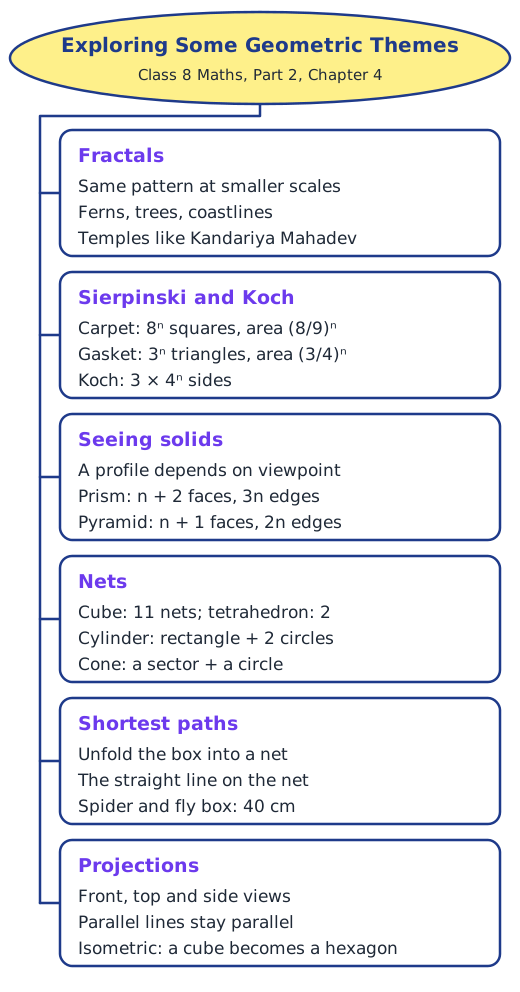
Fractals (pages 70–75)
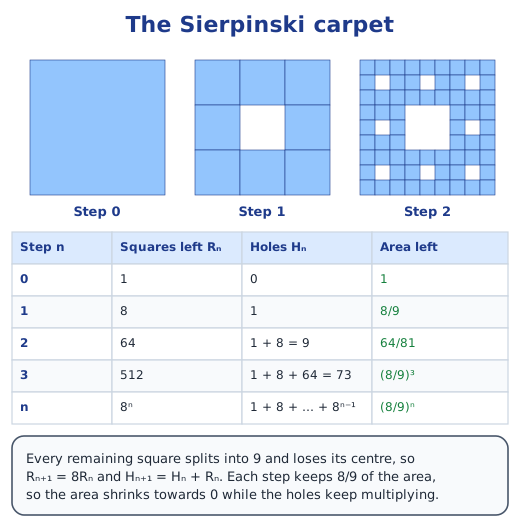
Sierpinski carpet: the pattern. The remaining squares go 1, 8, 64, 512, … (Rₙ = 8ⁿ), and the holes 0, 1, 9, 73, … (Hₙ₊₁ = Hₙ + Rₙ, so Hₙ = 1 + 8 + … + 8ⁿ⁻¹ = (8ⁿ − 1) ÷ 7).
Show that joining the midpoints makes 4 identical equilateral triangles. In triangle ABC with midpoints D (on AB), E (on BC) and F (on CA), AD = AF, each half of an equal side, and ∠A = 60°. An isosceles triangle with a 60° angle between its equal sides has its other two angles equal to 60° too, so ADF is equilateral with side half of AB. The same holds at B and C. The middle triangle DEF has sides DF, DE and EF, each a side of a corner triangle, so it is equilateral with the same side. All four are identical.
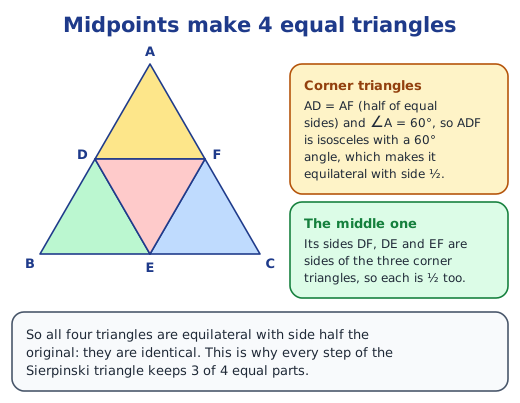
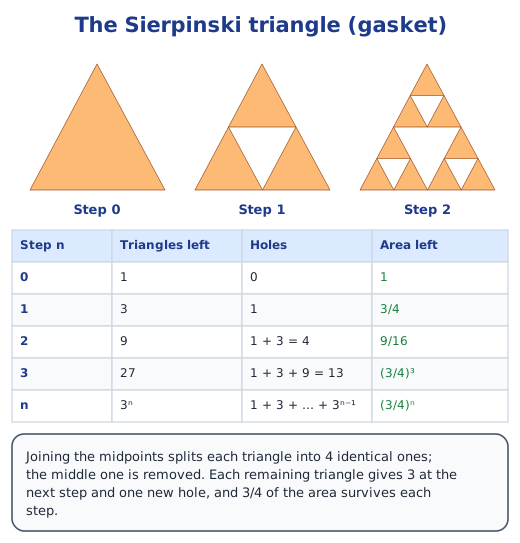
Figure it Out (page 72), 1. See the drawing below: step 0 a full triangle, step 1 three triangles round a hole, step 2 nine triangles. 2. Triangles left: 1, 3, 9, 27, …, 3ⁿ. Holes: 0, 1, 4, 13, …, 1 + 3 + … + 3ⁿ⁻¹ = (3ⁿ − 1) ÷ 2. 3. Carpet: each step keeps 8/9 of the area, so the area at step n is (8/9)ⁿ square units. Triangle: each step keeps 3/4, so (3/4)ⁿ square units.
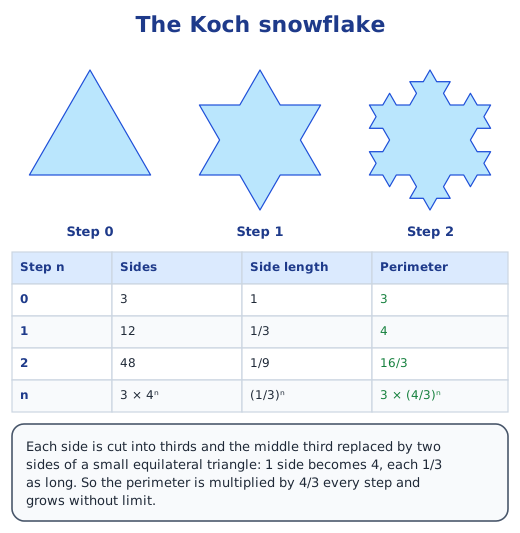
Koch snowflake, Figure it Out (page 73), 1. See the drawing. 2. Each side becomes 4 sides, so the number of sides is 3, 12, 48, …, 3 × 4ⁿ. 3. Each new side is 1/3 as long, so a side at step n is (1/3)ⁿ and the perimeter is 3 × 4ⁿ × (1/3)ⁿ = 3 × (4/3)ⁿ units.
Build it in your imagination (pages 75–77)
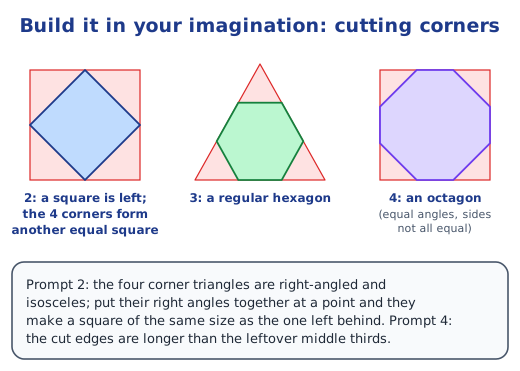
1. Done in the mind: for example, RAVI read backwards is I, V, A, R. 2. A smaller square, tilted by 45°, with half the area. The four corner pieces are right-angled isosceles triangles; put their right-angled corners together at one point and they make a square the same size as the one left. 3. A regular hexagon. 4. An octagon with all angles equal (135°), but its cut edges are longer than the leftover middle thirds.
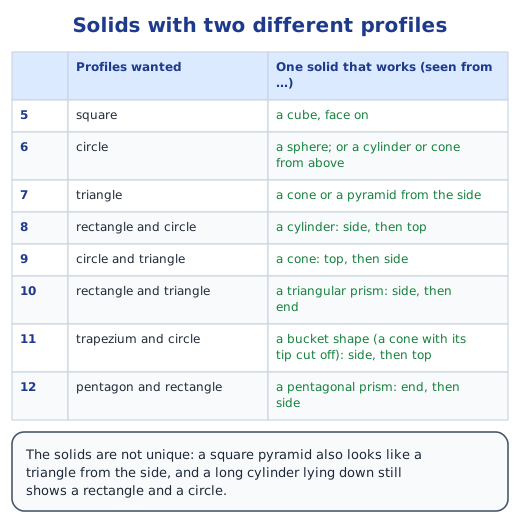
5–12. See the table: a cube face-on (square); a sphere, or a cylinder or cone from above (circle); a cone or pyramid from the side (triangle); a cylinder (rectangle and circle); a cone (circle and triangle); a triangular prism (rectangle and triangle); a bucket shape, a cone with its tip cut off (trapezium and circle); a pentagonal prism (pentagon and rectangle). Unique? No: several solids fit most conditions, for instance a square pyramid also has a triangular side profile.
Prisms and pyramids (page 79)
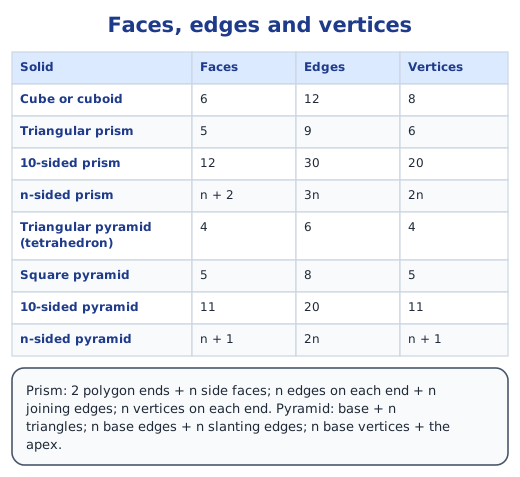
10-sided prism: 12 faces, 30 edges, 20 vertices; n-sided: n + 2 faces, 3n edges, 2n vertices. 10-sided pyramid: 11 faces, 20 edges, 11 vertices; n-sided: n + 1 faces, 2n edges, n + 1 vertices.
Nets (pages 79–84)
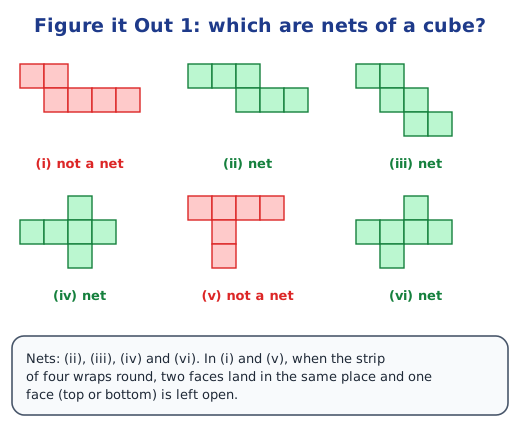
Figure it Out (page 80), 1. Nets of a cube: (ii), (iii), (iv) and (vi). (i) and (v) are not: folding them puts two squares on the same face and leaves another face open.
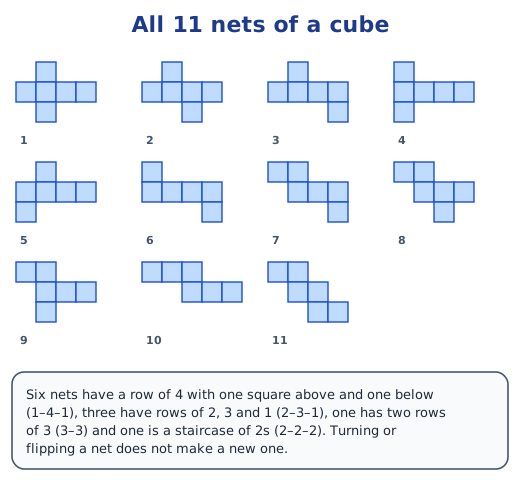
2. All 11 nets are drawn below. 3. (i) A strip of four rectangles, 5 × 3, 5 × 1, 5 × 3 and 5 × 1 (in cm), with a 3 × 1 rectangle attached at each end of one of them. (ii) The same with 6 × 3, 6 × 2, 6 × 3 and 6 × 2 rectangles and two 3 × 2 rectangles at the ends.
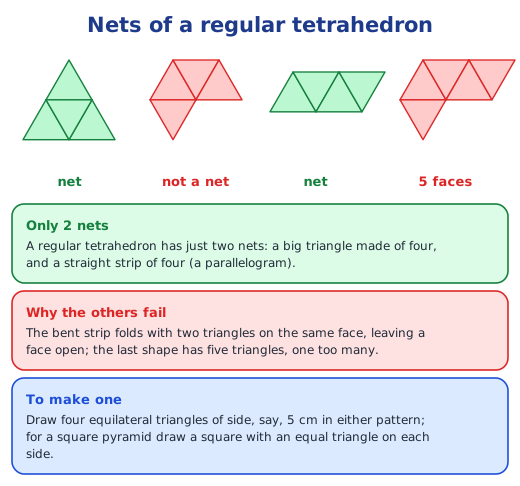
Nets of a regular tetrahedron. The first figure (a big triangle of four) and the third (a straight strip of four) are nets. The second folds with two triangles on one face, and the fourth has five triangles. There are no others. Measured nets: for a tetrahedron, four equilateral triangles of side, say, 6 cm in either arrangement; for a square pyramid, a 6 cm square with an equilateral (or isosceles) triangle of base 6 cm on each side.
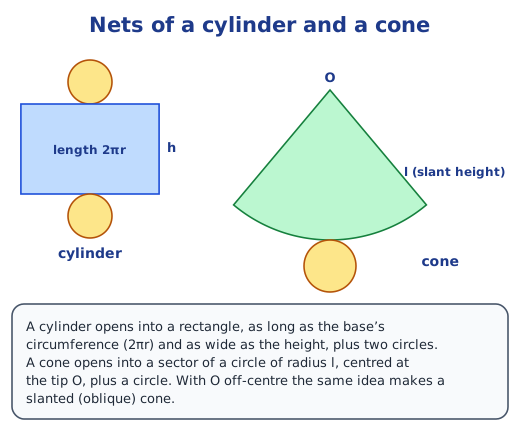
Net of a cylinder. The rectangle has length 2πr, the circumference of the base, and width h, the height. Net of a cone: a sector of a circle of radius l (the slant height) centred at O, plus a circle for the base. With O placed off the centre of the arc, the slant lengths differ, and the net rolls into a slanted, or oblique, cone whose tip is not above the centre of its base. Triangular prism: three rectangles side by side (for an equilateral end of side 4 cm and length 8 cm: three 8 × 4 rectangles) with an equilateral triangle on each end.
Octahedron: eight equilateral triangles folded from the net shown in the book make two square pyramids base to base. Net of a sphere? Not possible: any flat cut-out wrapped round a ball wrinkles, leaves gaps or overlaps, because a sphere curves in every direction.
Shortest paths on a cuboid (pages 84–87)
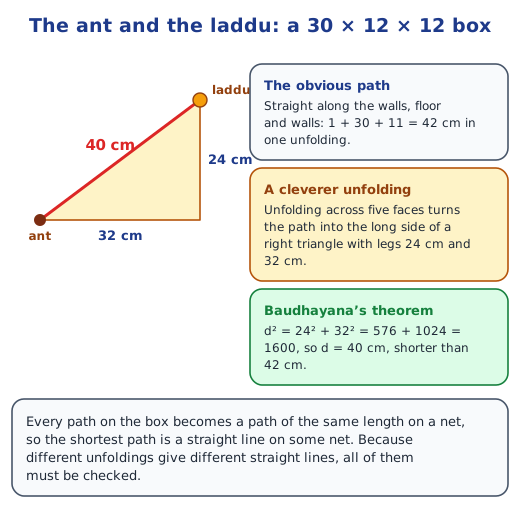
First case: the marked path becomes a straight line on the net, so it is the shortest. Second case: the given paths bend on the net, so they are not shortest; the straight line on the net is. How can we be sure? On a net the shortest route is a straight line, and every path on the box has the same length on the net. Third case (8 cm, 4 cm, 4 cm box): in the first unfolding the straight line leaves the net, so it is not a real path; unfolding differently keeps the line on the net and gives the shortest path. Trickier case (30 × 12 × 12 box): the unfoldings give different lengths, 42 cm for one and √(24² + 32²) = 40 cm for another; the shortest path is 40 cm. Have we finished? Only after every way of unfolding has been compared.
Projections (pages 87–92)
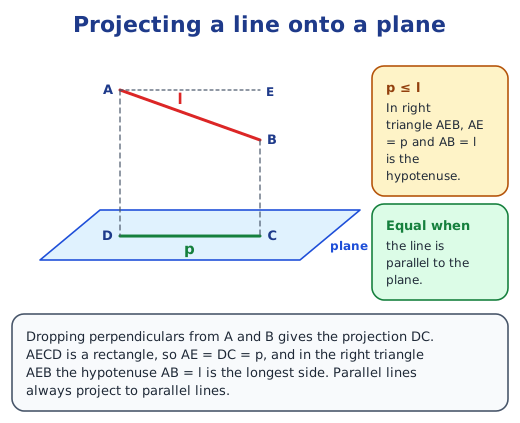
Compare p and l. AECD is a rectangle because AD and EC are both perpendicular to the plane and AE is drawn parallel to DC, so AE = DC = p. In triangle AEB, ∠AEB = 90°, so AB = l is the hypotenuse: p ≤ l. Equal when the line is parallel to the plane.
Projections of a square: a square (parallel to the plane), a rectangle (tilted about one side), a parallelogram (tilted otherwise) or a segment (edge-on). Of a parallelogram: always a parallelogram or a segment, never another kind of quadrilateral, because parallel lines project to parallel lines. Of a regular n-gon: an n-sided polygon (regular only when parallel to the plane), keeping parallel sides parallel, or a segment. Cube and cone: a cube gives a square, rectangle or hexagon; a cone gives a circle (from above), a triangle (from the side) or a rounded shape in between. Another object with the same projection: a longer line tilted more, a taller cuboid seen end-on, and for a cone, a square pyramid of the same height and base width (same triangle from the side) or a cylinder (same circle from above).
Figure it Out (page 92), 1. All three lines have the same front view, so they cover the same width. The side view shows how far each line goes back, and the top view is the slanted length: (top view)² = (front view)² + (side view)². In general, the squares of the three view lengths add up to twice the square of the line’s true length.
2. With faces parallel to the planes: cube: three equal squares. Cuboid: three rectangles. Parallelepiped: parallelograms or rectangles depending on its tilt. Cylinder standing up: rectangle (front), circle (top), rectangle (side). Cone standing up: triangle, circle with its centre marked, triangle. Triangular prism lying on a rectangular face: triangle (front), rectangle (top), rectangle (side). Square pyramid: triangle, square with its diagonals, triangle.
3. Measuring jug: the last row (jug, circle with spout and handle, jug). Funnel: the sixth row. Hammer: the seventh row. Car: the first row. Slide: the third row (narrow rectangle, long strip, sloping side). Chair: the fourth row. Ceiling fan: the fifth row. Lunch box: the second row (box with lid, circle with handle, box with handle).
Shadows (page 94)
The shadow is like the projection but scaled up. Moving the torch closer to the object makes the shadow bigger, because the light rays spread out from the torch and fan out more before reaching the wall; moved far away, the rays are almost parallel and the shadow approaches the projection. A parallelogram’s shadow in sunlight is always a parallelogram.
Figure it Out (pages 95–97)
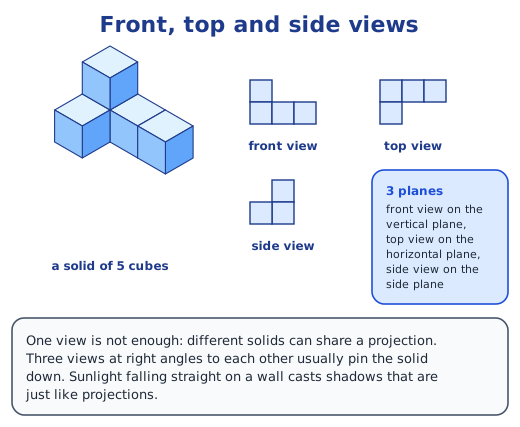
1. Look along each arrow. First shape (a flat L): front a long rectangle, top an L, side a short rectangle. Second (a low block beside a tall column): front a short square beside a tall rectangle, top an L of squares, side a tall rectangle with a low step behind. Third (a flat zigzag): front a long rectangle, top a Z-shaped step, side a rectangle. Fourth (a slab with a stepped wall behind): front a wide base with a taller part rising on the left, top a rectangle with lines at the steps, side an L. Fifth (an upright T): front a column with a square sticking out to the right, top a short row, side a single column. Sixth (a slotted wall on a base): front a base with two posts and a gap, top a rectangle with lines, side an L.
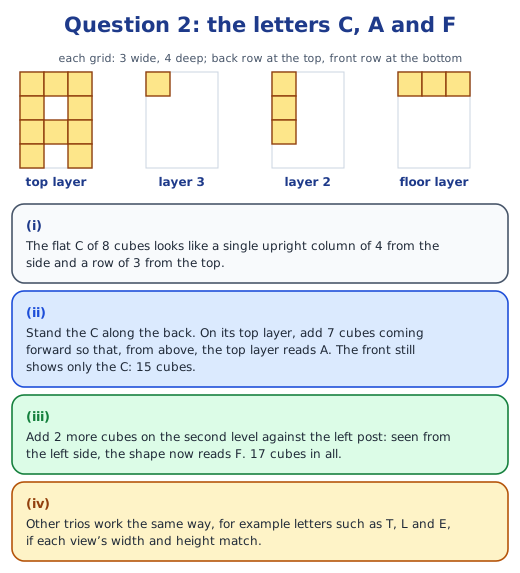
2. (i) From the side, a single upright column of 4 cubes; from the top, a row of 3. (ii) Stand the C along the back and add 7 cubes on its top layer, coming forward, so the top layer reads A from above: 15 cubes. (iii) Add 2 more cubes on the second level against the left post: from the left side it now reads F, 17 cubes in all. (iv) Other trios can be built the same way as long as each view’s width and height agree.
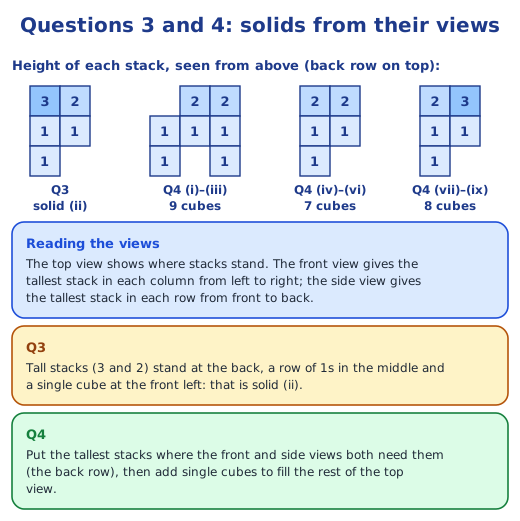
3. Solid (ii): tall stacks of 3 and 2 at the back, a row of single cubes in the middle and one cube at the front left. 4. (i)–(iii): 9 cubes; (iv)–(vi): 7 cubes; (vii)–(ix): 8 cubes, built as in the height grids below.
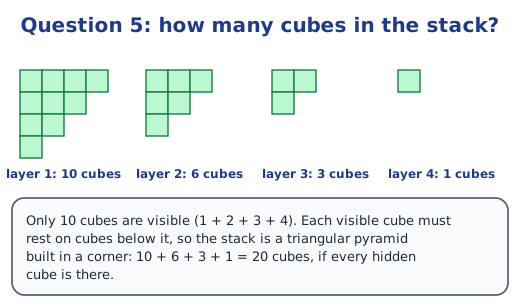
5. 10 cubes can be seen. If every cube rests on cubes below it, the stack is a triangular pyramid with layers of 10, 6, 3 and 1: 20 cubes.
6. A square, a rectangle or a hexagon (a regular hexagon when the cube balances on a corner).
Isometric projections (pages 97–102)
Why are the projected edges equal? With the cube balanced on a corner, its long diagonal is vertical, and the cube looks the same after a third of a turn about it. So the three edges at the top corner, and likewise all 12 edges, tilt by the same amount and project to the same length. A 2 × 2 × 2 cube is drawn by going two units along each axis, as shown.
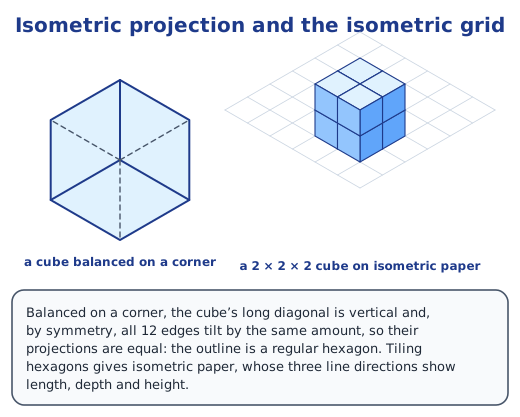
Why is isometric paper so effective? Parallel edges stay parallel and equal steps along length, depth and height stay equal, so the drawing keeps the shape’s proportions.
Figure it Out (page 100), 1. Yes, besides the five flat shapes there are three more: a corner in which three cubes are joined to one central cube in three directions, and two twisted shapes that are mirror images of each other. 2. Draw each edge in turn along the height (|), length or depth lines, counting units. 3. Yes: the ball seems to go round and round always moving the same way, yet return to its start. Each part of the drawing is possible, but the whole loop cannot exist; isometric drawing hides depth, so points far apart can appear joined. 4. (i) No; a real model of cubes can only look like it from one exact viewpoint. Its front, top and side profiles would each be an L-shape made by two of its three bars. (ii) Draw each bar along one isometric direction. (iii) The illusion works because an isometric drawing has no depth information: we read each corner correctly, and the brain assumes that ends that meet in the drawing meet in space.
Practice
-
Which of these is NOT a net of a cube?
Show answer
Answer: (c) a row of four with two squares hanging below the same end square
-
The perimeter of the Koch snowflake at step n, starting from side 1, is:
Show answer
Answer: (b) 3 × (4/3)ⁿ
-
How many cubes are in the 17-cube shape that looks like C, A and F?
Show answer
Answer: (c) 17
-
Can a triangle be cut out so that it folds into a regular tetrahedron? Describe it.
Show answer
Answer: Yes: draw an equilateral triangle, join the midpoints of its sides to make four equal triangles, cut it out and fold the three corner triangles up until their tips meet.
-
Find the number of holes in the Sierpinski triangle after 3 steps.
Show answer
Answer: 1 + 3 + 9 = 13 holes, while 27 small triangles remain.
Stuck on a question?
Take a photo and Lagnever AI explains it step by step. Try it for 7 days for ₹2.
Get it on Google Play Open in browser
For parents: after the trial, the plan renews monthly by UPI or card autopay. You can cancel anytime in the app.