
Class 8 Maths Part 2 Chapter 4: Exploring Some Geometric Themes Notes
This chapter in five lines
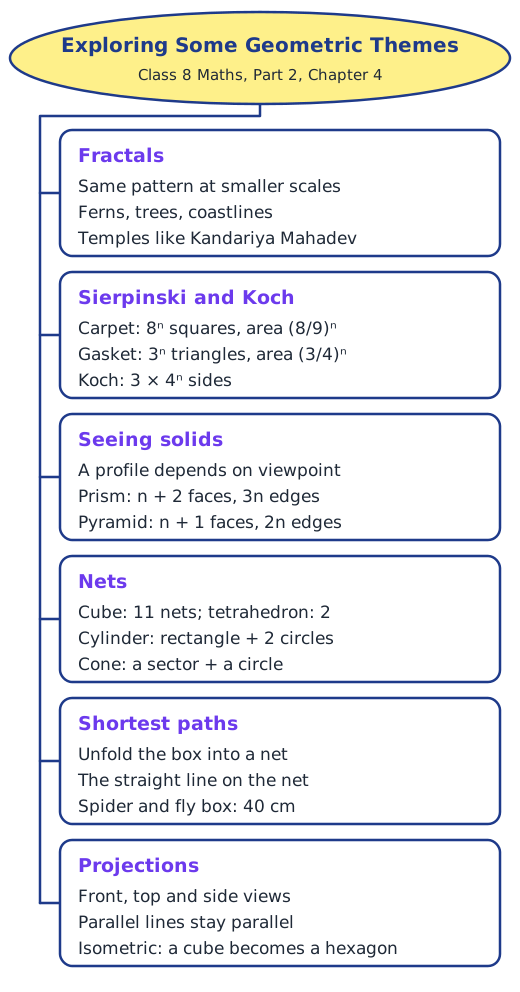
Exploring Some Geometric Themes has two parts. Fractals repeat their own pattern at ever smaller scales, as in ferns, the Sierpinski carpet and the Koch snowflake. Visualising solids covers profiles, faces, edges and vertices, nets, shortest paths on a box, front, top and side views, and isometric drawing, in which a cube becomes a regular hexagon.
What is this chapter about?
This chapter explores two geometric themes. The first is fractals: shapes that repeat their own pattern at smaller and smaller scales. The second is visualising solids: imagining shapes in the mind, unfolding them into nets, finding shortest paths on their surfaces, and drawing them on flat paper with projections and isometric grids.
Fractals
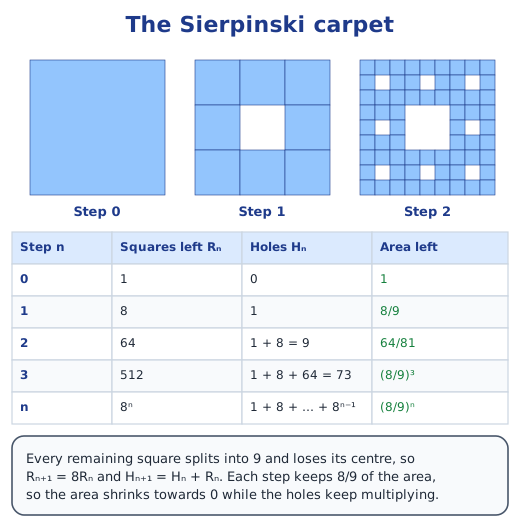
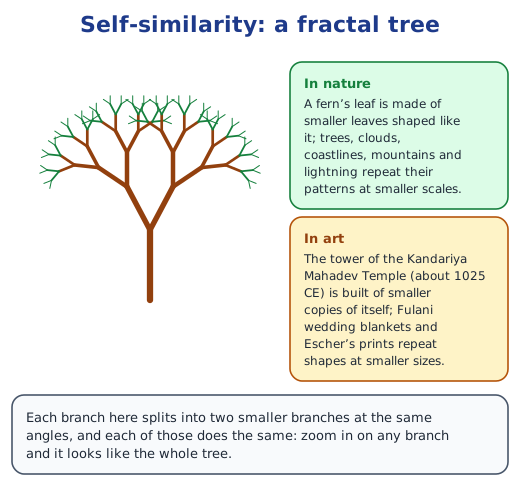
A fern shows the idea well: each leaf is made of smaller leaves shaped like the whole, and those of smaller ones still. Trees, clouds, coastlines, mountains and lightning repeat themselves in the same way. Mathematicians build fractals step by step. In the Sierpinski carpet, a square is cut into 9 and the centre removed, again and again, so after n steps 8ⁿ squares remain and the area left is (8/9)ⁿ. In the Sierpinski triangle, joining midpoints splits a triangle into 4 identical ones and the middle one is removed. In the Koch snowflake, every side’s middle third grows into a small triangle, so each side becomes 4 sides and the perimeter is multiplied by 4/3 at every step. Read fractals.
Fractals in art
Some of the oldest human-made fractals are in Indian temples. The tower of the Kandariya Mahadev Temple at Khajuraho, completed around 1025 CE, is made of smaller copies of itself, which carry even smaller copies; temples in Madurai, Hampi, Rameswaram and Varanasi show similar patterns. Nigerian Fulani wedding blankets nest diamonds within diamonds, and the Dutch artist M.C. Escher drew lizards at smaller and smaller scales.
Seeing solids
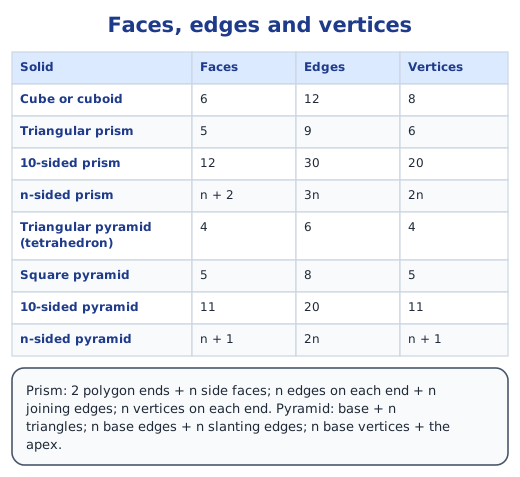
Inventors like Nikola Tesla built machines in their heads before building them for real. Try it: cut the corners off an imaginary square at the midpoints of its sides and a smaller square remains. What we see of a solid is its profile from one viewpoint, and it can change completely as we move: a cone looks like a circle from above and a triangle from the side. Flat-faced solids have faces, edges and vertices; an n-sided prism has n + 2 faces, 3n edges and 2n vertices, and an n-sided pyramid n + 1 faces, 2n edges and n + 1 vertices. Read visualising solids.
Nets and shortest paths
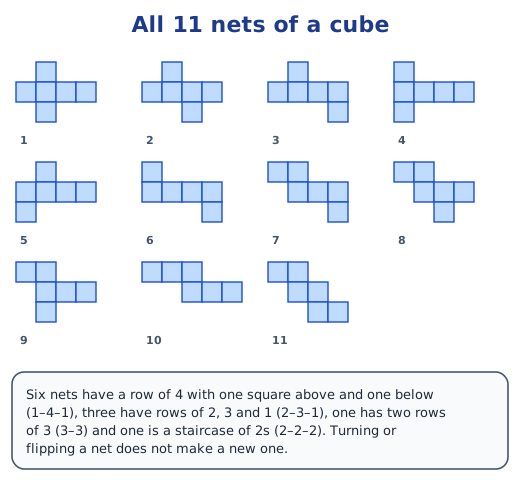
A net is a flat shape that folds into a solid. A cube has 11 different nets and a regular tetrahedron only 2; a cylinder opens into a rectangle and two circles, and a cone into a sector of a circle and a circle. Nets also solve a puzzle: a hungry ant on a box wants the shortest route to a laddu. Unfold the box, and the shortest path is a straight line on the right net. In a 30 × 12 × 12 box, the right unfolding gives a right triangle with legs 24 cm and 32 cm, so the path is 40 cm, shorter than the obvious 42 cm. Read nets of solids.
Projections and views
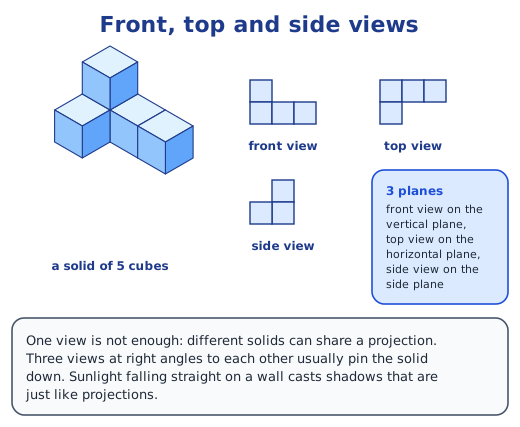
The projection of a point on a plane is the foot of the perpendicular from the point; together, the projections of all its points make the projection of an object. A projection is never longer than the line itself, and parallel lines stay parallel. Because different objects can share one projection, engineers use three: the front view on a vertical plane, the top view on a horizontal plane and the side view on a side plane. Sunlight falling straight onto a wall casts shadows that match projections.
Isometric drawing
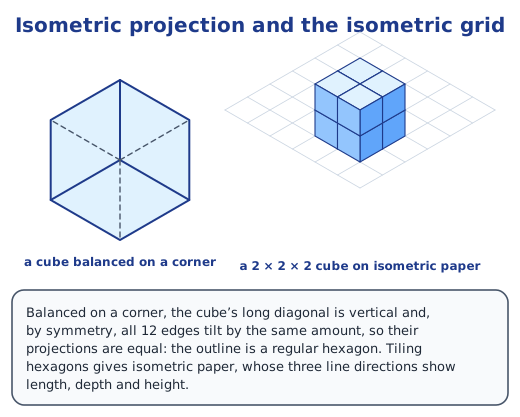
Balance a cube on one corner and look straight down: all 12 edges appear the same length, and the outline is a regular hexagon. This isometric projection is the basis of isometric grid paper, whose three line directions stand for length, depth and height. Drawing on it, edge by edge, makes solid shapes easy to show, such as the five shapes of four squares from Tetris turned into cubes. The same grid also explains impossible figures, like a triangle of cubes that seems to close up but could never be built.
In a nutshell
Fractals repeat themselves at every scale, and simple rules (keep 8 of 9, 3 of 4, or turn 1 side into 4) give exact counts. Solids can be imagined, unfolded into nets and drawn with projections; three views pin a solid down, and isometric paper keeps all three directions in one picture. Answers to every question are in the NCERT solutions for Part 2 Chapter 4.
Key terms
| Term | Meaning |
|---|---|
| Fractal | A self-similar shape that shows the same or a similar pattern again and again at smaller and smaller scales. |
| Sierpinski carpet | A fractal made by cutting a square into 9 and removing the centre, then repeating on every remaining square. |
| Sierpinski triangle (gasket) | A fractal made by joining the midpoints of a triangle, removing the middle triangle and repeating. |
| Koch snowflake | A fractal made by replacing the middle third of every side with two sides of a small equilateral triangle, again and again. |
| Profile | The outline of a solid seen from one particular viewpoint. |
| Faces, edges and vertices | The flat surfaces of a solid, the line segments where faces meet, and the corner points where edges meet. |
| Prism | A solid with two congruent polygons as opposite faces joined by parallelograms. |
| Pyramid | A solid with a polygon base whose vertices are joined to one point outside it, the apex. |
| Net | A flat shape that folds up into a solid; the solid ‘unfolded’ onto a plane. |
| Projection | The shadow-like image of a point or object on a plane, made by dropping perpendiculars onto it. |
| Front, top and side views | The projections of an object on the vertical, horizontal and side planes. |
| Isometric projection | A view of a cube in which all its edges project to equal lengths; the outline is a regular hexagon. |
Topics in this chapter
Practice
-
How many squares remain after step 2 of the Sierpinski carpet?
Show answer
Answer: (c) 64
-
Each step of the Koch snowflake multiplies the perimeter by:
Show answer
Answer: (c) 4/3
-
How many edges does a hexagonal prism have?
Show answer
Answer: (b) 18
-
How many different nets does a cube have?
Show answer
Answer: (c) 11
-
Which solid looks like a circle from above and a triangle from the side?
Show answer
Answer: (b) cone
-
The isometric projection of a cube is a:
Show answer
Answer: (c) regular hexagon
Questions students ask
What are the main topics of Class 8 Maths Part 2 Chapter 4?
Fractals: the Sierpinski carpet and triangle, the Koch snowflake and fractals in nature and art. Visualising solids: imagining shapes, profiles, faces, edges and vertices of prisms and pyramids, nets of solids, shortest paths on a cuboid, projections, front, top and side views, shadows, and isometric drawing.
Is Exploring Some Geometric Themes in the new NCERT Class 8 Maths book?
Yes. It is Chapter 4 of Ganita Prakash, Grade 8 Part 2, on pages 70 to 102.
What is a fractal in simple words?
A fractal is a shape that contains smaller copies of itself, and those contain even smaller copies, and so on. A fern leaf is made of smaller leaves shaped like it; the Sierpinski triangle is made of three smaller Sierpinski triangles.
How do you find the shortest route between two points on the surface of a box?
Unfold the box into a net so that both points lie on it, and join them with a straight line that stays on the net. Different ways of unfolding give different straight lines, so try them all and take the shortest; in the book’s 30 × 12 × 12 box it is 40 cm, found with the Baudhayana theorem.
Stuck on a question?
Take a photo and Lagnever AI explains it step by step. Try it for 7 days for ₹2.
Get it on Google Play Open in browser
For parents: after the trial, the plan renews monthly by UPI or card autopay. You can cancel anytime in the app.