
Nets of solids and the shortest path on a box
Answer in short
A net is a flat shape that folds into a solid. A cube has 11 different nets and a regular tetrahedron 2. A cylinder unfolds into a rectangle and two circles, and a cone into a sector and a circle. Nets also give the shortest route between two points on a box: a straight line on a suitable net.
Stuck on a question? Take a photo and Lagnever AI explains it step by step. Try it for 7 days for ₹2. Get it on Google Play
What is a net?
Many hollow solids, such as boxes, tins and cones, are made by folding flat sheets of paper, card or metal. The flat shape that folds into a solid is its net: the solid ‘unfolded’ onto a plane. Packaging boxes add extra flaps for gluing; those help in making the model but are not part of the net. A real model also needs card that is stiff enough to stand.
Nets of a cube
A cross of six squares, a row of four with one square above and one below, folds into a cube. It is not the only net. Counting two nets as the same when one can be turned or flipped into the other, a cube has exactly 11 nets: six of the 1–4–1 type, three of the 2–3–1 type, one 3–3 and one 2–2–2 staircase. A quick test: if two squares would land on the same face when folding, the shape is not a net.
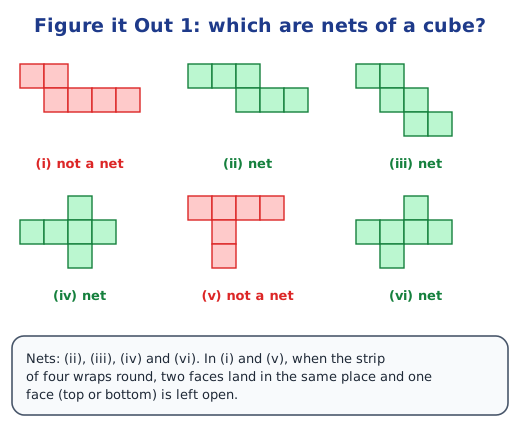
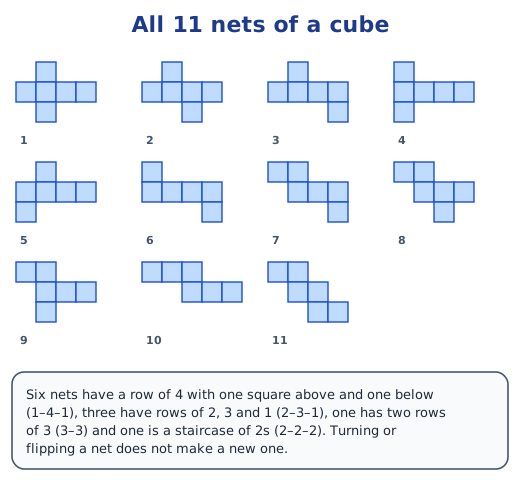
A cuboid’s net is drawn the same way with rectangles: for a 5 cm × 3 cm × 1 cm box, a strip of four rectangles (5 × 3, 5 × 1, 5 × 3, 5 × 1) with two 3 × 1 rectangles on the ends.
Tetrahedron, cylinder and cone
A regular tetrahedron has four equilateral triangles as faces and just 2 nets: a big triangle made of four, and a straight strip of four. A square pyramid’s net is a square with an equal triangle on each side. Cut a cylinder along its height and unroll it: the curved surface becomes a rectangle as long as the base’s circumference, 2πr, and as wide as the height, with the two circular ends attached. Slit a cone along a slanting line and unroll it: every point of its base rim is the same distance from the tip O, so the curved surface becomes a sector of a circle centred at O, plus a circle for the base. An octahedron, two square pyramids joined at their bases, has 11 nets, and a dodecahedron, with 12 pentagonal faces, has 43,380.
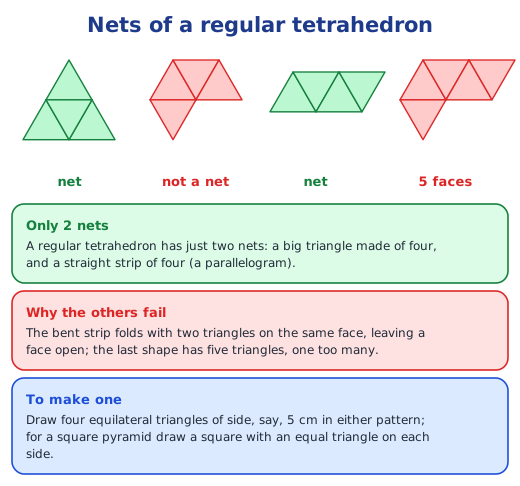
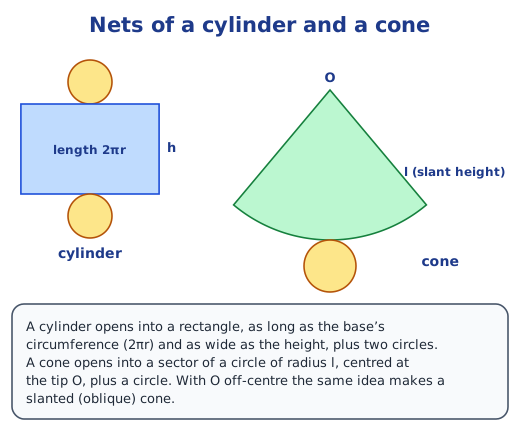
A ball is different: no paper cut-out can wrap a sphere without wrinkles, gaps or overlaps, so a sphere has no net.
The ant and the laddu
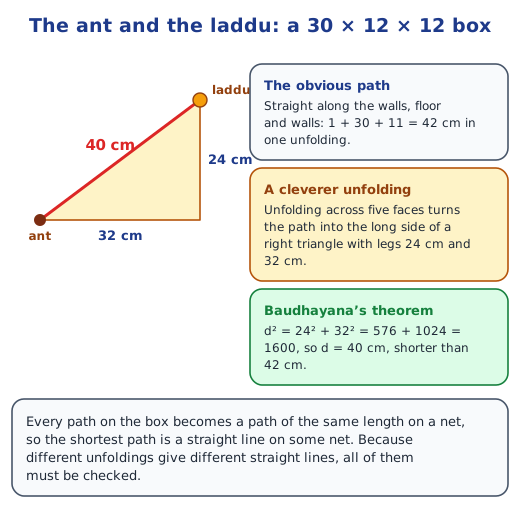
A hungry ant on the surface of a box wants to reach a laddu, walking only on the surface. On a flat surface the shortest path is a straight line, so unfold the box: every path on the box becomes a path of equal length on the net. If the ant’s path becomes a straight line on the net, it is the shortest; if it bends on the net, a straighter route exists. Sometimes the straight line runs off the net, which means that unfolding cannot be used, and another way of unfolding must be tried.
In the book’s trickiest case, a 30 cm × 12 cm × 12 cm box, the ant sits in the middle of one square end, 1 cm below its top edge, and the laddu in the middle of the other end, 1 cm above its bottom edge. One unfolding gives a straight path of 1 + 30 + 11 = 42 cm. Another, crossing five faces, turns the path into the long side of a right triangle with legs 24 cm and 32 cm: by the Baudhayana theorem, d² = 24² + 32² = 1600, so d = 40 cm. The cleverer route is shorter, which is why all the unfoldings must be checked.
More: fractals, visualising solids, the chapter notes and the NCERT solutions.
Practice
-
How many nets does a regular tetrahedron have?
Show answer
Answer: (b) 2
-
The curved surface of a cylinder unfolds into a:
Show answer
Answer: (c) rectangle
-
A cone’s curved surface unfolds into a:
Show answer
Answer: (b) sector of a circle
-
Find the shortest path if the legs of the right triangle on the net are 24 cm and 32 cm.
Show answer
Answer: By the Baudhayana theorem, d² = 24² + 32² = 576 + 1024 = 1600, so d = 40 cm.
-
Why can no paper net wrap a ball perfectly?
Show answer
Answer: A sphere curves in every direction, so a flat sheet cannot cover it without wrinkles, gaps or overlaps. That is also why every flat map of the Earth stretches some regions.
Questions students ask
What is a net of a solid?
A net is a flat shape that folds up into the solid; you can think of it as the solid cut along some edges and unfolded flat. When making a model, flaps are added for gluing, but they are not part of the net.
How many nets does a cube have?
Eleven, counting nets as the same when one can be turned or flipped into another: six with a row of four and one square on each side, three with rows of two, three and one, one with two rows of three and one staircase.
How does a net help find the shortest path on a box?
Every path on the box becomes a path of the same length on a net and back again. On a flat net the shortest path is a straight line, so unfold the box in different ways, draw the straight line that stays on the net each time, and choose the shortest.
Stuck on a question?
Take a photo and Lagnever AI explains it step by step. Try it for 7 days for ₹2.
Get it on Google Play Open in browser
For parents: after the trial, the plan renews monthly by UPI or card autopay. You can cancel anytime in the app.