
Fractals: the same pattern at every scale
Answer in short
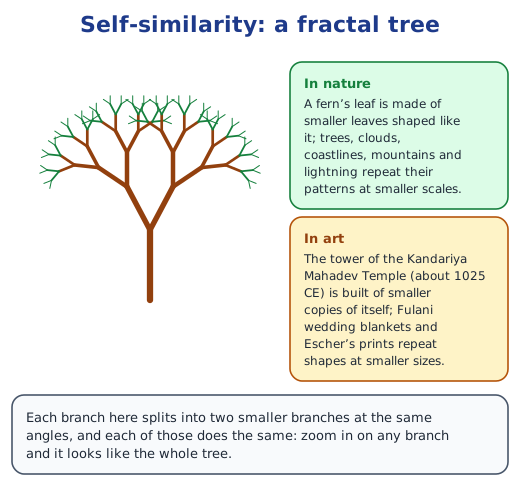
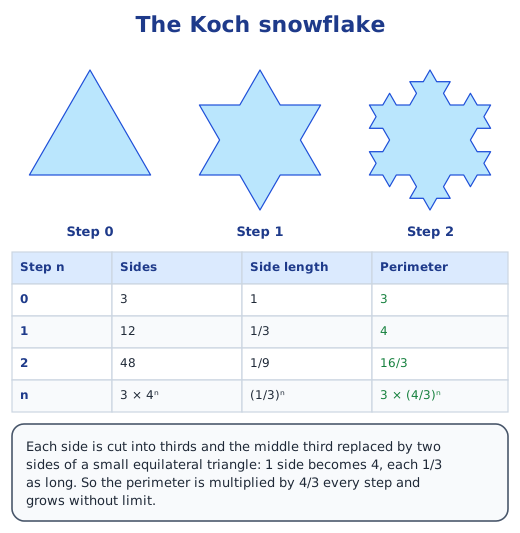
A fractal is a self-similar shape: it repeats its pattern over and over at ever smaller scales, like a fern whose leaves are made of smaller leaves. The Sierpinski carpet keeps 8 of every 9 squares at each step, the Sierpinski triangle keeps 3 of 4 triangles, and the Koch snowflake turns every side into 4 shorter sides.
Stuck on a question? Take a photo and Lagnever AI explains it step by step. Try it for 7 days for ₹2. Get it on Google Play
Self-similar shapes
Look closely at a fern. Each leaf is a small copy of the whole fern, and each part of a leaf is a smaller copy again. A tree trunk divides into limbs, limbs into branches and branches into twigs; clouds, coastlines, mountains and lightning are built the same way. Shapes like these, which repeat their own pattern at ever smaller sizes, are called fractals. Mathematics can build fractals step by step with very simple rules.
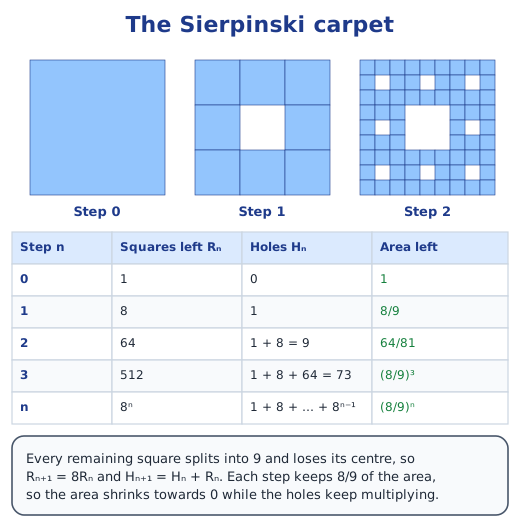
The Sierpinski carpet
The Polish mathematician Sierpinski took a square, cut it into 9 equal squares and removed the centre one. Then he did the same to each of the 8 squares left, and so on. Let Rₙ be the squares remaining and Hₙ the holes after step n. Every remaining square gives 8 squares at the next step, so Rₙ₊₁ = 8Rₙ and Rₙ = 8ⁿ. Every remaining square also makes one new hole, while old holes stay, so Hₙ₊₁ = Hₙ + Rₙ: the holes go 0, 1, 9, 73, …, that is 1 + 8 + 8² + … + 8ⁿ⁻¹. Since 8/9 of the area survives each step, the area left after n steps is (8/9)ⁿ of the first square.
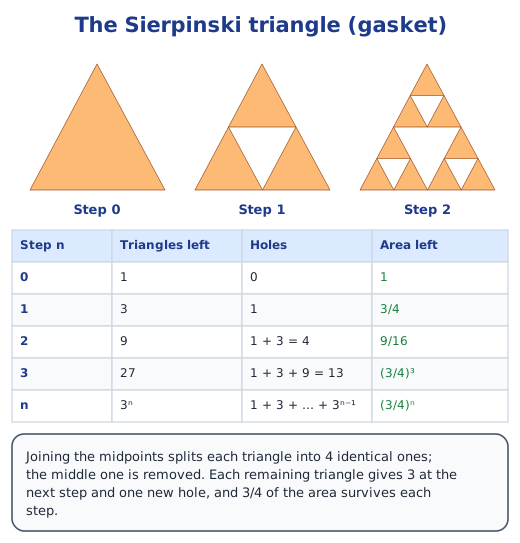
The Sierpinski triangle
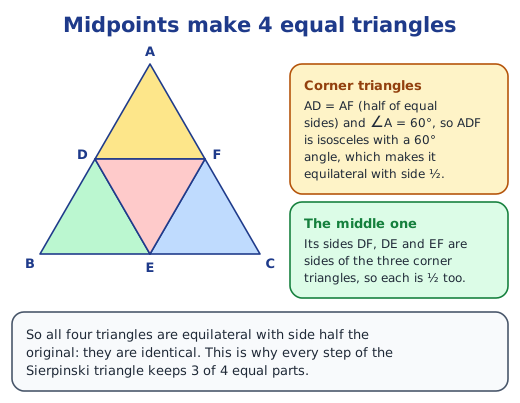
The same idea works with an equilateral triangle. Joining the midpoints of its sides splits it into 4 identical equilateral triangles, because each corner triangle has two equal halves of sides around a 60° angle and so is itself equilateral. Remove the middle triangle, then repeat on the 3 that remain. After n steps there are 3ⁿ triangles, 1 + 3 + … + 3ⁿ⁻¹ holes, and the area left is (3/4)ⁿ.
The Koch snowflake
Described by the Swedish mathematician von Koch in 1904, this one also starts with an equilateral triangle. Divide each side into three equal parts, raise an equilateral triangle on the middle part and remove that middle part, so each side becomes a bump of 4 shorter sides. Repeat on every side of the new shape. Starting with sides of 1 unit, step n has 3 × 4ⁿ sides, each (1/3)ⁿ long, so the perimeter is 3 × (4/3)ⁿ: 3, 4, 16/3, 64/9, … It keeps growing with every step.
Fractals in art
Perhaps the oldest human-made fractals are in India’s temples. The Kandariya Mahadev Temple at Khajuraho, finished around 1025 CE, rises in a tower made of smaller copies of the full tower, carrying still smaller copies, and similar patterns appear in temples in Madurai, Hampi, Rameswaram and Varanasi. Nigerian Fulani wedding blankets nest diamond patterns inside diamonds, and the Dutch artist M.C. Escher’s print ‘Smaller and Smaller’ repeats lizards at shrinking sizes.
Why fractals matter
Fractals are more than pretty pictures. Their exact counts follow from simple rules, which makes them a good way to practise powers and patterns: 8ⁿ, 3ⁿ and 4ⁿ grow very fast, while (8/9)ⁿ and (3/4)ⁿ shrink towards zero. They also behave strangely. The Sierpinski carpet ends up with almost no area but countless holes, and the Koch snowflake stays inside a fixed circle while its boundary grows longer than any length you choose. Shapes like these help scientists describe rough, branching things such as coastlines, blood vessels and river networks.
More from this chapter: visualising solids, nets of solids, the chapter notes and the NCERT solutions.
Practice
-
How many holes does the Sierpinski carpet have after step 2?
Show answer
Answer: (b) 9
-
What fraction of the area of the Sierpinski triangle remains after step 1?
Show answer
Answer: (c) 3/4
-
How many sides does the Koch snowflake have at step 2?
Show answer
Answer: (c) 48
-
Find the area left at step 3 of the Sierpinski carpet if the first square has area 1.
Show answer
Answer: Each step keeps 8/9 of the area, so after 3 steps the area left is (8/9)³ = 512/729, a little over 0.7 square units.
-
Find the perimeter of the Koch snowflake at step 3, starting from a triangle of side 1.
Show answer
Answer: Perimeter = 3 × (4/3)³ = 3 × 64/27 = 64/9, about 7.1 units: 192 sides, each 1/27 long.
Questions students ask
What is a fractal?
A fractal is a shape that is self-similar: it repeats the same or a similar pattern again and again, each time smaller. Ferns, trees, clouds, coastlines, mountains and lightning are natural examples; the Sierpinski carpet, Sierpinski triangle and Koch snowflake are mathematical ones.
How is the Sierpinski triangle made?
Start with an equilateral triangle. Join the midpoints of its sides to split it into 4 identical equilateral triangles and remove the middle one. Repeat with each of the 3 triangles left, and so on. After n steps there are 3ⁿ small triangles and the area left is (3/4)ⁿ of the original.
Are there fractals in Indian art?
Yes. The tower of the Kandariya Mahadev Temple at Khajuraho, completed around 1025 CE, is built of smaller copies of the whole tower, which carry even smaller copies. Fractal-like patterns also appear in temples at Madurai, Hampi, Rameswaram and Varanasi.
Stuck on a question?
Take a photo and Lagnever AI explains it step by step. Try it for 7 days for ₹2.
Get it on Google Play Open in browser
For parents: after the trial, the plan renews monthly by UPI or card autopay. You can cancel anytime in the app.