
Visualising solids: profiles, views and isometric drawing
Answer in short
Visualising solids means imagining shapes and showing them on flat paper. A solid’s profile, its outline from one viewpoint, changes as the viewpoint moves. Projections drop each point straight onto a plane; the front, top and side views together describe a solid. In an isometric projection all edges of a cube look equal and its outline is a regular hexagon.
Stuck on a question? Take a photo and Lagnever AI explains it step by step. Try it for 7 days for ₹2. Get it on Google Play
Building in your imagination
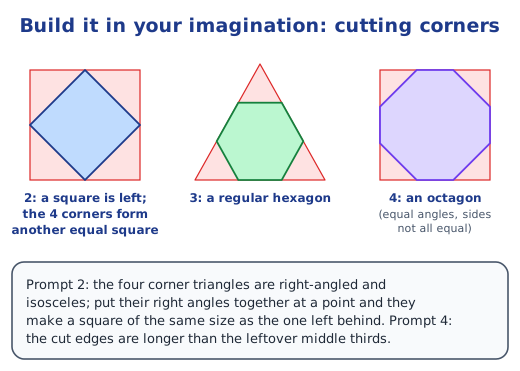
Before drawing anything, try picturing it. Read your name backwards by seeing the letters in your mind. Cut the four corners off an imaginary square, each cut joining the midpoints of two neighbouring sides: a smaller, tilted square remains, and the four corner triangles fit together into another square of the same size. Cut the corners of an equilateral triangle at the third-marks and a regular hexagon remains; do the same to a square and an octagon remains.
Profiles change with the viewpoint
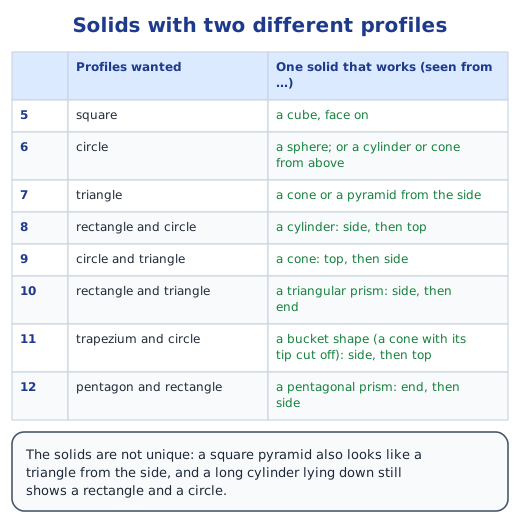
When we look at a solid we see its profile, its outline from that viewpoint. An elephant seen from the front, the side and above gives three very different outlines, and simple solids do the same. A cylinder shows a rectangle from the side and a circle from above; a cone a triangle and a circle; a triangular prism a rectangle and a triangle; a bucket shape a trapezium and a circle. More than one solid can fit the same pair of profiles.
Faces, edges and vertices
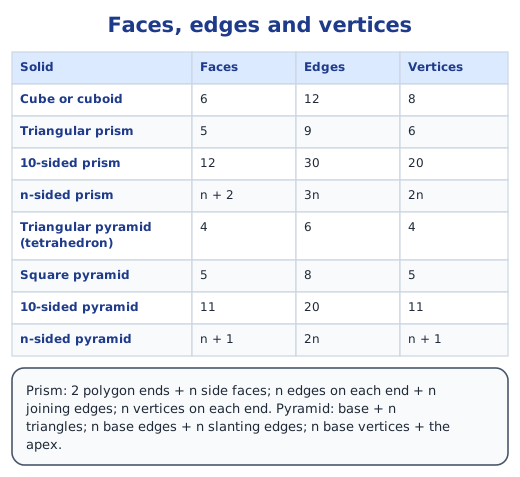
Solids with flat faces can be counted. A cube has 8 vertices, 12 edges and 6 faces. A prism has two congruent polygons as opposite faces, joined by parallelograms; with n-sided ends it has n + 2 faces, 3n edges and 2n vertices. A pyramid has an n-sided base joined to one apex; it has n + 1 faces, 2n edges and n + 1 vertices. A triangular pyramid is also called a tetrahedron.
Projections
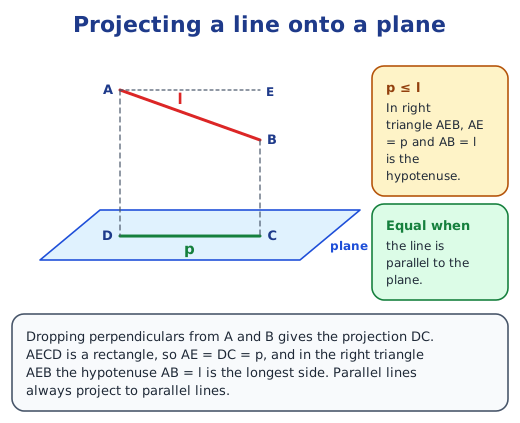
The projection of a point P on a plane is the point O where a line from P meets the plane at right angles. Projecting every point of an object gives its projection. A line’s projection is never longer than the line, because the line is the hypotenuse of a right triangle whose leg is the projection; they are equal only when the line is parallel to the plane. Parallel lines always project to parallel lines, so a parallelogram always projects to a parallelogram (or, edge-on, to a segment). Sunlight shining straight at a wall makes shadows that are practically projections.
Front, top and side views
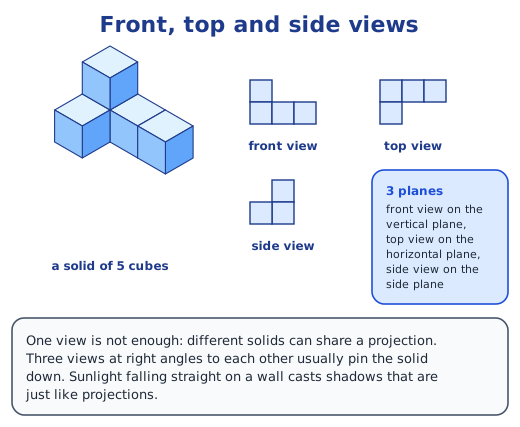
Since many objects share a projection, engineers use three planes at right angles: the front view on the vertical plane, the top view on the horizontal plane and the side view on the side plane. To build a solid from its views, start from the top view to see where stacks stand, then read the tallest stack in each column from the front view and in each row from the side view.
Isometric drawing
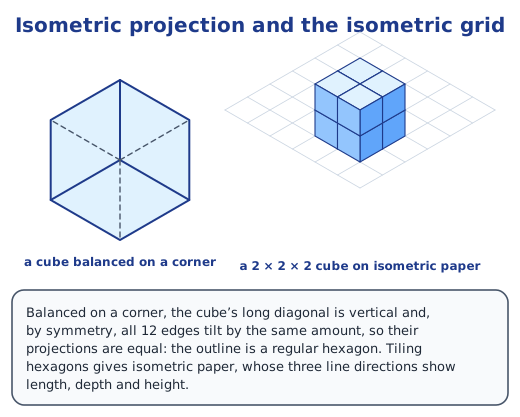
If a cube is balanced on one corner and projected straight down, all 12 edges come out the same length: an isometric projection, a regular hexagon. Tiling the plane with such hexagons gives isometric paper, with lines in three directions for length, depth and height. Draw solids edge by edge along these directions, counting units, and they look right because parallel edges stay parallel and equal steps stay equal.
More: fractals, nets of solids, the chapter notes and the NCERT solutions.
Practice
-
Which solid has a rectangle as one profile and a circle as another?
Show answer
Answer: (b) cylinder
-
A pentagonal pyramid has how many edges?
Show answer
Answer: (c) 10
-
The projection of a parallelogram can be:
Show answer
Answer: (b) a parallelogram or a line segment
-
How many faces, edges and vertices does a 10-sided prism have?
Show answer
Answer: 12 faces (2 ends + 10 sides), 30 edges (10 on each end + 10 joining them) and 20 vertices (10 on each end).
-
Why does a cube balanced on a corner look like a regular hexagon from above?
Show answer
Answer: With a long diagonal vertical, the cube looks the same after turning it by a third of a turn, so every edge is tilted by the same amount and projects to the same length. The outline is six equal edges with equal angles: a regular hexagon.
Questions students ask
What are the front, top and side views of a solid?
They are its projections on three planes at right angles to each other: the front view on a vertical plane in front, the top view on a horizontal plane below, and the side view on a plane to one side. Together they describe the solid, while any one view may fit several solids.
What is an isometric projection?
It is a view in which all the edges of a cube project to the same length; ‘isometric’ means ‘equal measure’ in Greek. A cube balanced on one corner and seen from above gives it: a regular hexagon. Tiling hexagons gives isometric grid paper, used to draw solids along length, depth and height.
What shapes can the projection of a cube make?
Depending on how it is turned: a square (face-on), a rectangle (tilted about one edge), or a hexagon (tilted in other ways), which is regular when the cube balances on a corner.
Stuck on a question?
Take a photo and Lagnever AI explains it step by step. Try it for 7 days for ₹2.
Get it on Google Play Open in browser
For parents: after the trial, the plan renews monthly by UPI or card autopay. You can cancel anytime in the app.