
NCERT Solutions Class 8 Science Chapter 10: Light: Mirrors and Lenses
Answers to every question in Chapter 10, Light: Mirrors and Lenses, of Curiosity, the Class 8 Science textbook (Reprint 2026-27): Probe and ponder, the questions in Activities 10.1 to 10.11 and in the text, all twelve questions of Keep the curiosity alive, and Discover, design, and debate. Page numbers follow the book (pages 152–169). Short notes: Chapter 10 notes.
Probe and ponder (page 152)
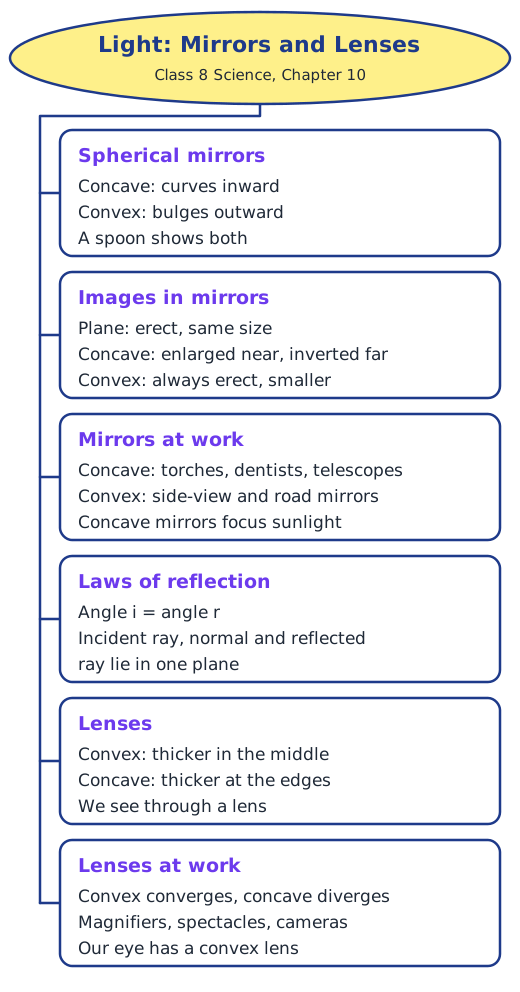
Can mirrors give enlarged or diminished images? Yes. A concave mirror gives an enlarged image of an object held close to it, and a convex mirror always gives a diminished image.
Why do side-view mirrors carry the warning about objects being closer? The mirrors are convex. They show a wide view of the road behind, but every vehicle appears smaller than it really is, and so seems farther away. The warning stops drivers from misjudging the distance.
The curved line on some reading glasses. Such glasses (bifocals) have two parts with different lenses: the upper part helps the wearer see distant things and the lower part helps with reading close up. The line marks where the two lenses meet.
Spherical mirrors and their images (pages 153–157)
Activity 10.1. Yes, the spoon acts like a mirror. In its inner, curved-in side the image of the face is inverted; on its outer, bulging side it is erect but smaller. Moving the spoon away changes the size of the image. The spoon’s two sides behave like a concave and a convex mirror.
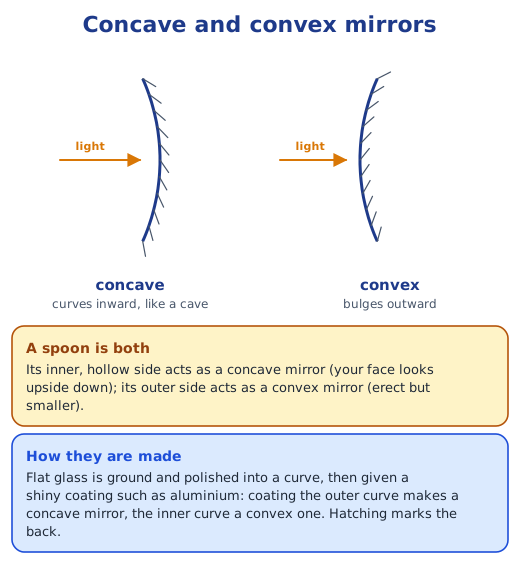
Activity 10.2. Seen from the side at eye level, the concave mirror’s surface dips inward and the convex mirror’s surface rises outward.
Activity 10.3. With the toy 3–4 cm away, the concave mirror shows an erect, enlarged image and the convex mirror an erect, diminished image; both show lateral inversion. As the toy moves away, the concave mirror’s image becomes inverted, enlarged at first and then smaller, while the convex mirror’s image stays erect and grows slightly smaller. Conclusion: unlike a plane mirror, the image in a spherical mirror changes with distance, and only the concave mirror can invert it.
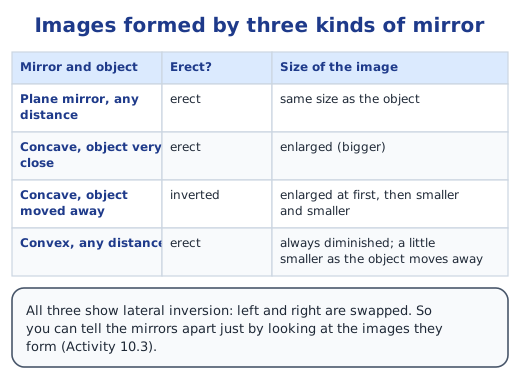
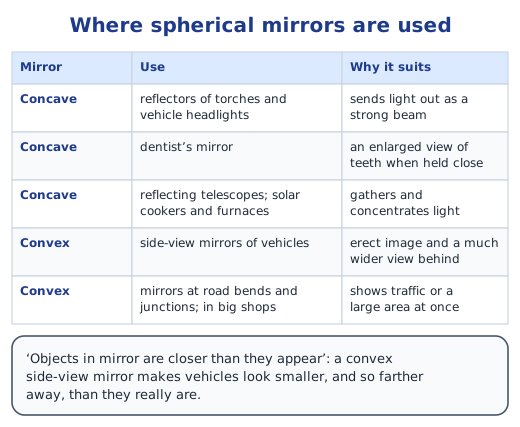
Where are they used? Concave: torch and headlight reflectors, dentists’ mirrors, telescopes. Convex: side-view mirrors, road safety mirrors at bends and junctions, and shop surveillance mirrors.
Laws of reflection (pages 157–160)
Activity 10.4. Yes, when the incident beam shifts, the reflected beam shifts too. A sample of readings for Table 10.1: i = 20°, r = 20°; i = 35°, r = 35°; i = 50°, r = 50° (small differences come from drawing and measuring). For a beam along the normal, both angles are 0°.
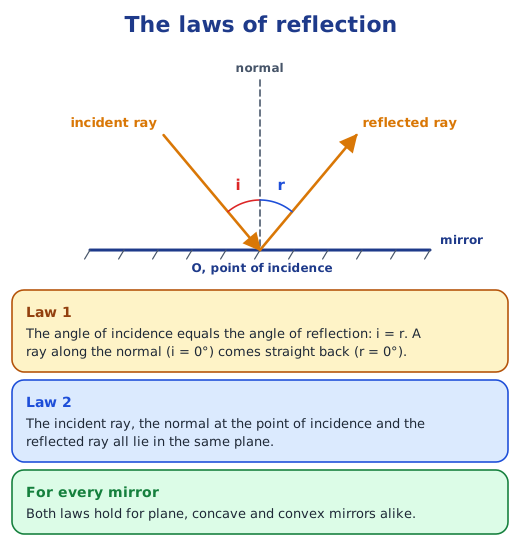
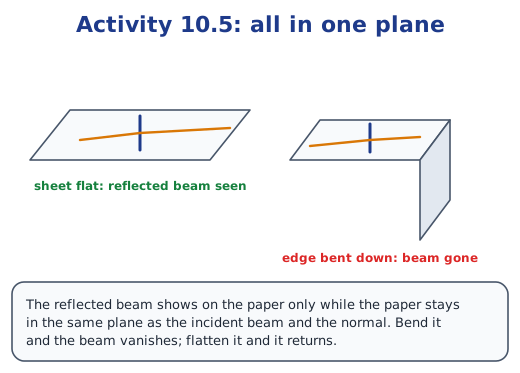
Activity 10.5. No: when the projecting part of the sheet is bent, the reflected beam cannot be seen on it; it reappears when the sheet is flattened. The incident ray, the normal and the reflected ray lie in one plane.
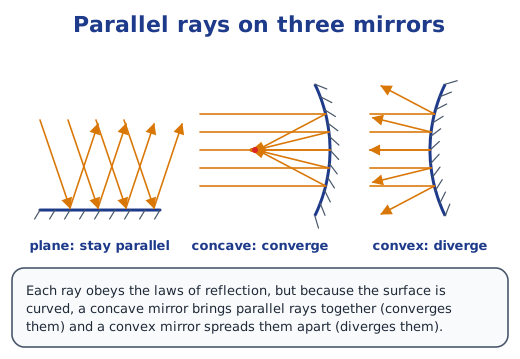
Activity 10.6. Yes, the observations match Fig. 10.11: the reflected beams stay parallel from the plane mirror, converge from the concave mirror and diverge from the convex mirror.
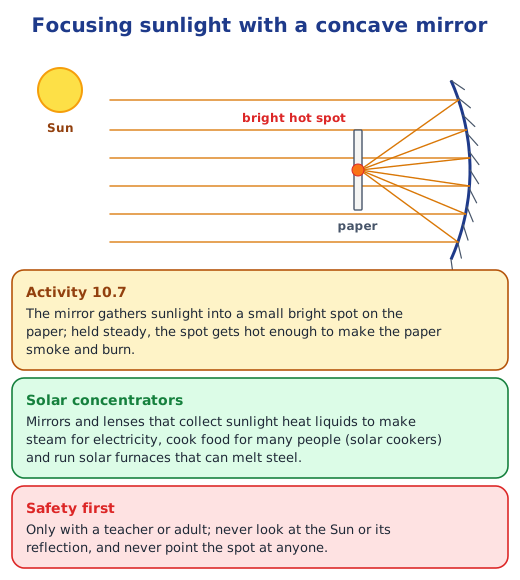
Activity 10.7. Yes. After a few minutes the bright spot makes the paper smoke and it may start to burn, because the concave mirror concentrates sunlight on that small spot.
Lenses (pages 161–165)
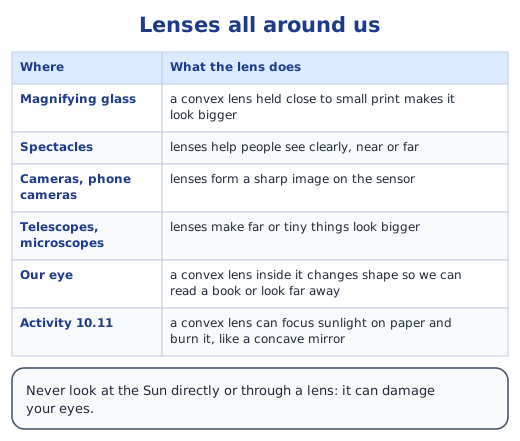
Activity 10.8. The water drop’s surface curves outward. The letters just below it look enlarged compared with the letters beside it: the drop acts as a simple convex lens.
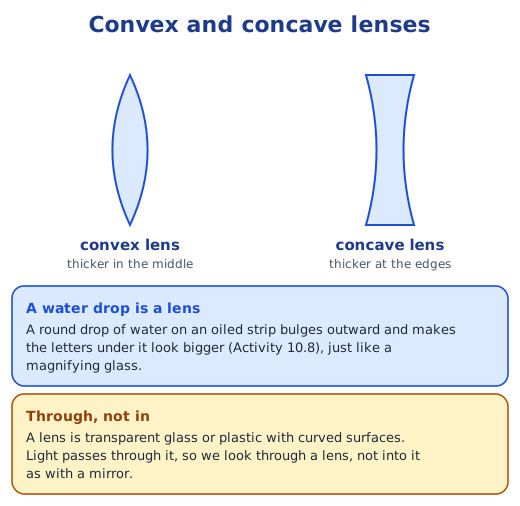
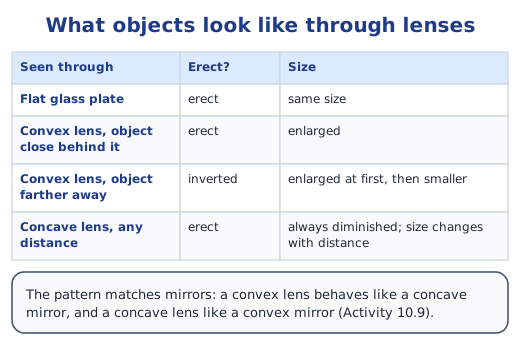
Activity 10.9. Through the convex lens, the nearby object looks erect and enlarged; as it moves away it looks inverted, enlarged at first and then smaller. Through the concave lens it always looks erect and diminished. Conclusion: a convex lens can enlarge and invert, depending on distance, while a concave lens always makes things look smaller and upright.
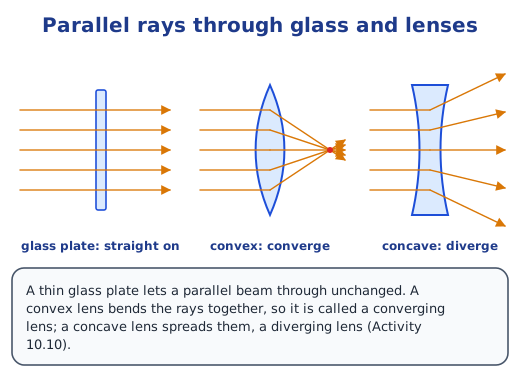
Activity 10.10. No, only through the thin glass plate does the beam pass unchanged. The convex lens converges the beams and the concave lens diverges them.
Activity 10.11. Yes, a convex lens held in sunlight can focus it into a bright spot that burns the paper, just as the concave mirror did. Never look at the Sun through the lens.
Keep the curiosity alive (pages 166–169)
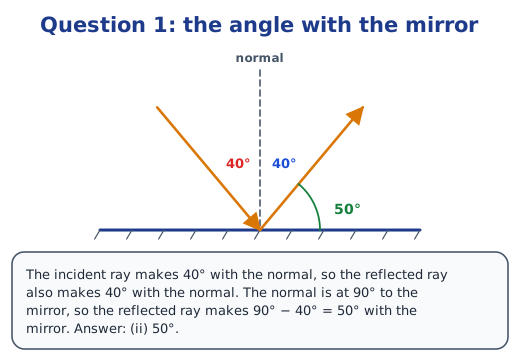
1. (ii) 50°. The reflected ray makes 40° with the normal, and so 90° − 40° = 50° with the mirror.
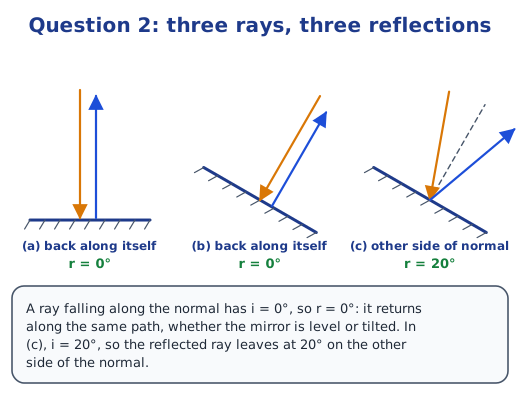
2. (a) The reflected ray goes straight back along the normal: angle of reflection 0°. (b) It also returns along its own path, since it falls along the normal of the tilted mirror: 0°. (c) It leaves 20° from the normal, on the other side: 20°.
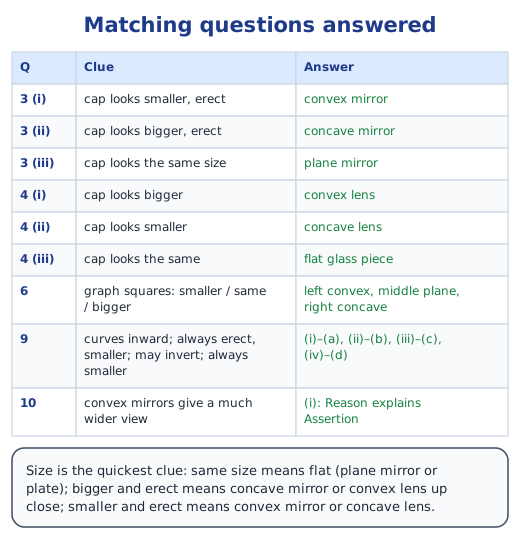
3. (i) The cap looks smaller and erect: convex mirror. (ii) It looks larger and erect: concave mirror. (iii) It looks the same size: plane mirror.
4. (i) Enlarged: convex lens. (ii) Diminished: concave lens. (iii) Same size: flat transparent glass piece.
5. (ii) The angle of incidence is 0° (and so is the angle of reflection; the light goes straight back).
6. Left mirror: the graph squares look smaller, so it is the convex mirror. Middle: the squares look the same as on the sheet, so it is the plane mirror. Right: the squares look larger, so it is the concave mirror.
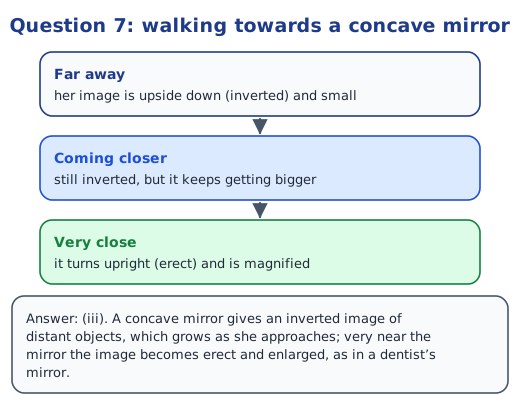
7. (iii). From far away she sees an inverted image that keeps growing as she walks closer; very near the mirror it becomes erect and magnified.
8. Held a few centimetres above the text, the magnifying glass shows the letters erect and bigger. Moved farther away, the letters grow, then blur, and beyond that they look upside down and smaller. A magnifying glass is a convex lens.
9. (i)–(a), (ii)–(b), (iii)–(c), (iv)–(d).
10. (i). Both are correct, and the Reason explains the Assertion: a convex mirror gives an erect image of a much larger area behind.
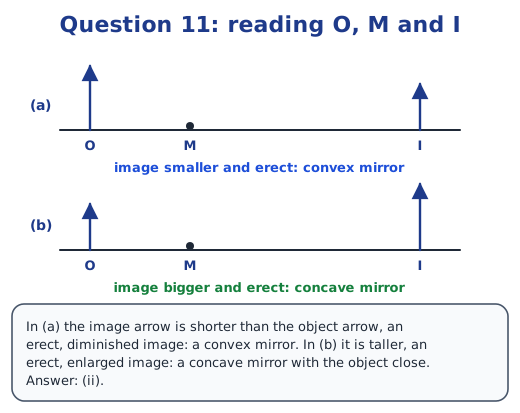
11. (ii). In Fig. 10.27(a) the image is erect but smaller than the object, as in a convex mirror; in (b) it is erect and larger, as in a concave mirror with the object close.
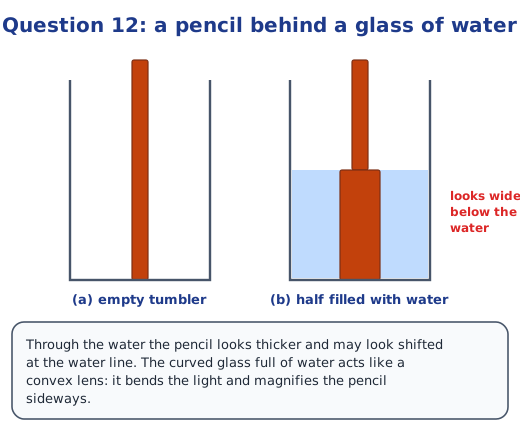
12. The part of the pencil seen through the water looks thicker, and it may look shifted at the water surface, while the part above looks normal. The round glass full of water acts like a convex lens: light from the pencil bends as it passes through, so the pencil looks magnified sideways.
Discover, design, and debate (page 169)
Doctors’ mirrors: dentists use a small concave mirror on a handle to see an enlarged view of the teeth; ENT doctors traditionally wear a concave head mirror that focuses light into the ear, nose or throat. Solar cooker proposal: for example, a box cooker of wood or cardboard with a black inner pot, a glass lid and a flap lined with shiny foil to reflect sunlight in, or a dish of curved mirrors that focuses sunlight on a pot; the proposal should list materials, size, where it will stand, how many people it serves and the cost of each item. Virtual experiments: in a ray-optics simulation, moving the object towards a concave mirror or convex lens shows the image switching from inverted to erect and enlarged.
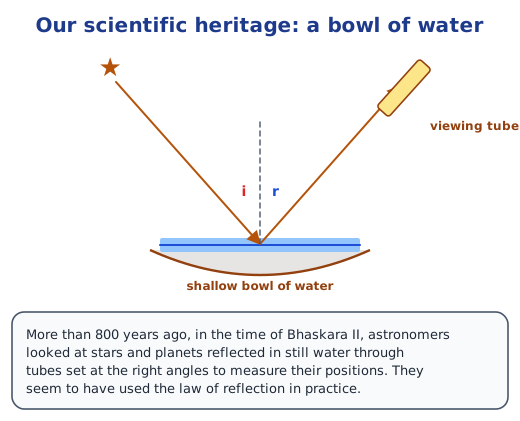
Our scientific heritage. Astronomers in Bhaskara II’s time measured the positions of stars and planets from their reflections in shallow bowls of water, viewed through tubes at the right angles; their methods show that they used the law of reflection in practice.
Practice
-
Walking towards a big concave mirror, a woman sees her image:
Show answer
Answer: (c) is inverted and grows, then becomes erect and magnified
-
When light falls along the normal on a mirror:
Show answer
Answer: (b) the angle of incidence is 0°
-
In Fig. 10.27 the image is smaller in (a) and larger in (b). The mirrors are:
Show answer
Answer: (b) convex and concave
-
Which kind of lens is a magnifying glass?
Show answer
Answer: A convex lens. Held close to print, it makes the letters look erect and bigger; moved farther away, they blur and then look upside down and smaller.
-
Why does a pencil behind a glass half filled with water look wider below the water line?
Show answer
Answer: The curved glass filled with water acts like a convex lens. Light from the pencil bends as it passes through, so the part seen through the water looks magnified sideways.
Stuck on a question?
Take a photo and Lagnever AI explains it step by step. Try it for 7 days for ₹2.
Get it on Google Play Open in browser
For parents: after the trial, the plan renews monthly by UPI or card autopay. You can cancel anytime in the app.