
Class 8 Science Chapter 10: Light: Mirrors and Lenses Notes
This chapter in five lines
Light: Mirrors and Lenses explains curved mirrors and lenses. A concave mirror curves inward and can give enlarged or inverted images; a convex mirror bulges outward and always gives smaller, erect images. Every mirror obeys the laws of reflection. A convex lens is thicker in the middle and converges light; a concave lens is thicker at the edges and diverges it.
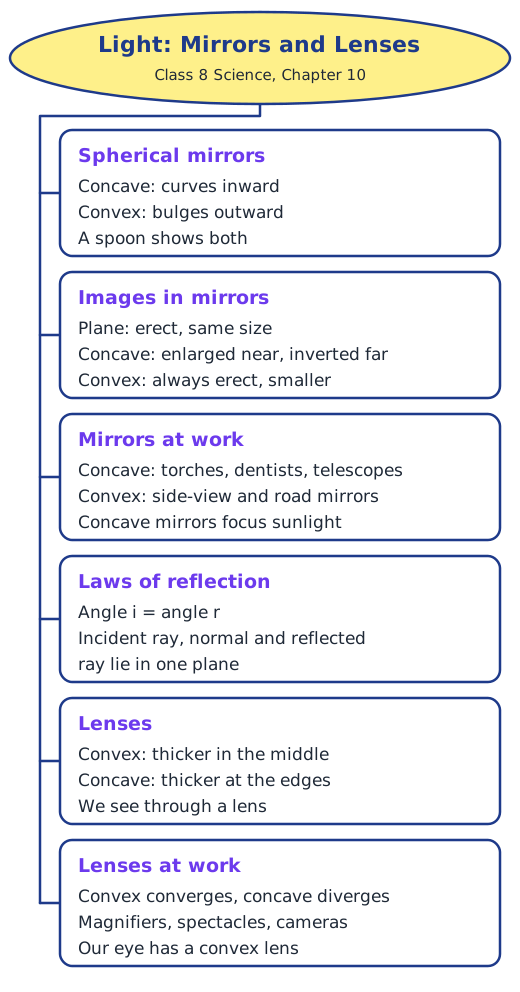
What is this chapter about?
At a science centre Meena looks into a row of curved mirrors. In one her face looks huge, her brother farther away appears upside down, and another mirror shows a tiny Meena. A plane mirror never does this. These are spherical mirrors, and the chapter explains them, the rules that every mirror follows, and their cousins, lenses, which we look through instead of into.
Spherical mirrors
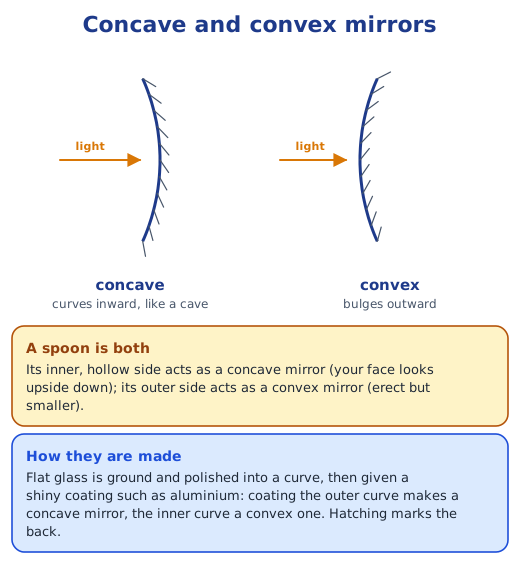
A shiny spoon is a good start (Activity 10.1). Its hollow inner side shows your face upside down; its bulging back shows it upright but smaller. A spherical mirror has a reflecting surface shaped like part of a hollow sphere. If it curves inward, it is a concave mirror; if it bulges outward, a convex mirror. Seen from the side on a table, the difference is easy to spot (Activity 10.2). Such mirrors are not sliced from a glass ball: flat glass is ground into a curve and coated, for example with aluminium. Read spherical mirrors.
The images they form
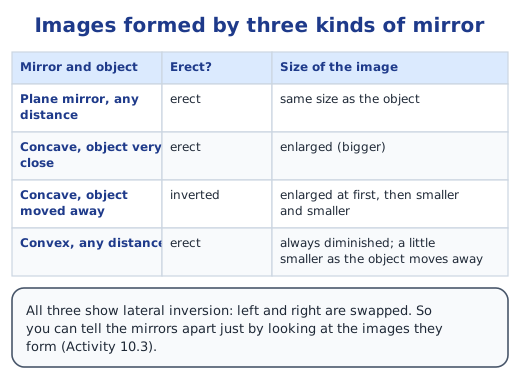
Put a toy in front of a concave and a convex mirror and move it away (Activity 10.3). In the concave mirror, a close object gives an erect, enlarged image; farther away the image turns inverted, at first enlarged and then smaller. The convex mirror’s image stays erect and diminished, shrinking slightly as the object moves away. A plane mirror always gives an erect image of the same size. All three show lateral inversion.
Mirrors at work
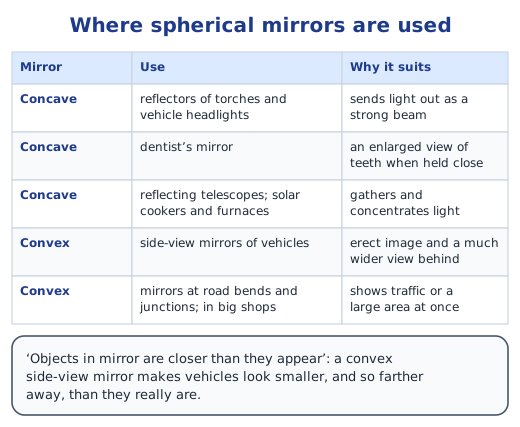
Concave mirrors form the reflectors of torches and vehicle headlights, the dentist’s small mirror that enlarges teeth, and the main mirror of most modern telescopes. Convex mirrors serve as side-view mirrors on vehicles, at sharp bends and road junctions, and in big shops, because they give an erect image of a much wider area. That is why a side-view mirror warns that objects are closer than they appear.
The laws of reflection
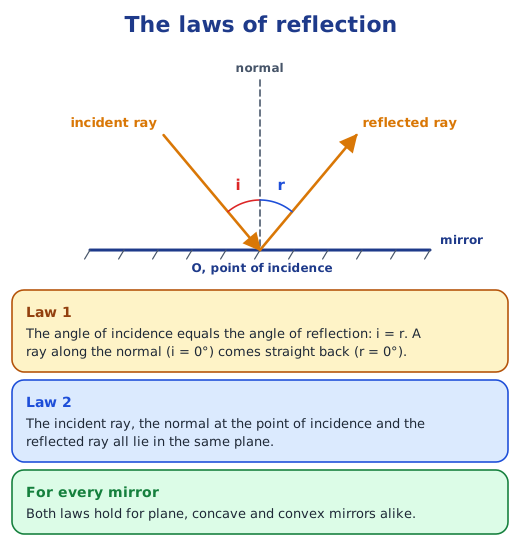
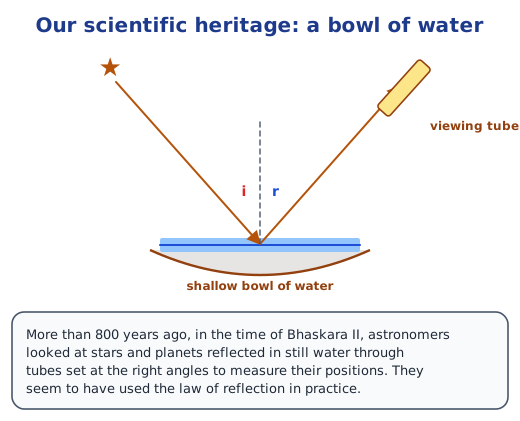
We draw light as rays, straight lines with arrows. The ray falling on a mirror is the incident ray, the one bouncing back the reflected ray, and a line at 90° to the mirror where the ray strikes is the normal. The angles they make with the normal are the angle of incidence (i) and the angle of reflection (r). Measuring them (Activity 10.4) shows that i = r. Bending a sheet of paper shows that the incident ray, the normal and the reflected ray lie in one plane (Activity 10.5). Both laws hold for plane and spherical mirrors. Read laws of reflection.
Bringing light together
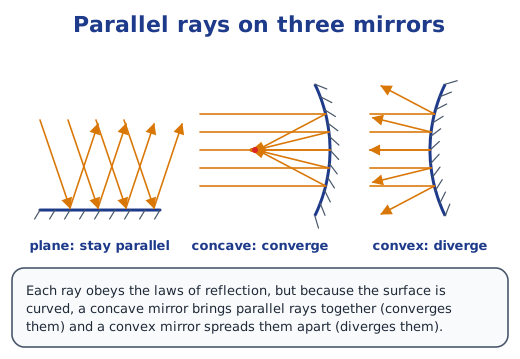
Send several parallel beams at different mirrors (Activity 10.6). From a plane mirror they stay parallel; a concave mirror converges them; a convex mirror diverges them. A concave mirror facing the Sun can gather light into a bright spot that makes paper smoke (Activity 10.7). Solar concentrators use the same idea to make steam, cook food and even melt steel.
Lenses
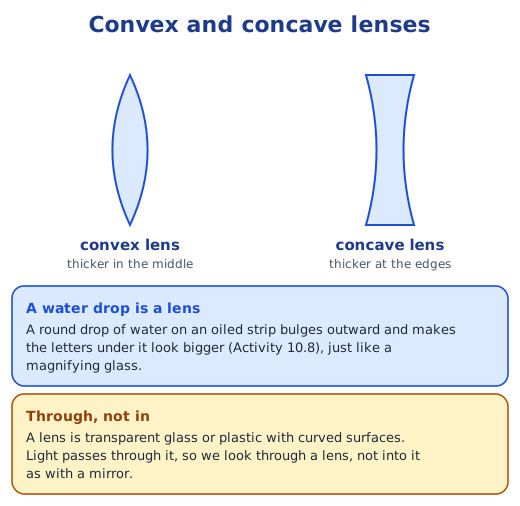
A drop of water on an oiled strip of plastic makes the letters under it look bigger (Activity 10.8): it acts as a simple lens. A lens is a piece of transparent glass or plastic with curved surfaces. A convex lens is thicker in the middle; a concave lens is thicker at the edges. Through a convex lens, a close object looks erect and enlarged, and a farther one inverted; through a concave lens, objects always look erect and smaller (Activity 10.9). A convex lens converges a parallel beam and a concave lens diverges it (Activity 10.10). Read lenses.
Lenses at work
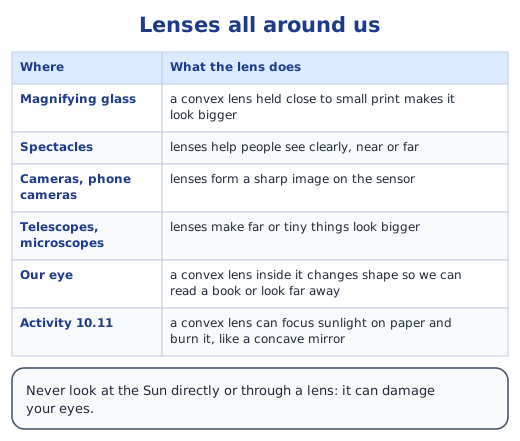
A convex lens can focus sunlight to burn paper (Activity 10.11). Lenses are in spectacles, cameras, telescopes and microscopes, and our own eye has a convex lens that changes shape so we can see both near and far.
Before we move on
More than 800 years ago, in the time of Bhaskara II, astronomers watched stars reflected in bowls of still water through angled tubes to measure their positions, using reflection in practice. Answers to every question are in the NCERT solutions for Chapter 10.
Key terms
| Term | Meaning |
|---|---|
| Spherical mirror | A mirror whose reflecting surface is curved like part of a hollow sphere. |
| Concave mirror | A spherical mirror whose reflecting surface curves inward, like the inside of a spoon. |
| Convex mirror | A spherical mirror whose reflecting surface bulges outward, like the back of a spoon. |
| Erect and inverted | An erect image is the right way up; an inverted image is upside down. |
| Enlarged and diminished | An enlarged image is bigger than the object; a diminished image is smaller. |
| Lateral inversion | The swapping of left and right in an image formed by a mirror. |
| Incident and reflected ray | The ray of light falling on a mirror, and the ray coming back from it. |
| Normal | A line drawn at 90° to the mirror at the point where the ray strikes it. |
| Angle of incidence (i) and of reflection (r) | The angles that the incident ray and the reflected ray make with the normal. |
| Converge and diverge | To bring rays of light together, or to spread them apart. |
| Lens | A piece of transparent glass or plastic with curved surfaces, through which light passes. |
| Convex lens | A lens thicker in the middle than at the edges; a converging lens. |
| Concave lens | A lens thicker at the edges than in the middle; a diverging lens. |
| Solar concentrator | A device that uses mirrors or lenses to gather sunlight into a small area for heat. |
Topics in this chapter
Practice
-
The inner, hollow side of a shiny spoon acts as a:
Show answer
Answer: (b) concave mirror
-
Which mirror always forms an erect, diminished image?
Show answer
Answer: (c) convex
-
A ray strikes a mirror at 30° to the normal. The angle of reflection is:
Show answer
Answer: (a) 30°
-
Which lens is thicker at the edges than in the middle?
Show answer
Answer: (b) concave lens
-
A dentist uses a concave mirror because it:
Show answer
Answer: (b) gives an enlarged view when held close
-
Parallel rays passing through a convex lens:
Show answer
Answer: (b) converge
Questions students ask
What are the main topics of Class 8 Science Chapter 10?
Spherical mirrors, concave and convex, and how to tell them apart; the images they form; their uses; the two laws of reflection; how concave and convex mirrors converge and diverge light; lenses, convex and concave; the images seen through them; and their uses, from magnifying glasses to the human eye.
Is Light: Mirrors and Lenses in the new NCERT Class 8 Science book?
Yes. It is Chapter 10 of Curiosity, the Class 8 Science textbook (Reprint 2026-27), on pages 152 to 169. It builds on ‘Light: Shadows and Reflections’ from the Class 7 book.
Why do side-view mirrors say ‘Objects in mirror are closer than they appear’?
Side-view mirrors are convex. They show a wide view of the road behind, but every image is smaller than the real vehicle, so vehicles look farther away than they actually are. The warning reminds drivers of this.
What is the difference between a mirror and a lens?
A mirror reflects light, so we see images in it. A lens is transparent and lets light pass through, bending it, so we see things through it. Both can be concave or convex, and both can make objects look bigger or smaller.
Stuck on a question?
Take a photo and Lagnever AI explains it step by step. Try it for 7 days for ₹2.
Get it on Google Play Open in browser
For parents: after the trial, the plan renews monthly by UPI or card autopay. You can cancel anytime in the app.