
Spherical mirrors: concave and convex
Answer in short
A spherical mirror’s reflecting surface is curved like part of a hollow sphere. A concave mirror curves inward: a close object gives an erect, enlarged image, a farther one an inverted image. A convex mirror bulges outward and always gives an erect, smaller image with a wide view. Torches and dentists use concave mirrors; vehicles use convex ones.
Stuck on a question? Take a photo and Lagnever AI explains it step by step. Try it for 7 days for ₹2. Get it on Google Play
Curved mirrors
In Class 7 you saw that a plane mirror’s image is upright and exactly as big as the object. Curved mirrors behave differently. Hold a shiny steel spoon near your face (Activity 10.1). In its hollow inner side your face appears upside down; on its bulging back it appears the right way up but smaller. The spoon is acting as two curved mirrors.
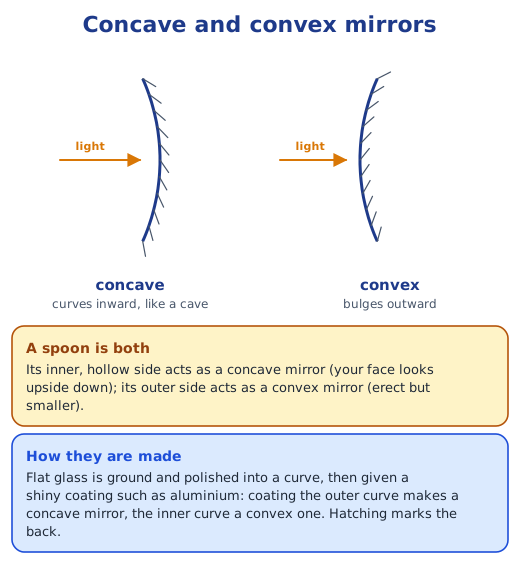
A spherical mirror is a curved mirror whose reflecting surface is part of an imaginary hollow sphere. When the reflecting surface curves inward, like the inside of the spoon, it is a concave mirror. When it bulges outward, like the back of the spoon, it is a convex mirror. In diagrams the back, non-reflecting side is shown shaded or hatched.
These mirrors are not made by cutting up a glass ball. A flat piece of glass is ground and polished into a curve and then given a reflecting coating, such as a thin layer of aluminium. Coating the outer curved surface gives a concave mirror; coating the inner surface gives a convex one.
Telling them apart
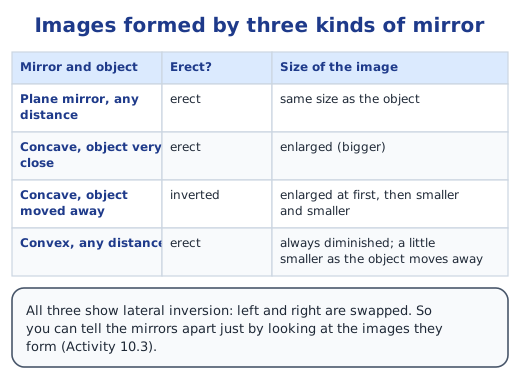
Place both mirrors face up on a table and look from the side with your eye at their level (Activity 10.2): one surface dips inward and the other rises outward. The images give another test. Stand the mirrors upright with a small toy 3 to 4 cm in front, then slowly move the toy away (Activity 10.3).
- In the concave mirror, the close toy looks erect and bigger. As it moves away the image turns upside down, at first still big and then smaller and smaller.
- In the convex mirror, the toy always looks erect and smaller, and shrinks a little more as it moves away.
- In a plane mirror it is always erect and the same size.
All three mirrors show lateral inversion, swapping left and right.
Converging and diverging
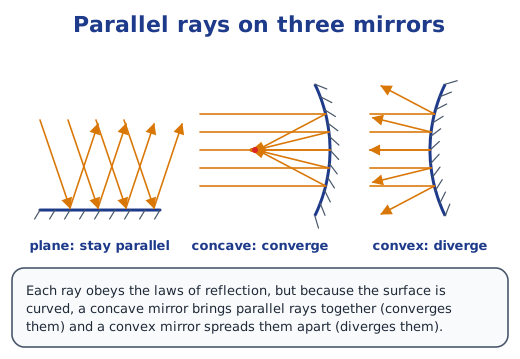
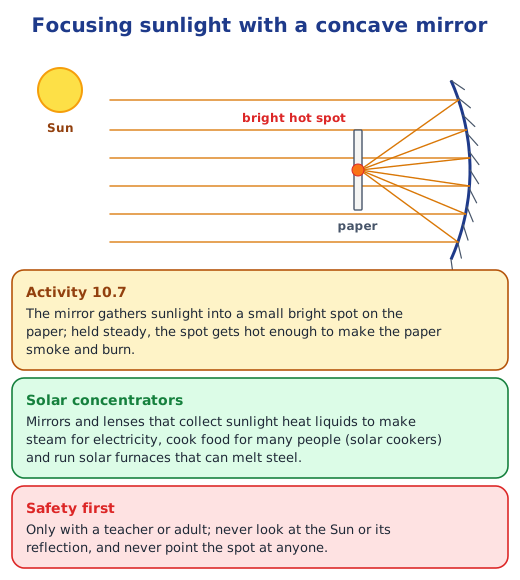
Every ray striking a curved mirror still obeys the laws of reflection, but the curve changes a whole beam. Parallel rays reflected by a concave mirror come together, or converge; parallel rays reflected by a convex mirror spread out, or diverge (Activity 10.6). A concave mirror facing the Sun can therefore gather sunlight into a small, very hot spot (Activity 10.7), the principle behind solar cookers and solar furnaces.
Where they are used
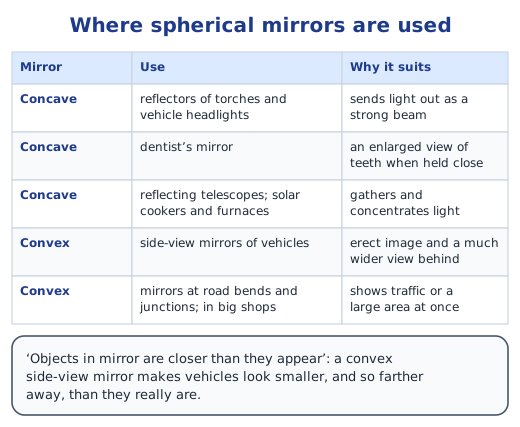
Concave mirrors shape the beams of torches and vehicle headlights; a dentist’s mirror, held close to the teeth, gives an enlarged view; and most modern telescopes collect light with a large concave mirror. Convex mirrors are side-view mirrors on vehicles, safety mirrors at sharp bends and junctions, and surveillance mirrors in big shops, because their erect images take in a wide area.
Why the side-view mirror warns you
A driver glancing at a convex side-view mirror sees the whole lane behind, which is the point of using it. But because the mirror makes every vehicle look smaller, a car that is actually close looks as if it were far back. Mirrors on many vehicles therefore carry the warning that objects are closer than they appear, and drivers learn to turn and check before changing lanes.
Next, see laws of reflection and lenses, or the Chapter 10 notes and the NCERT solutions.
Practice
-
The back of a shiny spoon acts as a:
Show answer
Answer: (b) convex mirror
-
Torch reflectors are:
Show answer
Answer: (c) concave mirrors
-
A mirror always gives a smaller, erect image. It is:
Show answer
Answer: (c) convex
-
How can you tell concave and convex mirrors apart without touching them?
Show answer
Answer: Lay them face up and look from the side at eye level: a concave mirror’s surface dips inward and a convex mirror’s bulges outward. Or look at the images: a convex mirror always shows a smaller, erect image, while a concave mirror shows an enlarged image close up and an inverted one farther away.
-
Why are convex mirrors placed at sharp bends on hill roads?
Show answer
Answer: A convex mirror shows an erect image of a much wider area than a plane mirror, so drivers coming from either side can see vehicles around the bend and avoid a collision.
Questions students ask
What is a spherical mirror?
A mirror whose reflecting surface is curved like part of a hollow sphere. If the shiny side curves inward it is a concave mirror; if it bulges outward it is a convex mirror. Such mirrors are made by grinding and polishing glass into a curve and coating one side, for example with aluminium.
What kind of image does a concave mirror form?
It depends on the distance. With the object very close, the image is erect and larger than the object. As the object moves away, the image becomes inverted; it is enlarged at first and then gets smaller and smaller.
Why are convex mirrors used as side-view mirrors?
They always give an erect image, and because they bulge outward they show a much wider stretch of the road behind than a plane mirror. The images are smaller, which is why the warning says objects are closer than they appear.
Stuck on a question?
Take a photo and Lagnever AI explains it step by step. Try it for 7 days for ₹2.
Get it on Google Play Open in browser
For parents: after the trial, the plan renews monthly by UPI or card autopay. You can cancel anytime in the app.