
The laws of reflection
Answer in short
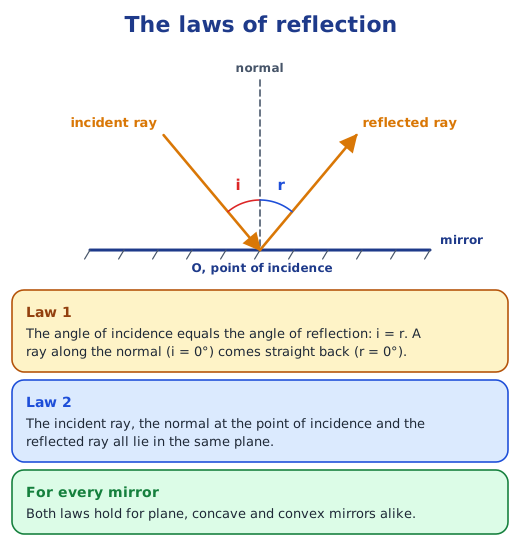
Light reflecting from any mirror follows two laws. The angle of incidence, between the incident ray and the normal, equals the angle of reflection, between the reflected ray and the normal: i = r. And the incident ray, the normal and the reflected ray lie in one plane. Both laws hold for plane, concave and convex mirrors.
Stuck on a question? Take a photo and Lagnever AI explains it step by step. Try it for 7 days for ₹2. Get it on Google Play
Drawing light as rays
Light travels in straight lines, so we draw its path as a ray: a straight line with an arrow. To study reflection, make a thin beam with a torch and a comb covered with black paper except for one gap, and let it fall on a plane mirror standing on white paper (Activity 10.4). Move the torch so the beam strikes the mirror at different angles: the reflected beam moves too.
Naming the parts
Trace the mirror, the beam going in and the beam coming out. The ray falling on the mirror is the incident ray; the ray that comes back is the reflected ray. Remove the mirror and, at the point where the incident ray met it, O, draw a line at 90° to the mirror line. This is the normal at the point of incidence. The angle that the incident ray makes with the normal is the angle of incidence (i); the angle between the normal and the reflected ray is the angle of reflection (r).
The first law
Measure i and r for several angles and record them in a table. They come out nearly equal every time, and with careful work exactly equal. This is the first law: the angle of incidence equals the angle of reflection. When the beam falls along the normal, both angles are zero and the light goes straight back.
The second law
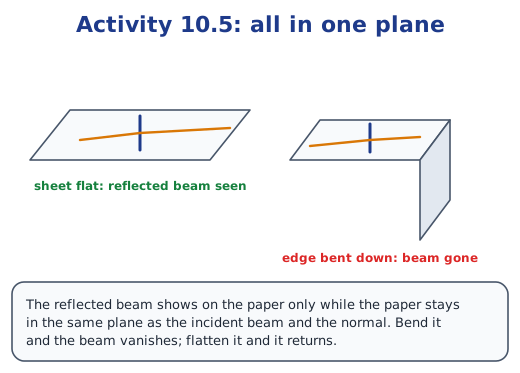
Repeat the activity on a stiff sheet that sticks out past the table’s edge (Activity 10.5). The reflected beam shows on the projecting part. Bend that part down along the table edge and the beam vanishes; flatten it and the beam returns. The bent paper is in a different plane. So the second law: the incident ray, the normal at the point where it strikes and the reflected ray all lie in one plane.
Working with angles
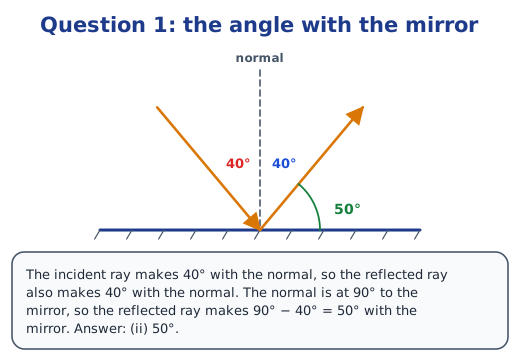
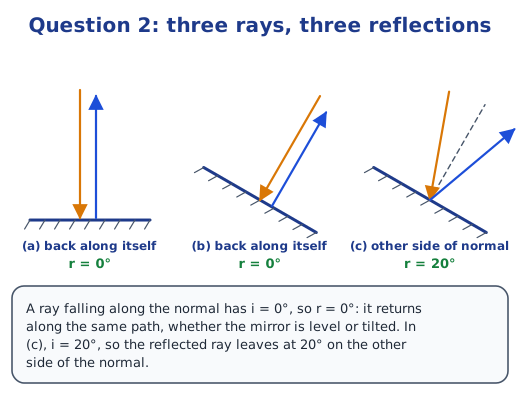
The normal is at 90° to the mirror, so an angle with the normal and the matching angle with the mirror add up to 90°. A ray at 40° to the normal reflects at 40° to the normal, which is 50° to the mirror. Tilting the mirror does not change the rule: if the ray falls along the new normal it comes straight back, and if it falls 20° from the normal it leaves 20° from the normal on the other side.
Curved mirrors obey them too
The laws hold for plane, concave and convex mirrors alike. On a curved mirror the normal points in a slightly different direction at each point, so a parallel beam is brought together by a concave mirror and spread out by a convex one, even though each ray follows i = r. Centuries ago, astronomers in Bhaskara II’s time measured stars from their reflections in still water, using reflection in practice.
Try it at home with a torch, a comb and a small mirror: shine the beam at a slant, mark where it lands on a wall, then tilt the mirror a little and watch how the spot moves. Turning the mirror by a small angle swings the reflected beam by twice that angle, a trick used in some measuring instruments.
Read more in spherical mirrors and lenses, or see the Chapter 10 notes and the NCERT solutions.
Practice
-
A ray makes 40° with the normal. The reflected ray makes what angle with the mirror?
Show answer
Answer: (b) 50°
-
When light falls along the normal, the angle of incidence is:
Show answer
Answer: (b) 0°
-
The laws of reflection apply to:
Show answer
Answer: (c) all mirrors
-
A ray strikes a tilted mirror at 20° from the normal. Describe the reflected ray.
Show answer
Answer: It leaves at 20° from the normal, on the other side of the normal, so the angle of reflection is 20°.
-
What does Activity 10.5 show when the paper is bent?
Show answer
Answer: The reflected beam disappears from the bent part and returns when the paper is flattened, showing that the reflected ray lies in the same plane as the incident ray and the normal.
Questions students ask
What are the two laws of reflection?
First, the angle of incidence equals the angle of reflection. Second, the incident ray, the normal drawn where it meets the mirror, and the reflected ray are all in one plane.
What is the normal?
The normal is a line drawn at 90° to the mirror’s surface at the point where the incident ray strikes it. The angles of incidence and reflection are both measured from this line.
What happens when light falls on a mirror along the normal?
The angle of incidence is 0°, so the angle of reflection is also 0°: the light goes straight back along the same path. This is true even if the mirror is tilted, as long as the ray is along the normal of the tilted surface.
Stuck on a question?
Take a photo and Lagnever AI explains it step by step. Try it for 7 days for ₹2.
Get it on Google Play Open in browser
For parents: after the trial, the plan renews monthly by UPI or card autopay. You can cancel anytime in the app.