
Lenses: convex and concave
Answer in short
A lens is transparent glass or plastic with curved surfaces. A convex lens, thicker in the middle, makes close objects look erect and enlarged and farther ones inverted, and converges light. A concave lens, thicker at the edges, always makes objects look erect and smaller, and diverges light. Magnifiers, spectacles, cameras and our eyes use lenses.
Stuck on a question? Take a photo and Lagnever AI explains it step by step. Try it for 7 days for ₹2. Get it on Google Play
A lens from a drop of water
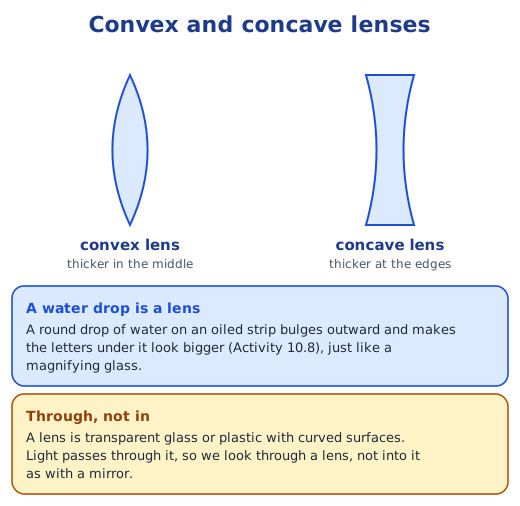
Look through a flat window pane and everything looks the same size and shape. A curved transparent surface changes that. Rub a little oil or wax on a clear plastic scale, put a drop of water on it, and look through the drop at printed text (Activity 10.8). The drop is rounded, bulging outward, and the letters under it look bigger than their neighbours. The drop is working as a simple lens, just like a magnifying glass.
A lens is a transparent piece of glass or plastic whose surfaces are curved. Light passes through it, so we see objects through a lens, not in it as with a mirror.
Two kinds of lens
- A convex lens is thicker in the middle than at the edges.
- A concave lens is thicker at the edges than in the middle.
What you see through them
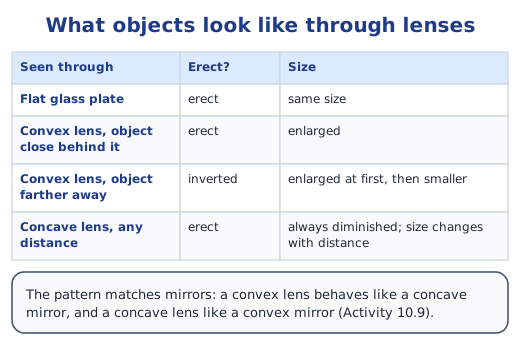
Stand a lens upright and look at a small object behind it, moving the object farther away (Activity 10.9).
- Through a convex lens, the object up close looks erect and enlarged. Farther away it looks inverted, first enlarged and then smaller.
- Through a concave lens, the object always looks erect and smaller, its size changing with distance.
- Through a flat glass plate, it looks the same.
Notice the pattern: a convex lens behaves like a concave mirror, and a concave lens like a convex mirror.
Bending a beam
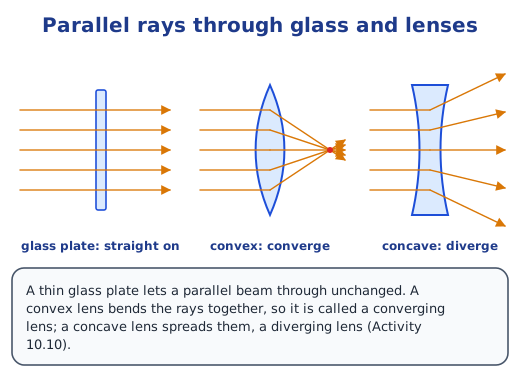
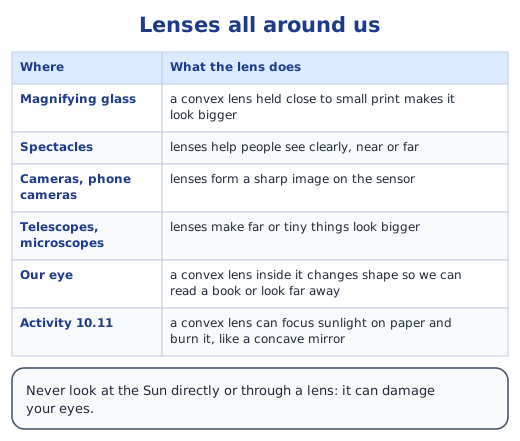
Fix a glass plate, then each lens, upright between two books and send several parallel beams through them from a torch and comb (Activity 10.10). The beams pass straight through the plate. A convex lens bends them together, so it is called a converging lens; a concave lens spreads them apart, a diverging lens. Like a concave mirror, a convex lens can gather sunlight into a spot hot enough to burn paper (Activity 10.11). Never look at the Sun directly or through a lens.
Lenses everywhere
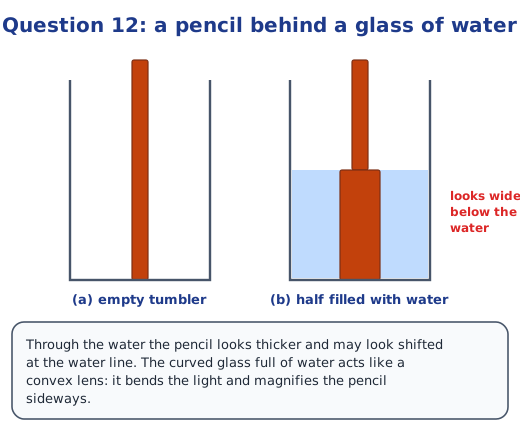
The spectacles that help people see clearly are lenses. So are the lenses in cameras, including the tiny ones in phones, and those in telescopes and microscopes. Our own eye contains a remarkable convex lens that changes its shape, letting us read a book one moment and look at a distant hill the next. A glass of water can act as a lens too: a pencil behind it looks wider through the water.
Lens or mirror?
Mirrors and lenses share names but work differently. A mirror sends light back, so we see the image in the mirror, on the same side as ourselves. A lens lets light through and bends it, so we see the object through the lens, on the far side. Their effects mirror each other: a convex lens and a concave mirror both bring light together and both can enlarge a close object, while a concave lens and a convex mirror both spread light and always make things look smaller.
Read more in spherical mirrors and laws of reflection, or see the Chapter 10 notes and the NCERT solutions.
Practice
-
A lens thicker in the middle than at the edges is a:
Show answer
Answer: (b) convex lens
-
Objects seen through a concave lens always look:
Show answer
Answer: (b) erect and smaller
-
A convex lens is also called a:
Show answer
Answer: (b) converging lens
-
Why does a drop of water on a plastic strip make letters look bigger?
Show answer
Answer: The drop’s surface bulges outward, so it acts like a tiny convex lens. Seen through it, the letters just below look enlarged.
-
Why must you never look at the Sun through a lens?
Show answer
Answer: A convex lens gathers sunlight into a small spot hot enough to burn paper. Concentrated sunlight entering the eye can badly damage it.
Questions students ask
What is a lens?
A lens is a transparent piece of glass or plastic with curved surfaces. Unlike a mirror it lets light pass through, bending it on the way, so we see objects through a lens rather than in it.
What is the difference between a convex lens and a concave lens?
A convex lens is thicker in the middle; it brings parallel rays together and makes close objects look erect and larger, farther ones inverted. A concave lens is thicker at the edges; it spreads rays apart and always makes objects look erect and smaller.
Where are lenses used?
In magnifying glasses, spectacles, cameras including phone cameras, telescopes and microscopes. Our eye has a convex lens too, which changes its shape so that we can see a book close by and things far away.
Stuck on a question?
Take a photo and Lagnever AI explains it step by step. Try it for 7 days for ₹2.
Get it on Google Play Open in browser
For parents: after the trial, the plan renews monthly by UPI or card autopay. You can cancel anytime in the app.