
NCERT Solutions Class 8 Science Chapter 11: Keeping Time with the Skies
Answers to Probe and ponder, the questions inside the chapter, Activities 11.1 to 11.4, all twelve Keep the curiosity alive questions and the Discover, design, and debate projects in Chapter 11, Keeping Time with the Skies, of Curiosity, the Grade 8 science textbook. Page numbers follow the 2026-27 reprint (pages 170–189). Short notes: Chapter 11 notes.
Probe and ponder (page 170)
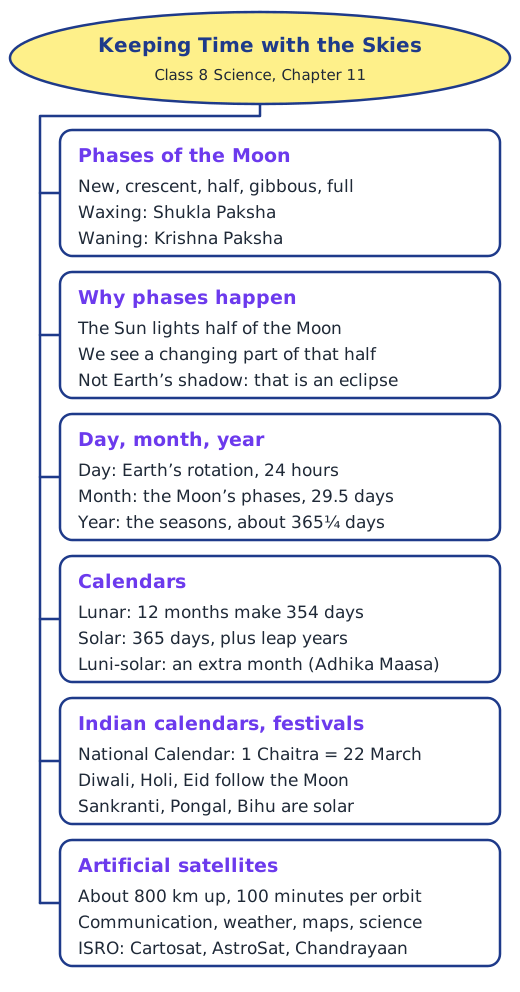
Have you seen the Moon during the day? Why? Yes. The Moon is above the horizon for about half of each day, and since it rises about 50 minutes later each day, part of that time often falls in daylight. Its sunlit surface is bright enough to see against the blue sky, except near the new Moon, when it is too close to the Sun.
If you lived on the Moon, what would a day, a month and a year mean? The same side of the Moon always faces the Earth, so the Moon turns once on its axis in the time it takes to go round the Earth. A day on the Moon, from one sunrise to the next, would therefore last about 29.5 Earth days, as long as a month. From the side facing us, the Earth would hang almost still in the sky and show phases of its own. A year would still be one trip round the Sun, about 365 Earth days.
What if the Earth had two moons? There would be two sets of phases with different cycles, so on some nights we might see two moons of different shapes, or one rising as the other set. Eclipses would be more frequent, and a calendar based on the Moon would be much harder to make.
Without clocks or calendars, how could we measure time? By the Sun’s height and the length of shadows (a sundial), the Moon’s phases, the stars that rise at sunset, and the cycle of seasons, such as flowering plants or migrating birds; or with water clocks, sand clocks and burning candles.
The Moon’s phases (pages 171–177)
Activity 11.1: analysing the Moon diary. The Moon looks different each day: from the full Moon, its bright part shrinks for about two weeks and then grows again. It is not visible on all days; around the new Moon it is too close to the Sun to be seen. It does not appear in the same place at the same time each day: at sunrise it appears closer to the Sun on each later morning, and at sunset, after the new Moon, farther from the Sun on each later evening.
Why does the lit part we see shrink when the Moon appears closer to the Sun? When the Moon is close to the Sun in our sky, it is roughly between the Earth and the Sun. Its lit half then faces mostly away from us, and we see only a thin edge of it as a crescent; at the new Moon we see none of it.
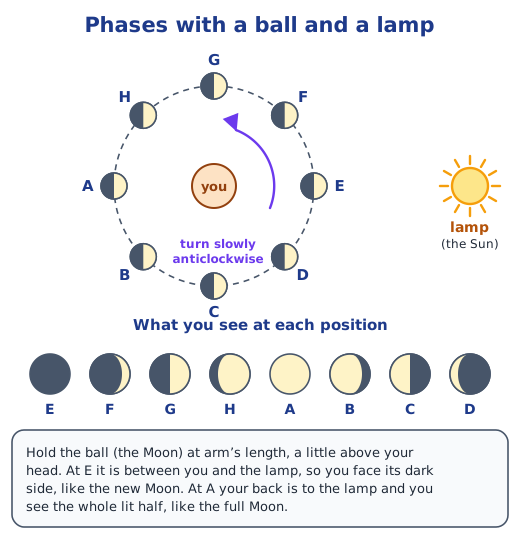
Activity 11.2: the ball and the lamp. At E, with the ball towards the lamp, the side facing you is not lit, like the new Moon. As you turn anticlockwise, the shape of the lit part changes: crescent, half, gibbous and full at A, then back again. The line between the lit and dark parts looks curved, except at the half, when it looks straight; this matches Fig. 11.4c and the real Moon.
Calendars and festivals (pages 178–184)
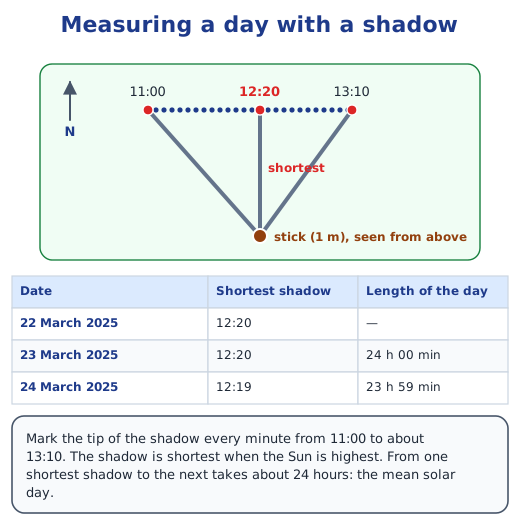
Activity 11.3: the length of a day. From the book’s readings, the days were 24 h 00 min and 23 h 59 min long, an average of 23 h 59.5 min, which is nearly 24 hours. That average is the mean solar day.
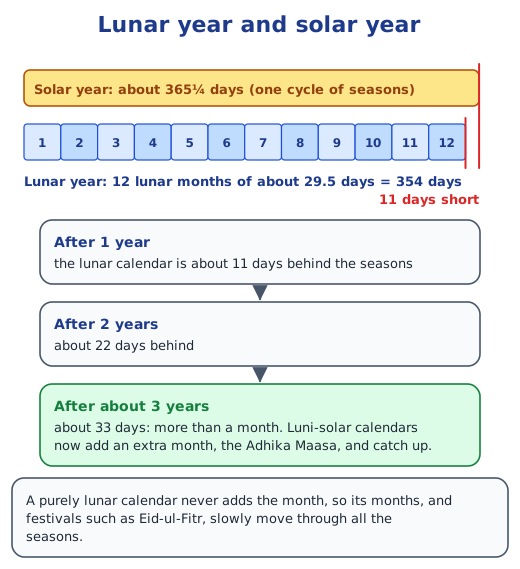
Why do most Indian festivals fall on different dates every year? Many follow lunar or luni-solar calendars, whose months follow the Moon and do not match the months of the solar Gregorian calendar. A lunar year is about 11 days shorter than a solar year, so these festivals fall on different Gregorian dates each year.
Artificial satellites (pages 185–186)
What are the ‘moving stars’ seen in the early evening? Is their motion periodic? They are artificial satellites, still lit by the Sun high above while the ground is dark. Their motion is periodic: most go round the Earth once in about 100 minutes, again and again.
Activity 11.4: spotting a satellite. Just before sunrise or after sunset, go with an adult to a place with an open view of the sky. A point of light, steady or flickering, moving fast across the sky is a satellite. Apps and websites list when satellites will pass over your location.
Keep the curiosity alive (pages 187–188)
1. True or False. (i) True: we see only the part of the Moon that reflects sunlight towards us. (ii) False: the phases come from how much of the Moon’s sunlit half we can see; a lunar eclipse is what happens when the Earth’s shadow falls on the Moon. (iii) True. (iv) False: the Moon is often seen in the daytime too.
2. Amol’s birthday. No. Full Moons come about every 29.5 days, so 12 of them take about 354 days, 11 days short of a year. In the next year the full Moon falls about 11 days before 6 May, and on his birthday the Moon is already waning. A full Moon returns to nearly the same date only after many years, about 19.
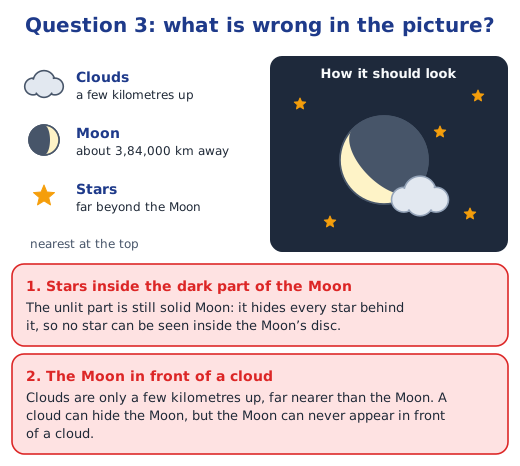
3. Two things wrong in Fig. 11.10. Stars are drawn inside the dark part of the Moon, but the unlit Moon still hides the stars behind it. And the Moon is drawn in front of a cloud, but clouds are only a few kilometres up while the Moon is about 3,84,000 km away, so a cloud can hide the Moon, never the other way round.
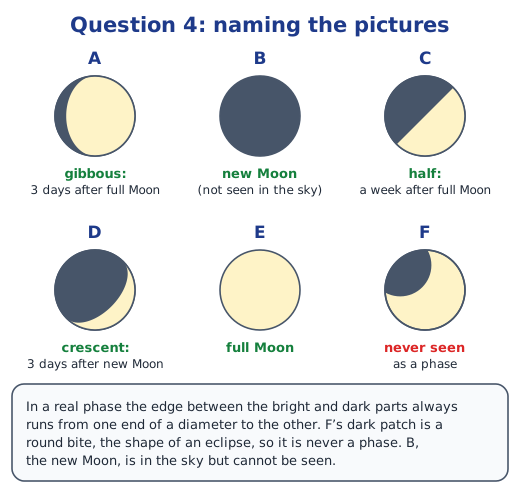
4. The six pictures. (i) Three days after new Moon: D (a thin crescent). Full Moon: E. Three days after full Moon: A (gibbous). A week after full Moon: C (half). Day of new Moon: B. (ii) F is never seen as a phase: in a real phase the edge between the bright and dark parts runs from one end of a diameter to the other, but F has a round ‘bite’, the shape of an eclipse. B, the new Moon, is also never seen in the sky. The pictures test shapes only; seen from India, a waning Moon is actually bright on its left (eastern) side.
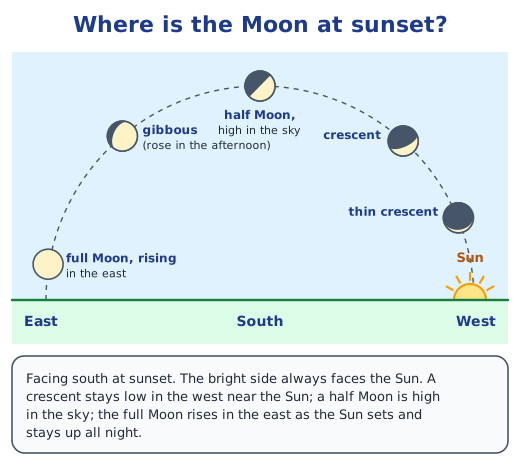
5. Malini’s Moon. (i) She saw a half Moon, its bright half on the side of the setting Sun, the western side (on the right as she faces south). (ii) It is waxing: a Moon high in the sky at sunset is about a week past the new Moon, in Shukla Paksha.
6. Ravi and Kaushalya. Kaushalya is telling the truth. A Moon rising in the east as the Sun sets is opposite the Sun, so it must be a full Moon, not a crescent; a crescent at sunset is low in the west, near the Sun, so Ravi is mistaken. A few days before full Moon, a waxing gibbous Moon rises in the afternoon and is seen in the eastern sky, just as Kaushalya said.
7. A slower Moon. Less often. If the Moon goes round more slowly, each lunar month gets longer, so 12 lunar months come closer to the length of the solar year. The yearly gap of about 11 days shrinks, takes longer to add up to a month, and the extra month is needed less often.
8. 37 full Moons in 3 years. Three years have 3 × 12 = 36 calendar months. Placing 37 full Moons into 36 months means that at least one month must hold two of them. This can happen because full Moons are about 29.5 days apart, while most months have 30 or 31 days.
9. Vaishali’s night. A full Moon. It is opposite the Sun, so it rises as the Sun sets and sets as the Sun rises, staying in the sky all night.
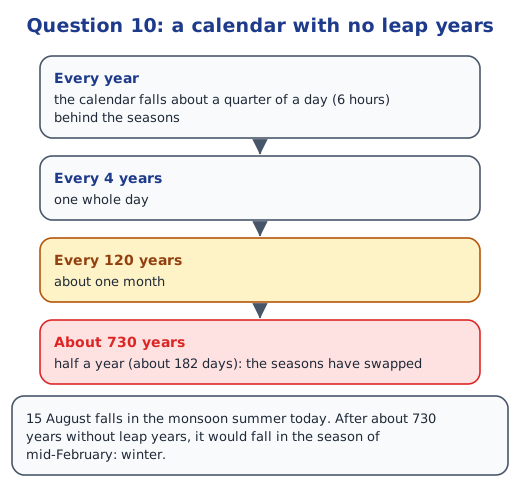
10. No leap years. The calendar would fall about a quarter of a day behind the seasons every year: one day in 4 years, about a month in 120 years. Independence Day, now in the hot monsoon summer, would move into winter once the shift reached about half a year, roughly 182 days, which takes about 182 × 4 ≈ 730 years.
11. Why launch artificial satellites? To carry phone, TV and internet signals, help with navigation, watch the weather, support disaster relief and do scientific research, such as mapping with Cartosat and studying stars with AstroSat.
12. Measures of time. (i) A day: the Earth’s rotation on its axis, seen as the Sun returning to its highest point. (ii) A month: the Moon’s revolution round the Earth, seen as one cycle of phases. (iii) A year: the Earth’s revolution round the Sun, seen as one cycle of seasons.
Discover, design, and debate (pages 188–189)
The crescent faces the Sun. Pointing from the Sun to a crescent Moon by the shortest path, your finger always reaches the lit edge first, showing that the Moon shines by reflected sunlight. The line joining the two tips of a crescent is a diameter of the Moon.
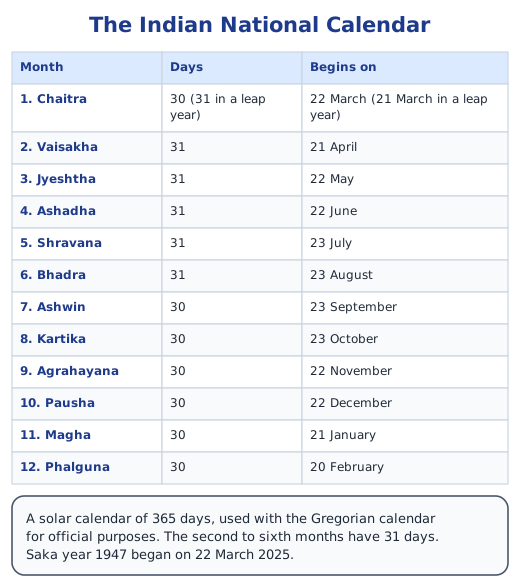
Indian National Calendar dates that differ. In a Gregorian leap year, the dates from 29 February to 20 April differ by one day: 10 Phalguna falls on 29 February instead of 1 March, 1 Chaitra on 21 March instead of 22 March, and Chaitra gets 31 days. From 1 Vaisakha (21 April) the dates match again.
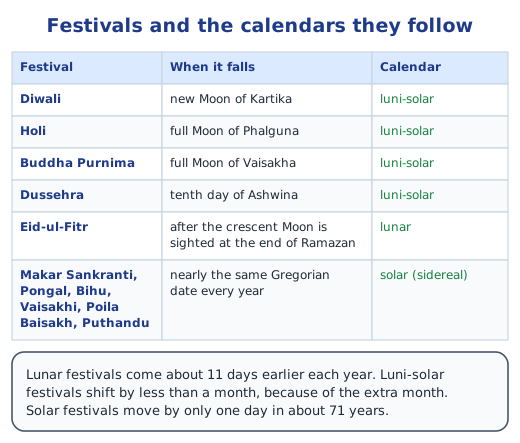
New Year festivals in different states. Andhra Pradesh and Telangana: Ugadi (luni-solar); Karnataka: Ugadi (luni-solar); Maharashtra: Gudi Padwa (luni-solar); Gujarat: Bestu Varas, the day after Diwali (luni-solar); Manipur: Sajibu Cheiraoba (luni-solar); Tamil Nadu: Puthandu (solar); Kerala: Vishu (solar); West Bengal: Poila Baisakh (solar); Assam: Bohag Bihu (solar); Punjab: Vaisakhi (solar); Odisha: Pana Sankranti (solar).
Eid-ul-Fitr and Diwali over five years. Dates as celebrated in most of India (some places differ by a day):
| Year | Eid-ul-Fitr | Diwali |
|---|---|---|
| 2021 | 14 May | 4 November |
| 2022 | 3 May | 24 October |
| 2023 | 22 April | 12 November |
| 2024 | 11 April | 31 October |
| 2025 | 31 March | 20 October |
Eid comes about 11 days earlier every year, because it follows the purely lunar calendar. Diwali also moves about 11 days earlier each year, but it jumps about 19 days later in 2023: that year had an extra month, Adhik Shravan, in July and August, which a luni-solar calendar showed between Diwali 2022 and Diwali 2023.
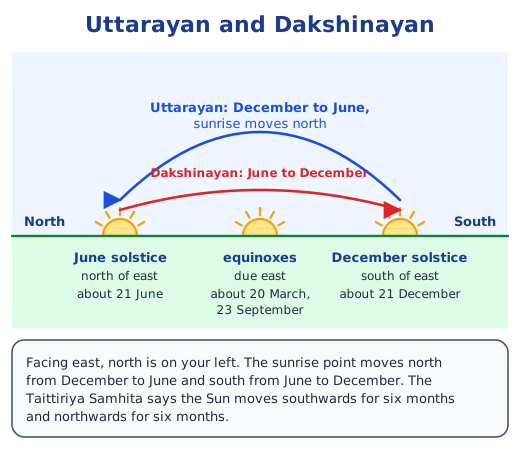
Sunrise through the year. Marked monthly from one spot, the sunrise point moves north (to the left as you face east) from late December to late June, then south until late December, and is due east around 20 March and 23 September. This is exactly the Uttarayan and Dakshinayan noticed by our ancestors.
Practice
-
If the Moon is seen in the sky from sunset to sunrise, its phase is:
Show answer
Answer: (d) full Moon
-
If 37 full Moons happen in 3 years, at least two of them must fall in the same:
Show answer
Answer: (b) month
-
If the Moon’s month grew longer, luni-solar calendars would need an extra month:
Show answer
Answer: (b) less often
-
Why is it wrong to draw stars inside the dark part of a crescent Moon?
Show answer
Answer: The dark part is still the solid Moon, only unlit. It hides the stars behind it, so no star can appear inside the Moon’s disc.
-
Does a birthday that fell on a full Moon fall on a full Moon every year?
Show answer
Answer: No. Twelve lunar months take about 354 days, 11 days less than a year, so in the next year the full Moon comes about 11 days before the birthday.
Stuck on a question?
Take a photo and Lagnever AI explains it step by step. Try it for 7 days for ₹2.
Get it on Google Play Open in browser
For parents: after the trial, the plan renews monthly by UPI or card autopay. You can cancel anytime in the app.