
Class 8 Science Chapter 11: Keeping Time with the Skies Notes
This chapter in five lines
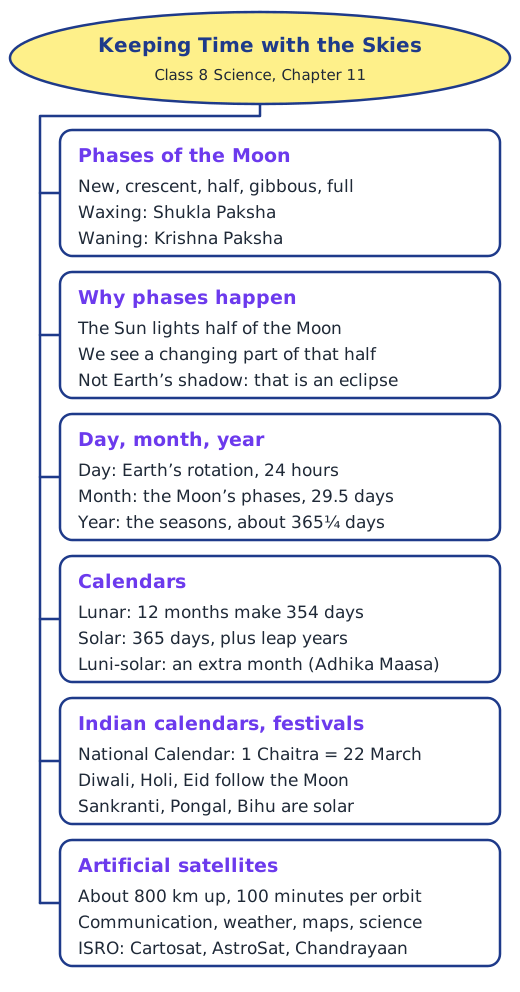
Keeping Time with the Skies explains how the sky gave us units of time. The Moon’s phases, from new Moon to full Moon and back in about 29.5 days, happen because we see a changing part of its sunlit half. Day, month and year come from natural cycles, which led to lunar, solar and luni-solar calendars, and the chapter ends with artificial satellites.
What is this chapter about?
At the kite festival in Ahmedabad on Makar Sankranti, Meera sees the Moon shining in the daytime, and not as a full circle. If the Moon is a sphere lit by the Sun, why does its shape seem to change? The chapter answers this by watching the Moon for a month, and then shows how the regular cycles of the Sun and the Moon gave us the day, the month, the year and our calendars.
Phases of the Moon
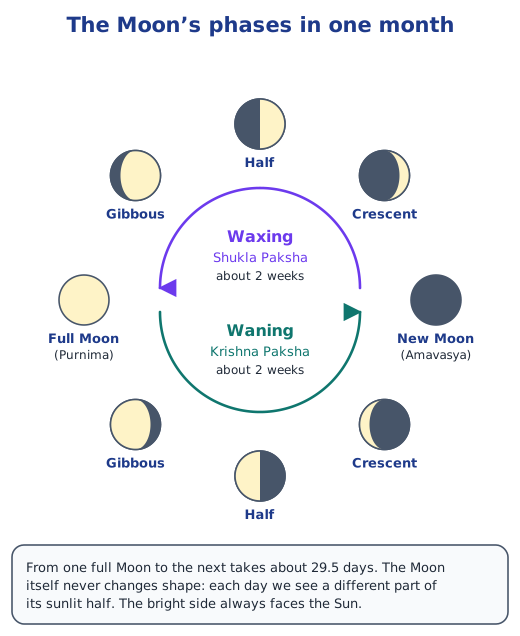
Watched at sunrise from the day after a full Moon, the Moon’s bright part shrinks to half within about a week and disappears after another week. This is the waning period, or Krishna Paksha. After the new Moon (Amavasya), the bright part grows to a half circle in a week and to the full Moon (Purnima) in another week: the waxing period, or Shukla Paksha. These changing shapes are the phases of the Moon, and one cycle takes about a month. Read phases of the Moon.
Why the phases happen
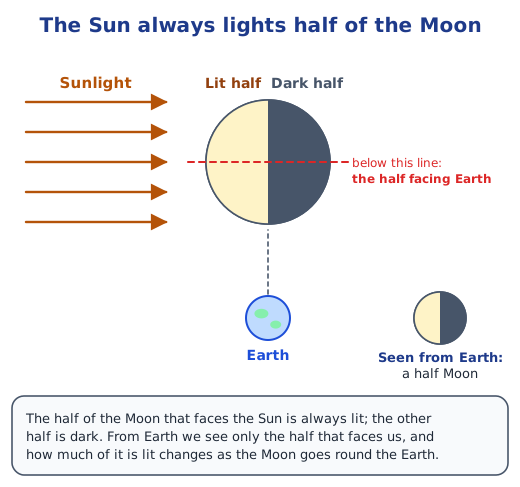
The Moon does not make its own light; it reflects sunlight. The half facing the Sun is always lit and the other half is dark. As the Moon goes round the Earth, the half that faces us changes how much of the lit side it includes: all of it at full Moon, none at new Moon, less than half for a crescent and more than half for a gibbous Moon. A ball held at arm’s length near a lamp shows the same thing.
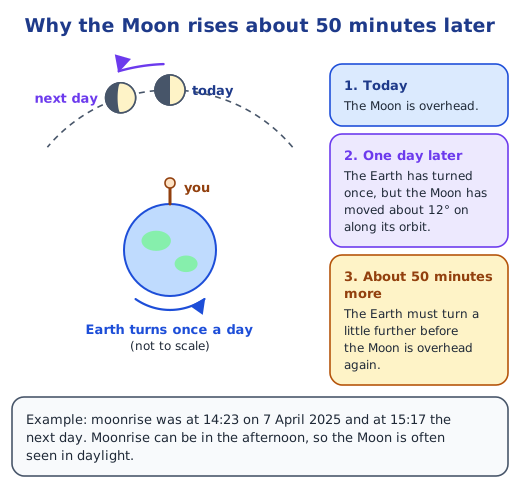
At full Moon, the Moon sits opposite the Sun; on later mornings it appears closer to the Sun, and at new Moon it is closest. Look for a waxing Moon around sunset and a waning one around sunrise. Because the Earth needs extra time to catch up with the Moon, which keeps moving along its orbit, moonrise comes roughly 50 minutes later every day, sometimes in the afternoon, which is why Meera saw it in daylight.
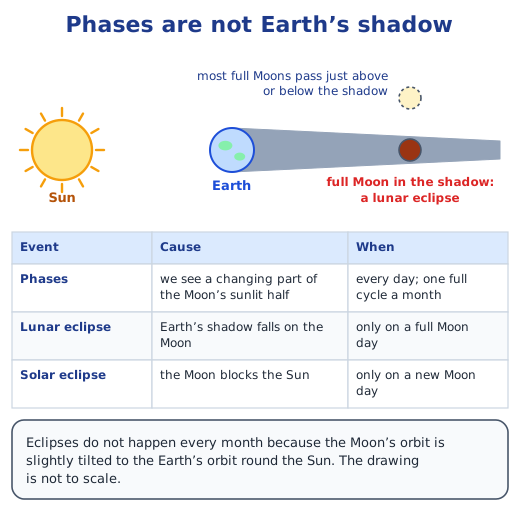
The phases are not caused by the Earth’s shadow. The Earth’s shadow on the Moon is a lunar eclipse, possible only at full Moon, just as a solar eclipse is possible only at new Moon. Eclipses do not happen every month because the Moon’s orbit is slightly tilted.
Day, month and year
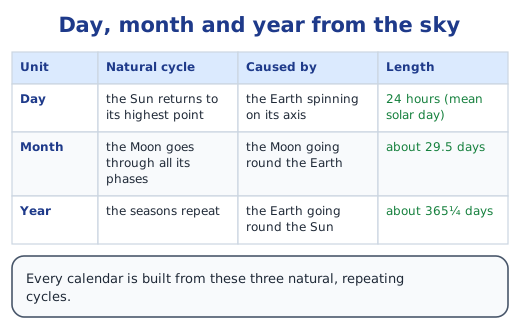
The Sun’s daily rise and set comes from the Earth’s rotation. The average time from the Sun’s highest point one day to the next is 24 hours, the mean solar day, which you can measure with the shortest shadow of a stick. The Moon’s phases repeat in about 29.5 days, giving the month, and the seasons repeat in about 365¼ days as the Earth goes round the Sun, giving the year.
Calendars
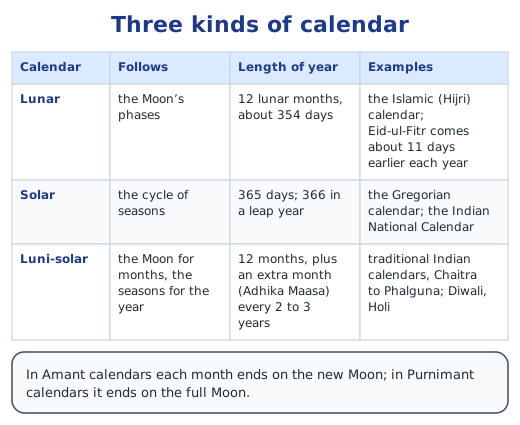
About 12 lunar months fit into one cycle of seasons, so lunar calendars have a 354-day year, which slowly drifts against the seasons. Solar calendars, such as the Gregorian calendar, follow the seasons with 365 days and add a leap day every four years, skipping it in century years not divisible by 400. Luni-solar calendars count months by the Moon but add an extra month, the Adhika Maasa, every 2 to 3 years. Read lunar, solar and luni-solar calendars.
Indian calendars and festivals
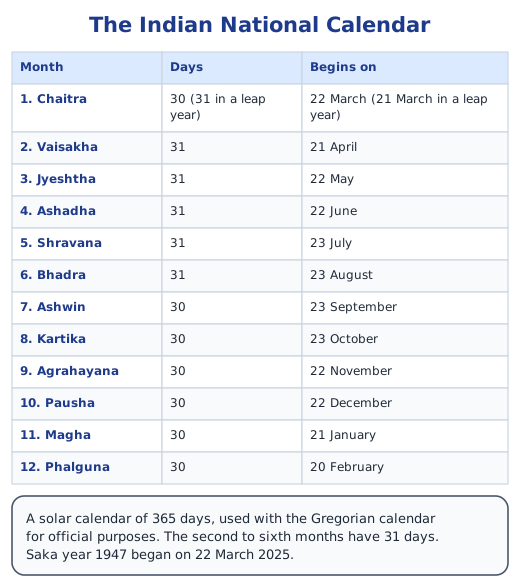
Long before telescopes, careful observers in India noticed that the Sun rises north of east in summer and south of east in winter: its northward movement is Uttarayan and its southward movement Dakshinayan, recorded in the Taittiriya Samhita. The Indian National Calendar, recommended by a committee chaired by the astrophysicist Meghnad Saha, is a solar calendar of 365 days that begins on 22 March. Festivals such as Diwali, Holi and Eid follow the Moon and change date every year, while Makar Sankranti, Pongal and Bihu follow a solar calendar.
Artificial satellites
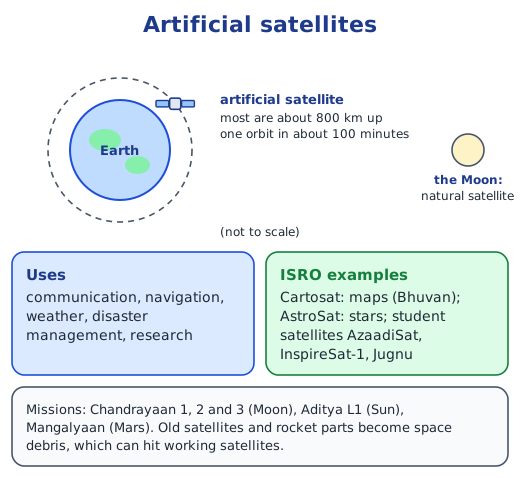
The Moon is the Earth’s natural satellite, but many artificial satellites also go round the Earth, most about 800 km up, once in about 100 minutes. They help with communication, navigation, weather, disaster management and research. ISRO has launched many, from Cartosat for maps to AstroSat for studying stars. Read artificial satellites.
Before we move on
The Moon’s phases, the seasons and the daily motion of the Sun are natural cycles that repeat in a predictable way, and people built calendars on them. Answers to every question are in the NCERT solutions for Chapter 11.
Key terms
| Term | Meaning |
|---|---|
| Phases of the Moon | The changing shapes of the Moon’s bright part, as seen from the Earth, from one day to the next. |
| Full Moon (Purnima) | The day the whole sunlit face of the Moon is seen as a bright disc. |
| New Moon (Amavasya) | The day the Moon cannot be seen at all, because its unlit side faces the Earth. |
| Waxing (Shukla Paksha) | The two weeks when the Moon’s bright part grows, from new Moon to full Moon. |
| Waning (Krishna Paksha) | The two weeks when the bright part shrinks, from full Moon to new Moon. |
| Crescent and gibbous | Crescent: less than half of the lit side is seen. Gibbous: more than half is seen. |
| Mean solar day | The average time, 24 hours, for the Sun to go from its highest point one day to its highest point the next. |
| Lunar month | One full cycle of the Moon’s phases, about 29.5 days. |
| Solar year | One cycle of the seasons as the Earth goes round the Sun, about 365¼ days. |
| Leap year | A year with an extra day, 29 February, added to keep the calendar in step with the seasons. |
| Luni-solar calendar | A calendar that counts months by the Moon but adds an extra month every few years to stay with the seasons. |
| Adhika Maasa | The extra, or intercalary, month added to a luni-solar calendar about every 2 to 3 years. |
| Uttarayan and Dakshinayan | The Sun’s apparent northward movement from December to June, and southward movement from June to December. |
| Artificial satellite | A human-made object launched to orbit the Earth, used for communication, weather, mapping and research. |
Topics in this chapter
Practice
-
The Moon’s phases are caused by:
Show answer
Answer: (c) the changing part of its sunlit half that we see
-
The period when the Moon’s bright part grows is called:
Show answer
Answer: (b) Shukla Paksha
-
About how long is one cycle of the Moon’s phases?
Show answer
Answer: (c) 29.5 days
-
A lunar year of 12 lunar months has about:
Show answer
Answer: (a) 354 days
-
Which of these years is NOT a leap year?
Show answer
Answer: (c) 1900
-
The Indian National Calendar is a:
Show answer
Answer: (b) solar calendar
Questions students ask
What are the main topics of Class 8 Science Chapter 11?
Observing the Moon over a month; the phases of the Moon and why they happen; why the Moon rises later each day; day, month and year as natural cycles; lunar, solar and luni-solar calendars and leap years; the Indian National Calendar; festivals and astronomy; and artificial satellites.
Is Keeping Time with the Skies in the new NCERT Class 8 Science book?
Yes. It is Chapter 11 of Curiosity, the Grade 8 science textbook, on pages 170 to 189 of the 2026-27 reprint.
Why does the Moon look different on different days?
The Sun always lights half of the Moon. As the Moon goes round the Earth, we see a different part of that lit half: all of it at full Moon, none of it at new Moon, and a crescent, half or gibbous shape in between.
Why do most Indian festivals fall on different dates every year?
Many follow the Moon. Lunar and luni-solar months do not match the months of the solar Gregorian calendar, so festivals such as Diwali, Holi and Eid fall on different Gregorian dates each year.
Stuck on a question?
Take a photo and Lagnever AI explains it step by step. Try it for 7 days for ₹2.
Get it on Google Play Open in browser
For parents: after the trial, the plan renews monthly by UPI or card autopay. You can cancel anytime in the app.