
Artificial satellites: helpers in orbit
Answer in short
An artificial satellite is a human-made object launched to go round the Earth. Most orbit about 800 km up and complete one orbit in about 100 minutes. They carry signals, guide navigation, watch the weather, support disaster relief and do research; ISRO has launched many, such as Cartosat and AstroSat.
Stuck on a question? Take a photo and Lagnever AI explains it step by step. Try it for 7 days for ₹2. Get it on Google Play
Natural and artificial satellites
A satellite is an object that goes round a planet. The Moon is the Earth’s natural satellite, taking about a month to go round us. Besides the Moon, many artificial satellites, made and launched by different countries, also orbit the Earth. Most of them are about 800 km above the Earth’s surface, far closer than the Moon, and take only about 100 minutes to go round once.
From the ground, an artificial satellite looks like a tiny point of light moving steadily across the sky. If you have ever seen a ‘moving star’ in the early evening, it was probably a satellite. Its motion is periodic, like the Moon’s: it goes round the same orbit again and again, so it can be predicted.
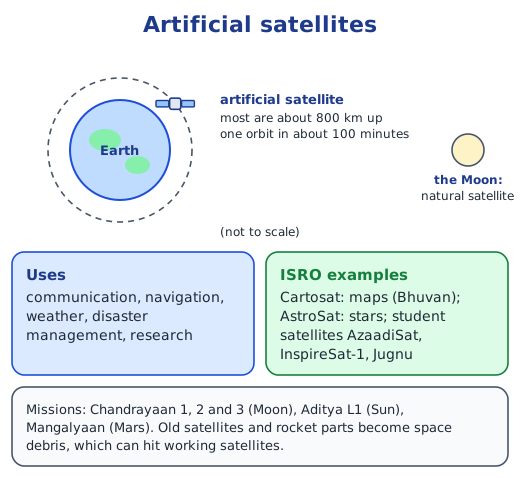
What satellites do for us
Satellites help in many ways:
- Communication: they relay signals for television, phone and internet links across long distances.
- Navigation: they help find positions on the Earth, which map apps use.
- Weather monitoring: they watch clouds and storms from above, which helps forecasting.
- Disaster management: their images show floods, cyclones and damage, helping relief reach the right places.
- Scientific research: above the air, their instruments can study the Earth, the Sun, stars and other objects in space.
India in space
India’s space agency, ISRO (the Indian Space Research Organisation), has sent up many satellites for these jobs. The Cartosat satellites photograph the Earth in fine detail; the pictures make maps more accurate and help in planning cities and responding to disasters. Bhuvan, ISRO’s online map, uses them to show the shape of the land, soils, how land is used and plant cover. AstroSat is a space observatory that studies stars and other objects in space. Beyond Earth orbit, Chandrayaan 1, 2 and 3 went to the Moon, Mangalyaan went to Mars, and Aditya L1 watches the Sun. Students, too, have built small satellites that ISRO launched, among them AzaadiSat, InspireSat-1 and Jugnu.
Spotting a satellite yourself
Activity 11.4 is a night-sky task. Just before sunrise or soon after sunset, go with an adult to a place with a clear view of the sky, away from trees and tall buildings. Look for a point of light, steady or flickering in brightness, moving fast across the sky; you can see it with your eyes or with binoculars. Mobile apps and websites tell you which satellites will pass over your location and when. The timing matters: at these hours the ground is dark, but a satellite high above is still in sunlight, so it shines by reflected sunlight, just as the Moon does.
Space debris
More and more satellites are launched every year. Once a satellite stops working, it stays in orbit along with spent rocket stages, and all of this turns into space junk, also called space debris. The junk fills up the space around the Earth and may smash into satellites that still work. Small bits burn up in the air when they fall, but bigger ones can hit the ground, so nations are now cooperating to clear it.
The scientist behind India’s space programme
Vikram Ambalal Sarabhai (1919–1971), who did research in space science and nuclear physics, is remembered as the father of India’s space programme. He pioneered India’s effort to launch its first artificial satellites. ISRO’s rocket and launch-vehicle centre in Thiruvananthapuram, the Vikram Sarabhai Space Centre, carries his name.
Read on: phases of the Moon, lunar, solar and luni-solar calendars, the chapter notes and the NCERT solutions.
Practice
-
Most artificial satellites orbit about how high above the Earth?
Show answer
Answer: (c) 800 km
-
Which ISRO satellite series takes images of the Earth for maps?
Show answer
Answer: (b) Cartosat
-
Who is remembered as the father of India’s space programme?
Show answer
Answer: (b) Vikram Sarabhai
-
Is the motion of a satellite periodic? Explain.
Show answer
Answer: Yes. A satellite goes round the Earth along its orbit again and again; most take about 100 minutes for each orbit, so its motion repeats regularly.
-
Name two satellites built by Indian students.
Show answer
Answer: Any two of AzaadiSat, InspireSat-1 and Jugnu.
Questions students ask
What is an artificial satellite?
A human-made object launched into space to go round the Earth. Unlike the Moon, Earth’s natural satellite, artificial satellites are built for jobs such as communication, navigation, weather monitoring, mapping and research.
Why are artificial satellites launched?
To carry phone, TV and internet signals, help with navigation, watch the weather, support disaster relief and do research. For example, Cartosat images improve maps and help plan cities and handle disasters, and AstroSat observes stars and other objects in space.
How can you spot an artificial satellite?
Just after sunset or before sunrise, with an adult, find a place with a clear view of the sky. Look for a point of light, steady or flickering, moving quickly across the sky. Mobile apps and websites list when satellites will pass over your area.
Stuck on a question?
Take a photo and Lagnever AI explains it step by step. Try it for 7 days for ₹2.
Get it on Google Play Open in browser
For parents: after the trial, the plan renews monthly by UPI or card autopay. You can cancel anytime in the app.