
Lunar, solar and luni-solar calendars
Answer in short
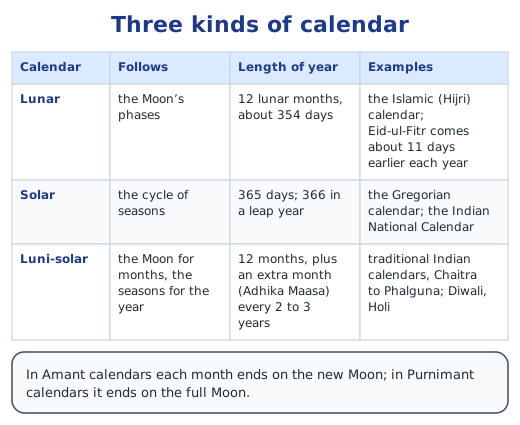
A day comes from the Earth’s rotation, a month from the Moon’s phases and a year from the seasons. Lunar calendars have 12 lunar months, a 354-day year; solar calendars follow the seasons with 365 days and a leap day every four years; luni-solar calendars count months by the Moon but add an extra month every 2 to 3 years.
Stuck on a question? Take a photo and Lagnever AI explains it step by step. Try it for 7 days for ₹2. Get it on Google Play
Three natural clocks
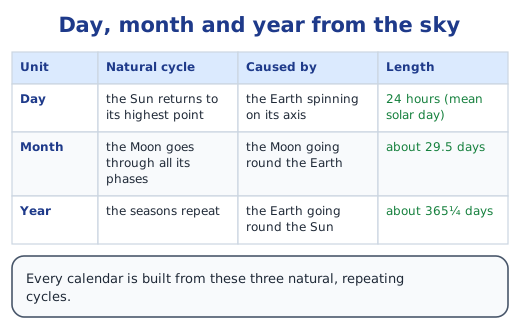
Calendars are built on cycles that repeat in a predictable way. The Sun seems to rise in the east and set in the west because the Earth spins on its axis; the average time from the Sun’s highest point on one day to its highest point the next is 24 hours, the mean solar day. The Moon goes through all its phases in about 29.5 days, which gives the month. The Earth takes nearly 365¼ days to go round the Sun, one cycle of seasons, which gives the year.
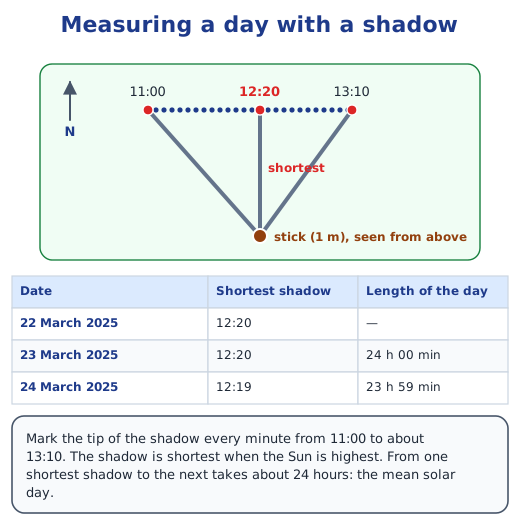
You can measure a day yourself (Activity 11.3). Fix a 1 m stick upright in a sunny spot and, from 11:00 to about 13:10, mark the tip of its shadow every minute. The Sun is highest when the shadow is shortest. Repeat on the next few days: in the book’s readings the shortest shadow came at 12:20, 12:20 and 12:19, so the days were 24 hours and 23 hours 59 minutes long, nearly 24 hours on average.
Lunar calendars
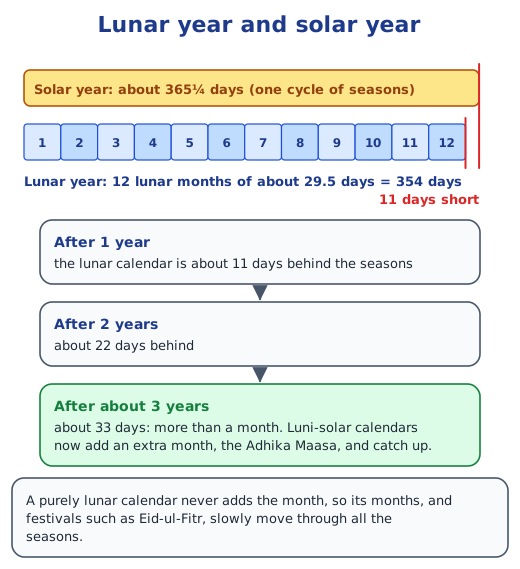
Long ago people noticed that about 12 cycles of the Moon’s phases fit into one cycle of seasons. That gave lunar calendars: days, months of about 29.5 days and a lunar year of 12 months. The Moon made this an easy and sound way to track time. But a lunar year has only 354 days, about 11 days fewer than the seasons take, so the seasons do not stay in the same months from year to year.
Solar calendars and leap years
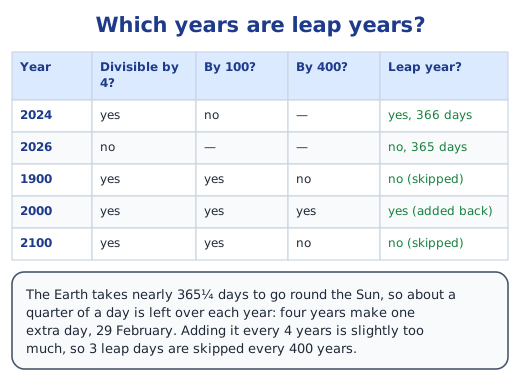
Farmers needed to know when seasons would arrive, which led to solar calendars. In the Gregorian calendar, used widely today, months of 30 or 31 days and a February of 28 days add up to 365 days. The Earth needs nearly a quarter day more, and these hours add up to about one day in four years, so a leap day is added: in a year divisible by four, February has 29 days. Adding a day every four years is slightly too much, so century years such as 1700, 1800 and 1900 skip it, and years divisible by 400, such as 1600 and 2000, keep it.
The Gregorian calendar follows the tropical year, from one spring equinox to the next. The sidereal year, which lasts until the same stars rise at sunset once more, is about 20 minutes longer; astronomers use it to track the Earth’s position in its orbit.
Luni-solar calendars
Luni-solar calendars count days and months by the Moon but keep up with the seasons. Since 12 lunar months fall about 11 days short, the gap comes close to a full month every 2 to 3 years, and an extra month, the Adhika Maasa or intercalary month, is added. Many Indian calendars work this way, with months such as Chaitra, Vaisakha, Shravana, Kartika and Phalguna. In Amant calendars a month ends on the new Moon; in Purnimant calendars it ends on the full Moon.
Watching the sky: Uttarayan and Dakshinayan
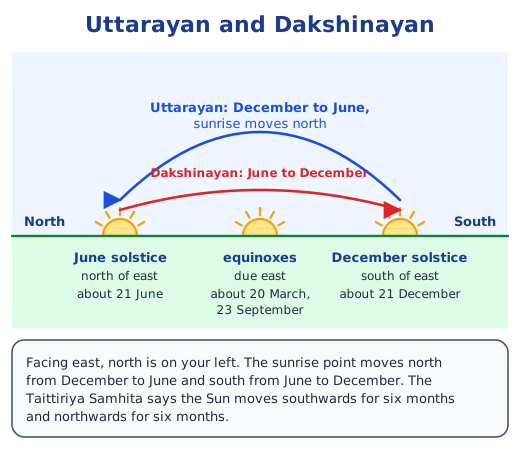
Without telescopes or the knowledge that the Earth goes round the Sun, people in ancient India found the length of the year by patient observation. The Sun rises a little north of east in summer and a little south of east in winter, with the extremes at the solstices, around 21 June and 21 December. The northward drift, December to June, is Uttarayan, and the southward one, June to December, is Dakshinayan, as the Taittiriya Samhita records. Texts such as the Surya Siddhanta also tracked which stars, such as Capricorn (Makar), lay behind the Sun.
The Indian National Calendar
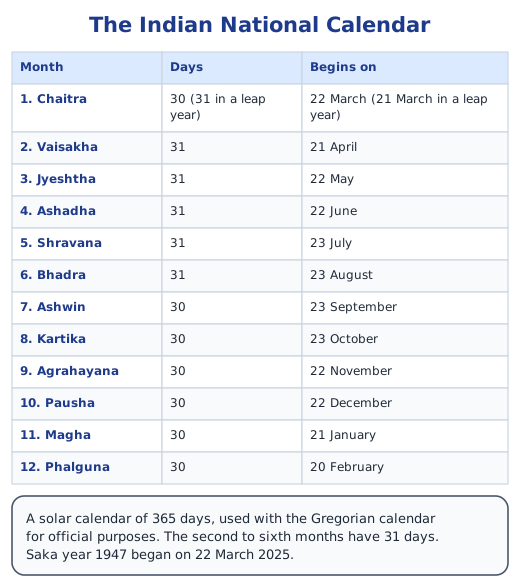
In 1952 a Calendar Reform Committee was appointed by the Government of India, with the astrophysicist Meghnad Saha as its chair, to study the many calendars in use and suggest one accurate calendar for the whole country. The Indian National Calendar, used officially along with the Gregorian calendar, is a solar calendar of 365 days. Its year begins on 22 March; months two to six have 31 days each and the other seven have 30. In a leap year Chaitra gets an extra day and the year begins on 21 March.
Festivals and calendars
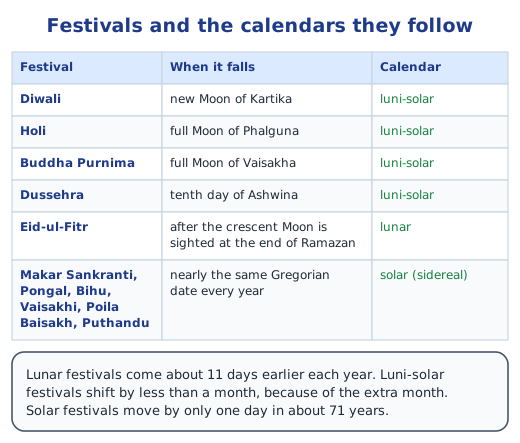
Many Indian festivals follow the Moon: Diwali comes on the new Moon of Kartika, Holi and Buddha Purnima on the full Moons of Phalguna and Vaisakha, and Dussehra on the tenth day of Ashwina, while Eid-ul-Fitr is celebrated after the crescent Moon is sighted at the end of Ramazan. Luni-solar festivals shift by less than a month from year to year, but purely lunar ones move through the seasons. A solar sidereal calendar sets the dates of Makar Sankranti, Pongal, Bihu, Vaisakhi, Poila Baisakh and Puthandu, so they fall on nearly the same date each year; Makar Sankranti moves ahead by one day about every 71 years. To keep dates uniform, the Positional Astronomy Centre publishes the Rashtriya Panchang every year.
Read on: phases of the Moon, artificial satellites, the chapter notes and the NCERT solutions.
Practice
-
Which kind of calendar adds an Adhika Maasa?
Show answer
Answer: (c) luni-solar
-
In an ordinary year the Indian National Calendar begins on:
Show answer
Answer: (c) 22 March
-
Which festival follows a solar calendar?
Show answer
Answer: (c) Makar Sankranti
-
Why does February have 29 days in a leap year?
Show answer
Answer: The Earth takes nearly 365¼ days to go round the Sun. The extra quarter day each year adds up to about one day in four years, so a day is added to February to keep the calendar in step with the seasons.
-
What is the difference between Amant and Purnimant calendars?
Show answer
Answer: In an Amant calendar each month begins the day after a new Moon and ends on the new Moon; in a Purnimant calendar it begins the day after a full Moon and ends on the full Moon.
Questions students ask
What is a luni-solar calendar?
A calendar that counts days and months by the Moon’s phases but adds an extra month, the Adhika Maasa, every 2 to 3 years so that the year stays in step with the seasons. Many traditional Indian calendars are luni-solar.
What is the difference between the tropical year and the sidereal year?
The tropical year is the time from one spring equinox to the next, and the Gregorian calendar is based on it. The sidereal year lasts until the same stars rise at sunset once more; it is about 20 minutes longer.
What is the Indian National Calendar?
A solar calendar of 365 days used by the Government of India along with the Gregorian calendar. It begins on 22 March, or 21 March in a leap year, and its months have 30 or 31 days, with names taken from traditional Indian calendars.
Stuck on a question?
Take a photo and Lagnever AI explains it step by step. Try it for 7 days for ₹2.
Get it on Google Play Open in browser
For parents: after the trial, the plan renews monthly by UPI or card autopay. You can cancel anytime in the app.