
Phases of the Moon: why the Moon seems to change shape
Answer in short
The phases of the Moon are the changing shapes of its bright part as seen from the Earth. The Sun always lights half of the Moon; as the Moon goes round the Earth in about a month, we see all, part or none of that lit half. So it waxes from new Moon to full Moon, then wanes back.
Stuck on a question? Take a photo and Lagnever AI explains it step by step. Try it for 7 days for ₹2. Get it on Google Play
Watching the Moon for a month
The chapter asks you to keep a Moon diary (Activity 11.1). Start at sunrise on the day after a full Moon, when the Moon is easy to find in the western sky. Each day, note the date and time, shade a circle to show the bright part, and record whether the bright part grew or shrank and whether the Moon looked closer to the Sun or farther from it. After about 15 days the Moon can no longer be seen at sunrise, so watch at sunset for the next 15 days. The diary shows that the Moon looks different each day, is not visible on every day, and is not in the same place in the sky at the same time each day.
Waxing and waning
From the full Moon, the bright part shrinks to half within about a week and vanishes after another week: this two-week waning period is called Krishna Paksha. The day the Moon cannot be seen is the new Moon (Amavasya). Then the bright part grows to a half circle in a week and to a full circle in another week: the waxing period, or Shukla Paksha, ending on the full Moon (Purnima). The whole cycle, full Moon to full Moon, lasts about 29.5 days. A shape showing less than half of the lit side is a crescent; more than half is gibbous.
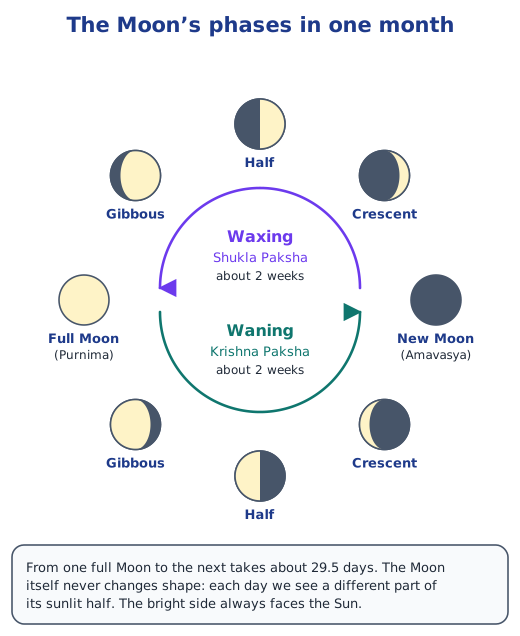
Why the Moon has phases
The Moon itself never changes shape. It has no light of its own and shines by reflecting sunlight, so the half facing the Sun is always lit and the other half is dark. The Moon goes round the Earth, and the same half of the Moon always faces us. But the half facing us is not always the lit half. Sometimes all of the lit half faces us, sometimes only part of it, and on new Moon day only the dark half faces us. What we call a phase is simply how much of the lit half we can see.
A model with a ball and a lamp
Activity 11.2 makes this clear. Push a stick into a small ball (the Moon) and stand in a dark place with a lamp or torch about 3 m away (the Sun); your head is the Earth. Hold the ball at arm’s length, a little above your head. Facing the lamp (position E), you see only the ball’s dark side, like the new Moon. Turn slowly anticlockwise and a thin lit edge appears, growing to a half and then more than half. With your back to the lamp (A), you see the whole lit half, like the full Moon. The line between the lit and dark parts looks curved, just like on the real Moon.
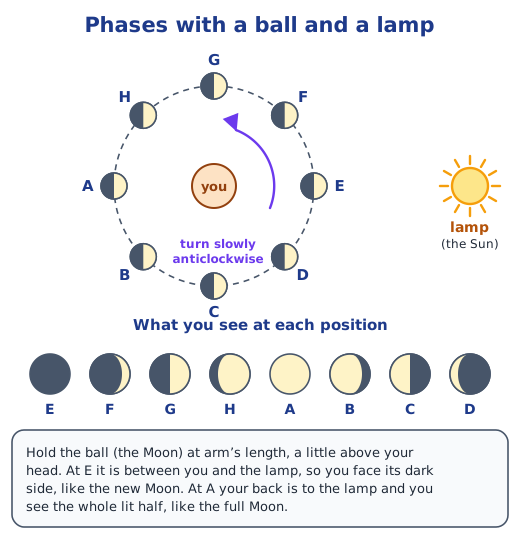
Following the Moon round its orbit
The real Moon goes round the Earth from position A back to A in about a month. At A we see all of its lit half (full Moon). At B and H we see more than half of it (gibbous), at C and G exactly half, at D and F less than half (crescent), and at E none (new Moon). From A to E it wanes, and from E back to A it waxes. Since the Earth turns once a day while the Moon takes a month to go round, people everywhere on Earth see nearly the same phase on any given day.
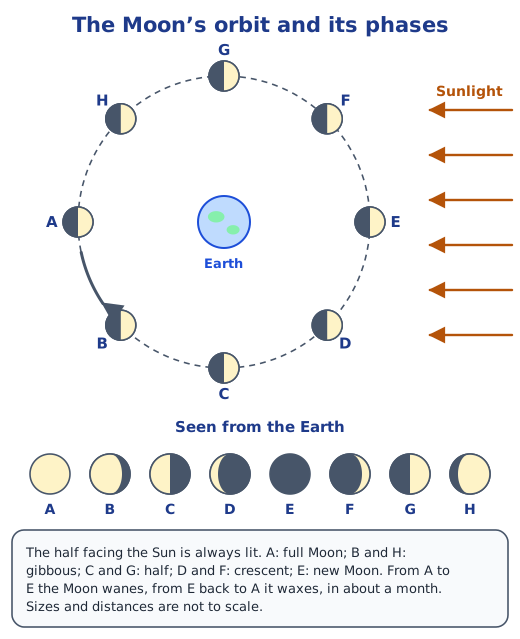
Where and when to look
At full Moon, the Moon sits almost opposite the Sun: while the Sun comes up in the east, the Moon goes down in the west. On the following mornings the shrinking Moon appears closer to the Sun; when it is a half circle it is overhead at sunrise, and a few days later the crescent is closer still. Look for a waxing Moon around sunset and a waning one around sunrise. Wherever it is, the bright side faces the Sun.
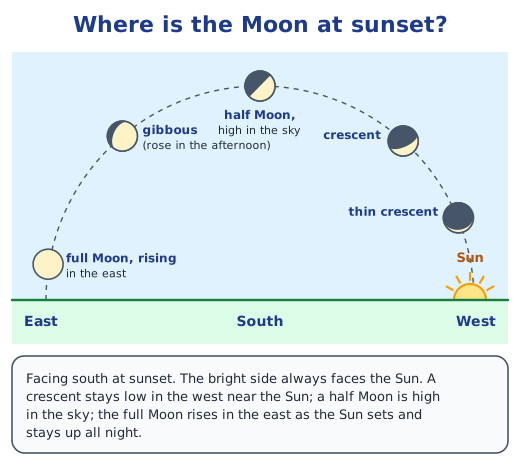
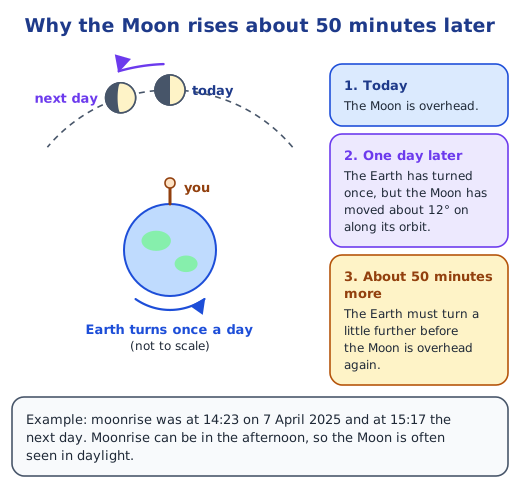
The Moon does not always rise when the Sun sets. While the Earth turns once, the Moon travels on along its orbit, so the Earth must turn for about 50 minutes more before the Moon is back in the same place. Moonrise times, listed in newspapers or by the Positional Astronomy Centre of the India Meteorological Department, move about 50 minutes later each day: moonrise was at 14:23 on 7 April 2025 and at 15:17 the next day. That is why the Moon is often seen in the afternoon sky.
Not the Earth’s shadow
A common mistake is to think the Earth’s shadow makes the phases. When the Earth’s shadow falls on the Moon, we get a lunar eclipse, which can happen only at full Moon; a solar eclipse can happen only at new Moon. Most months have no eclipse, because the Moon’s orbit is slightly tilted to the Earth’s orbit round the Sun.
Read on: lunar, solar and luni-solar calendars, artificial satellites, the chapter notes and the NCERT solutions.
Practice
-
In which phase is the Moon roughly between the Earth and the Sun?
Show answer
Answer: (b) new Moon
-
When more than half of the Moon’s lit side can be seen, the phase is called:
Show answer
Answer: (b) gibbous
-
A waxing Moon is easiest to spot:
Show answer
Answer: (c) at sunset
-
Why do people all over the Earth see nearly the same phase on a given day?
Show answer
Answer: The Earth turns once a day, but the Moon takes about a month to go round the Earth, so in one day its position, and therefore its phase, hardly changes.
-
Where is the Moon at sunrise on a full Moon day?
Show answer
Answer: Almost opposite the Sun: as the Sun rises in the east, the full Moon is setting in the west.
Questions students ask
What are the phases of the Moon?
They are the shapes of the Moon’s bright part as seen from the Earth on different days: new Moon, crescent, half, gibbous and full Moon, first growing (waxing) and then shrinking (waning) over about a month.
What is the difference between Shukla Paksha and Krishna Paksha?
Shukla Paksha is the waxing fortnight, when the bright part grows from new Moon to full Moon. Krishna Paksha is the waning fortnight, when it shrinks from full Moon to new Moon.
Why can we see the Moon during the day?
Moonrise comes roughly 50 minutes later every day, so for much of the month it is above the horizon for part of the daytime. Its sunlit side is bright enough to be seen against the blue sky.
Stuck on a question?
Take a photo and Lagnever AI explains it step by step. Try it for 7 days for ₹2.
Get it on Google Play Open in browser
For parents: after the trial, the plan renews monthly by UPI or card autopay. You can cancel anytime in the app.