
NCERT Solutions Class 8 Science Chapter 12: How Nature Works in Harmony
Answers to Probe and ponder, the questions inside the chapter, Activities 12.1 to 12.10, all nine Keep the curiosity alive questions and the Discover, design, and debate projects in Chapter 12, How Nature Works in Harmony, of Curiosity, the Grade 8 science textbook. Page numbers follow the 2026-27 reprint (pages 190–209). Short notes: Chapter 12 notes.
Probe and ponder (page 190)
Why do elephants enter farms? When forests are cut and rainfall changes, vegetation dries and waterholes shrink, so elephants lose food and water in their habitat and wander into farms and villages for bananas and sugarcane.
Life as a tree in a dense forest. I would take water and minerals from the soil, often helped by fungi and microbes, and sunlight and carbon dioxide to make food; give oxygen, shade and shelter to birds and insects; feed animals with leaves and fruits; depend on insects to pollinate my flowers and on birds to spread my seeds; and drop leaves that decompose and enrich the soil, while my roots hold it in place.
Can the Earth thrive without humans? Can humans survive without the Earth? The Earth’s ecosystems thrived for millions of years before humans. Humans cannot survive without the Earth, which gives every bit of our air, water and food.
Two kinds of birds competing for the same fruit. Over time they may divide the resource, feeding at different times, on different parts of the tree or on different fruits; or one may move away or decline.
Can human actions cause natural disasters? They can make them more frequent or more damaging: cutting forests on slopes adds to landslides and floods, destroying mangroves exposes coasts to storms, and climate change strengthens heatwaves and heavy rain.
Inside the chapter (pages 191–206)
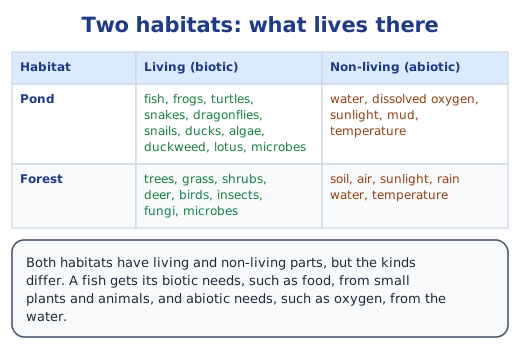
Activity 12.1 and the pond. Both habitats have living and non-living parts, of different kinds. Besides fish, a pond holds frogs, turtles, snakes, dragonflies, mosquitoes, snails, ducks, algae, diatoms, duckweed and lotus.
Activity 12.2. Fill the blanks with the plants you counted, for example a population of 20 grass plants and only 5 marigold plants in the same 1 m² area. A habitat with one kind of organism? All would need the same food, water and space, so competition and shortages would follow; there would be no food chains and no decomposers to recycle waste.
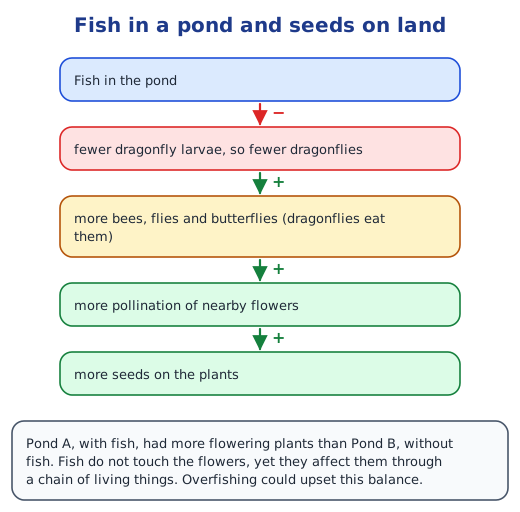
Activity 12.3. Pond A had fish, which eat dragonfly larvae, so it had fewer dragonflies, which eat bees, flies and butterflies. More pollinators around Pond A meant more seeds on nearby plants. Overfishing would bring back the dragonflies, cut the pollinators and reduce seed production, and also affect animals that eat fish.
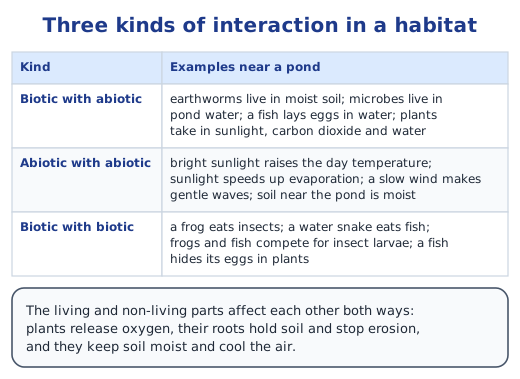
Activity 12.4 and Fig. 12.6. Interactions are between living and non-living parts, between two non-living parts, and among living things. Fig. 12.6 shows a river (aquatic) overlapping mountains, forests, grassland and farmland (terrestrial); the farmland is human-made.
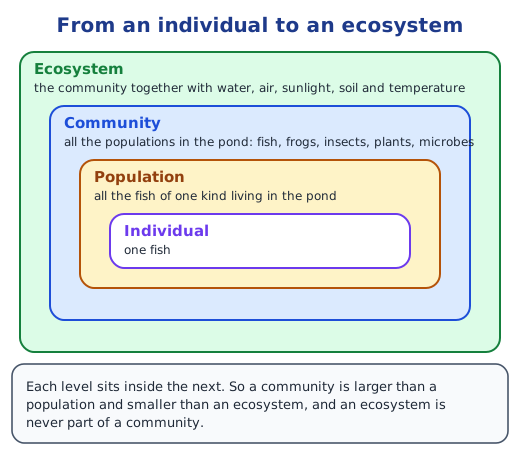
Activity 12.5. Only the tree photosynthesises. Deer and hare eat plants; the vulture and shikra eat animals; the Bengal fox, squirrel and mouse eat both; the mushroom feeds on dead matter. Heterotrophs: every organism in the table except the tree.
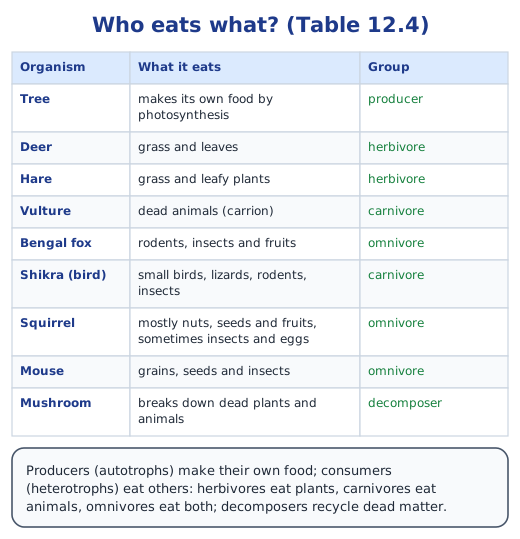
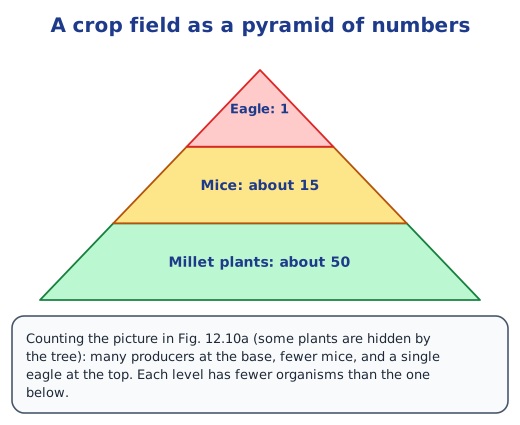
Activities 12.6 and 12.7. Arrows: grass → hare, grass → grasshopper, grasshopper → frog, frog → snake, snake → eagle, hare → eagle. Another chain: grass → hare → eagle. In the crop field there are about 50 millet plants (some hidden by the tree), about 15 mice and one eagle, which stack into a pyramid with millets at the base.
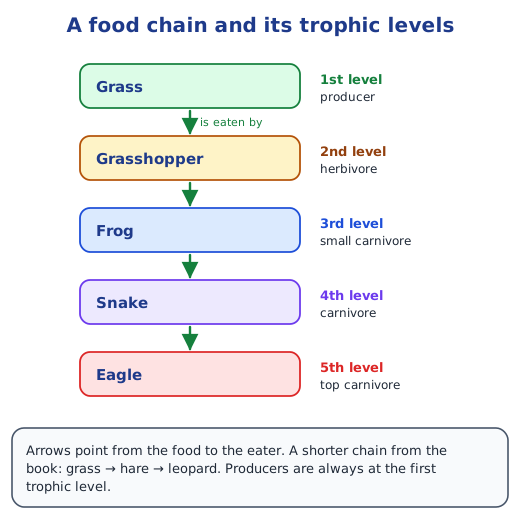
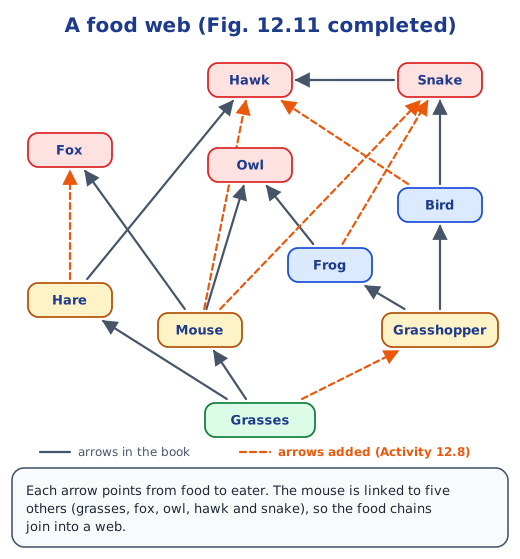
Activity 12.8. Missing arrows: grasses → grasshopper, hare → fox, mouse → hawk, mouse → snake, frog → snake and bird → hawk. The mouse alone is linked to five organisms, so the chains form a web.
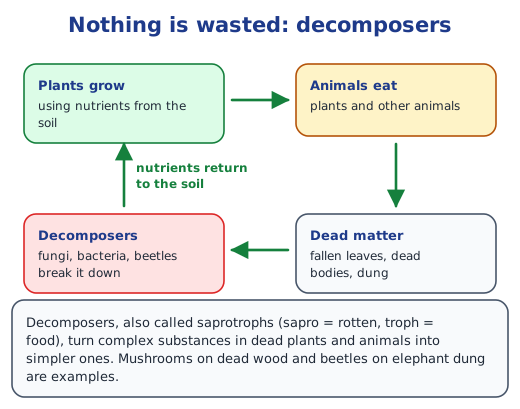
Does nature really waste anything? No. Decomposers return the nutrients in dead matter to the soil, where plants use them again.
Winter birds. Look for winter visitors such as the Demoiselle Crane, bar-headed goose, northern pintail and rosy starling in your area, and note where they come from.
Activity 12.9: what happens when we intervene? Removing frogs let pests multiply, which forced more pesticide use and harmed soil, water and health, so one human action rippled through the whole system.
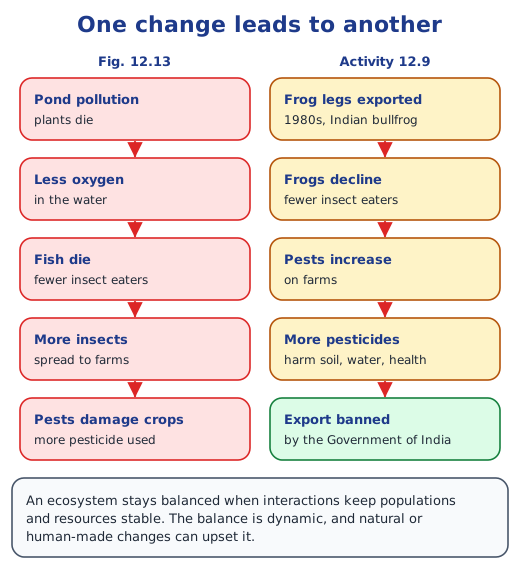
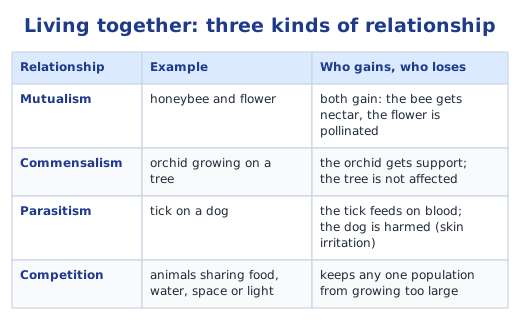
Fig. 12.16. The bee and flower both gain (mutualism); the orchid gains and the tree is unaffected (commensalism); the tick gains and the dog is harmed (parasitism).
Protecting forests, rivers and wetlands. Plant native trees, never dump waste in water bodies, cut plastic use, save water and electricity, join clean-up drives, report illegal cutting or hunting, and respect protected areas such as those in the table.
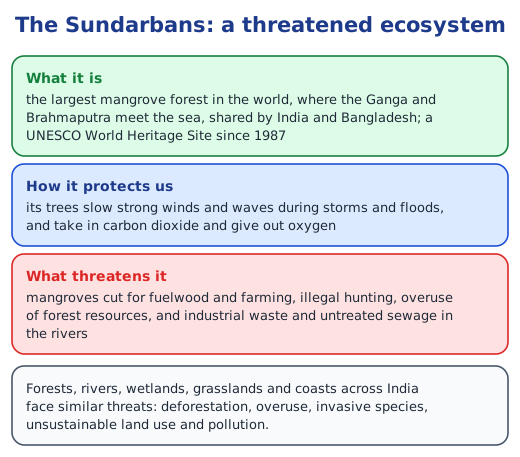
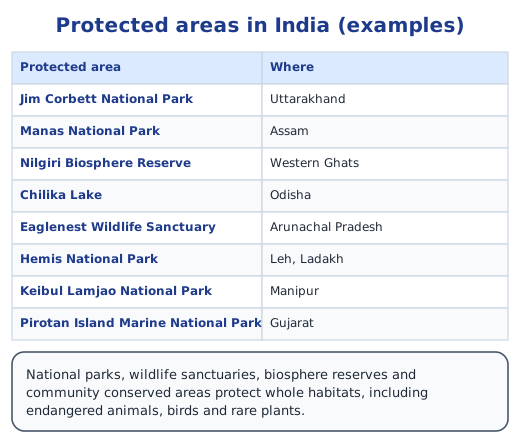
Human-made ecosystems near you. A school garden, park, fish pond, farm or aquarium.
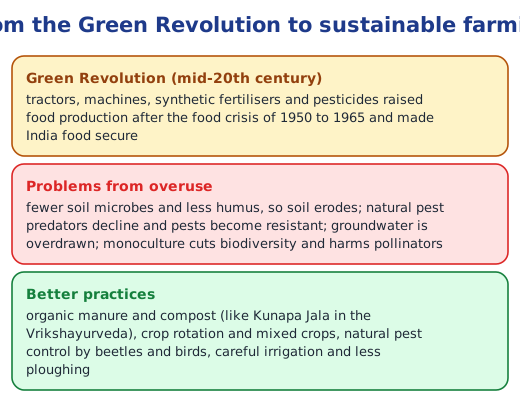
Activity 12.10 and the Green Revolution. Overused chemicals leave residues in food and water and can harm health; they reduce soil microbes and humus, kill natural predators of pests, and make pests resistant, while heavy pumping drains groundwater and monoculture harms pollinators. Practices that help: organic manure and compost, crop rotation and mixed crops, legumes to enrich soil, natural pest control, careful irrigation and less ploughing.
Keep the curiosity alive (pages 207–208)
1. (iii) is wrong: an ecosystem is not part of a community; a community is part of an ecosystem.
2. Dead plants, animals and waste would pile up, and their nutrients would stay locked in them. The soil would slowly lose its fertility, plants would struggle, and then the animals that depend on them. Decomposers are essential because they recycle nutrients and keep the environment clean.
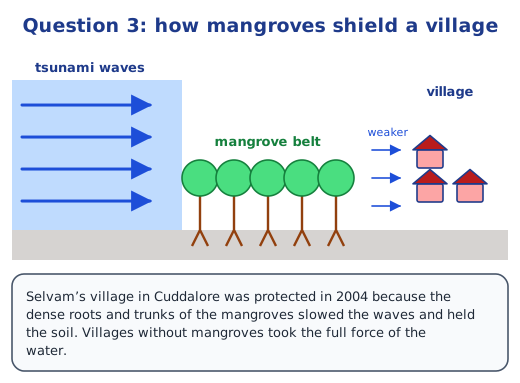
3. Mangroves grow in a dense belt along the coast. Their tangled roots and trunks slow down waves and hold the soil, so a tsunami loses much of its force before reaching the land. Selvam’s village, behind the mangroves, was hit less hard than villages without them.
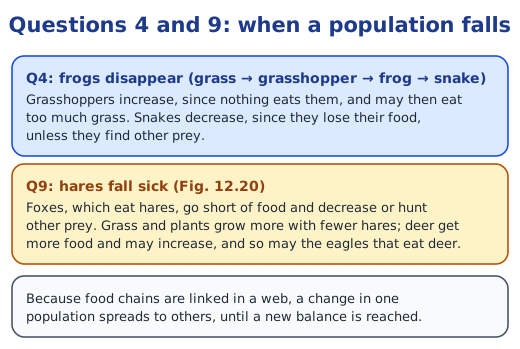
4. Grasshoppers would increase, since nothing eats them, and might then eat too much grass; snakes would decrease because they lose their food, unless they find other prey.
5. Possible reasons: pesticides in the garden, fewer flowering plants for nectar, the loss of plants on which caterpillars feed, or a hot, dry season. Steps: grow nectar-rich flowers such as marigold, zinnia and ixora; plant caterpillar food plants such as curry leaf and lemon for the lime butterfly; stop spraying pesticides; and leave a damp, muddy patch.
6. Producers alone cannot keep going. Without decomposers, dead matter would pile up and nutrients would not return to the soil, so the producers would eventually starve of nutrients; without consumers, there would be no animal pollinators or seed dispersers and no check on plant growth.
7. A park has trees, grass, flowers, birds, squirrels and insects with soil, water and shade; a roadside has a few plants with dust, smoke, noise, heat and concrete. The park supports far more life and interactions.
8. Agricultural fields are necessary because they feed us. But overuse of chemicals, groundwater and monoculture degrades soil and harms pollinators and natural predators, so farms must be made sustainable with organic manure, crop rotation, mixed crops, natural pest control and careful irrigation.
9. Foxes, which eat hares, would go short of food and decline or hunt other prey. Grass and plants would grow more; deer would get more food and might increase, and so might the eagles that eat deer.
Discover, design, and debate (pages 208–209)
Clean-up day. Plastic wrappers and bottles are usually the most common litter. Reduce them by carrying your own bottle and box, refusing single-use plastic, keeping separate bins and recycling.
Tribes and animals. Besides the Nyishi, Mishmi and Baiga, the Bishnoi community of Rajasthan is known for protecting blackbuck and chinkara, and the Toda people of the Nilgiris give buffaloes a central place in their culture.
Watching a tree. Note new leaves, flowers, fruits and visitors each week, and share them on SeasonWatch as a citizen scientist.
Farm visits and Fig. 12.21. The picture shows mixed farming: cattle for dung manure, bullock ploughing, a mixed crop field, a kitchen garden, poultry and fruit trees. Suggestions: compost and vermicompost, crop rotation, mixed crops, neem-based sprays, and harvesting rainwater.
Practice
-
Which statement about Fig. 12.19 is wrong?
Show answer
Answer: (c) An ecosystem is part of a community
-
If frogs disappear from grass → grasshopper → frog → snake, grasshoppers will:
Show answer
Answer: (b) increase
-
Which of these is a heterotroph?
Show answer
Answer: (c) mushroom
-
Why can an ecosystem not have only producers?
Show answer
Answer: Without decomposers, dead matter would pile up and nutrients would never return to the soil, so the producers would run out of nutrients; without consumers, there would be no pollination or seed dispersal by animals and no check on plant growth.
-
How did mangroves protect Selvam’s village in 2004?
Show answer
Answer: The dense roots and trunks of the mangrove forest slowed the tsunami waves and held the soil, so the water reached the village with much less force.
Stuck on a question?
Take a photo and Lagnever AI explains it step by step. Try it for 7 days for ₹2.
Get it on Google Play Open in browser
For parents: after the trial, the plan renews monthly by UPI or card autopay. You can cancel anytime in the app.