
Class 8 Science Chapter 12: How Nature Works in Harmony Notes
This chapter in five lines
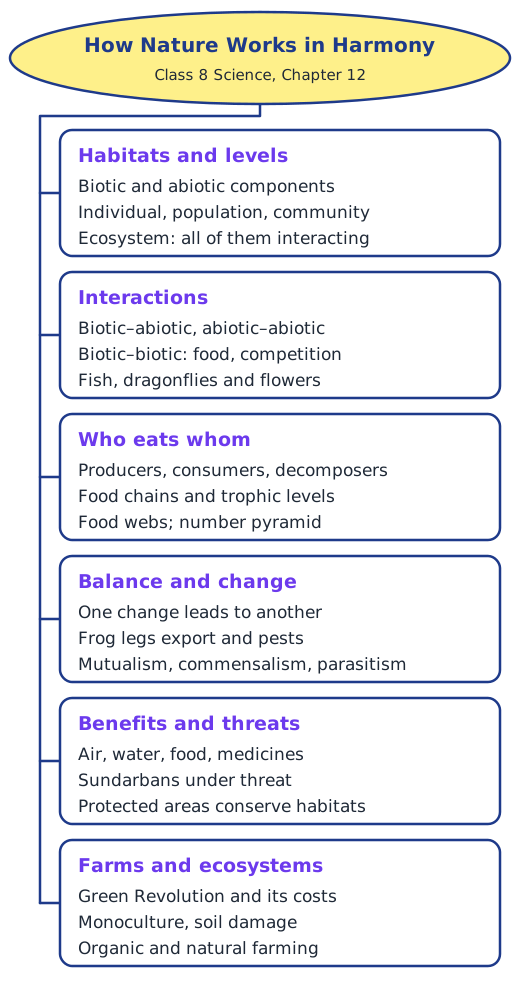
How Nature Works in Harmony shows that living things and their non-living surroundings are tightly linked. Organisms form populations and communities, which with air, water, soil and sunlight make an ecosystem. Food chains link into food webs, decomposers recycle nutrients, and one change spreads to many others, so ecosystems need protecting and farming must be sustainable.
What is this chapter about?
In parts of Assam, West Bengal, Odisha, Jharkhand and Chhattisgarh, elephants stray into farms when their forests dry and shrink. That chain of events, from rainfall to forests to elephants to farmers, shows how closely nature’s parts are linked. The chapter studies these links: who lives together, who eats whom, how waste is recycled, and how human actions can upset the balance.
Habitats, populations and communities
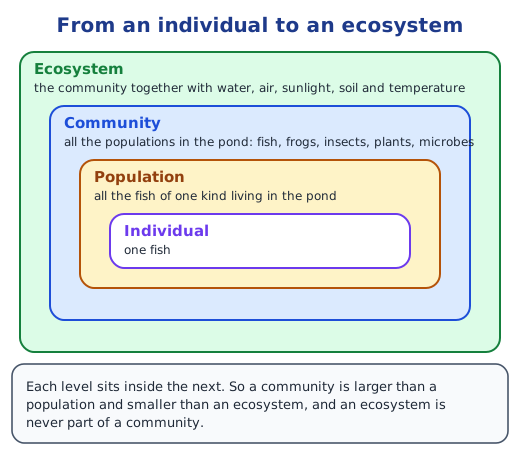
A habitat is where an organism lives, with biotic (living) and abiotic (non-living) components. A pond offers fish food, oxygen, shelter and space. A group of one kind of organism in a habitat is a population; all the populations together form a community; and the community with its non-living surroundings forms an ecosystem. Read ecosystems and interactions.
Interactions
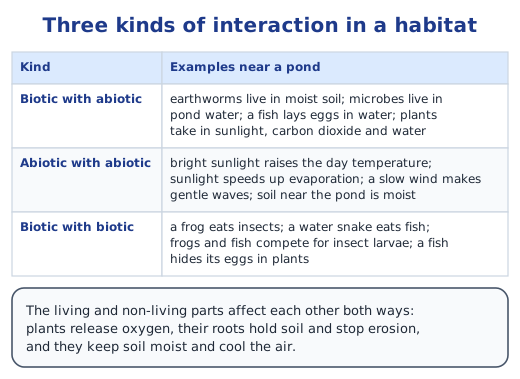
Living things interact with non-living things, non-living things affect each other, and living things affect one another. Earthworms need moist soil, sunlight speeds evaporation, and a frog eats insects. The effects run both ways: plants release oxygen, their roots hold soil, and they keep the ground moist and cool. Ecosystems may be aquatic or terrestrial, large or small, and they often overlap.
Who eats whom
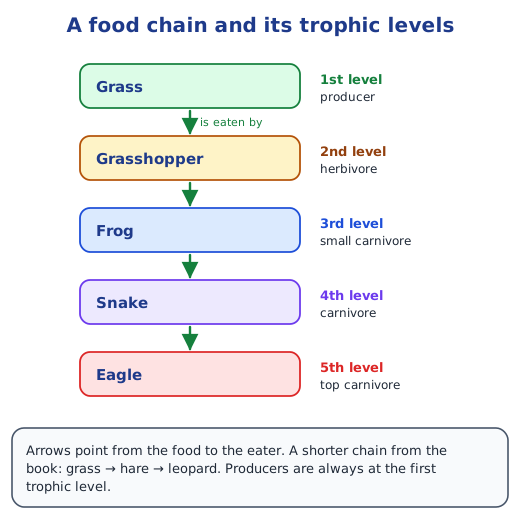
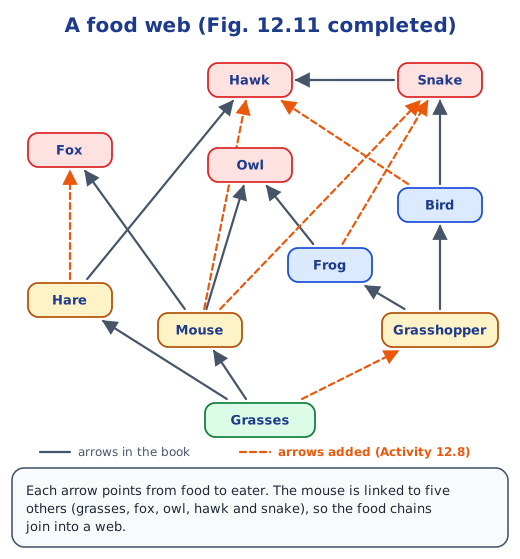
Green plants are producers: they make their own food. Consumers depend on others: herbivores eat plants, carnivores eat animals and omnivores eat both. A food chain shows who eats whom, each step being a trophic level, and the chains of an ecosystem join into a food web. Read food chains and decomposers.
Nothing is wasted
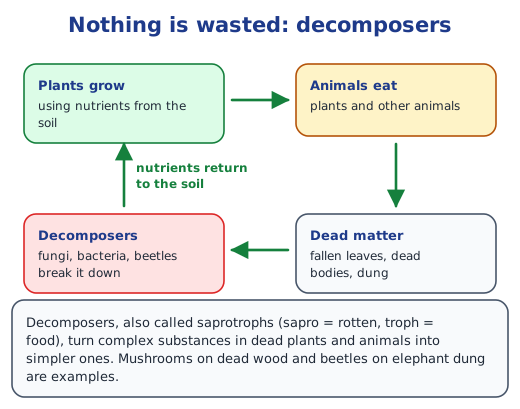
Fungi, bacteria and small insects such as dung beetles are decomposers: they break dead plants, animals and droppings into simple substances and return nutrients to the soil, which plants use again. In nature, everything is reused.
Balance and change
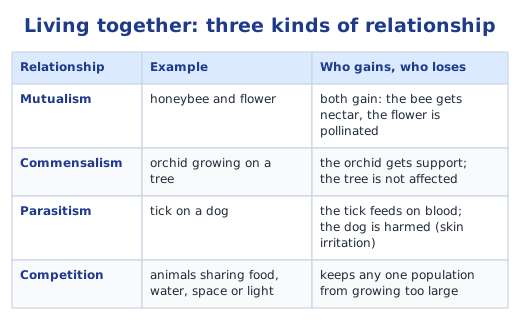
One change can set off many others: when India exported large numbers of frog legs in the 1980s, frogs declined, pests rose and farmers used more pesticides, until the export was banned. Competition and relationships such as mutualism, commensalism and parasitism help keep populations in balance, though the balance is always shifting. Read protecting ecosystems.
Ecosystems and us
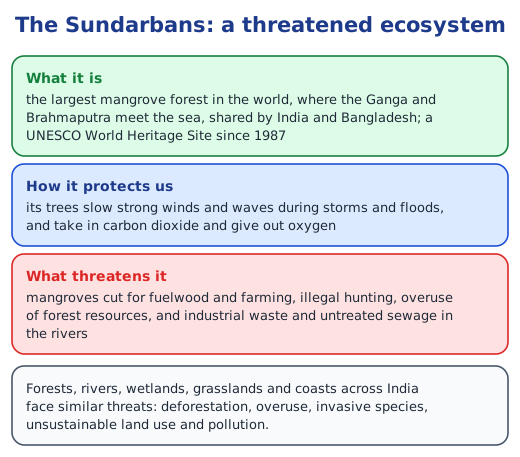
Forests give fresh air, fertile soil, food, fibre, timber and medicines, and water bodies give water and food. Yet ecosystems such as the Sundarbans, the largest mangrove forest in the world, are threatened by cutting, hunting and pollution. Protected areas, careful use of resources and sustainable farming help keep nature healthy.
Before we move on
Every living thing depends on others and on its non-living surroundings, and human actions can either upset or protect this web. Answers to every question are in the NCERT solutions for Chapter 12.
Key terms
| Term | Meaning |
|---|---|
| Habitat | The place where an organism lives, which gives it the conditions it needs; it can be as small as a tree’s bark. |
| Biotic and abiotic components | Biotic: the living parts, such as plants, animals and microbes. Abiotic: the non-living parts, such as air, water, soil, sunlight and temperature. |
| Population | A group of organisms of the same kind living in a habitat at a given time. |
| Community | All the different populations sharing a habitat. |
| Ecosystem | The community of living things together with the non-living components they interact with. |
| Producer (autotroph) | An organism, such as a green plant, that makes its own food by photosynthesis. |
| Consumer (heterotroph) | An organism that depends on others for food: a herbivore, carnivore or omnivore. |
| Decomposer (saprotroph) | An organism, such as a fungus or bacterium, that breaks down dead matter and returns nutrients to the soil. |
| Food chain | The order in which food passes from one organism to the next in an ecosystem. |
| Trophic level | The position of an organism in a food chain; producers are at the first level. |
| Food web | The network formed when the food chains of an ecosystem are linked. |
| Mutualism, commensalism, parasitism | Relationships where both gain; one gains and the other is unaffected; one gains and the other is harmed. |
| Protected area | An area of land or water kept aside for conserving wildlife and its home, such as a national park or biosphere reserve. |
| Monoculture | Growing the same crop again and again on the same land, which reduces biodiversity. |
Topics in this chapter
Practice
-
A group of the same kind of fish living in a pond is a:
Show answer
Answer: (b) population
-
Which of these is an abiotic component?
Show answer
Answer: (b) sunlight
-
Organisms that break down dead matter are called:
Show answer
Answer: (c) decomposers
-
Producers are at which trophic level?
Show answer
Answer: (a) first
-
An orchid growing on a tree is an example of:
Show answer
Answer: (b) commensalism
-
The Sundarbans is famous for its:
Show answer
Answer: (b) mangrove forests
Questions students ask
What are the main topics of Class 8 Science Chapter 12?
Habitats and their biotic and abiotic components; populations, communities and ecosystems; interactions; producers, consumers and decomposers; food chains, trophic levels and food webs; how one change leads to another; relationships between organisms; the benefits of ecosystems and threats to them; protected areas; and sustainable farming.
Is How Nature Works in Harmony in the new NCERT Class 8 Science book?
Yes. It is Chapter 12 of Curiosity, the Grade 8 science textbook, on pages 190 to 209 of the 2026-27 reprint.
What is an ecosystem?
A community of living things together with the non-living parts of its surroundings, such as air, water, soil and sunlight, all interacting. A pond, a forest and even a large tree can be ecosystems.
Why are decomposers important?
They break down dead plants, animals and waste into simple substances and return nutrients to the soil, where plants use them again. Without them, dead matter would pile up and the soil would lose its fertility.
Stuck on a question?
Take a photo and Lagnever AI explains it step by step. Try it for 7 days for ₹2.
Get it on Google Play Open in browser
For parents: after the trial, the plan renews monthly by UPI or card autopay. You can cancel anytime in the app.