
Protecting ecosystems
Answer in short
Ecosystems stay balanced when interactions keep populations and resources stable, but one change can ripple through a whole web, as when exporting frog legs led to more pests. Ecosystems give us air, water, food and medicines, yet many, like the Sundarbans, are threatened. Protected areas, careful use of resources and sustainable farming help keep them healthy.
Stuck on a question? Take a photo and Lagnever AI explains it step by step. Try it for 7 days for ₹2. Get it on Google Play
One change leads to another
In nature, a small change rarely stays small. If pollution kills the plants in a pond, less oxygen is produced and fish die; with fewer fish to eat them, insects multiply and spread to nearby farms, and farmers turn to pesticides, which harm the environment further.
A real example: in the 1980s India exported large numbers of frog legs, mainly of the Indian bullfrog. As frogs declined, the insects they eat multiplied into farm pests, so farmers used more synthetic pesticides, harming soil, water and health. The Government of India then banned the export of frog legs.
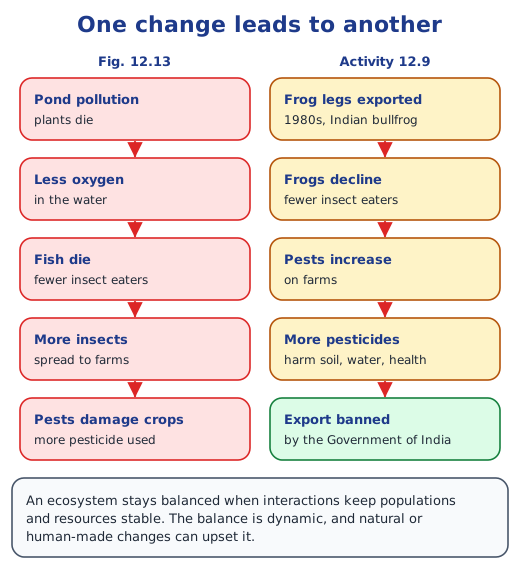
An ecosystem is balanced when the way its members interact keeps both populations and resources steady. That balance is dynamic: it keeps shifting and can be upset by natural or human-made changes.
Relationships that keep the balance
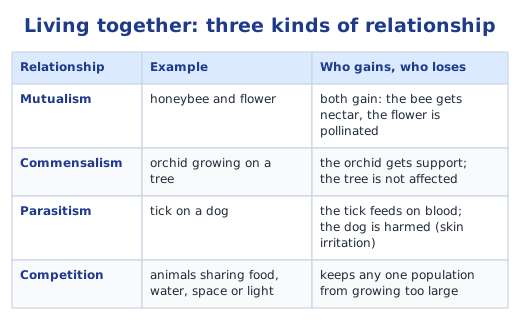
Organisms compete for food, water, space and sunlight, and this competition keeps any one species from multiplying out of control. Other relationships matter too. In mutualism both gain, like a honeybee getting nectar while pollinating a flower. In commensalism one gains and the other is unaffected, like an orchid supported by a tree. In parasitism one gains and the other is harmed, like a tick feeding on a dog’s blood. The wildlife biologist A.J.T. Johnsingh showed in Bandipur National Park that tigers and leopards depend on healthy populations of prey such as deer and wild boar.
What ecosystems give us
Forests give fresh air, fertile soil, food, fibre, timber and medicines; ponds, rivers and lakes give water and food; and all of them have beauty and recreational value. Overusing or misusing these resources upsets the balance on which we depend.
The Sundarbans under threat
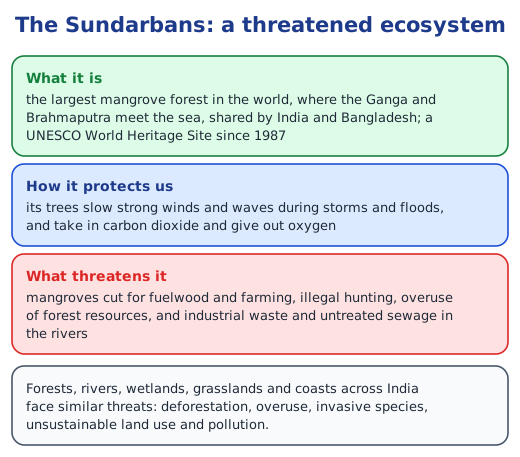
The Sundarbans, where the Ganga and Brahmaputra meet the sea between India and Bangladesh, is the largest mangrove forest in the world and home to many endangered plants and animals. Its trees break the force of storm winds, waves and floods, and take in carbon dioxide. UNESCO declared it a World Heritage Site in 1987. Yet mangroves are cut for fuelwood and farming, animals are hunted illegally, and industrial waste and sewage pollute its rivers.
Protected areas
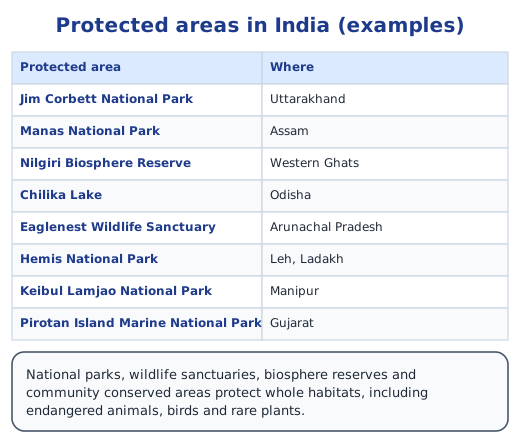
Protected areas are stretches of land or water kept aside to protect wildlife and their homes: national parks, biosphere reserves, wildlife sanctuaries and community conserved areas. They protect entire habitats, including endangered animals and rare plants, for future generations.
Farming in harmony with nature
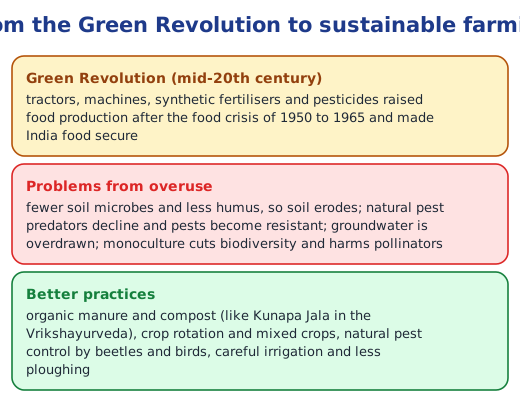
Fish ponds, farms and parks are human-made ecosystems that need human care. After a food crisis between 1950 and 1965, tractors, synthetic fertilisers and pesticides raised production in the Green Revolution. But long-term overuse reduces soil microbes and humus, so soil erodes; it kills natural predators of pests, and pests become resistant; heavy irrigation drains groundwater; and monoculture cuts biodiversity and harms pollinators. Organic and natural farming, compost and organic manure, such as Kunapa Jala described in the ancient text Vrikshayurveda, crop rotation and natural pest control help protect the soil and our food security.
Read on: ecosystems and interactions, food chains and decomposers, the chapter notes and the NCERT solutions.
Practice
-
Why did the Government of India ban the export of frog legs?
Show answer
Answer: (b) fewer frogs meant more crop pests and more pesticide use
-
Growing the same crop again and again on the same land is called:
Show answer
Answer: (b) monoculture
-
In which state is Keibul Lamjao National Park?
Show answer
Answer: (c) Manipur
-
How do the Sundarbans protect people?
Show answer
Answer: The mangroves break the force of storm winds, waves and floods, shielding the coast, and the trees take in carbon dioxide and give out oxygen.
-
Name two practices that make farming more sustainable.
Show answer
Answer: For example, using organic manure and compost instead of only synthetic fertilisers, and rotating or mixing crops instead of growing one crop again and again.
Questions students ask
What threatens ecosystems in India?
Deforestation, overuse of natural resources, invasive species, unsustainable land use and pollution, which damage forests, rivers, scrublands, wetlands, grasslands and coasts.
What are protected areas?
Areas of land or water kept aside to protect wildlife and their homes, such as national parks, biosphere reserves, wildlife sanctuaries and community conserved areas. Examples include Jim Corbett, Manas, Hemis and Keibul Lamjao National Parks and Chilika Lake.
Why is the Green Revolution way of farming now called unsustainable?
Because of the overuse of synthetic fertilisers and pesticides, too much groundwater extraction and growing one crop for profit. These degrade soil, reduce natural predators and pollinators, and make pests resistant.
Stuck on a question?
Take a photo and Lagnever AI explains it step by step. Try it for 7 days for ₹2.
Get it on Google Play Open in browser
For parents: after the trial, the plan renews monthly by UPI or card autopay. You can cancel anytime in the app.