
Food chains, food webs and decomposers
Answer in short
Producers such as green plants make their own food; consumers eat other organisms; decomposers break down dead matter. A food chain shows who eats whom, and each step is a trophic level, starting with producers. The chains of an ecosystem join into a food web, while decomposers return nutrients to the soil, so nothing in nature is wasted.
Stuck on a question? Take a photo and Lagnever AI explains it step by step. Try it for 7 days for ₹2. Get it on Google Play
Producers and consumers
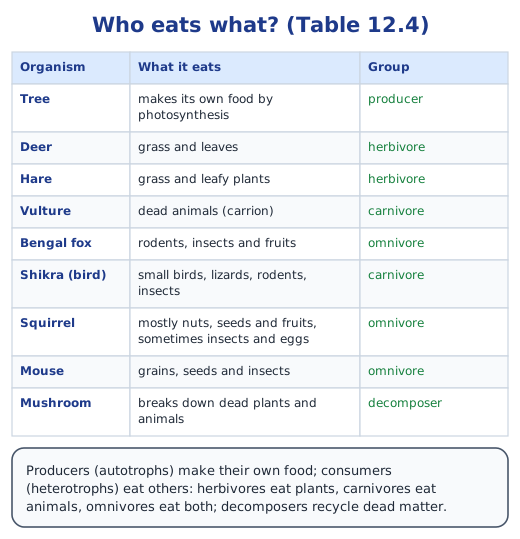
Green plants make their own food by photosynthesis, so they are producers or autotrophs (auto = self, troph = food). All other organisms depend on others for food: they are consumers or heterotrophs (hetero = other). Consumers that eat only plants, such as deer and hares, are herbivores; those that eat only animals, such as leopards, are carnivores; and those that eat both, such as crows, foxes and mice, are omnivores. Finding out what forest animals eat (Activity 12.5) sorts them into these groups.
Food chains
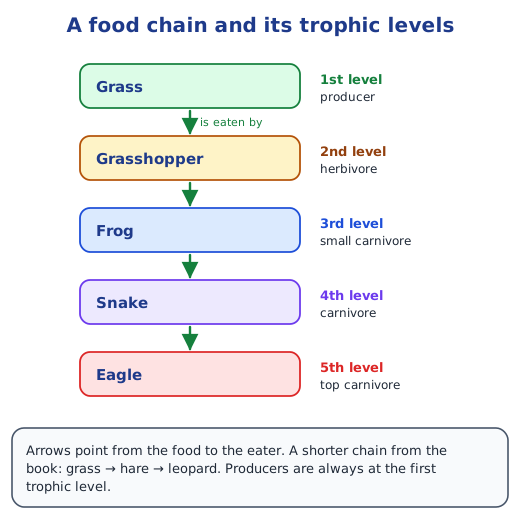
In a grassland, grass is eaten by a hare, and the hare by a leopard. Such a sequence of who eats whom is a food chain. Another chain from the same grassland is grass → grasshopper → frog → snake → eagle. Each position in a food chain is a trophic level: producers are at the first level, herbivores at the second, small carnivores such as frogs at the third, and large carnivores such as tigers or vultures above them.
A pyramid of numbers
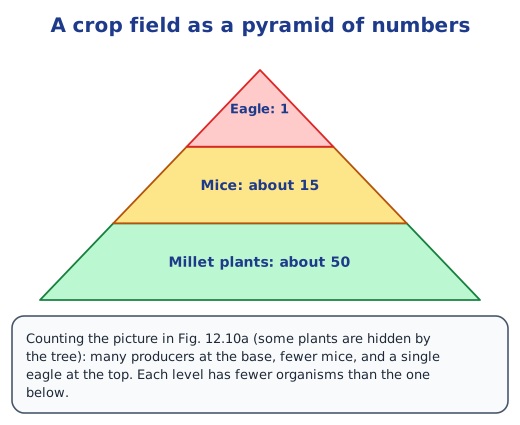
Activity 12.7 counts the organisms in a picture of a millet field: about 50 millet plants, about 15 mice, and a single eagle in a tree. Stacking the numbers with the largest at the bottom gives a pyramid. Each trophic level supports fewer organisms than the one below it. Why does the pyramid narrow? Each animal must eat many organisms from the level below to stay alive, so a field can feed many mice but only a few eagles.
Food webs
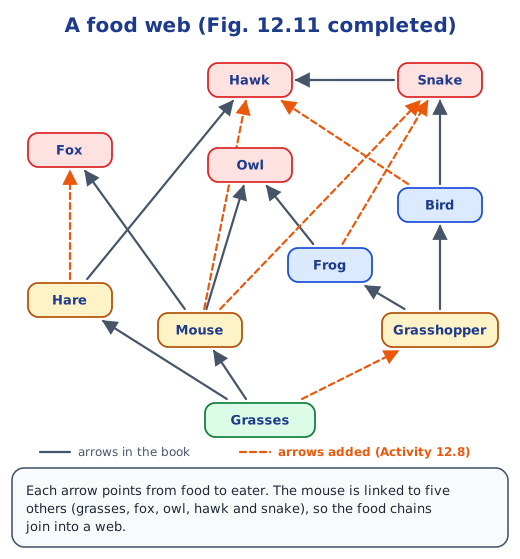
Most organisms eat more than one thing and are eaten by more than one predator. In the book’s food web, grasses feed hares, mice and grasshoppers; the mouse alone is eaten by the fox, owl, hawk and snake. When we add the missing arrows (Activity 12.8), the separate food chains clearly join into a network, a food web. A web is more stable than a single chain: if one food runs short, many animals can switch to another.
Decomposers: nature’s recyclers
Living things grow, carry out their life processes and die, leaving dead bodies, fallen leaves, droppings and food waste. Mushrooms growing on dead wood in the rainy season are fungi feeding on this dead matter. Fungi and bacteria reduce the remains of dead plants and animals to simple substances, while beetles and flies work through animal dung, such as elephant dung. This is decomposition, and the organisms that do it are decomposers or saprotrophs (sapro = rotten).
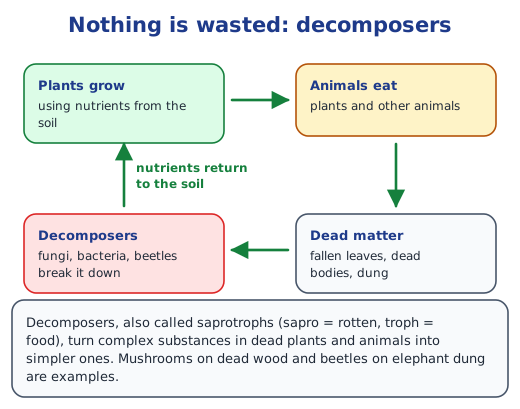
Decomposition returns nutrients to the soil, where plants take them up again. So does nature waste anything? No: in nature, everything is reused.
Why every link matters
Because chains are linked, a change at one level spreads. If frogs vanish from grass → grasshopper → frog → snake, grasshoppers multiply and snakes go hungry. If decomposers vanished, dead matter would pile up and the soil would slowly lose its nutrients, starving the producers on which every chain depends.
Read on: ecosystems and interactions, protecting ecosystems, the chapter notes and the NCERT solutions.
Practice
-
Which organism is a producer?
Show answer
Answer: (c) tree
-
A fox that eats rodents, insects and fruits is:
Show answer
Answer: (c) an omnivore
-
In the crop field, the organism with the smallest number is the:
Show answer
Answer: (c) eagle
-
Give a food chain of five organisms from a grassland.
Show answer
Answer: Grass → grasshopper → frog → snake → eagle.
-
Why are food chains in an ecosystem joined into a web?
Show answer
Answer: Because most organisms eat, and are eaten by, more than one kind of organism. A mouse, for example, eats grass and is eaten by the fox, owl, hawk and snake, so many chains cross.
Questions students ask
What is a trophic level?
The position of an organism in a food chain. Producers such as green plants are at the first level, herbivores at the second, small carnivores such as frogs at the third, and large carnivores such as tigers or vultures at the next.
What is a food web?
The network formed when the food chains of an ecosystem are interlinked, because each organism may be eaten by two or more kinds of organisms.
What do decomposers do?
Decomposers, or saprotrophs, such as fungi and bacteria, turn dead plants, animals and droppings into simple substances, so their nutrients go back into the soil for plants to use again.
Stuck on a question?
Take a photo and Lagnever AI explains it step by step. Try it for 7 days for ₹2.
Get it on Google Play Open in browser
For parents: after the trial, the plan renews monthly by UPI or card autopay. You can cancel anytime in the app.