
Ecosystems and interactions
Answer in short
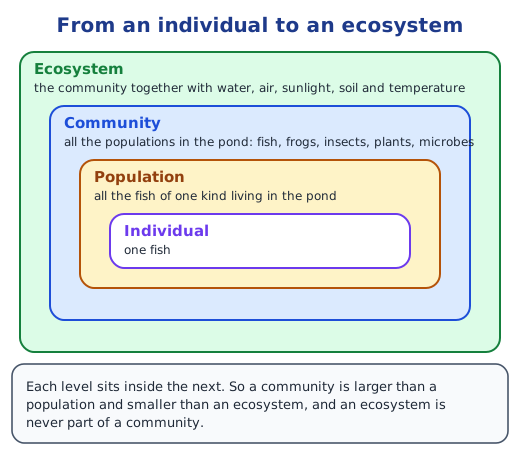
An ecosystem is a community of living things, the biotic components, together with the non-living abiotic components around them, such as air, water, soil, sunlight and temperature, all interacting. Organisms of one kind form a population, populations together form a community, and living and non-living parts constantly affect each other.
Stuck on a question? Take a photo and Lagnever AI explains it step by step. Try it for 7 days for ₹2. Get it on Google Play
When forests shrink
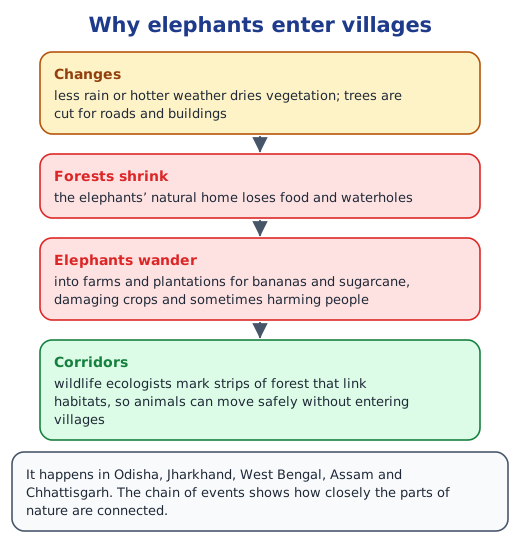
Elephants often wander into farms and villages in Odisha, Jharkhand, West Bengal, Assam and Chhattisgarh. When rainfall drops or the weather gets hotter, vegetation dries; when trees are cut for roads and buildings, forests shrink further. Hungry elephants then raid farms for bananas and sugarcane, damaging crops and sometimes hurting people. To reduce this conflict, wildlife ecologists mark corridors, strips of forest that connect habitats so that animals can travel between them safely.
Habitats and their components
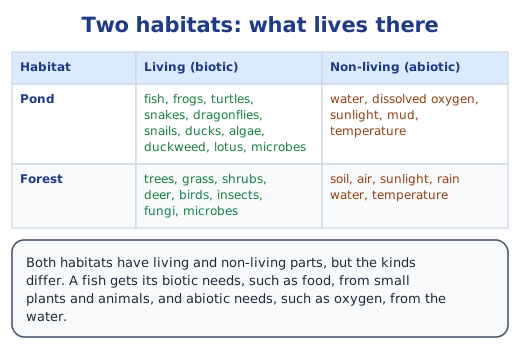
A habitat is the place where an organism lives: a pond, a forest, a farm, or even the bark of a single tree. Exploring a pond and a forest (Activity 12.1) shows that both have living and non-living parts, but different ones. The living parts are the biotic components and the non-living parts, such as air, sunlight, water, temperature and soil, are the abiotic components. A pond gives fish their food from small plants and animals, and oxygen from the water.
Animals sharing a habitat can still use it differently. A forest may be warm by day and cool by night; a snake that hunts at night and a rodent active by day live side by side yet face different conditions. This is how organisms coexist in harmony.
From individuals to ecosystems
Many fish of one kind living together in a pond form a population. Counting plants in a 1 m × 1 m square of the school garden (Activity 12.2) shows how populations can be measured. All the populations in a habitat, plants, animals and microorganisms, make up a community, whose members depend on each other. The community together with its abiotic surroundings forms an ecosystem.
A habitat with only one kind of organism would not work well: every individual would need the same food, water and space, leading to fierce competition and shortages, and with no other organisms there would be no food chains and no recycling of waste.
Does every organism matter?
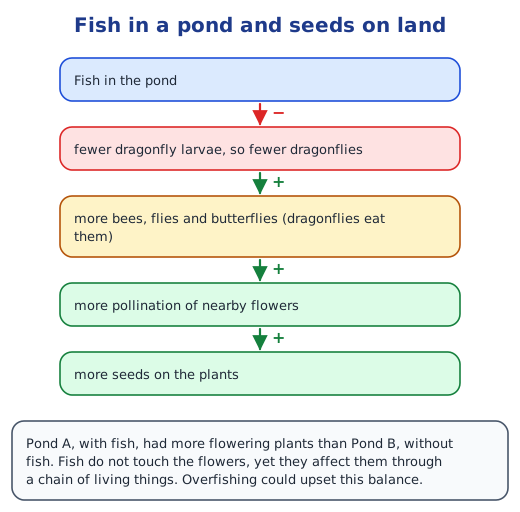
Researchers compared two ponds (Activity 12.3). Pond A had fish and many flowering plants around it; Pond B had no fish and fewer flowers. Fish eat dragonfly larvae, so Pond A had fewer dragonflies. Dragonflies eat bees, flies and butterflies, so around Pond A more of these pollinators survived, and the flowers made more seeds. Fish never touch the flowers, yet they help them. Overfishing could break this chain.
Three kinds of interaction
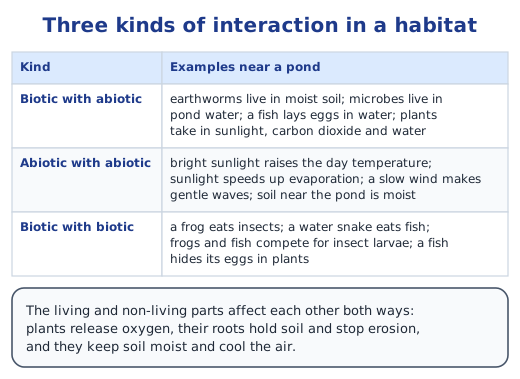
Activity 12.4 sorts interactions into three kinds: between living and non-living parts (earthworms live in moist soil), between two non-living parts (sunlight raises the temperature and speeds evaporation), and among living things (a frog eats insects, and frogs and fish compete for larvae). Living things need sunlight, carbon dioxide and water to make food, soil for nutrients and air for oxygen; in return, plants release oxygen, roots stop erosion and plants keep soil moist and the air cool.
Aquatic ecosystems include ponds, rivers and lakes; terrestrial ecosystems include forests, grasslands, farms and even a big banyan, mango or pilkhan tree. They often overlap, like a river running through forest, grassland and farmland. Farmland is a human-made ecosystem.
Read on: food chains and decomposers, protecting ecosystems, the chapter notes and the NCERT solutions.
Practice
-
Which is the largest level of organisation?
Show answer
Answer: (d) ecosystem
-
‘Sunlight speeds up evaporation from a pond’ is an interaction between:
Show answer
Answer: (b) two abiotic components
-
Which of these is a human-made ecosystem?
Show answer
Answer: (c) farmland
-
Why did ponds with fish have more flowering plants nearby?
Show answer
Answer: Fish eat dragonfly larvae, so there were fewer dragonflies to eat bees, flies and butterflies. More of these pollinators visited nearby flowers, so the plants made more seeds.
-
How can two animals share a habitat without getting in each other’s way?
Show answer
Answer: By using it differently: for example, a snake that hunts after dark and a rodent busy by day live in the same forest but meet different conditions and use different times.
Questions students ask
What is the difference between a population and a community?
A population is a group of the same kind of organism in a habitat, such as all the rohu fish in a pond. A community is made of all the different populations sharing that habitat.
What are the two main types of ecosystem?
Aquatic ecosystems, such as ponds, rivers and lakes, and terrestrial ecosystems, such as forests, grasslands, farms and even a large tree. Ecosystems can be large or small, and they often overlap.
Why do wildlife corridors matter?
They are strips of habitat that connect forests, so animals such as elephants can move between them safely without entering villages and farms.
Stuck on a question?
Take a photo and Lagnever AI explains it step by step. Try it for 7 days for ₹2.
Get it on Google Play Open in browser
For parents: after the trial, the plan renews monthly by UPI or card autopay. You can cancel anytime in the app.