
NCERT Solutions Class 8 Science Chapter 13: Our Home: Earth, a Unique Life Sustaining Planet
Answers to Probe and ponder, the questions inside the chapter, Activities 13.1 to 13.3, all twelve Keep the curiosity alive questions and the Discover, design, and debate projects in Chapter 13, Our Home: Earth, a Unique Life Sustaining Planet, of Curiosity, the Grade 8 science textbook. Page numbers follow the 2026-27 reprint (pages 210–228). Short notes: Chapter 13 notes.
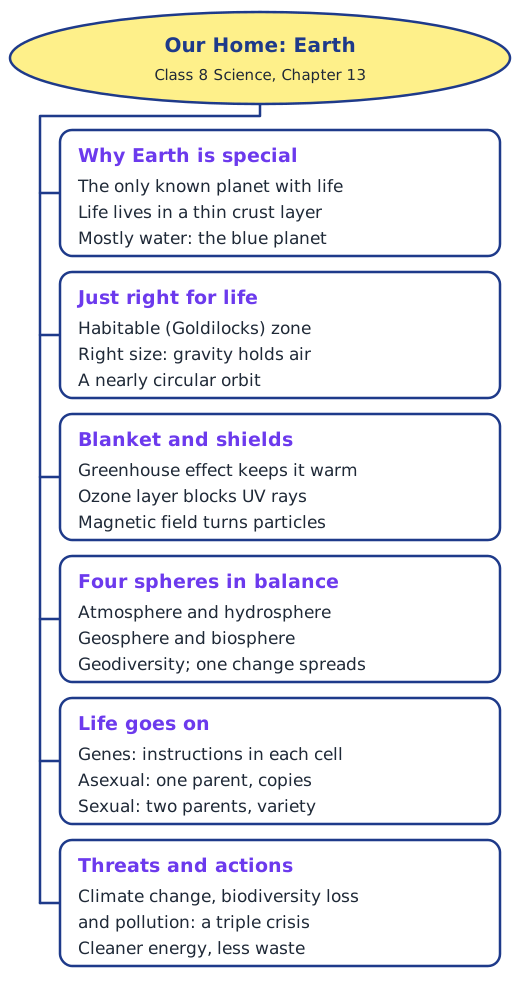
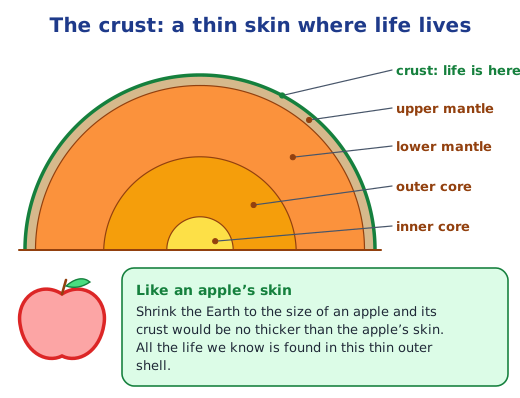
Probe and ponder (page 210)
Earth with no life at all. Bare rock, sand, ice and water, with no green forests or grasslands. There would be little true soil, since soil forms partly from the remains of plants and animals, and little oxygen in the air, since plants release oxygen during photosynthesis.
How has life kept going for billions of years? Reproduction keeps every kind of living thing going, and the small changes passed down let life adapt to new conditions. With so many kinds of living things, some survive even major disasters. Earth’s steady conditions, liquid water, a protective atmosphere, the ozone layer and the magnetic field, keep the planet habitable.
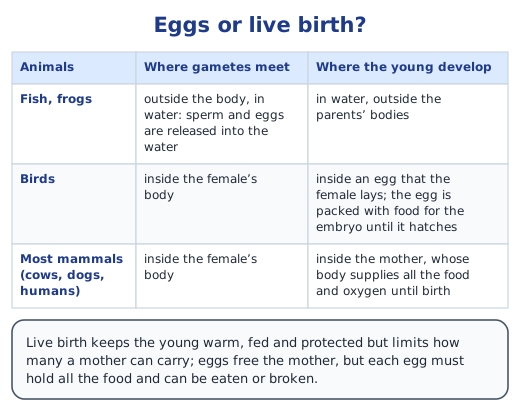
Dogs that lay eggs? Hens with live chicks? Each kind of animal passes its own instructions (genes) to its young. In dogs, as in most mammals, the young develop inside the mother, who feeds them through her body. Hens pack food into an egg, and the chick develops outside the body. Each way is inherited, so it does not change from one generation to the next.
Soil and water on Mars. Not on their own. Mars’s air is 100 times thinner than Earth’s, so it is far too cold, water would freeze or escape, and harmful rays reach the surface. Plants could grow only inside a sealed, warm, shielded greenhouse with air, light and water.
Inside the chapter (pages 211–223)
Activity 13.1: features of the Earth. Besides the two in the table: water stays liquid in most places; temperatures stay moderate, neither scorching nor freezing; the ozone layer blocks harmful UV rays; a compass needle points north because of Earth’s magnetic field; and soil holds the nutrients that crops need.
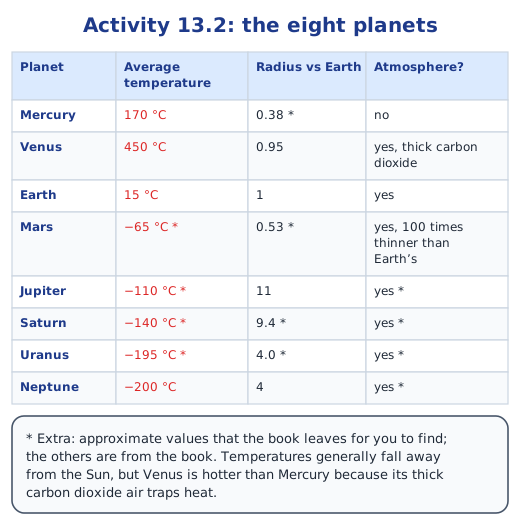
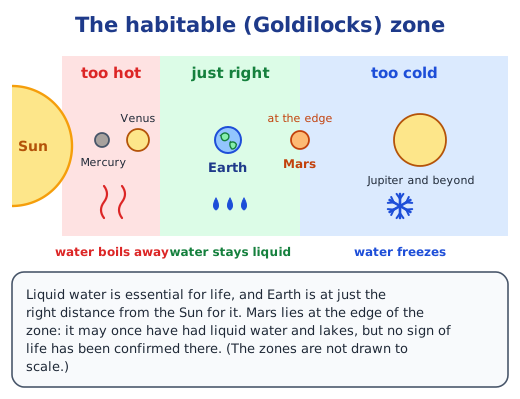
Activity 13.2: the planets. The table below fills in the missing values; those marked * are approximate and are not given in the book. Planets generally get colder away from the Sun, but Venus is the hottest because its thick carbon dioxide air traps heat.
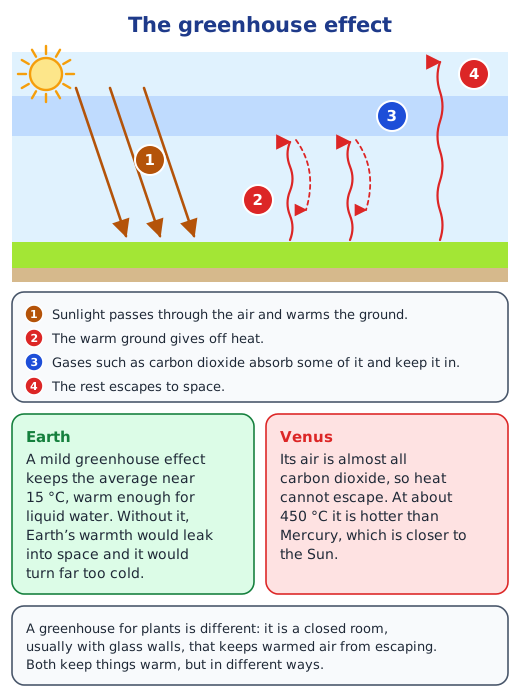
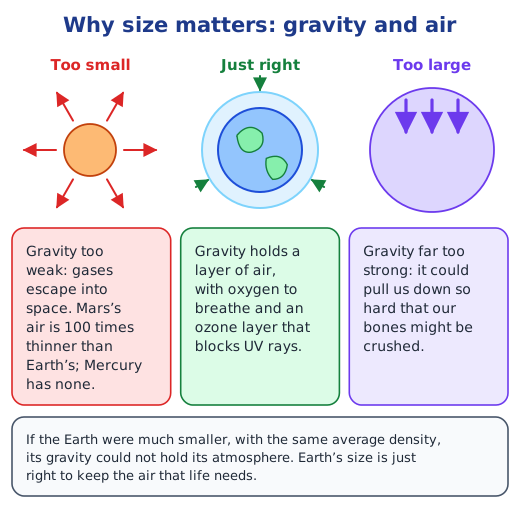
Is distance from the Sun the only factor? No. Earth’s size matters: if it were too small, its weak gravity could not hold an atmosphere; if it were too big, gravity would be strong enough to crush bones. The atmosphere, the ozone layer, the magnetic field and the nearly circular orbit all help too.
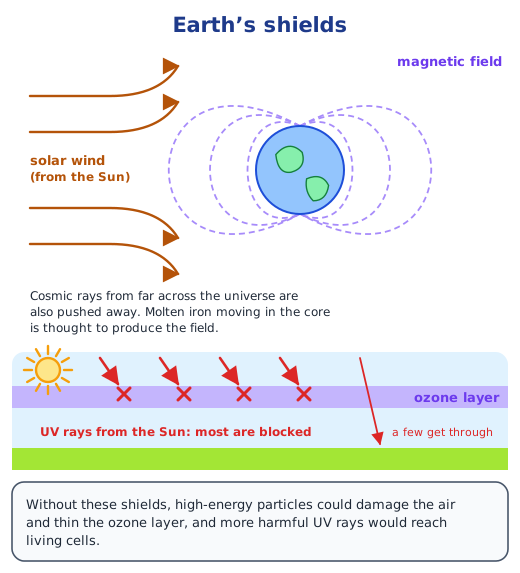
Does the magnetic field help sustain life? Yes. It pushes away many cosmic rays and much of the solar wind, which could otherwise harm the atmosphere and thin the ozone layer, so that more harmful UV rays would get through.
Bamboo and sugarcane. They are grown from pieces of the stem with buds on them, a kind of vegetative propagation, so farmers do not need their seeds. Other plants that grow this way: money plant, rose and hibiscus from stem cuttings, and potato, ginger, turmeric and onion from underground parts.
Activity 13.3. Roots usually appear first on the money plant cutting, then a new leaf; the potato eyes and the ginger piece send up shoots. Record the number of days for your own plants, since it depends on warmth, water and light. Each new plant has exactly the same instructions as the plant it came from.
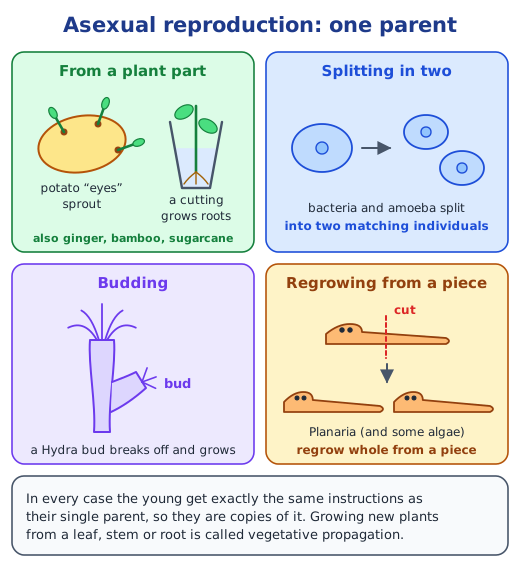
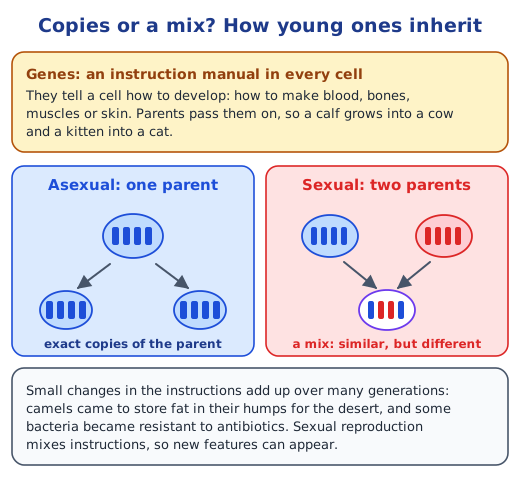
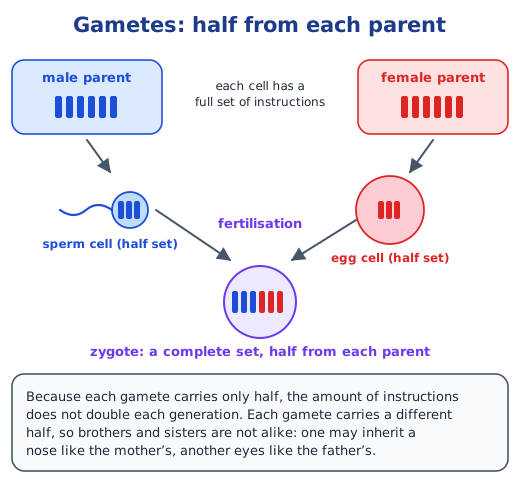
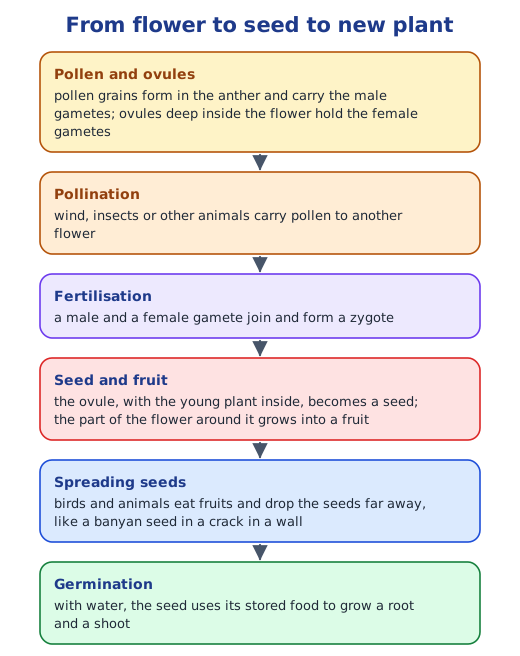
Giving birth or laying eggs? Giving birth keeps the young warm, fed and protected inside the mother until it can survive outside, but the mother carries it for a long time, needs much more food and can have only a few young at a time. Laying eggs frees the mother sooner, but each egg must already hold all the food the embryo needs, and eggs can be eaten, broken or get too cold. Could dogs, cows or humans lay eggs? No. Their bodies are built for the young to develop inside the mother, and this way is passed down in their instructions, just as egg-laying is in birds.
Keep the curiosity alive (pages 226–227)
1. “What is one major reason Mars cannot currently support life like Earth?” (iii) It lacks a thick atmosphere and liquid water. Its air is about 100 times thinner than Earth’s, so it cannot keep the planet warm, and liquid water cannot last on its surface today.
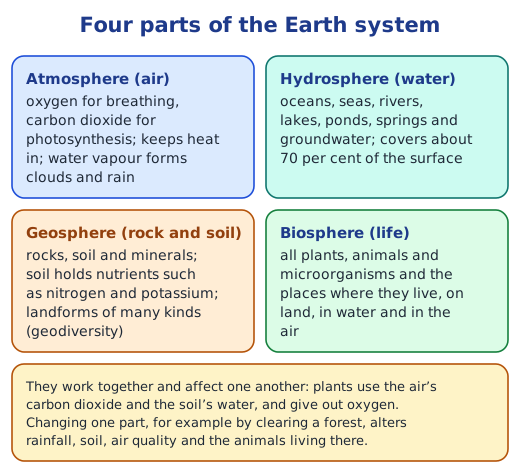
2. “Which of these is an example of geodiversity?” (ii) Different landforms like mountains, valleys, and deserts. Geodiversity is the variety of landforms, rocks and soils. Bird calls and kinds of fish are part of the variety of living things, and monsoon weather is a change in the air.
3. “If the Earth were smaller with the same density, what might happen to its atmosphere?” (ii) It would escape into space due to weaker gravity. A smaller planet of the same density has less mass, so its gravity cannot hold the gases, as Mars and Mercury show.
4. “In sexual reproduction, why are offspring different from their parents?” (iv) They get mixed instructions (genes) from both parents. Each gamete carries half of a parent’s instructions, and the halves combine in a new way each time.
5. “You notice tiny green plants growing in cracks on your school wall after the monsoon. Where do you think the seeds came from? What conditions helped these plants grow there?” The seeds may have been blown in by the wind, if they are small and light; dropped by birds after eating fruits, as with the banyan in the chapter; or washed in by rain. Dust and bits of soil collect in the cracks, the monsoon rain keeps them moist, and there is air, sunlight and warmth, so the seeds can use their stored food to sprout. Extra: many tiny green patches on old walls are mosses or ferns, which grow from spores, not seeds.
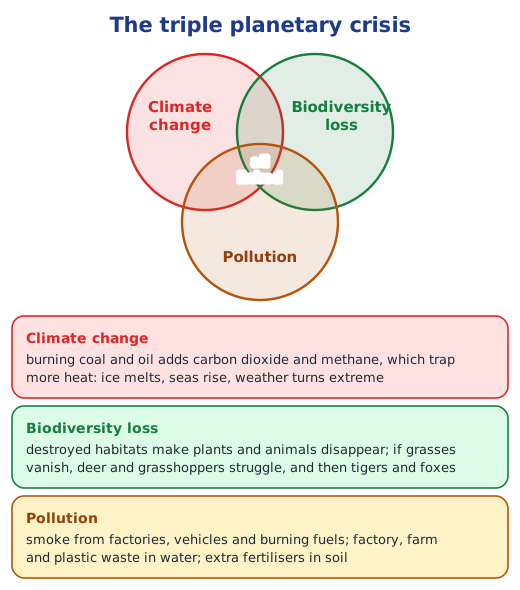
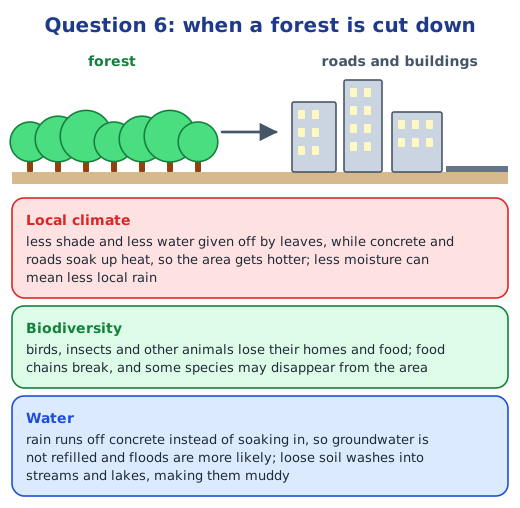
6. “A city has recently cut down a large patch of forest to build new roads and buildings. Discuss the possible effects this could have on the local climate and biodiversity? How might this affect water availability or quality in the area?” Climate: with less shade and less water given off by leaves, and with concrete and roads soaking up heat, the area becomes hotter, the air less clean, and local rain may change. Biodiversity: birds, insects and other animals lose their homes and food, food chains break, and some species may disappear from the area. Water: rain runs off concrete instead of soaking in, so groundwater is not refilled and floods become more likely, while loose soil and building waste make streams and lakes muddy and polluted.
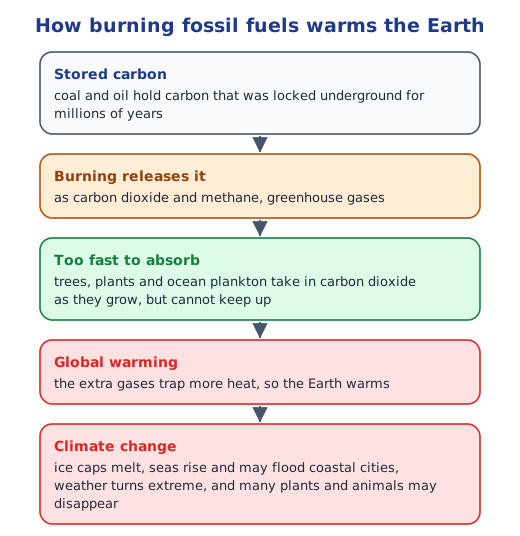
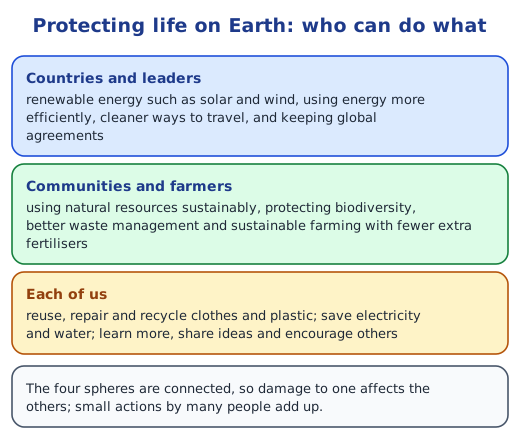
7. “A friend says, ‘The Earth has always had climate changes in the past, so today’s global warming is nothing new.’ How would you respond using what you’ve learnt in this and other chapters of your science book?” It is true that Earth’s climate has changed before, through natural causes, usually very slowly. Today’s warming is different. It is caused mainly by people burning coal and oil, which releases carbon locked underground for millions of years far faster than trees, plants and ocean plankton can absorb it. The extra greenhouse gases trap more heat, so the Earth is warming within a few human lifetimes, melting ice, raising seas and bringing extreme weather. Because people cause it, people can also reduce it, with cleaner energy and less waste.
8. “Imagine Earth’s magnetic field suddenly disappeared. What kinds of problems could arise for life on Earth? Explain.” The solar wind and cosmic rays would strike the atmosphere directly. They could damage the air and thin the ozone layer, so more harmful UV rays would reach the ground and damage the cells of people, animals and plants. Over a long time, the atmosphere itself could be worn away. Compasses would stop pointing north. Extra: some animals, such as certain migrating birds and sea turtles, are thought to use the magnetic field to find their way, so they could get lost.
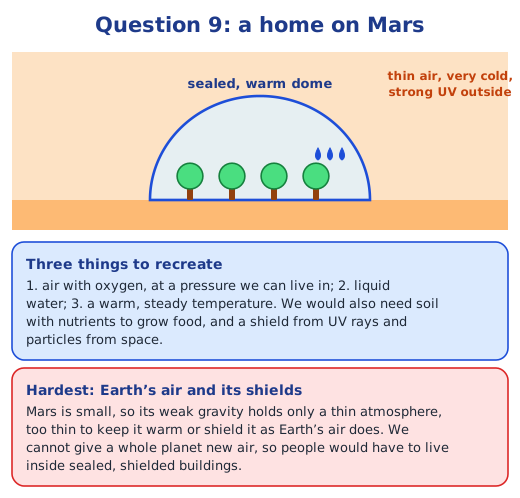
9. “You are tasked with designing a new settlement for humans on Mars. Name three things you would need to recreate from Earth to support human life there. Which of these do you think is the hardest to replicate, and why?” Three things: air with oxygen, at a pressure we can live in; liquid water; and a warm, steady temperature. We would also need soil with nutrients to grow food, and shielding from harmful rays. The hardest is Earth’s air with its protection. Mars is smaller, so its weaker gravity holds only a thin atmosphere; we cannot give a whole planet thick new air, so people would have to live inside sealed, warmed and shielded buildings.
10. “In a village, the temperature has been increasing and rainfall has become unpredictable over the past few years. What could be causing this change? Suggest two ways the village could adapt to these new conditions.” Cause: climate change, as greenhouse gases from burning fossil fuels trap more heat worldwide; local changes such as cutting trees or filling ponds can add to it. Two ways to adapt: collect and store rainwater in ponds, check dams or tanks to use in dry spells; and grow crops that need less water, use drip irrigation and adjust sowing times. Planting trees for shade also helps.
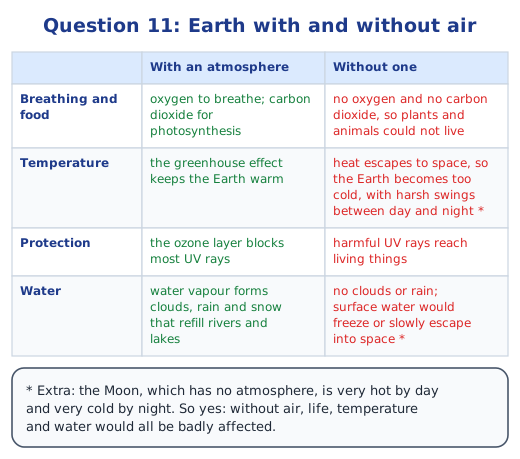
11. “If there were no atmosphere on the Earth, would it affect life, temperature, and water on the planet? Explain.” Yes, all three. Life: there would be no oxygen to breathe and no carbon dioxide for photosynthesis, and no ozone layer to block harmful UV rays. Temperature: without the greenhouse effect, Earth would lose its heat to space and become too cold. Water: with no water vapour there would be no clouds, rain or snow to refill rivers and lakes, and surface water would freeze or slowly escape.
12. “Discuss five examples of vegetative propagation.” (1) Money plant: a stem cutting kept in water or soil grows roots. (2) Potato: the buds in its “eyes” sprout into new plants. (3) Ginger: a piece of it, planted in moist soil, sends up shoots. (4) Sugarcane and (5) bamboo: farmers plant pieces of the stem with buds on them, so they do not need seeds. Extra: Bryophyllum grows small new plants along the edges of its leaves, and sweet potato grows from its roots.
Discover, design, and debate (page 227)
An Earth Survival Kit. A sealed model would need a light source in place of the Sun; air with oxygen and carbon dioxide; water; soil with nutrients; plants as producers; animals; decomposers to recycle waste; a cover to keep heat and moisture in; and protection from too much heat or UV. Every part matters, because the parts depend on one another, as on Earth.
Plants in Moon soil. Even with water, Moon soil has no humus, few nutrients and no microbes, and the Moon has no air. An experiment: grow fast-sprouting seeds, such as moong, in three pots of crushed rock (as a stand-in for Moon soil), crushed rock with compost added, and garden soil, giving each the same water, light and warmth; record which sprout and how well they grow.
Bright, scented flowers. Colour and smell attract insects and birds, which come for nectar and carry pollen from flower to flower. This helps pollination, so fertilisation and seeds follow.
Hundreds of eggs. Fish and frogs release eggs into water, where many are never fertilised, and most eggs and young are eaten, with no parent to guard them. Laying many raises the chance that a few survive. Advantage: some young survive without parental care; disadvantage: most are wasted, and each egg holds little food. Animals that lay a few eggs put more food and care into each one.
Sparrows and snakes. Sparrows build nests, keep their eggs warm, and feed and guard their chicks, so each young one has a much better chance of surviving. Snake eggs left without protection are more easily eaten or harmed, so fewer of them may survive, although young snakes can look after themselves as soon as they hatch.
Practice
-
Which of these reproduces by splitting into two?
Show answer
Answer: (b) amoeba
-
Mars lies:
Show answer
Answer: (b) on the outer edge of the habitable zone
-
Which of these is NOT part of the geosphere?
Show answer
Answer: (d) clouds
-
Why does a bird’s egg need so much stored food?
Show answer
Answer: The embryo develops outside the mother’s body after the egg is laid, so all the food it needs until it hatches must already be packed inside the egg.
-
Give one way the Montreal Protocol helped life on Earth.
Show answer
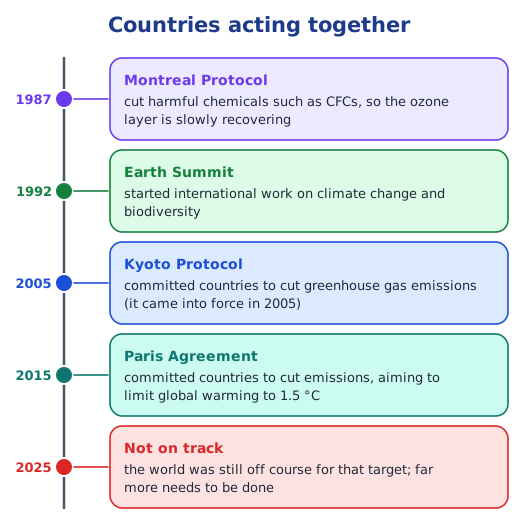
Answer: It reduced harmful chemicals such as CFCs, so the ozone layer, which blocks harmful UV rays, is slowly recovering.
Stuck on a question?
Take a photo and Lagnever AI explains it step by step. Try it for 7 days for ₹2.
Get it on Google Play Open in browser
For parents: after the trial, the plan renews monthly by UPI or card autopay. You can cancel anytime in the app.