
Class 8 Science Chapter 13: Our Home: Earth, a Unique Life Sustaining Planet Notes
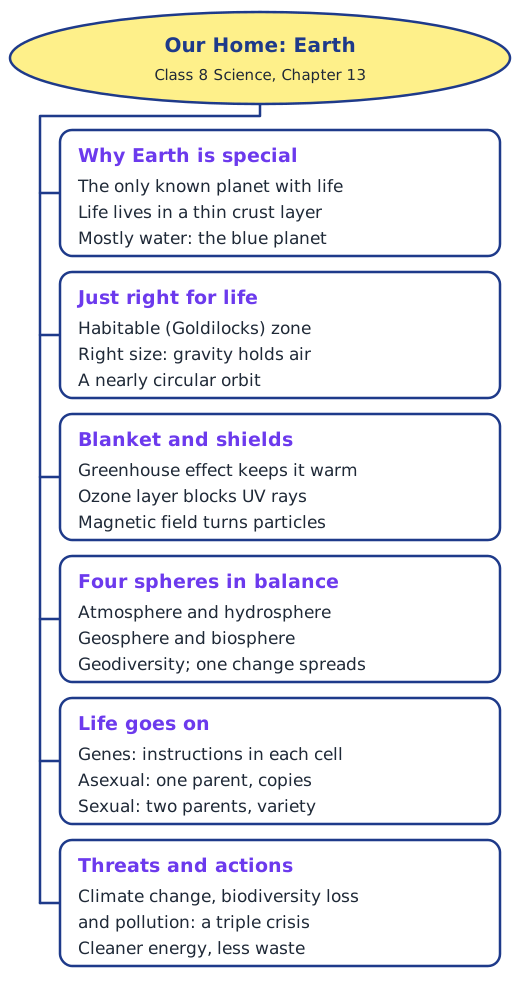
This chapter in five lines
Earth is the only planet known to support life. It lies in the Sun’s habitable zone, where water stays liquid, and is the right size to hold an atmosphere that keeps it warm and, with the ozone layer and magnetic field, shields it. Air, water, rock and life work together in balance, reproduction keeps life going, and climate change, biodiversity loss and pollution now threaten it.
What is this chapter about?
This last chapter of the book brings together what you have learnt to answer one question: why is our planet, Earth, like no other place we know? It looks at what makes Earth fit for life, what keeps life going, and what threatens it today. Satellites help us study it: an ISRO Earth Observation Satellite picture of our planet was made by joining nearly 3000 smaller images, in false colours that show different kinds of information, such as plant cover on land and tiny life in the sea.
Why is Earth special?
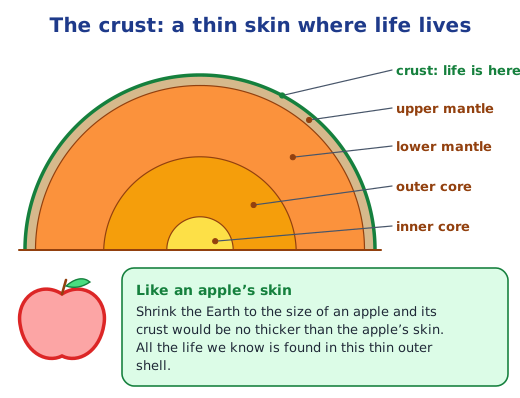
There may be billions of planets in the universe, but life as we know it has been found only on Earth. All of it lives in a very thin outer layer, the crust: shrink Earth to the size of an apple and the crust would be no thicker than its skin. Among the eight planets, Mercury, Venus, Earth and Mars are small and rocky, while the outer four, Jupiter, Saturn, Uranus and Neptune, are giants made mostly of gas. Read why Earth supports life.
The right place and the right size
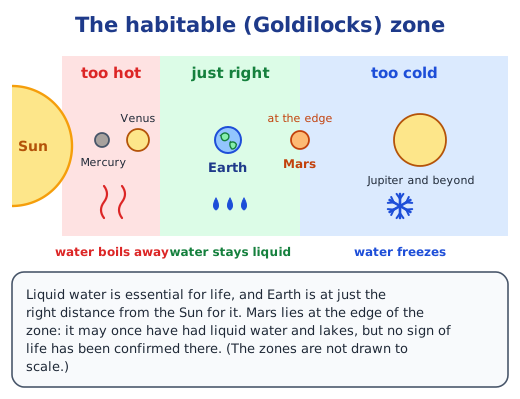
Earth is at just the right distance from the Sun for water to stay liquid. This band of distances is called the habitable zone, or the Goldilocks zone. Closer to the Sun, water would boil away; farther out, it would freeze. Earth’s nearly circular orbit keeps the sunlight it receives nearly steady through the year. Its size matters too: its gravity is strong enough to hold an atmosphere, but not so strong that it would crush us.
A blanket and two shields
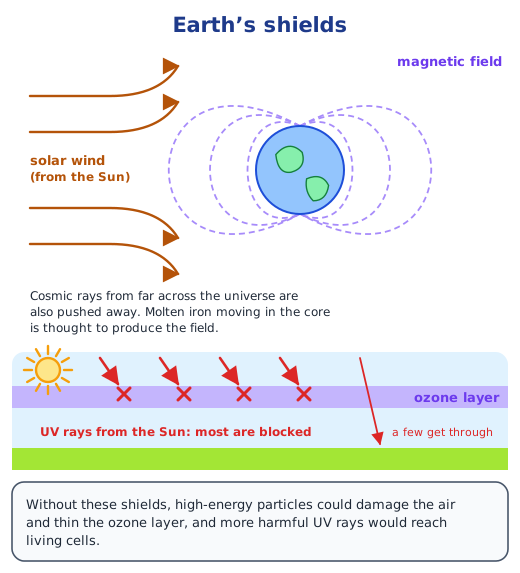
Gases such as carbon dioxide trap some of the heat that the warmed Earth gives off, keeping it warm. This is the greenhouse effect. On Venus, whose air is almost all carbon dioxide, it makes Venus the hottest planet. Some oxygen high in the air becomes ozone and forms the ozone layer, which blocks harmful ultraviolet (UV) rays. Earth’s magnetic field pushes away many high-energy particles, cosmic rays and the solar wind, that could damage the air and the ozone layer.
Four spheres working together
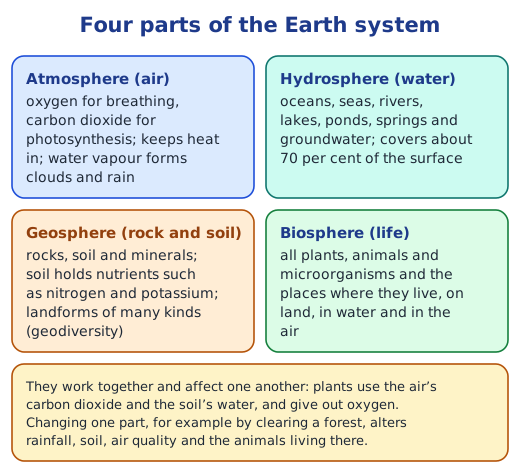
Life is sustained because the atmosphere (air), hydrosphere (water), geosphere (rocks, soil and minerals) and biosphere (all living things) interact. Plants use the air’s carbon dioxide and the soil’s water, and give out oxygen; water covers about 70 per cent of the surface; soil holds nutrients such as nitrogen and potassium; and the variety of landforms and rocks, geodiversity, creates many different habitats. Changing one part, for example by clearing a forest, alters rainfall, soil, air quality and the animals there.
How does life keep going?
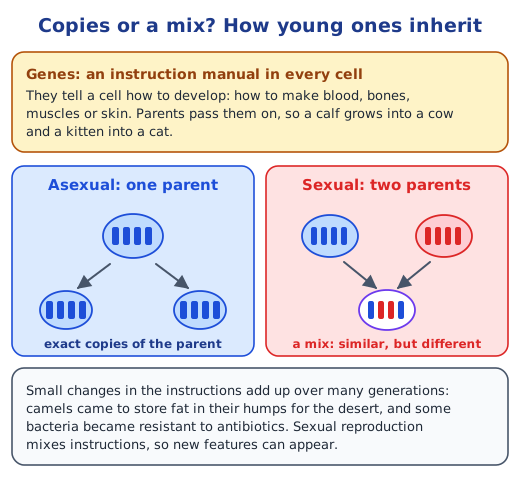
Without reproduction, life would slowly disappear. Parents pass on genes, instructions stored in every cell, so a calf grows into a cow and a kitten into a cat. In asexual reproduction, one parent produces exact copies, as when a potato sprouts from its eyes or an amoeba splits in two. In sexual reproduction, gametes from two parents join to form a zygote, so the young are similar to their parents but not identical. Small changes over many generations help living things adapt. Read asexual and sexual reproduction.
What threatens life?
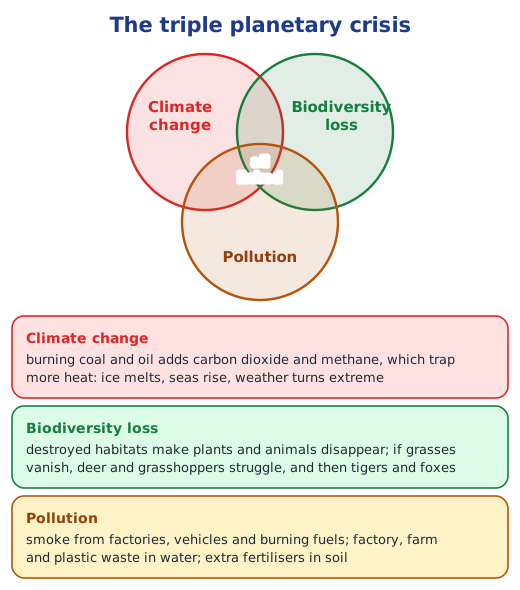
Human actions are upsetting Earth’s balance. Climate change, biodiversity loss and pollution together form the triple planetary crisis. Burning coal and oil adds greenhouse gases that warm the Earth; destroyed habitats make species disappear; and polluted air, water and soil harm people and nature. Global agreements, cleaner energy and everyday actions such as reusing, repairing and recycling can help. Read threats to life on Earth.
Before we move on
Earth is unique because many things come together: its distance from the Sun, its size, its air and water, its shields and the web of life, all in balance. Protecting that balance is up to all of us. Answers to every question are in the NCERT solutions for Chapter 13.
Key terms
| Term | Meaning |
|---|---|
| Habitable (Goldilocks) zone | The range of distances from a star where water can stay liquid; Earth lies in the Sun’s habitable zone. |
| Greenhouse effect | The trapping of heat by gases such as carbon dioxide, which absorb the heat a planet gives off after the Sun warms it. |
| Atmosphere | The layer of gases around the Earth, held in place by gravity. |
| Ozone layer | A part of the atmosphere containing ozone, a three-atom form of oxygen, which blocks harmful ultraviolet (UV) rays. |
| Magnetic field | The region around the Earth where its magnetism acts; it pushes away many cosmic rays and much of the solar wind. |
| Hydrosphere | All the water on Earth: oceans, seas, rivers, lakes, ponds, springs and groundwater. |
| Geosphere | The solid parts of the Earth: rocks, soil and minerals. |
| Biosphere | All living things together with the places where they live, on land, in water and in the air. |
| Geodiversity | The variety of landforms, rocks and soils, and the processes that shape and change them. |
| Genes | Instructions stored in every cell and passed from parents to young, telling the body how to develop. |
| Asexual reproduction | Reproduction by a single parent, giving young that are exact copies of it. |
| Vegetative propagation | Growing a new plant from a leaf, stem or root, as with a money plant cutting or potato eyes. |
| Sexual reproduction | Reproduction in which instructions from two parents combine, so the young are like both but not exactly like either. |
| Gametes and zygote | Gametes are reproductive cells carrying half a parent’s instructions; a male and a female gamete join to form a zygote. |
| Triple planetary crisis | Climate change, biodiversity loss and pollution, the three biggest environmental challenges, taken together. |
Topics in this chapter
Practice
-
Why is Venus hotter than Mercury?
Show answer
Answer: (b) its thick carbon dioxide air traps heat
-
The band of distances from a star where water can stay liquid is the:
Show answer
Answer: (b) habitable zone
-
Which shields life from most of the Sun’s harmful UV rays?
Show answer
Answer: (b) the ozone layer
-
Rocks, soil and minerals make up the:
Show answer
Answer: (c) geosphere
-
A potato grows new plants from its “eyes”. This is:
Show answer
Answer: (b) vegetative propagation
-
Climate change, biodiversity loss and pollution together are called the:
Show answer
Answer: (b) triple planetary crisis
Questions students ask
What are the main topics of Class 8 Science Chapter 13?
Why Earth is unique; the planets of the solar system; the greenhouse effect; the habitable zone; Earth’s size, atmosphere, ozone layer and magnetic field; the four spheres and geodiversity; asexual and sexual reproduction; and the threats to life, the triple planetary crisis.
Is Our Home: Earth, a Unique Life Sustaining Planet in the new NCERT Class 8 Science book?
Yes. It is Chapter 13, the last chapter of Curiosity, the Grade 8 science textbook, on pages 210 to 228 of the 2026-27 reprint.
Why is Earth called a unique planet?
It is the only planet known to support life. It is at the right distance from the Sun for liquid water, the right size to hold an atmosphere, and protected by the ozone layer and a magnetic field.
What is the triple planetary crisis?
The three biggest environmental challenges we face today: climate change, biodiversity loss and pollution. Together they threaten the balance on which life on Earth depends.
Stuck on a question?
Take a photo and Lagnever AI explains it step by step. Try it for 7 days for ₹2.
Get it on Google Play Open in browser
For parents: after the trial, the plan renews monthly by UPI or card autopay. You can cancel anytime in the app.