
How do living things reproduce?
Answer in short
Living things reproduce so that life continues. In asexual reproduction a single parent makes young that are exact copies of it, as with potato sprouts, a dividing amoeba or a budding Hydra. In sexual reproduction, gametes from two parents join to form a zygote, so the young get a mix of instructions and show variation.
Stuck on a question? Take a photo and Lagnever AI explains it step by step. Try it for 7 days for ₹2. Get it on Google Play
Why do living things reproduce?
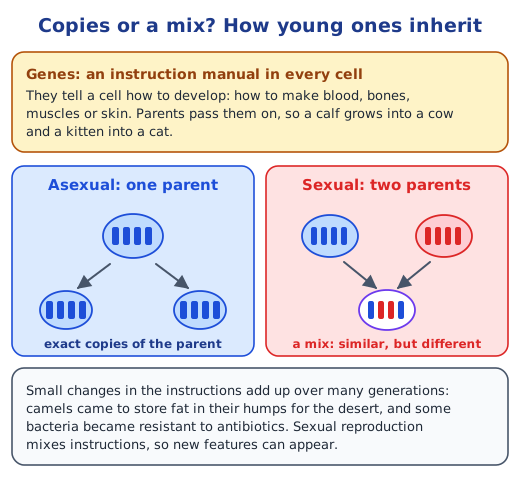
If plants and animals did not reproduce, life would slowly disappear from Earth. Reproduction makes sure each kind of living thing carries on. We expect young ones to resemble their parents: a cow’s young is a calf, and a cat’s is a kitten. The reason is that parents hand down a set of instructions that guide growth, starting from one cell. These instructions are called genes, and every cell holds them. Think of them as an instruction manual: some pages tell a cell how to make blood, others how to form bones, muscles or skin. Together they make sure a calf grows into a cow.
How can young be similar and yet different?
Reproduction does more than make copies. Small changes in the instructions can be handed down too, and some of them make it easier for a plant or animal to live in new surroundings. Over a long time, camels came to store fat in their humps to survive in deserts, and some bacteria have become resistant to antibiotics. Over many generations such changes can add up to new features, and even new kinds of living things.
So how can one process give both similarity (calves always grow into cows) and variation (differences in colour or height)? There are two kinds of reproduction. In asexual reproduction, a single parent produces young with exactly the same instructions. In sexual reproduction, the young get instructions from two parents, mixed together, so they share traits with both but are not exactly like either.
What is asexual reproduction?
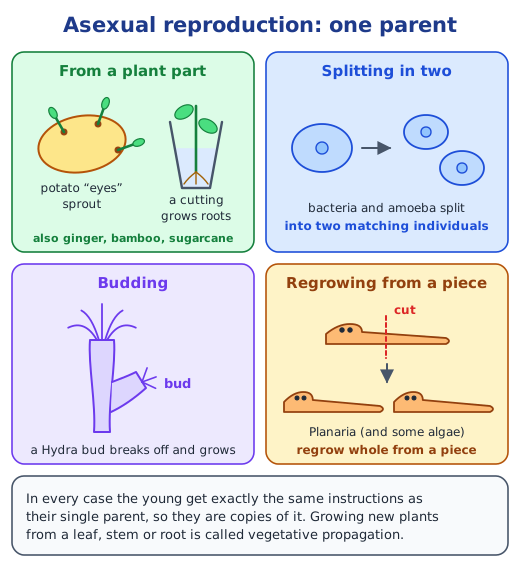
Many plants can grow from a leaf, stem or root planted in soil. This is vegetative propagation. A money plant cutting kept in water grows roots, the “eyes” of a sprouted potato grow shoots, and a piece of ginger sprouts too. Bamboo and sugarcane are also grown from pieces of the plant, which is why you may never have seen their seeds.
Microbes and simple animals reproduce asexually too. Bacteria and amoeba, each just one cell, split into two matching individuals. Small pieces of some algae can grow into whole new algae. Hydra grows tiny buds that break off and become new animals. Planaria, a flatworm, can regrow a whole body from a small piece, so scientists study it to understand regeneration.
What are gametes?
Sexual reproduction involves two parents, usually called male and female. Flowering plants, too, have male and female parts, and some microorganisms, such as bacteria and yeast, have two “mating types” that act like two parents.
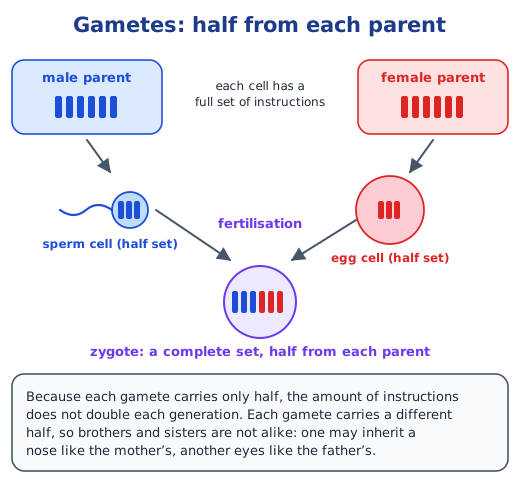
If both parents passed on all their instructions, the young would have double the amount, and it would keep doubling every generation. That does not happen, because each parent makes special reproductive cells called gametes, which carry only half of the parent’s instructions. When a male and a female gamete join, they form a new cell, the zygote, with one complete set: half from each parent. Every gamete carries a different half, so brothers and sisters look different. One child may inherit a nose like the mother’s, another eyes like the father’s.
How do flowering plants reproduce?
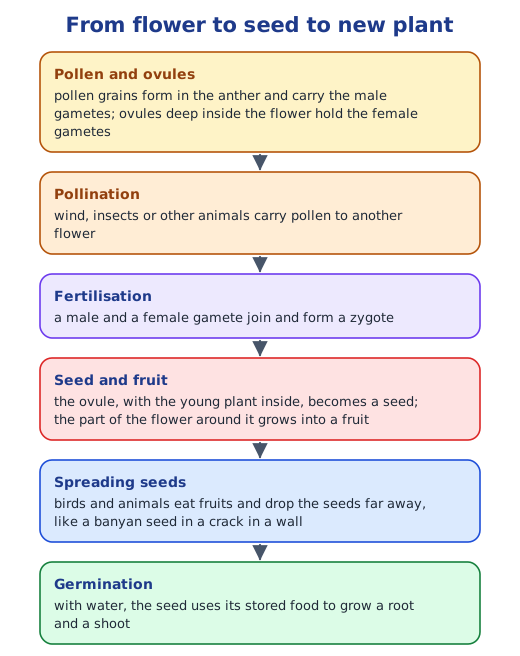
Pollen grains form in the anther of a flower and carry the male gametes; ovules, deep inside the flower, hold the female gametes. Wind, insects or other animals carry pollen to another flower: this is pollination. When the male and female gametes join, it is fertilisation, and a zygote forms. The ovule, with the young plant inside, becomes a seed, and the fleshy part of the flower around it grows into a fruit. Birds and animals eat fruits and drop the seeds far away, which explains a banyan sapling appearing in a cracked wall once the monsoon arrives. Given water, a seed uses its stored food to grow a root and a shoot.
How do animals reproduce?
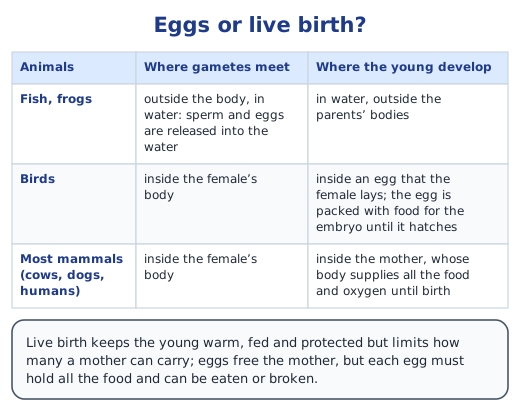
In animals the gametes are sperm (male) and eggs (female). In fish and frogs, the male and female release sperm and eggs into water, where they join to form zygotes, and the young develop in the water. In birds and mammals, including humans, the sperm are placed inside the female’s body and fertilisation happens there.
After that, birds and mammals differ. A bird lays its fertilised egg, and the embryo develops outside the mother until it hatches, so the egg must hold all the food the embryo needs. In most mammals the young develop inside the mother, whose body supplies all their food and oxygen until birth.
Read on: why Earth supports life, threats to life on Earth, the chapter notes and the NCERT solutions.
Practice
-
A potato grows new plants from its “eyes”. This is:
Show answer
Answer: (b) vegetative propagation
-
Which animal grows buds that break off and become new individuals?
Show answer
Answer: (a) Hydra
-
The cell formed when a male and a female gamete join is the:
Show answer
Answer: (c) zygote
-
Why do brothers and sisters often look different?
Show answer
Answer: Each child gets a different mix of instructions, half from each parent, because each gamete carries a different set.
-
Where does fertilisation take place in frogs?
Show answer
Answer: Outside the body, in water: the male and female release sperm and eggs into the water, where they join, and the young develop there.
Questions students ask
What is the difference between asexual and sexual reproduction?
Asexual reproduction needs one parent and produces young that are exact copies of it. Sexual reproduction needs two parents, whose instructions mix, so the young share features with both but are not exactly like either.
What is vegetative propagation?
Growing a new plant from a part of a plant, such as a leaf, stem or root, instead of a seed. A money plant cutting, potato eyes and a piece of ginger can all grow into new plants.
Why do birds lay eggs while cows give birth to calves?
They feed their developing young in different ways. A bird packs all the food the embryo needs into the egg, which develops after it is laid. In most mammals, such as cows, the young develop inside the mother, whose body supplies food and oxygen until birth.
What is pollination?
The carrying of pollen from one flower to another by wind, insects or other animals. It comes before fertilisation, when a male and a female gamete join.
Stuck on a question?
Take a photo and Lagnever AI explains it step by step. Try it for 7 days for ₹2.
Get it on Google Play Open in browser
For parents: after the trial, the plan renews monthly by UPI or card autopay. You can cancel anytime in the app.