
What threatens life on Earth?
Answer in short
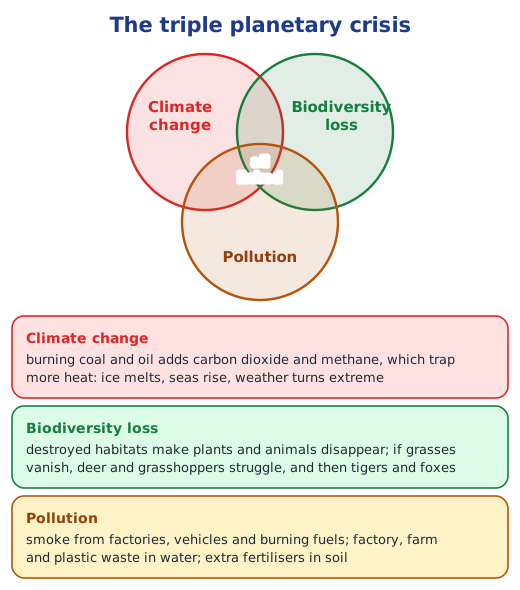
Today life on Earth faces three linked threats: climate change, biodiversity loss and pollution, which make up the triple planetary crisis. Burning fossil fuels adds greenhouse gases that warm the planet, destroyed habitats make species disappear, and polluted air, water and soil harm living things. Cleaner energy, less waste and global agreements can help.
Stuck on a question? Take a photo and Lagnever AI explains it step by step. Try it for 7 days for ₹2. Get it on Google Play
Why is Earth’s balance at risk?
Living things and their non-living surroundings keep each other in a fine balance, and life depends on it. Even small changes can put life at risk: a little more or less oxygen in the air, a slightly higher or lower temperature, or a little less ozone high in the atmosphere. Today, human actions are disturbing this balance.
What is the triple planetary crisis?
Three environmental problems stand above the rest today: climate change, biodiversity loss and pollution. They are grouped together as the triple planetary crisis. They are linked: a warmer climate harms wildlife habitats, cutting forests adds to warming, and polluted water and soil weaken the living things that keep nature in balance.
How does burning fossil fuels change the climate?
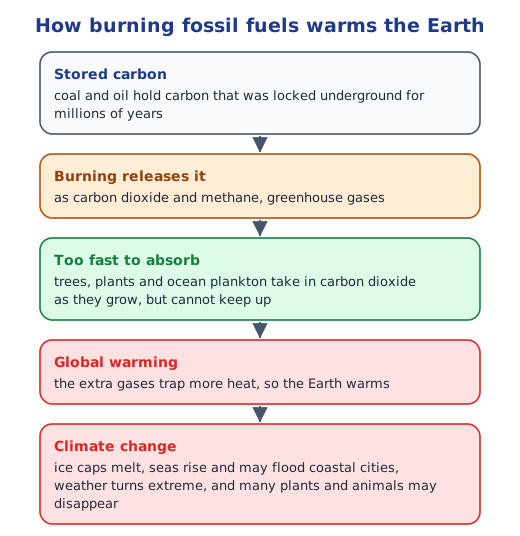
Coal and oil are fossil fuels. Burning them releases greenhouse gases such as carbon dioxide and methane, which trap even more heat in the atmosphere. This causes global warming. Normally the Earth keeps a balance, because trees, plants and even tiny plankton in the oceans absorb carbon dioxide as they grow. But fossil fuels hold carbon that was locked underground for millions of years, and burning releases it far faster than the Earth can take it back, so the extra heat keeps piling up.
A little extra warmth is enough to shrink ice caps and push up sea levels, which could put coastal cities under water; it also brings fiercer weather and puts many plants and animals at risk of dying out. When temperature, rainfall and weather patterns shift like this over a long period, we call it climate change. It touches farms, water supplies, the homes of wildlife and our own health.
Why does losing species matter?
Destroying forests, grasslands and wetlands can wipe out the plants and animals living there and throw ecosystems off balance. Recall the food chains of Chapter 12: take away the grass and grass-eaters such as deer and grasshoppers go hungry; with fewer of them, hunters such as tigers and foxes go hungry too. Each species does a job, so every loss leaves nature a little less able to keep life going. Ecosystems with many kinds of living things are sturdier and steadier.
How does pollution harm life?
Smoke from factories, vehicles and burning fuel causes air pollution, which hurts people and nature alike: it makes breathing harder, damages crops, and produces smog and acid rain.
Water and soil pollution are serious threats too. Waste from factories and farms, and plastic waste, harm life in water and make water unsafe to use. Too much fertiliser and careless waste disposal pollute the soil, cut crop yields, and let harmful substances pass from one living thing to the next along food chains. Better waste management and sustainable farming help protect them.
What are countries doing together?
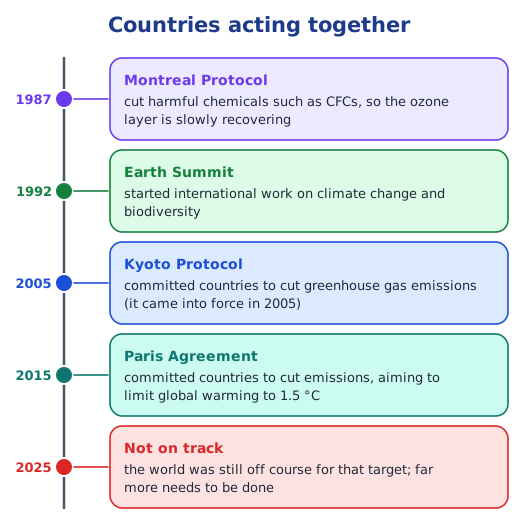
Nations have also signed agreements to look after the environment together. Under the Montreal Protocol (1987), countries cut down harmful chemicals such as chlorofluorocarbons (CFCs), so the ozone layer is slowly recovering. The Earth Summit (1992) started international efforts on climate change and biodiversity. The Kyoto Protocol, in force from 2005, and the Paris Agreement (2015) committed countries to cut greenhouse gas emissions, and the Paris Agreement aims to limit global warming to 1.5 °C. By 2025, though, the world was still off course for that target, so far more needs to be done.
What can we do?
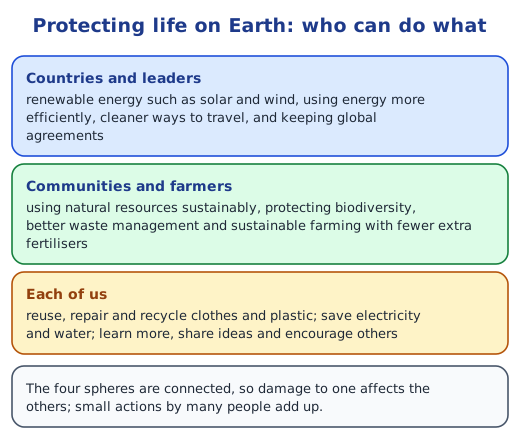
The atmosphere, hydrosphere, geosphere and biosphere are connected, so damage to one affects the others. Protecting the climate means cutting greenhouse gases by using renewable energy such as solar and wind, using energy more efficiently, and choosing cleaner ways to travel. Protecting biodiversity matters just as much, and people in each locality can do a lot by using their natural resources with care.
Each of us has a part too. When we reuse, repair and recycle things like clothes and plastic, there is less waste and pollution. Little habits, such as switching off lights and fans and not wasting water, count when many people follow them, and so does finding out more and getting friends and family involved. Keeping Earth fit for life is a job for everyone, from neighbourhood groups to world leaders.
Read on: why Earth supports life, asexual and sexual reproduction, the chapter notes and the NCERT solutions.
Practice
-
Which three problems make up the triple planetary crisis?
Show answer
Answer: (b) climate change, biodiversity loss and pollution
-
Which agreement helped the ozone layer begin to recover?
Show answer
Answer: (c) the Montreal Protocol
-
Which of these is a renewable source of energy?
Show answer
Answer: (c) wind
-
Why can’t the Earth absorb all the carbon dioxide released by burning fossil fuels?
Show answer
Answer: Trees, plants and ocean plankton absorb carbon dioxide as they grow, but burning releases carbon that was locked underground for millions of years much faster than they can take it in, so heat builds up.
-
Name two harmful effects of air pollution.
Show answer
Answer: Any two: breathing problems in people, damage to crops, smog and acid rain.
Questions students ask
What is the triple planetary crisis?
It is the name for the three biggest environmental challenges we face: climate change, biodiversity loss and pollution. They are linked, and together they threaten the balance that keeps life on Earth going.
How does burning fossil fuels cause global warming?
Coal and oil hold carbon that was stored underground for millions of years. Burning them releases carbon dioxide and methane, greenhouse gases that trap more heat in the atmosphere, so the Earth warms.
What can students do to protect the Earth?
Reuse, repair and recycle things like clothes and plastic, save electricity and water, avoid littering, learn more about the environment, and share ideas with family and friends. Small actions by many people add up.
Stuck on a question?
Take a photo and Lagnever AI explains it step by step. Try it for 7 days for ₹2.
Get it on Google Play Open in browser
For parents: after the trial, the plan renews monthly by UPI or card autopay. You can cancel anytime in the app.