
Why does Earth support life?
Answer in short
Earth supports life because it lies at the right distance from the Sun for water to stay liquid, and is the right size for its gravity to hold an atmosphere. The greenhouse effect keeps it warm, the ozone layer blocks harmful UV rays, the magnetic field turns away harmful particles, and air, water, rock and life work together.
Stuck on a question? Take a photo and Lagnever AI explains it step by step. Try it for 7 days for ₹2. Get it on Google Play
Where on Earth is life found?
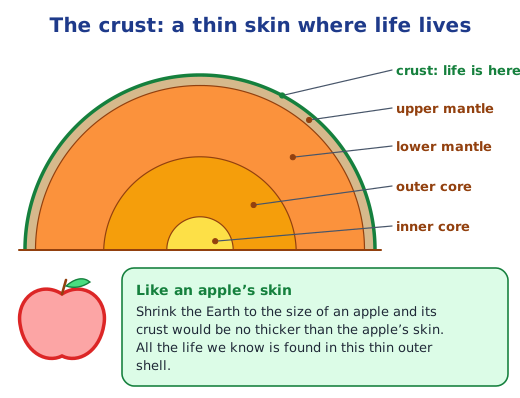
Every mountain, river, forest, animal and person sits on a very thin outer shell of the planet, the crust. Even the span from the highest peak to the deepest sea floor is tiny next to the size of the whole Earth. Shrink Earth to the size of an apple and the crust would be no thicker than its skin. Earth gives us the air we breathe, the water we drink, soil to grow crops, and rock and timber to build our homes and roads.
What are the other planets like?
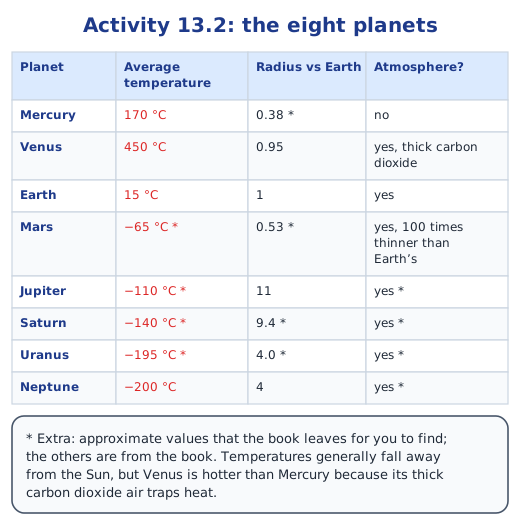
Eight planets go round the Sun in nearly circular orbits: Mercury, Venus, Earth, Mars, Jupiter, Saturn, Uranus and Neptune. The first four are small and rocky; the other four are large and made mostly of gases. All of them get their energy from the Sun, so planets farther away are generally colder. But Venus, the second planet, is the hottest of all.
Why is Venus hotter than Mercury?
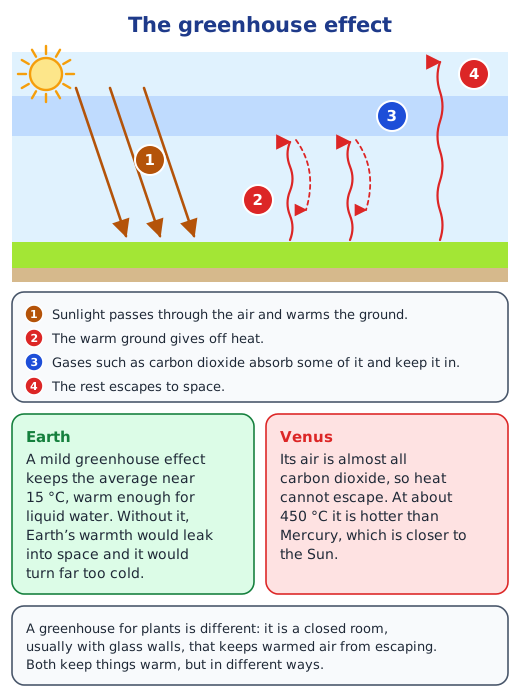
The air on Venus is almost all carbon dioxide, which does not let heat escape. This is the greenhouse effect. The Sun warms a planet’s surface, the warm surface gives off heat, and gases such as carbon dioxide absorb some of it and keep it in. On Earth this effect is mild: it holds in just enough warmth for water to remain liquid. With no air around it, Earth’s warmth would leak away into space and the planet would turn far too cold. A greenhouse for growing plants works differently: it is a closed room with glass walls that simply keeps the warmed air inside.
Why does distance from the Sun matter?
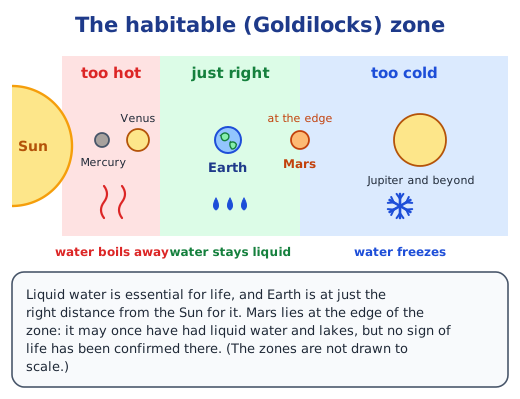
Above all, Earth can hold life because of how far it is from the Sun. If Earth were closer, it would be too hot and all its water would evaporate; if it were farther, all its water would freeze. As far as scientists know, life needs liquid water to begin and to thrive. The range of distances from a star where water stays liquid is the habitable zone, or Goldilocks zone, and Earth sits inside it. So much of its surface is water that from space it looks blue: the Blue Planet.
Mars sits on the outer edge of the habitable zone around the Sun. Rovers have explored it and no proof of life has been found, but scientists think it may once have had liquid water and lakes. Earth’s nearly circular orbit also keeps the sunlight it receives nearly steady through the year.
Why does Earth’s size matter?
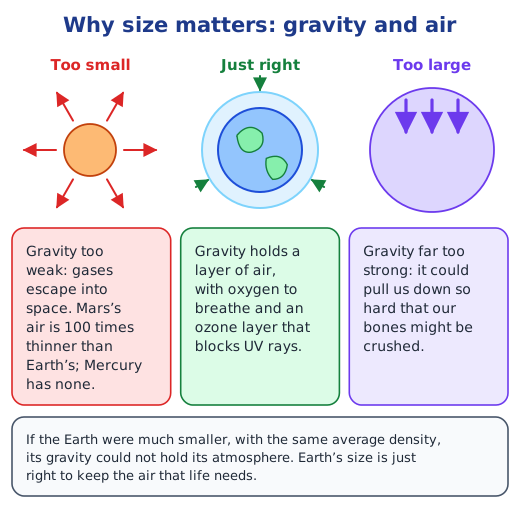
Gravity holds the atmosphere, the layer of gases around the Earth. Shrink Earth a lot while keeping its average density the same, and its gravity becomes too weak to stop the gases drifting off into space. The atmosphere of Mars is 100 times thinner than Earth’s, and Mercury has none. If Earth were far larger, its gravity might pull us down so hard that our bones could be crushed. Earth’s size is just right to keep the air that almost all life needs, with oxygen for breathing.
How is life on Earth shielded?
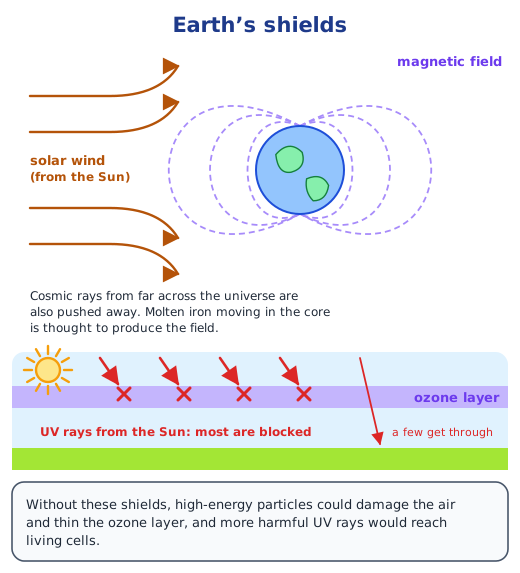
Some oxygen high in the atmosphere becomes ozone, a molecule of three oxygen atoms, and forms the ozone layer. It acts like a shield, blocking most of the Sun’s harmful ultraviolet (UV) rays that can damage living cells.
A freely hanging magnet settles in a fixed direction because the Earth itself behaves like a giant magnet. Scientists think molten iron flowing in Earth’s core gives rise to its magnetic field. Earth is always hit by tiny, high-energy particles: cosmic rays from far across the universe and the solar wind from the Sun. They can damage the atmosphere and thin the ozone layer. The magnetic field pushes many of them away, keeping our air, and life, safe.
How do air, water, rock and life work together?
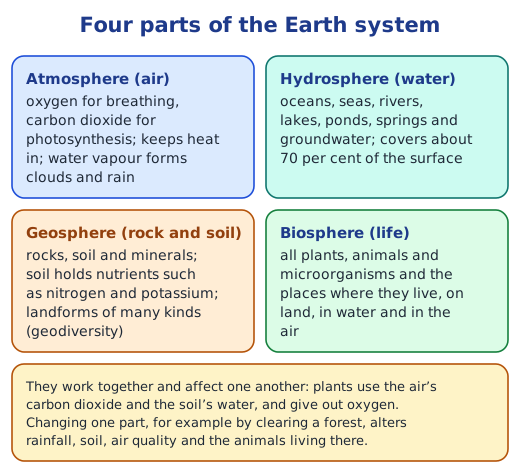
Earth’s conditions make life possible, but its parts working together keep life going. The atmosphere gives oxygen for breathing and carbon dioxide for photosynthesis. The hydrosphere, all the water on Earth, covers about 70 per cent of the surface; it carries nutrients in plants, helps animals control body temperature and digest food, and is home to life from tiny plankton to giant whales. The geosphere of rocks, soil and minerals gives soil rich in nutrients such as nitrogen and potassium, and minerals such as salt, coal, oil, iron and copper. Its variety of landforms, rocks and soils, geodiversity, creates many habitats. The biosphere is all living things with the places where they live. A change in one part, such as cutting down a forest, affects rainfall, soil, air quality and animals, which is why this balance needs protecting.
Read on: asexual and sexual reproduction, threats to life on Earth, the chapter notes and the NCERT solutions.
Practice
-
Which planet is the hottest?
Show answer
Answer: (b) Venus
-
If Earth were much smaller, with the same average density, its atmosphere would:
Show answer
Answer: (b) escape into space
-
Which high-energy particles come from the Sun?
Show answer
Answer: (b) the solar wind
-
Why does Earth look blue from space?
Show answer
Answer: Because water covers most of its surface, about 70 per cent, so it is called the Blue Planet.
-
How does the ozone layer help living things?
Show answer
Answer: It blocks most of the Sun’s harmful ultraviolet (UV) rays, which can damage living cells.
Questions students ask
Why is the habitable zone also called the Goldilocks zone?
The name comes from a children’s story in which something is neither too hot nor too cold, but just right. In the habitable zone a planet is neither too hot nor too cold, so water can stay liquid.
Could there be life on Mars?
No proof of life has been found there. Mars sits on the outer edge of the habitable zone, and scientists think it may once have had liquid water and even lakes, so the search goes on. India’s Mangalyaan, launched by ISRO in 2013, studied its atmosphere and surface.
What would happen without the greenhouse effect?
Earth would lose its heat to space and become too cold for water to stay liquid. A mild greenhouse effect keeps Earth’s average temperature near 15 °C.
Why is Earth’s magnetic field important for life?
It pushes away many cosmic rays and much of the solar wind. These high-energy particles could damage the atmosphere and thin the ozone layer, so more harmful UV rays get through.
Stuck on a question?
Take a photo and Lagnever AI explains it step by step. Try it for 7 days for ₹2.
Get it on Google Play Open in browser
For parents: after the trial, the plan renews monthly by UPI or card autopay. You can cancel anytime in the app.