
NCERT Solutions Class 8 Science Chapter 3: Health: The Ultimate Treasure
Answers to Probe and ponder, the questions inside the chapter, Activities 3.1 to 3.7, all eleven Keep the curiosity alive questions and the Discover, design, and debate projects in Chapter 3, Health: The Ultimate Treasure, of Curiosity, the Grade 8 science textbook. Page numbers follow the 2026-27 reprint (pages 28–45). Short notes: Chapter 3 notes. These answers explain what the book teaches; they are not medical advice. For any illness, see a doctor.
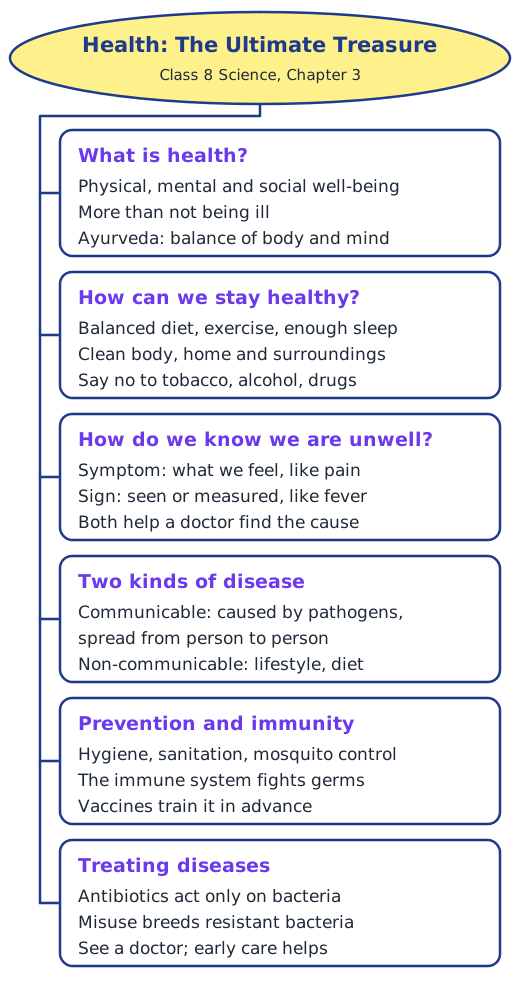
Probe and ponder (page 28)
What happens in the body when we catch a cold? The immune system recognises the virus and fights it. While it does, we may get a runny or blocked nose, sneezing, a sore throat, a cough, body ache or a mild fever. Resting at home helps the body recover and keeps others from catching it. If the fever is high or you feel very unwell, see a doctor.
Why do we hardly hear of smallpox or polio today, but often of diabetes and heart disease? Vaccination wiped smallpox out and has controlled polio (Extra: India was certified as having ended polio in 2014). Diabetes and heart disease are non-communicable and linked to lifestyle: people now eat more processed food, exercise less and live longer, so these diseases have grown.
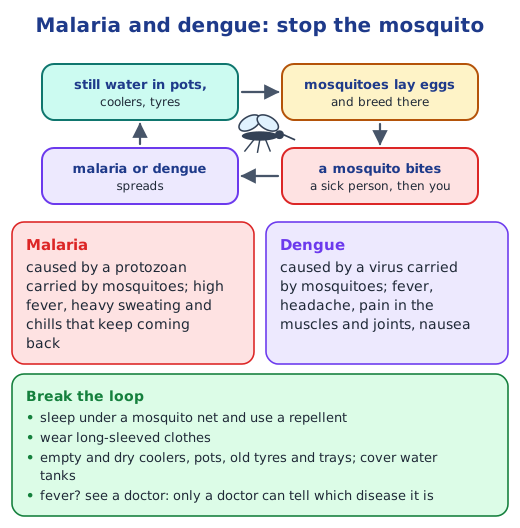
Can a changing climate bring new diseases? It could. Warmer and wetter weather can let mosquitoes breed in more places and for more months, so diseases such as malaria and dengue may reach new areas, and floods can spread diseases through dirty water. Scientists are studying these links.
Can worry and stress make us ill? Yes. Long worry or loneliness can cause headaches, poor sleep and loss of appetite or weight, as with the student in Activity 3.1. (Extra: long-lasting stress can also weaken the body’s defences.) Talking to family, friends, a teacher or a counsellor helps.
Why are some groups hit harder when a disease spreads? People living in crowded homes, without clean water or toilets, or with too little food fall ill more easily. So do the very young, the old and people already ill, and those who cannot reach doctors or vaccines easily.
Share your questions. For example: Why do some people catch every cold going around? Can we catch the same disease twice? Why do mosquitoes bite some people more than others?
Inside the chapter (pages 29–41)
Activity 3.1: Think and reflect. The boy’s problems began with loneliness: a new city, no friends and busy parents. He turned to his phone and social media for comfort, and that only made him feel worse; he had headaches, lost weight and slept badly. His habits (too much screen time, staying alone) and his surroundings (a new place with no friends) affected his body and mind together. Less screen time, a counsellor and new friends helped him recover.
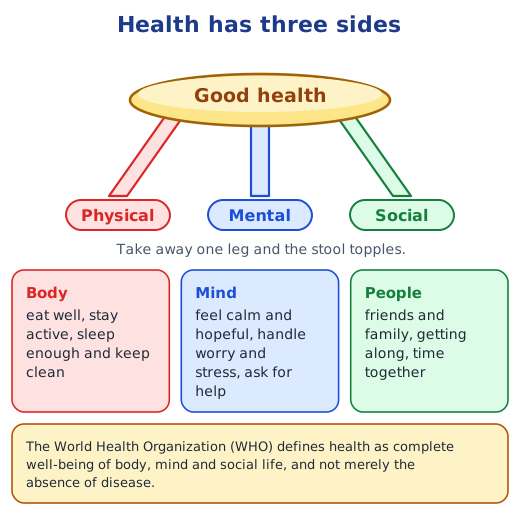
Activity 3.2: Let us list. Good habits to add: brushing teeth twice a day, washing hands before eating and after the toilet, drinking clean water, sleeping and waking at fixed times, playing outdoors, eating fruits and vegetables daily, and talking to someone when worried. Habits to add to the harmful list: eating oily snacks late at night, sitting still for hours, drinking sugary drinks often, and using a phone in bed. Tick the good habits you already follow and pick one new one to start.
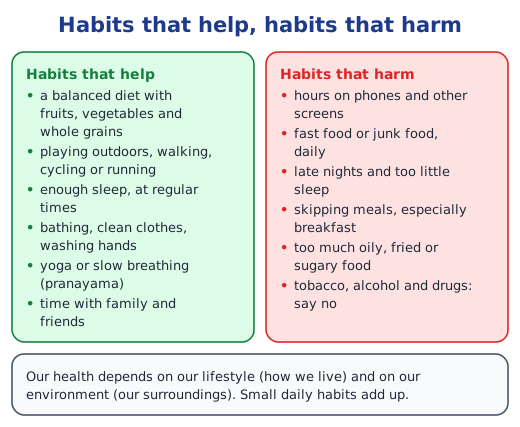
Activity 3.3: Which playground? The clean, green one, because it is safe and pleasant. The dirty one has garbage and still water where flies and mosquitoes breed, and people living near such places fall sick more often.
Is every disease an infection? (page 35) No. Non-communicable diseases such as diabetes, asthma and cancer are linked to lifestyle, diet and environment, and deficiency diseases come from too little of a nutrient.
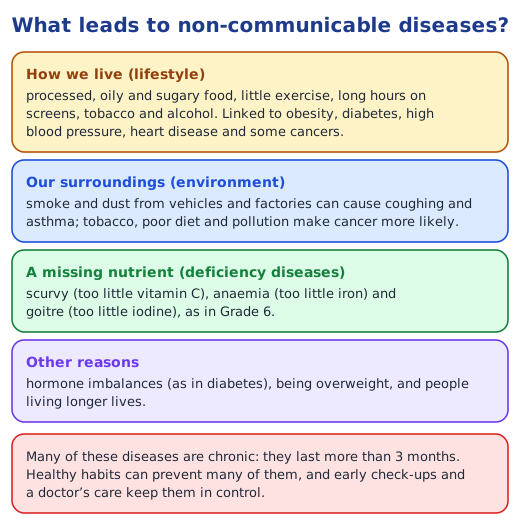
Can too many vitamins or minerals harm us? (page 36) More is not better. (Extra: too much of some vitamins and minerals, such as vitamin A or iron, can harm the body.) A balanced diet usually gives what we need, so take supplements only on a doctor’s advice.
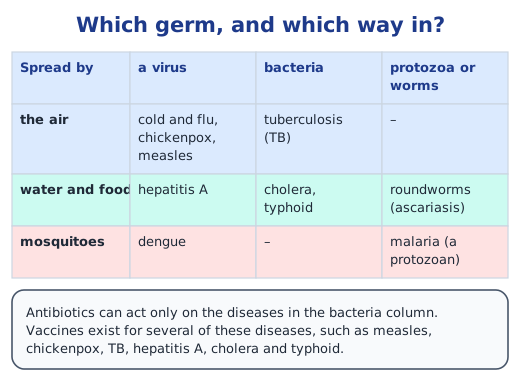
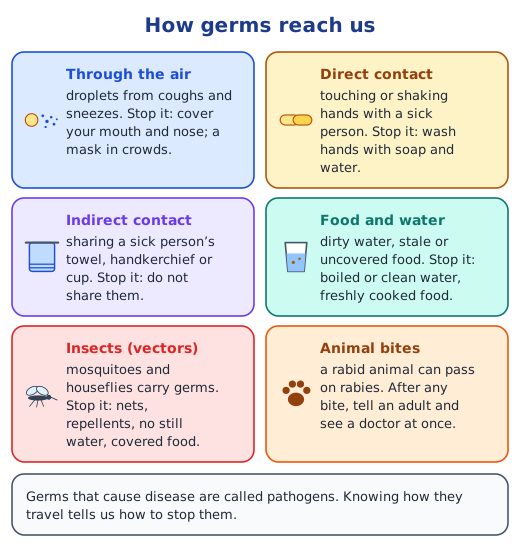
Activity 3.4: Let us find out. Checking Table 3.1 shows a pattern: the way a disease spreads tells us how to stop it. Air: cover coughs, wear masks, isolate patients, get vaccinated. Water and food: boiled water, properly cooked food, hygiene and sanitation. Insects: nets, repellents, long sleeves and no mosquito breeding near the home.
Activity 3.5: Table 3.2 (sample). Your survey answers will depend on your neighbourhood. This sample is for learning only; it is not a way to tell whether anyone has a disease, which only a doctor can do.
| Disease | Signs and symptoms | Suggested lifestyle changes |
|---|---|---|
| Obesity | weight much higher than healthy for one’s height; tiring easily | a balanced diet and regular exercise |
| Diabetes | frequent urination, great thirst, weight loss, tiredness, slow healing of wounds | less sugar and junk food, daily exercise, a healthy weight, regular check-ups |
| High blood pressure | often no signs at all; found by measuring blood pressure (Extra) | less salt (Extra), exercise, no tobacco, managing stress, regular check-ups |
| Asthma (your own row) | coughing, wheezing, difficulty breathing | avoiding smoke and dust, and following the doctor’s plan |
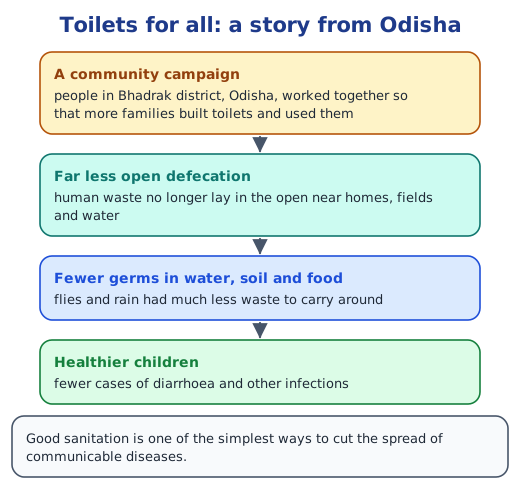
Activity 3.6: What do you infer? Simple steps such as building and using toilets greatly cut the spread of communicable diseases like diarrhoea. Campaigns near you might include cleanliness drives under the Swachh Bharat Mission (Extra), handwashing awareness in schools or anti-mosquito drives before the monsoon.
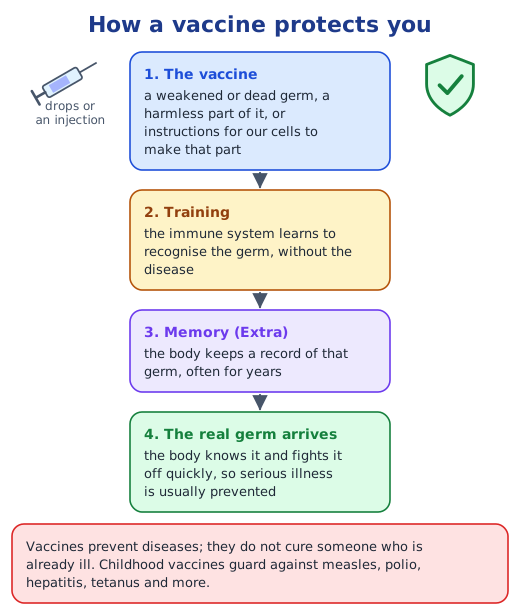
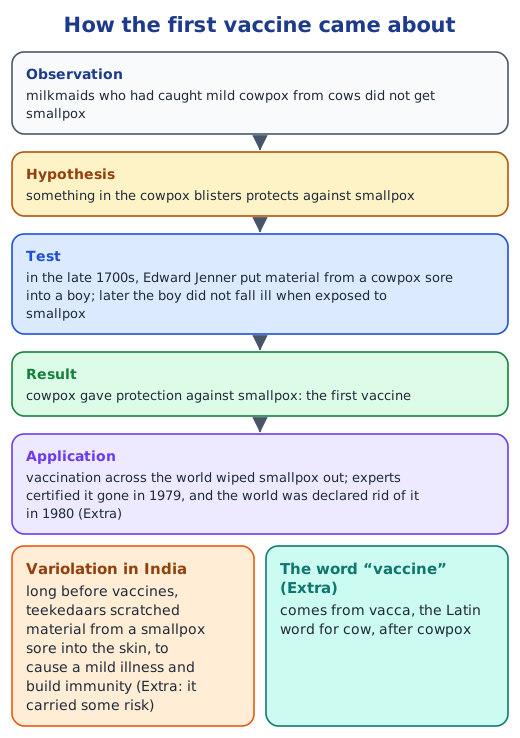
When did the first vaccine appear? (page 38) In the late 1700s (Extra: in 1796), when Edward Jenner showed that material from cowpox sores protected people from smallpox.
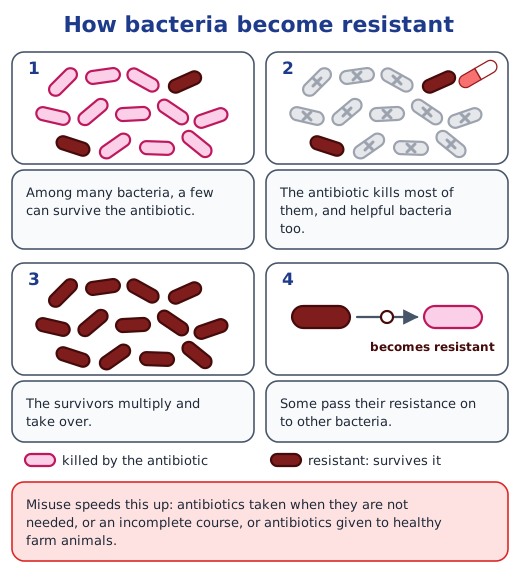
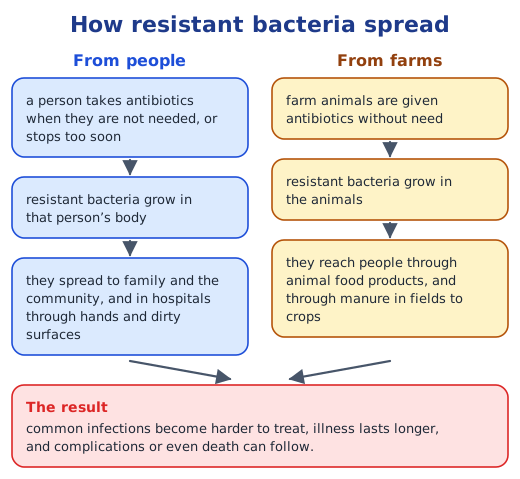
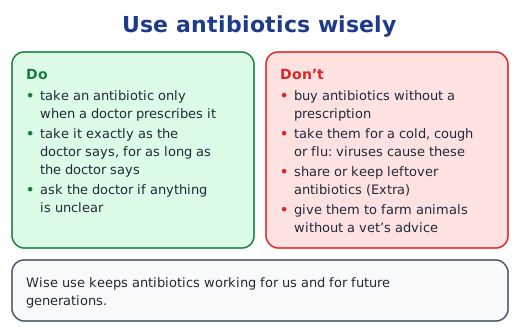
Activity 3.7: Let us infer. Resistance develops because a few bacteria in any group can survive an antibiotic. When antibiotics are taken without need, or the course is not completed, these survivors multiply and pass on their resistance; antibiotics given to farm animals breed resistant bacteria that reach people through food and fields. Precautions: take antibiotics only when a doctor prescribes them, in the right dose and for the right time, never for colds or flu, never without a prescription, and not for farm animals without a vet’s advice.
Keep the curiosity alive (pages 42–45)
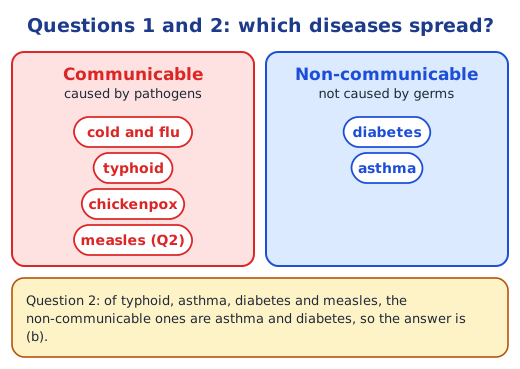
1. “Group the diseases shown in the images as communicable or non-communicable.” (The images show cold and flu, typhoid, diabetes, asthma and chickenpox.) Communicable: cold and flu, typhoid and chickenpox, because pathogens cause them and they spread. Non-communicable: diabetes and asthma, which are not caused by germs and do not spread.
2. “Diseases can be broadly grouped into communicable and non-communicable diseases. From the options given below, identify the non-communicable diseases. (i) Typhoid (ii) Asthma (iii) Diabetes (iv) Measles (a) (i) and (ii) (b) (ii) and (iii) (c) (i) and (iv) (d) (ii) and (iv)” (b) (ii) and (iii): asthma and diabetes. Typhoid and measles are communicable.
3. “There is a flu outbreak in your school. Several classmates are absent, while some are still coming to school coughing and sneezing.”
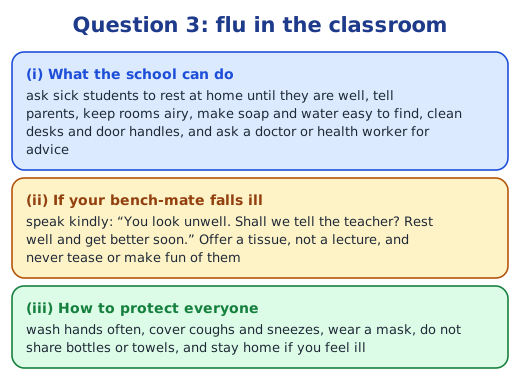
(i) “What immediate actions should the school take to prevent further spread?” Ask sick students to stay home and rest until they are well and inform their parents; keep classrooms airy; provide soap and water for handwashing; ask students who cough to wear masks; clean desks and door handles often; and ask a doctor or health worker for advice.
(ii) “If your classmate, who shares the bench with you, starts showing symptoms of the flu, how can you respond in a considerate way without being rude or hurtful?” Speak gently: “You don’t look well. Shall we tell the teacher? Please rest and get well soon.” Offer a tissue, never tease, and keep in touch by message while they rest at home.
(iii) “How can you protect yourself and others from getting infected in this situation?” Wash hands often with soap and water, cover coughs and sneezes, wear a mask, do not share bottles, towels or handkerchiefs, and stay home if you start to feel ill.
4. “Your family is planning to travel to another city where malaria is prevalent.”
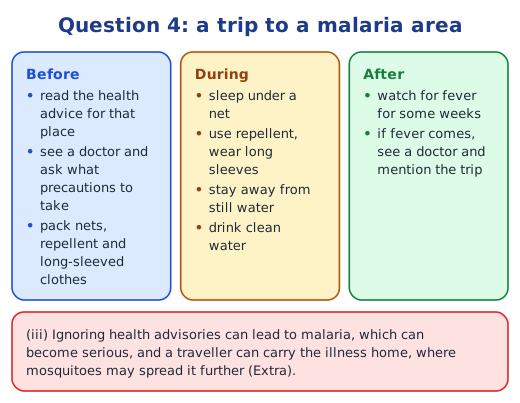
(i) “What precautions should you take before, during, and after the trip?” Before: read the health advisory for that city, see a doctor and ask what precautions to take, and pack mosquito nets, repellent and long-sleeved clothes. During: sleep under a net, use repellent, wear long sleeves and stay away from still water. After: watch for fever for some weeks, and if it comes, see a doctor and mention the trip.
(ii) “How can you explain the importance of mosquito nets or repellents to your sibling?” “Malaria germs travel inside mosquitoes. The net is a wall they cannot get through while we sleep, and the repellent keeps them away from our skin. No bite, no malaria.”
(iii) “What could happen if travellers ignore health advisories in such areas?” They could get malaria, which brings high fever and chills and can become serious. (Extra: a traveller can also carry the illness home, where local mosquitoes may spread it.)
5. “Your uncle has started smoking just to fit in with his friends, even though it is well known that smoking can seriously harm health and even cause death.”
(i) “What would you say to him to make him stop, without being rude?” “Uncle, I care about you and want you around for a long time. Smoking harms the lungs and heart and can cause cancer. Your real friends will like you without a cigarette. Shall we go for a walk together instead?” Speak calmly and suggest that he talk to a doctor about stopping.
(ii) “What would you do if your friend offers you a cigarette at a party?” Say “No, thanks” firmly and calmly, without a lecture, move away or change the topic, and if the pressure continues, leave and tell a trusted adult.
(iii) “How can schools help prevent students from indulging in such harmful habits?” By teaching how tobacco, alcohol and drugs harm the body; inviting doctors to talk; offering counselling; training students to say no to peer pressure; keeping the campus away from tobacco; and giving students sports, clubs and other healthy ways to fit in.
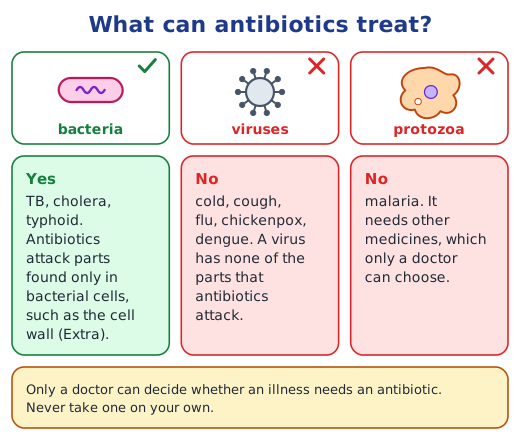
6. “Saniya claims to her friend Vinita that “Antibiotics can cure any infection, so we don’t need to worry about diseases.” What question(s) can Vinita ask her to help Saniya understand that her statement is incorrect?” Vinita could ask: Do antibiotics work on a cold, flu or dengue, which viruses cause? Can they cure malaria, caused by a protozoan? What happens when bacteria become resistant to an antibiotic? Can an antibiotic cure diabetes or asthma? If antibiotics cured everything, why would we need vaccines and clean water?
7. “The following table contains information about the number of dengue cases reported in a hospital over a period of one year:” (January 10, February 12, March 15, April 18, May 22, June 40, July 65, August 65, September 65, October 30, November 30, December 20.) “Make a bar graph of the number of cases on the Y-axis and the month on the X-axis. Critically analyse your findings and answer the following:”
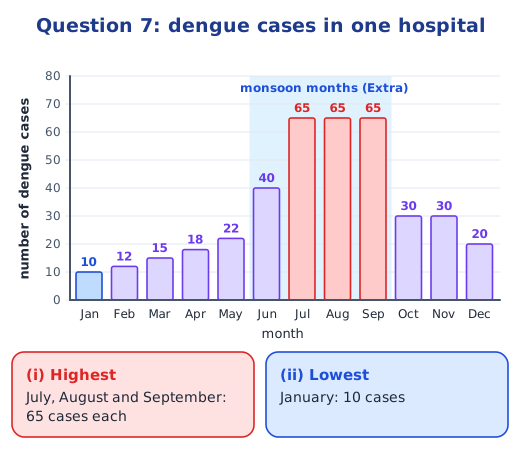
(i) “In which three months were the dengue cases highest?” July, August and September, with 65 cases each.
(ii) “In which month(s) were the cases lowest?” January, with 10 cases.
(iii) “What natural or environmental factors during the peak months might contribute to the increase in dengue cases?” These are the monsoon months: rain leaves still water in pots, coolers, tyres, drains and potholes, where mosquitoes breed, and the warm, humid weather helps them multiply.
(iv) “Suggest a few preventive steps that the community or government can take before the peak season to reduce the spread of dengue.” Before the rains: clean drains and remove still water; cover water tanks; collect old tyres and containers; spray to kill mosquito larvae where water cannot be removed (Extra); run awareness drives on nets, repellents and long sleeves; and keep clinics ready to test and treat fever early.
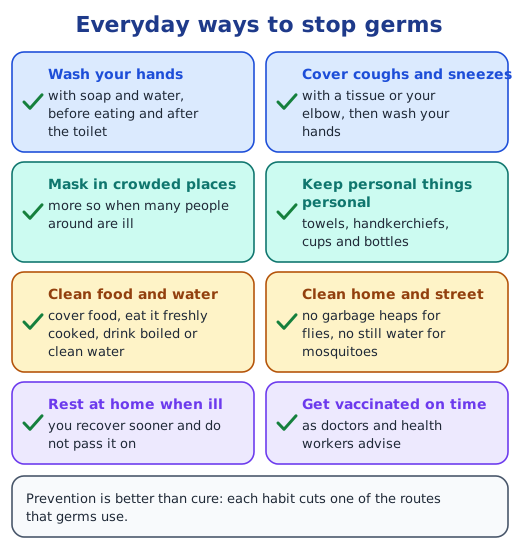
8. “Imagine you are in charge of a school health campaign. What key messages would you use to reduce communicable and non-communicable diseases?” For communicable diseases: “Wash your hands with soap”, “Cover your cough”, “Drink clean water”, “No still water, no mosquitoes” and “Vaccines on time”. For non-communicable diseases: “Eat a rainbow of fruits and vegetables”, “Less oil, sugar and salt”, “Play outdoors every day”, “Screens off, sleep on time”, “Say no to tobacco and alcohol” and “Talk about your worries”.
9. “It is recommended that we should not take an antibiotic for a viral infection like a cold, a cough, or flu. Can you provide the possible reason for this recommendation?” Antibiotics act only on bacteria, by attacking parts that bacterial cells have; viruses have no such parts, so the antibiotic cannot help with a cold, cough or flu. Taking it anyway also kills helpful bacteria in the body and lets resistant bacteria survive and multiply, so the antibiotic may not work when it is really needed.
10. “Which disease(s) among the following may spread if drinking water gets contaminated by the excreta from an infected person? Hepatitis A, Tuberculosis, Poliomyelitis, Cholera, Chickenpox.” Hepatitis A, poliomyelitis and cholera. (Extra: the polio virus also spreads through water and food dirtied by an infected person’s faeces.) Tuberculosis and chickenpox spread through the air.
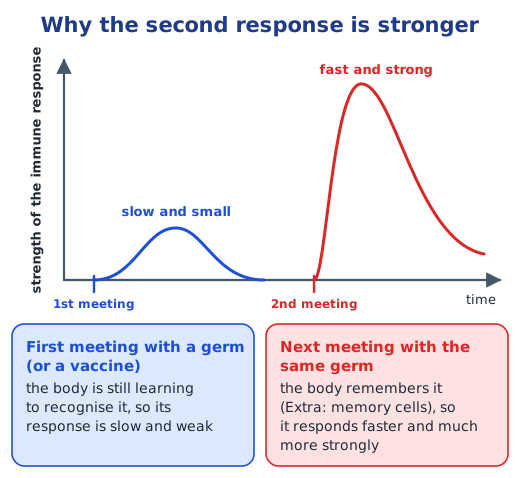
11. “When our body encounters a pathogen for the first time, the immune response is generally low but on exposure to the same pathogen again, the immune response by the body is much more compared to the first exposure. Why is it so?” The first time, the immune system has never seen this pathogen, so it takes time to recognise it and build a response, which stays low. It also keeps a memory of the pathogen (Extra: in memory cells). The next time, it recognises the pathogen at once and responds much faster and more strongly. This acquired immunity is also how vaccines work.
Prepare some questions of your own (page 44). For example: Why do some vaccines need more than one dose? How long does a cold virus live on a door handle? Why does a fever come with an infection? Can healthy habits lower the risk of diabetes even if it runs in a family?
Discover, design, and debate (page 45)
A health diary. For a month or longer, note each day what you ate, how you kept clean, how long you exercised, slept and used screens, and how you felt. At the end, look for patterns, such as worse sleep after late screen time, and choose one habit to change.
Indian scientists in health (Extra, to read about). Suniti Solomon, a doctor and microbiologist, led the team that first found HIV in India, in 1986, and worked for decades on its treatment and awareness. Asima Chatterjee, a chemist, studied medicinal plants and developed medicines against epilepsy and malaria. Yellapragada Subbarao, a biochemist, helped develop the cancer medicine methotrexate and an early antibiotic, aureomycin. Mary Poonen Lukose became the first woman Surgeon General in India, in the state of Travancore.
Smallpox and the vaccination debate. Smallpox spread only from person to person, and vaccination gave lasting protection, so teams vaccinated everyone around each new case until the virus had nowhere to go (Extra). For the debate: those in favour of required vaccination can argue that it protects babies and people who cannot be vaccinated, as smallpox showed; those against can argue for personal choice and the need for trust. Both sides should use facts from doctors and scientists.
CPR (cardiopulmonary resuscitation). The steps change as guidelines are updated, so learn them hands-on from a doctor or trained instructor during the school’s mock drill, not from a page. In any emergency, first call for help (Extra: 112 is India’s emergency number).
Talk with a doctor on nutrition. Possible questions: What is the difference between under-nutrition and over-nutrition? Why is anaemia common among teenagers? How much junk food is too much? Can someone be overweight and still be poorly nourished?
A health card. It could include your name, age, blood group, height and weight, vaccinations with dates, allergies, any long-term illness, a family contact and a doctor’s number. Keep it with your family; never share it publicly.
Fast food and companion animals. Points for the debate: pets need food made for their kind; salty, oily and sugary human snacks can make them overweight and ill, and some human foods are poisonous to pets (Extra: chocolate, grapes and onions for dogs). Ask a vet before giving a pet any new food.
Practice
-
Which disease spreads through dirty drinking water?
Show answer
Answer: (b) cholera
-
A long-lasting disease, lasting more than 3 months, is called:
Show answer
Answer: (b) chronic
-
In Fleming’s petri dish, what stopped the bacteria from growing?
Show answer
Answer: (b) a mould
-
Name two diseases for which vaccines are given in childhood.
Show answer
Answer: Any two of polio, measles, tetanus and hepatitis (the examples in the chapter).
-
Why is a disease like typhoid more common where there are no toilets?
Show answer
Answer: Human waste lying in the open gets into water and food through flies and rain, and the bacteria that cause typhoid spread this way.
Stuck on a question?
Take a photo and Lagnever AI explains it step by step. Try it for 7 days for ₹2.
Get it on Google Play Open in browser
For parents: after the trial, the plan renews monthly by UPI or card autopay. You can cancel anytime in the app.