
Class 8 Science Chapter 3: Health: The Ultimate Treasure Notes
This chapter in five lines
Health means feeling well in body, mind and social life, and is more than not being ill. A balanced diet, exercise, sleep, hygiene and a clean environment keep us healthy. Diseases are communicable, caused by pathogens that spread, or non-communicable, linked to lifestyle, diet or environment. Hygiene, sanitation and vaccines prevent many diseases; antibiotics treat only bacterial infections and must be used wisely.
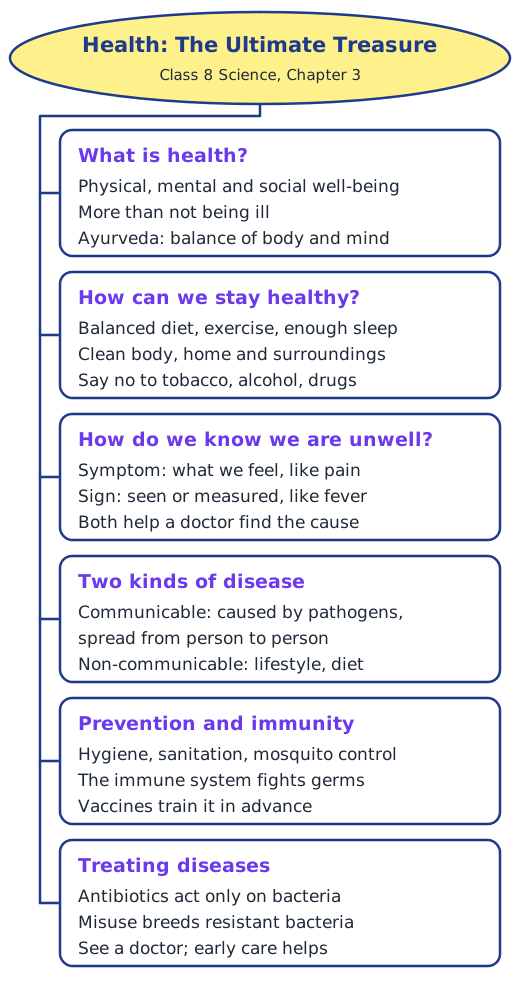
What is this chapter about?
The chapter opens with a notice board of health news: diabetes on the rise, malaria and dengue after the monsoon, polluted air, too much screen time, and yoga and handwashing that help. It asks what being healthy really means, why we fall ill, how diseases spread and how we can protect ourselves and others. Chapter 2 showed that some microbes help us; this chapter turns to the ones that make us sick, and to the habits, vaccines and medicines that keep us well.
What does it mean to be healthy?
Being healthy is more than not being sick. The World Health Organization (WHO) describes health as complete well-being of body, mind and social life, and not merely the absence of disease. A healthy person looks after the body, keeps a positive mind and gets along well with others. The chapter tells of a Grade 8 student who moved to a new city, felt lonely and spent hours on his phone; he began to have headaches, lost weight and slept badly. Less screen time and help from a counsellor to make friends set him right. Ayurveda, India’s traditional system of medicine, also sees health as a balance of body, mind and surroundings, kept through a daily and seasonal routine, fresh food, exercise, rest and a calm mind.
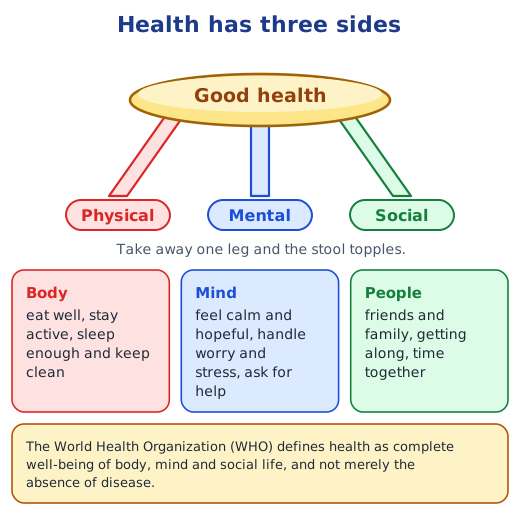
How can we stay healthy?
Two things shape our health most: our lifestyle, meaning the way we live, and our environment, meaning the place around us. Eat a balanced diet with fruits, vegetables and whole grains, and cut down on processed, oily and sugary food. Play outdoors, walk or cycle, limit screen time, sleep enough, practise yoga or slow breathing such as pranayama, and say no to tobacco, alcohol and drugs. Keep yourself and your surroundings clean: dirty places with flies and mosquitoes make people fall ill more often, and smoky or dusty air can cause coughing and asthma. Feelings matter too: time with family and friends keeps the mind healthy. Read staying healthy and preventing disease.
How can we tell that we are ill?
When something inside the body is not working as it should, it shows. A symptom is what we feel, such as pain, tiredness or dizziness. A sign is something others can see or measure, such as a fever on a thermometer, a rash, swelling or high blood pressure. Symptoms and signs help a doctor work out what is wrong, so if you feel unwell, tell an adult and see a doctor.
What are the two kinds of disease?
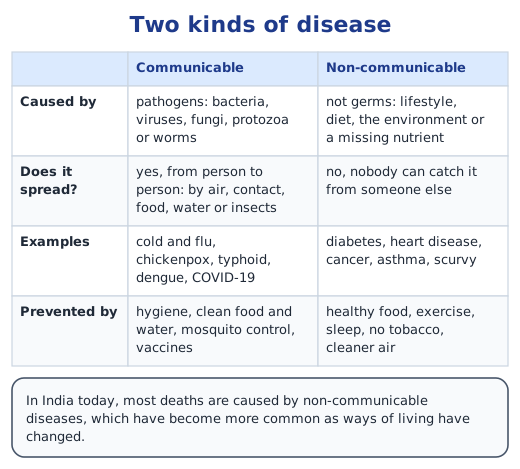
A disease is any condition that upsets the way the body or mind normally works. Some are caused by germs (bacteria, viruses, fungi, protozoa or worms); disease-causing organisms are called pathogens. Communicable diseases, such as typhoid, dengue, flu, chickenpox and COVID-19, are caused by pathogens and can spread from person to person. Non-communicable diseases (NCDs), such as cancer, diabetes and asthma, are not caused by germs and do not spread; they are linked to lifestyle, diet or environment. NCDs have become more common in India as people eat more processed food, exercise less and live longer, and they now cause most deaths in the country.
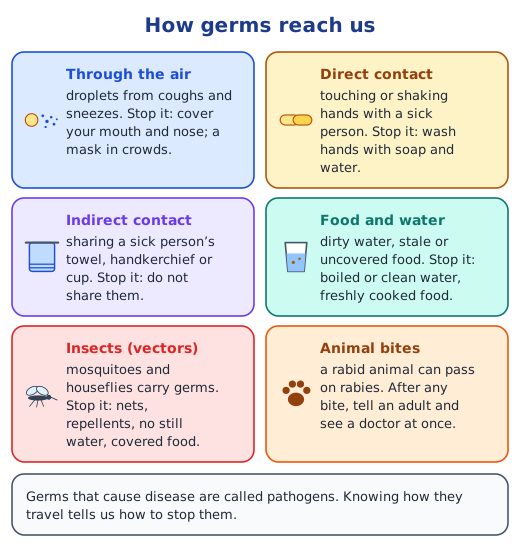
How do communicable diseases spread?
Pathogens travel through the air when a sick person coughs or sneezes, by direct contact such as shaking hands, and indirectly through shared towels, handkerchiefs or cups. Some spread through dirty water or food. Others are carried by insects such as mosquitoes and houseflies, which are called vectors. Some worms live inside our intestines as parasites, feeding on our food; they spread through dirty food, water or soil. Read communicable and non-communicable diseases.
What causes non-communicable diseases?
Unhealthy food, little exercise, being overweight, tobacco, alcohol and polluted air all raise the risk. Deficiency diseases, such as scurvy, anaemia and goitre, which you met in Grade 6, are caused by too little of a nutrient and are non-communicable too. Diseases such as cancer, diabetes and asthma often last more than 3 months; such long-lasting diseases are called chronic. Diabetes is growing among adults and children, and India now counts among the countries with the most people living with diabetes. The scientist Kamal Ranadive (1917–2001) studied how hormones and some viruses are linked to cancer, and showed how tobacco, diet and pollution raise its risk.
How can we prevent diseases?
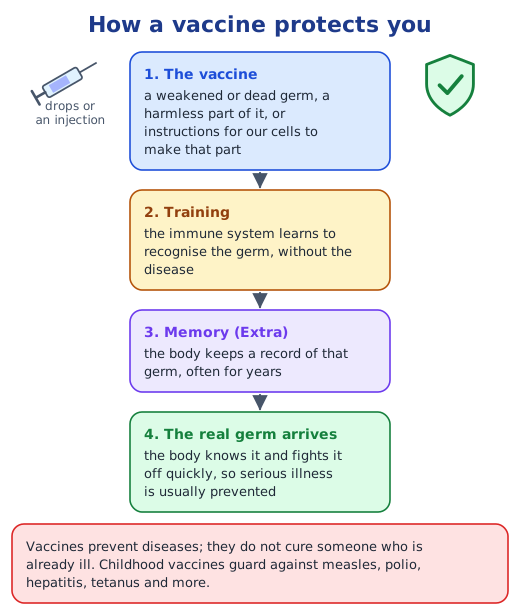
Prevention is better than cure. Simple steps such as washing hands, covering coughs, clean water and a clean neighbourhood stop many communicable diseases. In Bhadrak district, Odisha, a community campaign helped more families build and use toilets, and children had fewer cases of diarrhoea and infections. Our body also defends itself: its natural ability to fight disease is immunity, carried out by the immune system. A vaccine trains the immune system to recognise a germ in advance, giving acquired immunity. Edward Jenner made the first vaccine, against smallpox, in the late 1700s, and long before that Indian teekedaars practised variolation. Mass vaccination later wiped smallpox out. Read immunity, vaccines and antibiotics.
How are diseases treated?
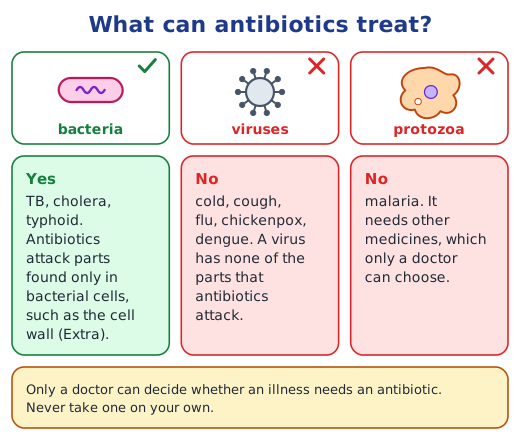
When the immune system cannot stop an infection, we need a doctor. For a bacterial infection, a doctor may prescribe an antibiotic, which kills bacteria. Antibiotics do not work against viruses or protozoa. Alexander Fleming found the first antibiotic, penicillin, in 1928, from a mould. Careless use, such as taking antibiotics when they are not needed or not completing the course, has made some bacteria resistant; this is antibiotic resistance. Traditional systems such as Ayurveda, Siddha and Unani help with some conditions and everyday well-being, but may not work for every disease or at every stage. Non-communicable diseases are managed with medicines, lifestyle changes and care, and early diagnosis helps.
Before we move on
Health is a treasure we keep through daily habits, clean surroundings and care for one another. This page explains what the book teaches; it is not medical advice, so for any illness, see a doctor. Answers to every question are in the NCERT solutions for Chapter 3.
Key terms
| Term | Meaning |
|---|---|
| Health | Feeling fully well in body, mind and relationships, which is more than simply not being ill. |
| Symptom | What a sick person feels and tells us, such as pain, tiredness or dizziness. |
| Sign | What can be seen or measured, such as a fever on a thermometer, a rash or swelling. |
| Disease | Any condition that upsets the normal working of body or mind. |
| Pathogen | A disease-causing organism: some bacteria, viruses, fungi, protozoa and worms. |
| Communicable disease | A disease caused by a pathogen that can spread from one person to another, such as flu or typhoid. |
| Non-communicable disease (NCD) | A disease not caused by germs and not passed on, linked to lifestyle, diet or environment, such as diabetes. |
| Vector | An insect, such as a mosquito or housefly, that carries pathogens from one person to another. |
| Parasite | An organism that lives in or on another living being and feeds on it, like roundworms in the gut. |
| Deficiency disease | A non-communicable disease caused by too little of a nutrient, such as scurvy, anaemia or goitre. |
| Chronic disease | A disease that lasts a long time, more than 3 months, such as diabetes or asthma. |
| Immunity | The body’s natural ability to fight diseases, carried out by the immune system. |
| Vaccine | A preparation that trains the immune system to recognise a germ before it can cause disease. |
| Antibiotic | A medicine that kills bacteria or stops them growing; it does not work against viruses or protozoa. |
| Antibiotic resistance | When bacteria that an antibiotic used to kill survive and multiply despite it. |
Topics in this chapter
Practice
-
According to the WHO, health means:
Show answer
Answer: (b) complete physical, mental and social well-being
-
Which of these is a sign, not a symptom?
Show answer
Answer: (c) a high body temperature on a thermometer
-
Which disease is non-communicable?
Show answer
Answer: (c) diabetes
-
Insects such as mosquitoes that carry pathogens are called:
Show answer
Answer: (b) vectors
-
Antibiotics work against diseases caused by:
Show answer
Answer: (b) bacteria
-
Who developed the first vaccine, against smallpox?
Show answer
Answer: (b) Edward Jenner
Questions students ask
What are the main topics of Class 8 Science Chapter 3?
What health means; healthy habits and a clean environment; symptoms and signs; communicable and non-communicable diseases and how they spread; prevention, immunity and vaccines; and how antibiotics treat bacterial infections and why their misuse causes resistance.
Is Health: The Ultimate Treasure in the new NCERT book?
Yes. It is Chapter 3 of Curiosity, the Class 8 science textbook (Reprint 2026-27), on pages 28 to 45. It follows Chapter 2, on cells and microorganisms.
What is the difference between communicable and non-communicable diseases?
Communicable diseases are caused by pathogens and spread from person to person, such as flu and typhoid. Non-communicable diseases are not caused by germs and do not spread; they are linked to lifestyle, diet or environment, such as diabetes and asthma.
Why should we not take antibiotics for a cold?
A cold is caused by a virus, and antibiotics act only on bacteria, so they cannot help. Taking them without need also helps bacteria become resistant. Only a doctor should decide whether an antibiotic is needed.
Stuck on a question?
Take a photo and Lagnever AI explains it step by step. Try it for 7 days for ₹2.
Get it on Google Play Open in browser
For parents: after the trial, the plan renews monthly by UPI or card autopay. You can cancel anytime in the app.