
How can we stay healthy and prevent diseases?
Answer in short
Health means physical, mental and social well-being. We stay healthy by eating a balanced diet, exercising, sleeping enough, limiting screen time and saying no to tobacco and alcohol. Washing hands, covering coughs, clean food and water, clean surroundings, toilets for all and mosquito control stop many diseases, because prevention is better than cure.
Stuck on a question? Take a photo and Lagnever AI explains it step by step. Try it for 7 days for ₹2. Get it on Google Play
What does being healthy mean?
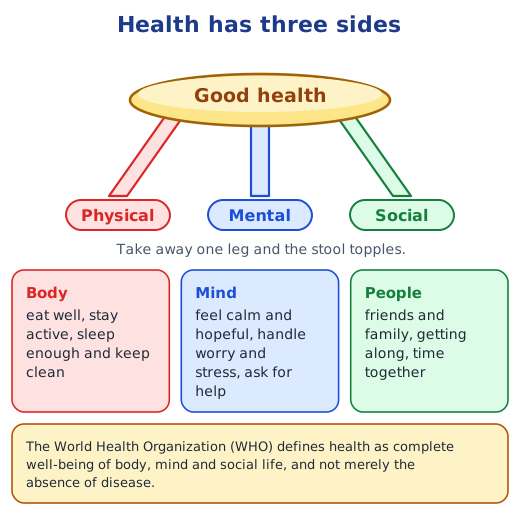
Health is more than not falling sick. The World Health Organization (WHO) defines health as complete well-being of body, mind and social life, and not merely the absence of disease. A healthy person looks after the body, keeps a positive mind and gets on well with friends, family and others. Such a person can usually do daily tasks well and cope better in hard times.
The chapter tells of a Grade 8 student who moved to a new city. With no friends there and busy parents, he felt lonely and spent more and more time on his phone. He began to get headaches, became thinner and slept badly. A doctor suggested cutting his screen time and talking to the school counsellor, who helped him make friends. His body, his mind and his relationships were all connected.
Ayurveda, India’s traditional system of medicine, also sees health as a balance of body, mind and surroundings. It suggests a daily routine (dinacharya) and a seasonal routine (ritucharya), fresh, wholesome food suited to one’s body type (prakriti), exercise, cleanliness, rest and a calm mind, with yoga and meditation.
Which habits keep us healthy?
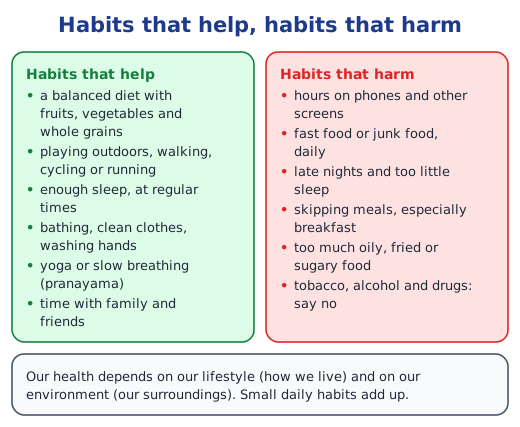
Many things shape our health, above all our lifestyle, meaning the way we live, and our environment, meaning the place around us. Good habits include a balanced diet rich in fruits, vegetables and whole grains; playing outdoors, walking, running or cycling; enough sleep; yoga or slow breathing such as pranayama; and time in nature instead of on screens. Avoid processed, fatty and sugary food, skipping meals, very late nights, and harmful substances such as tobacco, alcohol and drugs.
Why does a clean environment matter?
Picture two playgrounds: one clean and green, the other full of garbage, flies and mosquitoes. Most of us would choose the clean one, and people living near dirty places do fall sick more often. Clean air and water matter too. Smoke from traffic and factories in cities can bring on coughs or asthma, and the Air Quality Index (AQI) shows how clean the air is on a given day. Even with good food and a clean home, we may not feel well if we are lonely or upset, so talking, laughing and playing with friends and family help keep the mind healthy.
How can we stop germs from spreading?
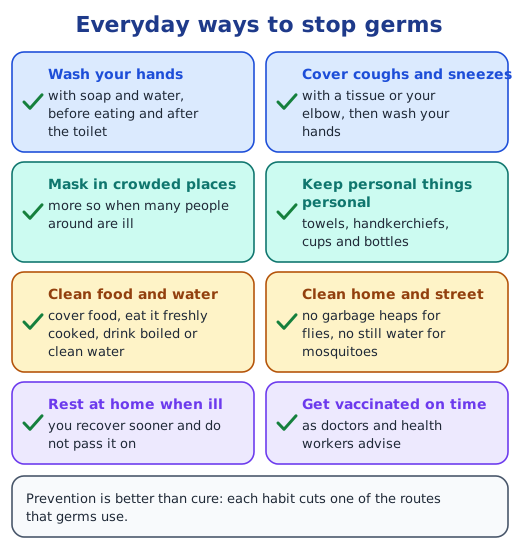
Most communicable diseases can be prevented with simple daily care:
- Keep yourself, your home, your food and your water clean.
- Wash your hands with soap and water to remove germs.
- Cover your mouth and nose when you cough or sneeze (Extra: a tissue or your elbow works well).
- Wear a mask in crowded places.
- Do not share towels and handkerchiefs.
- Stay at home and rest when you are unwell, so your body recovers and others stay safe.
How does sanitation protect a whole community?
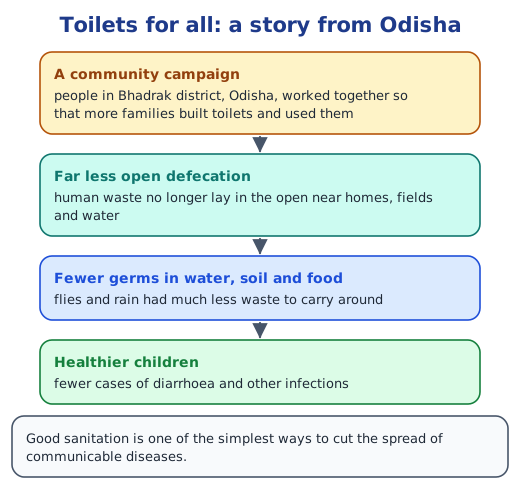
Prevention is better than cure. A sanitation drive run by the community in Bhadrak district, Odisha, got more families to build toilets and use them. Open defecation fell sharply, and children had fewer cases of diarrhoea and other infections. When human waste does not lie in the open, flies and rain cannot carry its germs into water and food.
Can we prevent lifestyle diseases too?
Yes, often. Non-communicable diseases such as diabetes and heart disease are linked to lifestyle, so healthy habits, a healthy weight and regular exercise can prevent many of them. Regular check-ups help to find problems early, and anyone who is ill should follow a doctor’s advice.
Our body can also fight germs on its own, and vaccines make it stronger. Read on: immunity, vaccines and antibiotics, the chapter notes and the NCERT solutions.
Practice
-
Which habit is good for health?
Show answer
Answer: (c) playing outdoors every day
-
The AQI tells us how clean the:
Show answer
Answer: (b) air is
-
Why should you stay at home when you have flu?
Show answer
Answer: (b) to rest, recover and not pass it on
-
Why do people living near dirty, polluted places fall sick more often?
Show answer
Answer: Flies, mosquitoes and germs breed in dirt and still water, and polluted air harms breathing, so infections and illnesses are more common.
-
How did the sanitation campaign in Bhadrak district, Odisha, improve children’s health?
Show answer
Answer: More families built and used toilets, so open defecation fell, fewer germs reached water and food, and children had fewer cases of diarrhoea and infections.
Questions students ask
What is the WHO definition of health?
The World Health Organization defines health as complete well-being of body, mind and social life, and not merely the absence of disease. Being well means more than not being ill.
How can students stay healthy?
Eat a balanced diet, play or exercise every day, sleep enough, limit screen time, keep clean, spend time with family and friends, and say no to tobacco, alcohol and drugs.
How can we prevent communicable diseases?
Wash hands with soap and water, cover coughs and sneezes, wear a mask in crowds, do not share towels or cups, drink clean water, keep surroundings clean, rest at home when ill and get vaccinated on time.
Why is mental health part of health?
Feelings affect the body. Loneliness, worry and stress can cause headaches, poor sleep and loss of appetite, so a calm mind and good friendships are part of being healthy.
Stuck on a question?
Take a photo and Lagnever AI explains it step by step. Try it for 7 days for ₹2.
Get it on Google Play Open in browser
For parents: after the trial, the plan renews monthly by UPI or card autopay. You can cancel anytime in the app.