
What are communicable and non-communicable diseases?
Answer in short
Communicable diseases, such as flu, typhoid, dengue and chickenpox, are caused by pathogens like bacteria, viruses, protozoa and worms, and spread from person to person. Non-communicable diseases, such as diabetes, cancer and asthma, are not caused by germs and do not spread; they are linked to lifestyle, diet or environment, or to a missing nutrient.
Stuck on a question? Take a photo and Lagnever AI explains it step by step. Try it for 7 days for ₹2. Get it on Google Play
What is a disease?
A disease is any condition that upsets the way the body or the mind normally works. It may begin when an organ, or a whole organ system, stops doing its job properly. Some diseases are short, like a cold that goes away in a few days. Others last a long time and need regular care. Scientists sort diseases into two big groups, by what causes them and whether they spread.
How can we tell that we are ill?
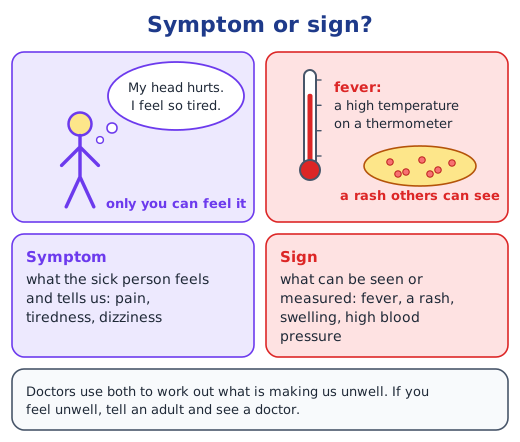
Our body gives us clues. A symptom is something we feel, like pain, tiredness or dizziness; only the sick person can tell us about it. A sign is something others can see or measure, like a fever on a thermometer, a rash, swelling or high blood pressure. Doctors use both to find out what is wrong. If you feel unwell, tell an adult and see a doctor.
What are communicable diseases?
Some diseases are caused by germs: certain bacteria, viruses, fungi, protozoa (single-celled organisms) and worms. These disease-causing organisms are called pathogens. Diseases caused by pathogens are communicable diseases, because they can pass from one person to another. Typhoid, dengue, flu, chickenpox and COVID-19 are examples. You met viruses, bacteria and protozoa in types of microorganisms in Chapter 2.
How do germs spread from one person to another?
Pathogens get into the body with the air we inhale, or with dirty food and water. They travel in several ways:
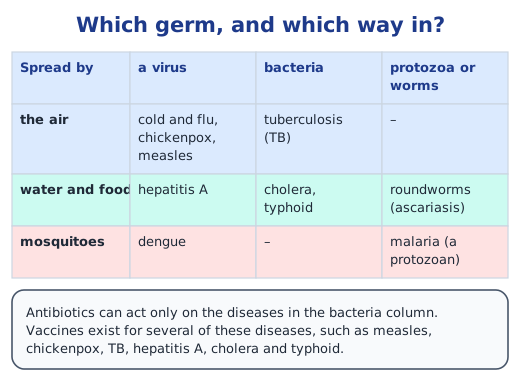
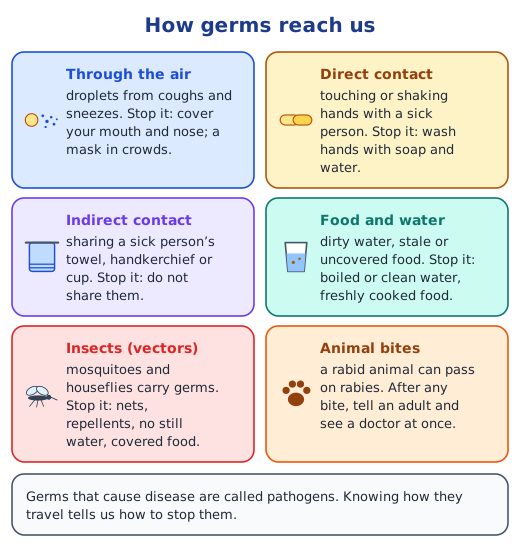
- Through the air: droplets from a cough or sneeze carry cold, flu, chickenpox, measles and tuberculosis (TB).
- Direct contact: shaking hands with or touching an infected person.
- Indirect contact: using an infected person’s towel, handkerchief or cup.
- Food and water: dirty water or food spreads hepatitis A, cholera and typhoid.
- Insects: mosquitoes and houseflies carry pathogens. Insects that do this are called vectors.
- Animal bites: the bite of a rabid animal can pass on rabies. After any animal bite, tell an adult and see a doctor at once.
Some worms, such as roundworms, live in our intestines as parasites: living things that make their home in or on another organism and feed off it. They spread through dirty food, water or soil, or by touching people or animals who carry them, and can cause poor growth, weight loss and anaemia.
Why do malaria and dengue rise after the rains?
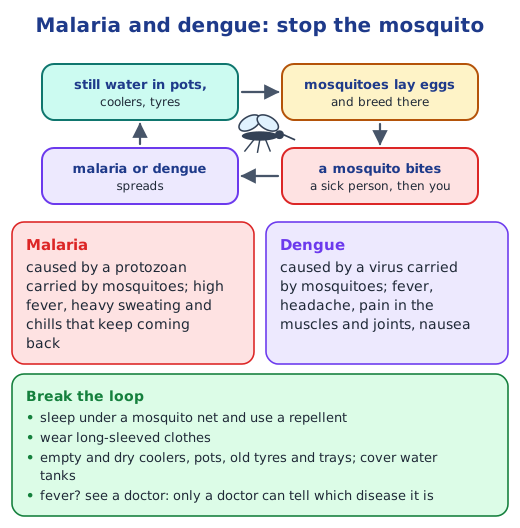
Both are spread by mosquitoes, which breed in still water. After the monsoon, water collects in pots, coolers, old tyres and potholes, so mosquitoes multiply. Malaria is caused by a protozoan and dengue by a virus. (Extra: malaria is carried by the Anopheles mosquito, and dengue by the Aedes mosquito, which bites mostly in the daytime.) Mosquito nets, repellents, long sleeves and emptying still water break the cycle. Any fever needs a doctor, because only a doctor can tell which disease it is.
What are non-communicable diseases?
Non-communicable diseases (NCDs), such as cancer, diabetes and asthma, do not come from pathogens, and nobody can pass them on to another person. They are usually linked to lifestyle, diet or environment. In Grade 6 you learnt about deficiency diseases, such as scurvy, anaemia and goitre, caused by too little of a nutrient; these are non-communicable too. Diseases such as cancer, diabetes and asthma often last more than 3 months; such long-lasting diseases are called chronic diseases.
Diabetes is becoming common in both adults and children, and India now counts among the countries with the most people living with diabetes. It usually comes from a mix of reasons: hormone imbalances, unhealthy eating, too little exercise and being overweight. Across India, NCDs have grown as people eat more processed food, exercise less and live longer, and they are now the most common cause of death.
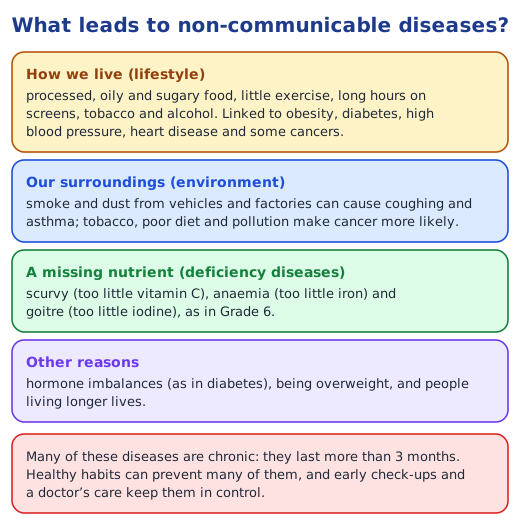
The Indian scientist Kamal Ranadive (1917–2001) studied how hormones and some viruses are linked to cancer. Her work helped improve its treatment and prevention, and showed that tobacco, unhealthy food and polluted air make cancer more likely. That is why a healthy lifestyle matters.
Read on: staying healthy and preventing disease, the chapter notes and the NCERT solutions.
Practice
-
Disease-causing organisms are called:
Show answer
Answer: (b) pathogens
-
Which disease is spread by mosquitoes?
Show answer
Answer: (b) malaria
-
Which is a deficiency disease?
Show answer
Answer: (c) goitre
-
Why is typhoid called a communicable disease?
Show answer
Answer: It is caused by bacteria, a pathogen, and spreads from person to person through dirty water and food.
-
Give two reasons why non-communicable diseases are becoming more common in India.
Show answer
Answer: People eat more processed food and get less exercise, and people are living longer lives.
Questions students ask
What is a communicable disease?
A disease caused by a pathogen, such as a bacterium, virus, protozoan or worm, that can pass from one person to another. Flu, typhoid, dengue, chickenpox and COVID-19 are examples.
What is a non-communicable disease?
A disease that is not caused by germs and does not spread from person to person. It is linked to lifestyle, diet, environment or a missing nutrient. Diabetes, cancer, asthma and anaemia are examples.
What is a vector?
An insect, such as a mosquito or a housefly, that carries pathogens from one person to another. Mosquitoes spread malaria and dengue.
Is asthma communicable?
No. Asthma does not spread from person to person. It is linked to the environment, and polluted air can make breathing harder for people who have it.
Stuck on a question?
Take a photo and Lagnever AI explains it step by step. Try it for 7 days for ₹2.
Get it on Google Play Open in browser
For parents: after the trial, the plan renews monthly by UPI or card autopay. You can cancel anytime in the app.