
Deficiency diseases
Answer in short
Deficiency diseases are caused when one or more nutrients are lacking in the diet for a long time. A lack of vitamin C causes scurvy, vitamin D rickets, vitamin B1 beriberi, vitamin A loss of vision, iodine goitre and iron anaemia. A balanced diet with fruits, vegetables, milk and iodised salt helps prevent them.
Stuck on a question? Take a photo and Lagnever AI explains it step by step. Try it for 7 days for ₹2. Get it on Google Play
What is a deficiency disease?
Why are we told to eat fruits, vegetables and other plant foods every day? They are rich in vitamins and minerals, the protective nutrients that keep the body healthy. We need them only in small amounts, but when one or more nutrients are missing from the diet for a long time, the body shows symptoms of a deficiency disease or disorder. The chapter explains this through two true cases.
Case 1: sailors and scurvy
In earlier times, sailors on long sea voyages often suffered from bleeding and swollen gums. During a voyage in 1746, the Scottish physician James Lind observed that sailors who ate lemons and oranges recovered. Bleeding and swollen gums are symptoms of scurvy, which is caused by a lack of vitamin C. Citrus fruits such as lemons and oranges contain vitamin C, which helps cure the disease.
Case 2: goitre and iodised salt
In the 1960s, Indian scientists found that swelling at the front of the neck was common among people in the Himalayan region and the Northern plains. The soil of these regions lacked iodine, so the local food and water lacked it too. Following government norms, common salt was supplemented with iodine to make iodised salt, and its use visibly reduced the symptoms. Swelling at the front of the neck is a symptom of goitre.
Iodised salt is simply common salt mixed with the required quantities of salts of iodine. Salt itself comes from the sea and rocks: the Agariya community of the Little Rann of Kutch in Gujarat works for eight months in the extreme heat of the desert to get salt from seawater (see separating salt by evaporation).
The chart of vitamins and minerals
The book’s chart (Fig. 3.5) lists the protective nutrients, what they do, some sources, and what happens when they are lacking.
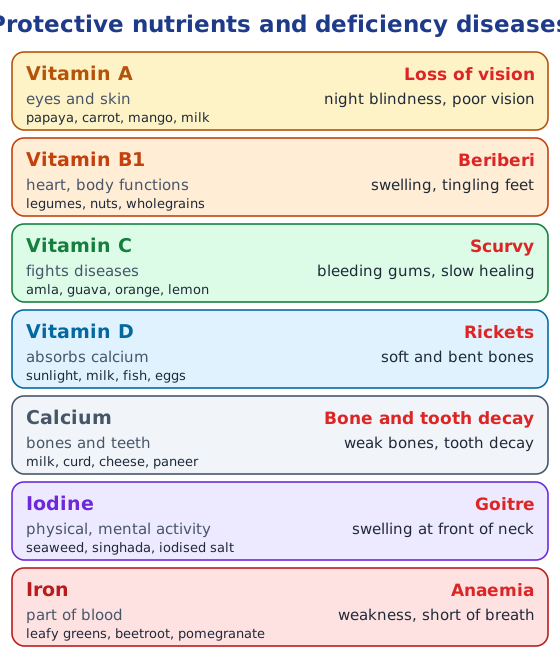
| Nutrient | What it does | Some sources | Disease or disorder | Symptoms |
|---|---|---|---|---|
| Vitamin A | Keeps eyes and skin healthy | Papaya, carrot, mango, milk | Loss of vision | Poor vision, loss of vision in darkness (night blindness), sometimes complete loss of vision |
| Vitamin B1 | Keeps the heart healthy and supports body functions | Legumes, nuts, wholegrains, seeds, milk products | Beriberi | Swelling, tingling or burning in feet and hands, trouble in breathing |
| Vitamin C | Helps the body fight diseases | Amla, guava, green chilli, orange, lemon | Scurvy | Bleeding gums, slow healing of wounds |
| Vitamin D | Helps the body absorb calcium for bones and teeth | Sunlight, milk, butter, fish, eggs | Rickets | Soft and bent bones |
| Calcium | Keeps bones and teeth healthy | Milk or soya milk, curd, cheese, paneer | Bone and tooth decay | Weak bones, tooth decay |
| Iodine | Helps us do physical and mental activities | Seaweed, water chestnut (singhada), iodised salt | Goitre | Swelling at the front of the neck |
| Iron | An important part of blood | Green leafy vegetables, beetroot, pomegranate | Anaemia | Weakness, shortness of breath |
How can we overcome deficiencies?
- Eat a balanced diet with milk, green vegetables, fruits and wholegrains every day (see what is a balanced diet).
- Eat some raw fruits and vegetables. High heat during cooking destroys some vitamin C, and washing cut or peeled vegetables washes away some vitamins, so wash them well before cutting.
- Use iodised salt to get enough iodine.
- Spend some time in sunlight: the body makes vitamin D when the skin is exposed to it.
- See a doctor if you notice symptoms. A doctor may advise changes in diet and, if needed, supplements.
Survey: Activity 3.4
In Activity 3.4 you study the chart, find more sources of vitamins and minerals, and, under a teacher’s guidance, talk to people in your neighbourhood. If someone shows a symptom on the chart, link it to their diet, suggest the possible cause and the change in diet that may help, and advise them to visit a doctor.
A scientist who fought deficiencies
Coluthur Gopalan (1918–2019) started nutrition research in India. He analysed more than 500 Indian foods for their nutritional value and recommended a suitable diet for Indians. His surveys found widespread deficiencies of protein, energy and other food components. This led to the Mid Day Meal Programme in 2002, now part of PM POSHAN, which provides balanced food in government and government-aided schools and has improved the health and nutrition of millions of children.
To learn what each nutrient does, read components of food. For the textbook’s questions, see the Chapter 3 NCERT solutions; for the whole chapter, see the Chapter 3 notes.
Practice
-
Swelling at the front of the neck (goitre) is caused by a lack of:
Show answer
Answer: (b) iodine
-
Soft and bent bones are a symptom of:
Show answer
Answer: (a) rickets
-
Which of these is a good source of iron?
Show answer
Answer: (a) Green leafy vegetables
-
How did James Lind's observation help sailors?
Show answer
Answer: In 1746 he saw that sailors with bleeding, swollen gums recovered after eating lemons and oranges. These citrus fruits contain vitamin C, whose lack causes scurvy.
-
Why was iodised salt introduced in India?
Show answer
Answer: In the 1960s many people in the Himalayan region and the Northern plains had swelling at the front of the neck (goitre), because the soil, and so the food and water, lacked iodine. Adding iodine to common salt visibly reduced these symptoms.
Questions students ask
What is a deficiency disease?
A disease or disorder caused when one or more nutrients are lacking in our diet for a long time. For example, a long lack of vitamin C causes scurvy, and a lack of iodine causes goitre.
Which vitamin deficiency causes night blindness?
Vitamin A. It keeps the eyes and skin healthy; its lack causes poor vision, loss of vision in darkness (night blindness) and sometimes complete loss of vision. Papaya, carrot, mango and milk are sources.
How can deficiency diseases be prevented?
By eating a balanced diet with fruits, vegetables, milk and wholegrains, using iodised salt, and getting some sunlight for vitamin D. If symptoms appear, visit a doctor, who may also advise supplements.
Stuck on a question?
Take a photo and Lagnever AI explains it step by step. Try it for 7 days for ₹2.
Get it on Google Play Open in browser
For parents: after the trial, the plan renews monthly by UPI or card autopay. You can cancel anytime in the app.