
Tests for starch, protein and fat
Answer in short
Starch turns blue-black when a few drops of diluted iodine solution are put on it. Fat leaves an oily patch on paper that lets light faintly shine through. Protein turns violet when its paste in water gets copper sulfate and caustic soda solutions; the teacher demonstrates this test because the chemicals are harmful.
Stuck on a question? Take a photo and Lagnever AI explains it step by step. Try it for 7 days for ₹2. Get it on Google Play
Why test food?
Which nutrients are present in the food we eat? Some nutrients, such as starch (a type of carbohydrate), fat and protein, can be detected with fairly simple tests; others can be detected only in a well-equipped laboratory. The book tests the same set of foods three times: a slice of potato, cucumber, bread, boiled rice, boiled gram, crushed peanuts, oil, butter and crushed coconut. You can add other foods too, and record everything in Table 3.3.
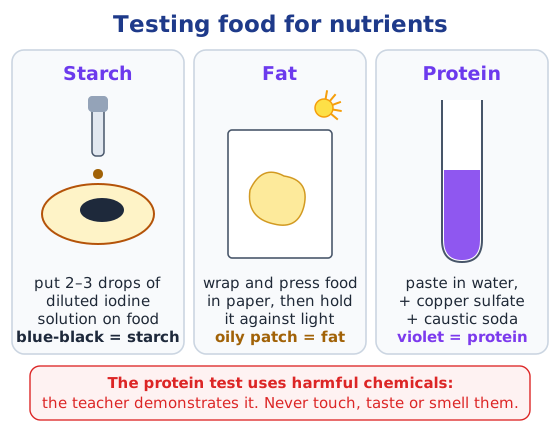
Test for starch (Activity 3.5)
- Place a small piece of each food item on a separate dish.
- With a dropper, put 2–3 drops of diluted iodine solution on each item.
- Watch the colour. Has it turned blue-black?
A blue-black colour shows that starch is present. Potato, bread and boiled rice turn blue-black. Sugar is a carbohydrate too, but it is not starch, so it does not turn blue-black: the iodine test detects starch only.
Test for fat (Activity 3.6)
- Place each food item on a separate piece of paper.
- Wrap the paper around the food and press it, taking care not to tear the paper.
- If the food contains some water, let the paper dry.
- Hold the paper against the light.
If the food contains oil or butter, it leaves an oily patch, and light shines faintly through the patch. An oily patch shows that fat is present. Butter, oil, peanuts and coconut leave an oily patch.
Test for protein (Activity 3.7)
This activity is demonstrated by the teacher.
- Make a paste or powder of each food item using a pestle and mortar.
- Put about half a teaspoon of each in a separate clean test tube.
- Add 2–3 teaspoons of water and shake well.
- Add two drops of copper sulfate solution with a dropper.
- With another dropper, add 10 drops of caustic soda solution.
- Shake well and leave the test tubes undisturbed for a few minutes.
A violet colour shows that protein is present. Boiled gram, peanuts and soya bean turn violet.
Precautions: these chemicals are harmful. Do not touch them unless asked to. If a chemical spills on your body, wash the area with water at once. Never put any chemical in your mouth or try to smell it.
Typical results
Here is what these foods usually show. Your results may differ a little with the sample and the amount of solution used, so always record what you actually see.
| Food item | Starch (blue-black) | Fat (oily patch) | Protein (violet) |
|---|---|---|---|
| Potato | Yes | No | No |
| Cucumber | No | No | No |
| Boiled rice | Yes | No | Little, if any |
| Boiled gram | Yes | Very little | Yes |
| Peanuts | Very little | Yes | Yes |
| Bread or chapati | Yes | Little, if made with fat | Yes, light violet |
| Butter | No | Yes | No |
| Coconut | No | Yes | Little |
What the results tell us
- More than one nutrient: boiled gram has starch and protein, and peanuts have both fat and protein. Any food we eat may contain several nutrients.
- None of the three: cucumber shows no starch, fat or protein, because it is mostly water. It still gives us water, roughage and some vitamins.
- Good sources to try next: wheat flour and sweet potato for starch, ghee and sesame seeds for fat, paneer and moong dal for protein.
These tests tell us only whether a nutrient is present, not how much. Vitamins and minerals need laboratory tests, which is why packaged foods list their nutrients on the label (see what is a balanced diet).
Two questions from the exercises
Iodine drops on clothes: a few drops of iodine fell on Mishti’s socks and on her teacher’s saree. The drops on the saree turned blue-black because cotton sarees are often stiffened with starch; the socks had no starch, so they did not change colour.
Is it iodine? To check whether an unknown solution could be iodine solution, put a few drops on a slice of potato or some boiled rice. If it turns blue-black, the solution may be iodine solution.
To learn what each nutrient does in the body, read components of food. For the textbook’s questions, see the Chapter 3 NCERT solutions; for the whole chapter, see the Chapter 3 notes.
Practice
-
Which colour shows starch in the iodine test?
Show answer
Answer: (b) Blue-black
-
In the protein test, the two solutions added are:
Show answer
Answer: (b) copper sulfate and caustic soda
-
Crushed peanuts leave an oily patch and turn violet in the protein test. They contain:
Show answer
Answer: (b) fat and protein
-
Why must the paper be dried before checking for an oily patch?
Show answer
Answer: Water also makes a wet patch. When the paper dries, a water patch disappears, but an oily patch stays and lets light shine through faintly, which shows fat.
-
A solution turns a slice of potato blue-black. What can you say about the solution?
Show answer
Answer: It may be iodine solution, because iodine turns starch blue-black and potato contains starch.
Questions students ask
How do you test food for starch?
Put a small piece of the food on a dish and add 2–3 drops of diluted iodine solution with a dropper. A blue-black colour shows starch, as with a potato slice, bread or boiled rice.
How do you test food for fat?
Wrap the food in a piece of paper and press it without tearing the paper. If the food is wet, let the paper dry. An oily patch through which light faintly shines shows fat.
How do you test food for protein?
The teacher puts half a teaspoon of the food's paste or powder in a test tube with 2–3 teaspoons of water, shakes it, adds 2 drops of copper sulfate solution and 10 drops of caustic soda solution, shakes again and waits a few minutes. A violet colour shows protein.
Stuck on a question?
Take a photo and Lagnever AI explains it step by step. Try it for 7 days for ₹2.
Get it on Google Play Open in browser
For parents: after the trial, the plan renews monthly by UPI or card autopay. You can cancel anytime in the app.